Cut the Religiosity. Just Be Nice!

Luke 3:7–17, Then he said to the multitudes. What’s really going on in this exchange between John and the religious folks of his day? Let’s step back and look at the bigger picture.
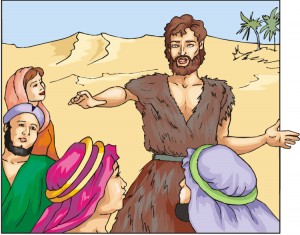
John Baptist preaching 20283162

Multitudes had made the long, hot and arduous journey down through the Judean mountains to the Jordan River, which was the lowest spot on earth, to hear John the Baptist who was the latest fad preacher to come on the scene. However, when they arrived at his lonely wilderness pulpit, instead of stroking their egos by complimenting them for their religious zeal, he excoriates them and calls them a brood of vipers and tells them if they don’t repent, the fires of YHVH’s judgment will consume them (John 3:7–9). John’s preaching pierces their hearts, and now laid low spiritually, they ask him what he expects them to do (John 3:10). John then preaches a message of social justice—give to the poor, be fair and honest in your business dealings, and if you’re a government worker, treat the citizens you serve with respect (John 3:11–14).

Interestingly, he doesn’t instruct these religious Jews in what many might consider to be the more weightier matters of the Torah-law.  He doesn’t tell them to punctiliously start observing the 613 commandments of the Torah, and, by the way, to stop working on the Sabbath, stop eating pork, to toss their Christmas tree in the dumpster, grow a beard, put on a tassel and head-covering, and to say “Yeshua” instead of “Jesus.” He’s basically telling them to go back to the basics—something they either never learned to do or they forgot along the way. He’s really saying,  “Just be nice to your neighbor.” Be fair, honest, loving and caring in your dealings with their fellow man. And then John points them to Yeshua the Messiah who is soon to become the new star on the Judean preaching scene (Luke 3:16–17). So be nice and follow Yeshua—the most loving Person of all.

When witnessing to people, what is our approach? Do we bang them over the head with the Torah scroll and tell them all the religious things that they need to start doing, or do we tell them simply to love one another and to follow Yeshua?

But there’s more. Continue reading


Let’s Go to the Movies Again

I’ve got another movie for you! It’s entitled, “The Deity of Yeshua and the Spirit of Antichrist.” In this hour-long video, I address issues pertaining to the deity of Yeshua and how those who are rejecting his deity status are of the spirit of antichrist—not because I say so, but because John the apostle says so.

71728866

Sadly, too many people are questioning or outrightly rejecting Yeshua’s deity, his Messiahship and incarnation. Unless they repent, my Bible says that they have no hope of eternal life.

As you watch these videos, you will have your own faith strengthened, and you will be able to help others who may be faltering in their own faith.

I shot this video from inside my office turned movie studio, which used to be chicken coop. Talk about humble beginnings!

Enjoy and be blessed!


Shepherds Outstanding in Their Field

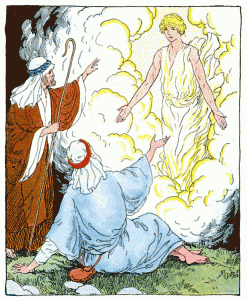
Luke 2:8, Shepherds living out in the fields. According to the Mishnah (a rabbinic Jewish legal-historical document from the end of the second century AD), these were no ordinary sheep or shepherds, but were shepherds who watched over sheep that were destined to become burnt offerings, peace offerings and the Passover offering for the temple service in Jerusalem (Mishnah Sheq 7:4; The Life and Times of Jesus the Messiah, by Alfred Edersheim, pp. 132–133).

25478487

Such sheep were kept in the environs of Jerusalem including Bethlehem, which lies just five miles south of that city. These sheep were apparently kept outdoors all year round.

Presumably they were carefully watched over to keep them safe from incurring any blemish that might render them unusable for the temple service.

Imagine the spiritual and prophetic significance of heaven’s angelic messenger revealing to these shepherds the birth in Bethlehem of the spotless and sin-free Lamb of Elohim who was destined to be sacrificed from the beginning of the world (Rev 13:8; John 1:29; 2 Cor 5:21; 1 Pet 2:22; 1 John 3:5). The angel announced that he was YHVH the Messiah (Isa 53:1; Christ the Lord)—the Savior (Luke 2:8 cp. Isa 53:6, 10–11).  He once and for all would take away the sins of the world (Heb 10:10, 12), thus rendering their jobs as temple shepherds unnecessary.


Naked and Ashamed Vs. Preparedness

Mark 14:51, A certain young man…naked. The reason for the inclusion of this detail in the Gospel record has puzzled many commentators. For example, Matthew Henry suggests that it was added to show the barbarous nature of the Jewish gang that arrested Yeshua, and how narrow was the disciples’ escape from their hands.

Naked and ashamed

Naked and Ashamed

There seems, however, to be a greater spiritual lesson to be learned from this story.

Previous to this, Yeshua, as he and his disciples were coming into the Garden of Gethsemane, admonished them to sit and pray with him (v. 32), to stay and watch (v. 34), to watch and pray so as not to fall into temptation because of the weakness of the flesh (v. 38). Instead, the disciples slept (vv. 37, 40).

Elsewhere, Yeshua instructs the elect saints of the last days to endure tribulation and spiritual apostasy to the end (Matt 24:13), and to watch vigilantly and be ready for his second coming (Matt 24:42, 44; 25:13). These warnings are in the context of his Parable of the Ten Virgins. All slept while awaiting the bridegroom’s arrival. While five were spiritually prepared, five were not. Those who were unprepared were dubbed as foolish and weren’t allowed into the wedding.

Likewise, in the end times, there will be believers who YHVH views as wretched, miserable, poor, blind, and naked because they have grown lukewarm spiritually (Rev 3:14–17).

The point of this discussion is this: If the disciples of Yeshua (that’s you and me) fail to maintain a state of spiritual preparedness (by watching, praying, keeping oil in their spiritual lamps, enduring to the end) while awaiting his return, they, like the young man in Gethsemane and the Laodiceans in the Book of Revelation, will be found to be spiritually naked lacking robes of righteousness on the day of his return and thus unprepared to meet him (Rev 19:7–9 cp. Matt 22:2, 11–12).


Prophetic Shadows in Joseph’s Life (pt 4)

This final post in this series on the life of Joseph is a little longer than the others, but stay with it to the end.  It’ll be worth the time to read it in that your understanding of end-times prophecy with regard to the Jewish and Christian people will be greatly expanded. Enjoy!

Joseph’s Brothers Didn’t Recognize Him as Their Brother (Gen 42:6, 8)

Joseph’s brothers did not recognize him, though he recognized them. This is prophetic of what would happen between the brothers in the future—they again wouldn’t recognize each other.

To understand how this scenario would play out prophetically,  we have to know who Joseph’s descendants would become. Ephraim and Manasseh, Joseph’s sons (Gen 41:50–52) would not only become whole nations or people-groups, but would become the leaders of other nations as well (see Ezek 37:16; Hos 6:10; 11:12; 2 Chr  30:1, 10–11).

Prophetically speaking, as Judah (the leader and spokesman of the brothers and whose descendants are the modern-day Jews didn’t recognize Joseph, so the Jews have not recognized Joseph’s descendants—the house of Ephraim—who constitute a major portion of the lost sheep of the house of Israel today (Matt 10:6; 15:24). The Jewish sages have long recognized that their Ephraimite brothers (along with those from the other tribes who had forgotten their identity) are scattered and will someday return by the divine hand of the Almighty and in fulfillment of numerous biblical prophecies. For example, Jewish teacher Jacob Immanual Schochet acknowledges that through the efforts of the Messiah, the ingathering of the exiles, including the ten tribes of the Northern Kingdom, will occur, and they will be reunited with Judah and together the whole house of Israel will serve YHVH as stated in Ezekiel 20:32–37, 40–42. The Talmud (the Jewish oral law) confirms this view position and states that the ten lost tribes will return to the land of Israel at the end of the age in conjunction with the coming of the Messiah to be reunited with their Jewish brothers.

Joseph’s Brothers Didn’t Recognize Him as Their Savior (Gen 42–44)

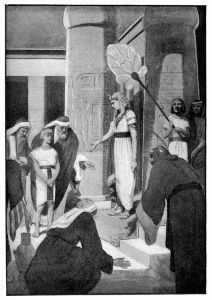
Joseph’s brothers didn’t recognize that Joseph was their savior (from famine). Prophetically, and in our time, most Jews neither recognize Christians (the descendants of Ephraim and Manasseh) as their brothers, nor that the Jesus of Christianity is their Savior who will supply spiritual food for which their hearts are longing (but not finding in rabbinical Judaism), but that he died to redeem them from their sins.

The Scriptures prophecy that this spiritual blindness would occur to many of the children of Israel, including the Jews. We read about this in Isaiah 8:14 and Romans 11:25.

The Concept of Deliverance Through Substitution (Gen 42:17–19, 24)

Joseph made known to his brothers a way of deliverance through substitution in that they would all be saved if Simeon were held back for ransom.

Continuing our comparison between Joseph and Yeshua, Continue reading


Prophetic Shadows in the Life of Joseph (pt 3)

Joseph: Antitype of Yeshua the Savior (Gen 42)

Joseph acted as a savior to his brothers and family to save them from death in a time of famine. Prophetically, Christians (who are, at least in part, descendants of Joseph) present Yeshua son of Joseph as the Savior to the world (including to the Jews) to save people from spiritual death.

Viewing Joseph’s role as a savior to the Israelite people in their time of need as a prophetic picture of ­Yeshua’s similar role as Savior should not seem strange to the reader. In pre-Christian Jewish literature, the Jewish sages identified two Messiahs that were to come: one whose life would resemble Joseph and was referred to as the suffering servant or “Messiah Son of Joseph” (Mashiach ben Yoseph), and a second Messiah whose life and ministry would resemble that of David, and who they referred to as the warrior king or “Messiah Son of David” (Mashiach ben David). This messianic title was prevalent even in Yeshua’s day, for on several occasions, he was asked if he was the [Messiah] Son of David (e.g., Matt 9:27; 12:23; 15:22; 20:30–31; 21:9, 15; 22:42). The Jewish sages came to the conclusion that there were two Messiahs because while reading the messianic prophecies in the Tanakh (OT) they saw two different, even conflicting Messiahs whose roles were very different from each other. What was not known by the ancient Jewish sages, which was a subject of much debate, was which Messiah would come first, when he would come, would he be the same person or two different individuals, and how much time would separate their two comings.

For believers in Yeshua, this is not a dilemma, because we can look back in time and clearly see that Yeshua fulfilled the Suffering Servant role at his first coming, and will fulfill the Conquering King role at his second coming. But two thousand years ago, without the benefit of historical perspective, this was not an easy matter to figure out. Even the disciples were at times in a quandary as to which mission Yeshua was to fulfill as evidenced by their last question to him before his final ascension, “Will you at this time restore again the kingdom to Israel?” (Acts 1:6).

Allusions to Yeshua the Messiah’s role as the Son of Joseph can be found in the following biblical passages:

  • The Suffering Servant will die a martyrs death for the sins of his people (Isa 52:13–53:12).
  • In the end of times, the Jews will look upon him whom they pierced and mourn for him as one mourns for his only son (Zech 12:9–10).
  • In verse one of Psalm 22 are some of the last words to come out of Yeshua’s mouth while he hung dying on the cross. This psalm predicts certain aspects of the Suffering Servant Messiah’s ministry.
  • John 1:45 may be a double entendre allusion to Yeshua as being not only the (adopted) son of Joseph, the husband of Mary, but to his being Messiah Son of Joseph, as well.

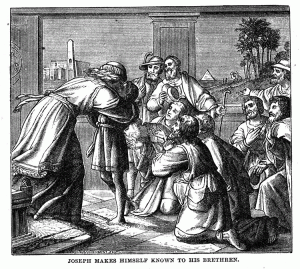
In Genesis 45:1–15 when Joseph finally reveals himself to his brothers, we see that Joseph, as an antitype of ­Yeshua, had mercy on his brothers who were now penitent for their sins against him. Joseph wept for joy and embraced his brothers (verse 14) when being reconciled to them. Past hurts and wrongs were forgiven. Prophetically, this points to Yeshua, our Savior and Redeemer, who lovingly accepts the repentant sinner and warmly embraces and welcomes him into Elohim’s spiritual family and kingdom (Ezek 18:27–32 and Ps 103:10–18).

Continuing with our comparison between Joseph and Yeshua, we see that during the remaining years of the famine, all of the Egyptians became indebted to Joseph as he judiciously doled out the stored wheat to those in need. In order to save their lives, the inhabitants of the famine-ravished land gave their lives and land to be servants of Joseph (who was a type of Yeshua) in exchange for food (Gen 45:13–26, 47:23). Yeshua, likewise, has bought us with the price of his blood (1 Cor 6:20; 1 Pet 1:18–19; Rev 5:9). Similarly, in the Apostolic Scriptures, the disciples of Yeshua are called to be his bondservants—a term the apostles apply to themselves numerous times.


Divorce for Any Reason?

Mark 10:2–10, cp. Matt 5:31–32 and 19 Is it lawful for a man to divorce his wife? Yeshua confirms the fact that divorce wasn’t part of YHVH’s original marriage plan, but that Moses allowed divorce only for a specific reason.

In the Torah, divorce was permitted for lack of virginity at the time of marriage, and for specific sexual sins committed that violated the marriage covenant (note Deut 22:13–14 cp. Deut 24:1–4), yet eventually (by the time of Yeshua), among some of the Jews, the divorce laws had become so liberal that a man could put his wife away for any reason (Matt 19:3). To those Jews who had such a liberal interpretation of the Torah’s divorce laws, Yeshua was addressing not what the Torah specifically said, but what the religious-legal interpretations had become of those laws.

To bring the concept of marriage and divorce back to the Creator’s original design, Yeshua upheld that, according to the Torah—YHVH’s master plan, marriage between a man and a woman was inviolable and that divorce was permissible only for certain gross sexual sins (see more at Matt 19:8–9).