New Video: How Firstfruits Day Prophetically Pictured the Death and Resurrection of Yeshua

This video explains how the ceremonies Elohim ordered the ancient Israelites to do on Firstfruits (or Wavesheaf) Day prophetically pictured the death,  burial and resurrection of Yeshua (Jesus) the Messiah some 1500 years before that event occurred, thus proving both the divine origination of the Bible and the divine mission of Yeshua.

A free study guide is available at http://hoshanarabbah.org/pdfs/firstfruits.pdf.


How the First Fruits Day Points to Yeshua

The Day of the Wave Sheaf Offering or First Fruits Day

In Hebrew roots circles, a day has gained prominence for celebrating the resurrection of Yeshua. It is called by many, the Feast of First Fruits or simply First Fruits. In several books published by Messianic or Hebrew roots teachers, this day has been elevated to the status as one of the “feasts” of YHVH on a par with Passover, Unleavened Bread, Pentecost, Trumpets, Atonement and Tabernacles. In creating a special designation for this day—one, as we shall see later, that Scripture does not give it—most of these teachers curiously omit the last of YHVH’s seven “feasts” or miqra-ee kodesh (commanded assemblies); namely, The Eighth Day or Shemini Atzeret. This festival is a Sabbath and immediately falls after the Feast of Tabernacles. It has important spiritual significance and represents the formation of the New Heaven and New Earth and the descent of the New Jerusalem after the end of the 1000-year long Millennium on earth. It literally represents heaven-on-earth for eternity. It is, therefore, a shame to omit this most important festival of YHVH!

A field of barley grain in the land of Israel.

A field of barley grain in the land of Israel.

The Nature of the Omer Offering/Service

Does the omer offering on “Wave Sheaf Sunday” prophetically point to and foretell the death and/or resurrection of Yeshua, and if so, how? First, let us look at the scriptural passages that speak of this day.

Leviticus 23:10–17, Speak unto the children of Israel, and say unto them, When you be come into the land which I give unto you, and shall reap the harvest thereof, then you shall bring a sheaf of the first fruits [reshiyth] of your harvest unto the priest: And he shall wave the sheaf before YHVH, to be accepted for you: on the morrow after the Sabbath the priest shall wave it. And you shall offer that day when you wave the sheaf an he lamb without blemish of the first year for a burnt offering unto YHVH. And the grain offering thereof shall be two tenth deals of fine flour mingled with oil, an offering made by fire unto YHVH for a sweet savor: and the drink offering thereof shall be of wine, the fourth part of an hin. And you shall eat neither bread, nor parched corn, nor green ears, until the selfsame day that you have brought an offering unto your Elohim: it shall be a statute for ever throughout your generations in all your dwellings. And you shall count unto you from the morrow after the Sabbath, from the day that you brought the sheaf [omer] of the wave offering; seven sabbaths shall be complete: Even unto the morrow after the seventh Sabbath shall you number fifty days; and you shall offer a new meat offering unto YHVH. You shall bring out of your habitations two wave loaves of two tenth deals: they shall be of fine flour; they shall be baked with leaven; they are the first fruits [bikkurim] unto YHVH.

Leviticus 23:10b–14a, … you are to bring the premier sheaf of your harvest to the priest. He is to elevate the sheaf before the presence of YHVH, for acceptance for you; on the morrrow after the Sabbath the priest is to elevate it. You are to perform a sacrifice on the day of your elevating the sheaf: a sheep, wholly-sound, in its (first) year, as an offering-up to YHVH, and its grain-gift: two tenth-measures of flour mixed with oil, a fire-offering to YHVH, a soothing savour; and its poured-offering of wine: a fourth of a hin. Now bread, parched-grain or groats, you are not to eat, until that same day, until you have brought the near-offering of our Elohim… (The Shocken Bible)

Leviticus 2:12–16, As for the offering of the first fruits, you shall offer them to YHVH, but they shall not be burned on the altar for a sweet aroma. And every offering of your grain offering you shall season with salt; you shall not allow the salt of the covenant of your God to be lacking from your grain offering. With all your offerings you shall offer salt. And if you offer a meal offering of thy first fruits [bikkurim] unto YHVH, you shall offer for the meal offering of thy first fruits [bikkurim] green ears [abib, H24, or green in the ears barley] of corn [qalah; H7033, roasted dried, burned, parched grain] dried by the fire, even corn beaten [geres; H1643, crushed grain or groats] out of full ears. And you shall put oil upon it, and lay frankincense thereon: it is a meat offering. And the priest shall burn the memorial of it, part of the beaten corn thereof, and part of the oil thereof, with all the frankincense thereof: it is an offering made by fire unto YHVH.

The Order of Events Associated With the Waving of the Omer

Now that we have the scriptural passages before us pertaining to the First Fruits Day, let’s list in chronological order the events and ceremonies that occurred on this day involving both the Israelite farmer and the priest.

Continue reading


He Is Risen!—Proof of the Resurrection from Isaiah

Here is proof from the Tanakh (Torah, Prophets & Writings aka Old Testament) that Yeshua’s resurrection was prophesied some 700 years before his death on the cross. This is found in a phrase from Isaiah 53:11 that is missing from most of our English Bibles.

20486791-1

Isaiah 53:11, See the light. The Qumran Great Isaiah Scroll translates verse 11 as follow:

Of the suffering of his soul he will see light and he will find satisfaction. And through his knowledge his servant, the righteous one will make many righteous, and he will bear their iniquities” (The Dead Sea Scrolls Bible, by Abegg, Flint and Ulrich, p. 360; Harper Collins Publishers, New York, N.Y.:1999).

Note the highlighted portion that is missing in the Masoretic text from which our most common English Bibles’ “Old Testament” portions are derived. The New International Version (NIV) translates this verse as follows and notes in its footnotes that this phrase originates from the Isaiah Dead Sea Scroll and from the Septuagint (LXX):

After the suffering of his soul, he will see the light [of life] and be satisfied; by his knowledge my righteous servant will justify many, and he will bear their iniquities.

Note the Septuagint (LXX) translation of this verse:

The Lord also is pleased to take away from the travail of his soul, to shew him light, and to form him with understanding; to justify the just one who serves many well; and he shall bear their sins. [translated by Sir Lancelot Charles Lee Brenton (1807-1862) originally published by Samuel Bagster & Sons, Ltd., London, 1851]

Light in bible is synonymous with life. In Bible times, a late night traveller would see light in a house and know there was life therein. The phrase in this verse, “he will see the light”, speaks of resurrection from the shadows of death into the light of life. What else could this mean except that Messiah would resurrect from the grave?


The Law of the Fringes and You

Shofars, Davidic worship dance, prayer shawls (talit or tallit), a Torah scroll and tzitziyot (plural for tzitzit) (fringes or tassels) all have something in common: they are hallmark symbols of those who are returning to the Hebrew roots of their faith. When a Christian begins to discover their ancient spiritual roots, it’s like coming home, or like a hand fitting into a glove. It’s not long before they begin acting out their renewed faith in a highly demonstrable manner such as growing beards, wearing fringes, blowing shofars, keeping the Sabbath and biblical feasts. Outsiders may view this as mere religious fanaticism and exhibitionism, but to the saint who truly feels that he has returned to his spiritual roots, these things are symbols of a faith that is more than superficial in nature. They represent a connectedness to his spiritual family tree, to the nation of Israel and eventually to the God of Israel, YHVH Elohim, the originator of that faith, family tree and nation.

tzitzitblue

As a wedding ring symbolizes the covenantal agreement between spouses, so the blue fringes worn on the corners of one’s garments are an outward symbol of one’s spiritual commitment and devotion to the Elohim of Israel through obedience to his instructions in righteousness as found in the Torah portion of the Scriptures.

Indeed, it is not because of a man-made tradition, but because of a direct command in the Torah that redeemed Israelites wear tzitziyot, for we read in Numbers 15:37–41,

And YHVH spoke unto Moses, saying, “Speak unto the children of Israel, and bid them that they make them fringes [Heb. tzitziyot] in the borders of their garments throughout their generations, and that they put upon the fringe of the borders a ribbon of blue. And it shall be unto you for a fringe, that you may look upon it, and remember all the commandments of YHVH, and do them; and that you seek not after your own heart and your own eyes, after which you use to go a whoring, that you may remember, and do all my commandments, and be set apart unto your Elohim. I am YHVH your Elohim, which brought you out of the land of Egypt, to be your Elohim: I am YHVH your Elohim.’”

In the eyes of YHVH, this command is serious enough that he repeated it again in Deuteronomy 22:12,

You shall make you fringes upon the four quarters [Heb. kanapah meaning “wings”] of your garments, wherewith you shall cover yourself.

Let’s discuss what is said in these two passages. Continue reading


Are You an End-Times Elijah? Here Are Your Marching Orders!

Isaiah 40:1–26, The End-Times Elijah Generation Preparing the Way for Messiah

Isaiah the prophet ministered in Judah for about 40 years from 740 to 697 b.c., approximately 100 years before the southern kingdom of Judah fell to the Babylonians in 586 b.c. Judah’s captivity in Babylon would last for 70 years. The Book of Isaiah contains more messianic prophecies than any other book in the Tankah, and many of those prophecies specifically relate to the redemption through the Messiah of the two houses of Israel.

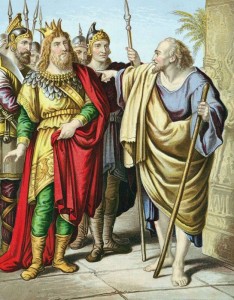
Elijah against the king 36931605

In the Isaiah 40 prophecy, according to rabbinic understanding, Isaiah is prophesying (in verses 3–5) concerning Israel’s deliverance from exile seventy years after her captivity (The Soncino Pentateuch, p. 777). This is not an incorrect interpretation of this prophecy, although it is not necessarily the only one, for we know, as with many of the Scripture’s ancient prophecies, there are sometimes multiple fulfillments. Because the old adage that says, “history repeats itself,” is true, and because human behavior remains unchanged from time immemorial, though the players and costumes change on history’s theatrical stage, many biblical prophetic themes have cyclical patterns. In the present case, where Isaiah speaks in verse three of “a voice crying in the wilderness,” (Isa 40:3) we know that the gospel writers ­applied this to John the Baptist preparing the way for the coming of Yeshua the Messiah (Matt 3:3; Mark 1:3; Luke 3:4; John 1:23). What in this prophecy did the gospel authors see as applying to Yeshua the Redeemer and Savior of Israel? First, Yeshua himself declared John the Baptist to be that messenger who would prepare the way for the Messiah that Malachi prophesied about (cp. Matt 11:10 and Mal 3:1). The messenger of Malachi 3 and 4 seems to be the same individual mentioned in Isaiah 40. Furthermore, Isaiah 40:3 speaks of preparing the way for YHVH and making a highway in the desert for Elohim. Clearly, the gospel writers recognized that Yeshua was YHVH Elohim based not only on his claims to deity, but based on the fact that Isaiah states that the Messiah, the Redeemer of Israel, would not only be YHVH Elohim, but that he was the arm of YHVH (Isa 53:1) making him a manifestation, if you will, of YHVH.

Not only did the gospel authors see John the Baptist in the Isaiah 40 prophecy (Isa 40:3–4 cp. Matt 3:3; Mark 1:3; Luke 3:4–5; John 1:23) because they recognized who Yeshua was Continue reading


Origin of the Anointing Oil, Ordination, and the Anointed One

Leviticus 8:12, Anointing oil … consecrates [Heb. kadash]. The Hebrew word kadash signifies the state of something that belongs to the realm of the sacred, and that is set-apart for divine use and has been separated from the sphere of the secular, common or profane. The Bible often uses the term holy (meaning “set-apart”) to signify this state of being. The word of Elohim designates many things as set-apart:

Anointing oil

Anointing oil

  • The ground upon which YHVH is standing (Exod 3:5; Josh 5:15)
  • The people of Israel (Exod 19:6; Deut 14:21; 26:19)
  • The Sabbath (Exod 16:23; 20:8)
  • The Tabernacle of Moses (Exod 26:33)
  • The garments worn by the high priest (Exod 28:2)
  • The altar of sacrifice (Exod 40:10)
  • The offerings made on the altar (Lev 6:18)
  • YHVH’s feast days (Lev 23:2)
  • The camp of Israel (Deut 23:14)
  • Heaven as the abode of Elohim (Deut 26:15)
  • YHVH Elohim (Job 6:10; Pss 22:3; 78:4; 99:5)
  • Zion and Jerusalem (Ps 2:6; Matt 27:53; Rev 22:19)
  • The Spirit of Elohim (Matt 1:20)
  • The angels (Matt 25:31)
  • The servants of Elohim (Mark 6:20)
  • The name of YHVH (Luke 1:49)
  • Yeshua (Acts 2:27; 3:14)
  • YHVH’s prophets (Acts 3:21)
  • The saints (1 Pet 2:9;Rev 22:11)
  • The Torah (2 Pet 3:21)

YHVH’s people are to learn to make a difference between that which he designates as being kadash (holy) and that which is profane (Lev 10:10). In order to do this, one must know what YHVH defines as set-apart and then align our thinking and lifestyle with that.

The act of consecrating someone (or something, e.g. Exod 30:26) as occurs in Leviticus 8:12 often involves the ritual of pouring olive oil on them to signify their being set-apart for a special work or service. This is called anointing (see Exod 28:41; 29:7; 1 Sam 16:12; 1 Kgs 1:34; Isa 61:1; 2 Cor 1:21).

Yeshua’s title is Messiah (Heb. Mashiach/ משח) literally meaning, “one who is anointed, smeared or consecrated with (olive) oil.” The English word Christ derives from the Greek word Christos, which is the Greek equivalent of the Hebrew word mashiach. In Biblical thought, the Messiah would be One coming from heaven who would possess a super-anointing of the Spirit of Elohim (Isa 11:1–10; 42:1–21; 61:1–3; John 3:34) to accomplish the purposes of Elohim on earth.


Why the Biblical Sacrificial System?

A Brief Study of the Sacrificial System—The Purpose of Sacrifice

Lamb sacrifice

  • The Levitical system foreshadowed and pointed to the Messiah’s ultimate sacrifice (Heb 9:11–12).
  • The tabernacle offerings were specifically designed to spiritually draw the offerer near to Elohim through the  sacrifice of a prescribed animal (Ps 51:16–17; 50:12–15 cp. 1 Pet 2:21).
  • Elohim commanded offerings to assist the offerer to better understand himself; his attitude, and his personal relationship with Elohim (e.g., Gen 3:21; 4:3–5; 8:20; 22:1–2 cp. 1 Cor 11:28).
  • Altars were erected by the patriarchs in order to honor Elohim through sacrifice after having had direct contact with him (Gen 12:6–8; 13:18; 26:24–25; 35:1; 35:2–4; Exod 17:13–16; cp. Exod 20:12).
  • Proper and regular sacrificial offerings kept the children of Israel in direct contact with the Elohim of the patriarchs (Exod 5:3; 10:25; cp. 1 Tim 2:5).
  • To make the offerer holy (set-apart) so that he would be allowed to approach and commune with the Set-Apart Elohim of Israel (Isa 43:15; 57:15; Lev 19:2 cp. 2 Cor 6:16–18).
  • Under certain circumstances, blood, as used in the Levitical system, could serve as a purification agent for both people and objects (Heb 9:18–23 cp. Luke 2:22–24).
  • The blood of the animal sacrifices served to cover the offerer’s sins, thereby allowing him to draw near to the Set-Apart Elohim of Israel. However, the offerer could only be forgiven for specific sins through full repentance and by returning to Elohim’s way of life as outlined in the Torah (Lev 1:4; 4:35; 23:27–28; Heb 10:3–4; cp. Rom 4:7–8).
  • The purpose of the animals offered by the Levitical priesthood served as a shadow of the blood of Messiah, which does not merely cover our sins, but removes all of the sins of the person who accepts Yeshua’s offering of himself for that sinner (Heb 9:11–12, 24–28; 1 Pet 1:18–19; Eph 5:25–27; Lev 25:47–49; Rom 5:11; John 1:29 cp. Heb 13:10–13).

YHVH instituted the biblical sacrificial system at the fall of man, and it pointed to the coming of Yeshua the Messiah, the Redeemer and Savior of mankind. Depending on how one understands the passages recording the vision of Ezekiel’s Temple (Ezek 40–48), there may or may not be a reinstitution of part of or the whole sacrificial system during the millennium. Some believe that Ezekiel’s Temple is only an allegorical picture of Yeshua on the cross and speaks to YHVH’s plan of salvation and therefore will never be built. Others feel that it is yet to be built. This author favors the former thesis.

After the fall of man, YHVH made Adam and Eve coats or garments of skins or leather (Gen 3:21). Though the Scriptures don’t tell us, we can guess these were made of leather from a kosher animal such as a cow, sheep or goat. In other words, YHVH probably sacrificed an animal to cover their physical and spiritual nakedness. This would have marked the beginning of the sacrificial system and thus pointed to Yeshua’s atoning death on the cross through his shed blood—the Lamb slain from the foundation of the world.

The next occurrence of a sacrifice was that of righteous Abel in Genesis chapter four. After that, animal sacrifices become a common occurrence with the male head of each family acting as the officiant or priest for his family. It was not until the golden calf incident (Exod 32) that the responsibility of the male head of the family to perform sacrifices passed to the Levites, thus, initiating the Levitical priesthood with its sacrificial system.

Sacrifices are no longer necessary, since Yeshua our Messiah offered his body as the penultimate sacrifice for our sins, once and for all, forever (Heb 10:10–21). HalleluYAH!!!