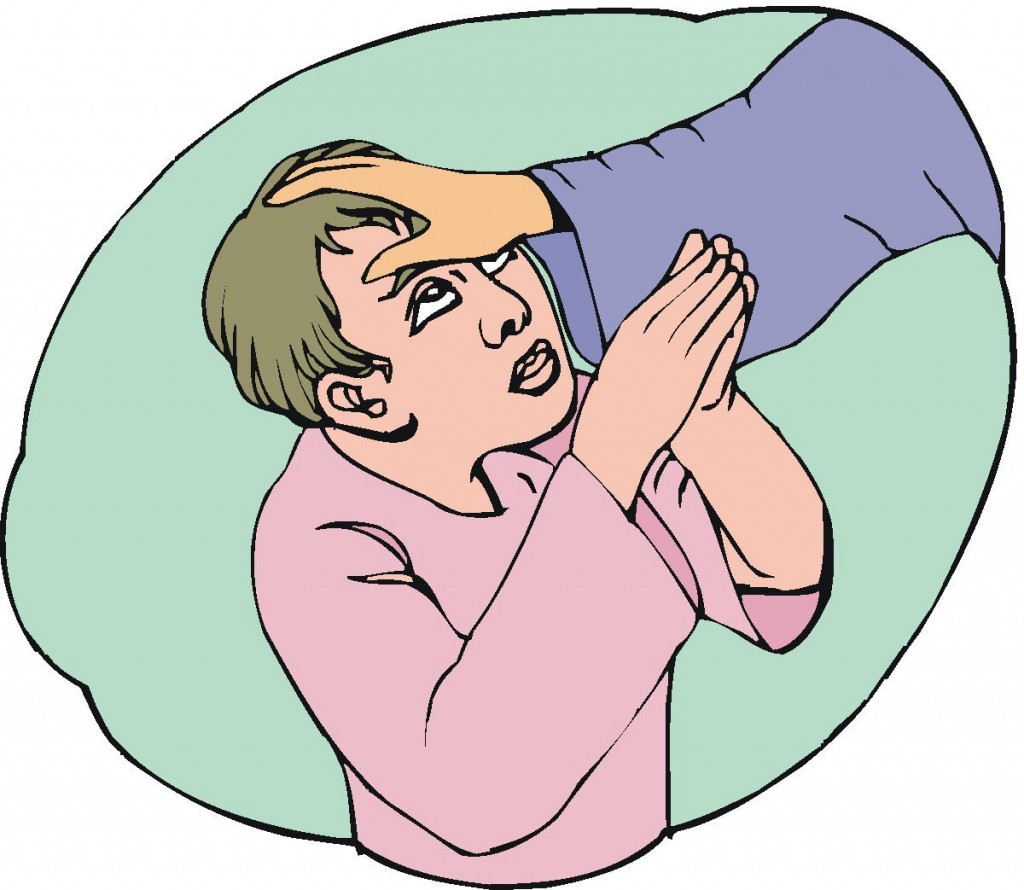
Matthew 20:34, Eyes received sight…the followed him. When the Son of David has compassion on someone and touches their eyes, they receive sight and see him, and the automatic response will be to follow him. His having compassion is first preceded by the heart cry on the part of the potential recipient of Yeshua’s grace, “Have mercy on us, Son of David.” When one recognizes one’s pitiful state and desparate need, how can Yeshua not have compassion on us, touch us and heal us?
Tag Archives: Yeshua
How to Be Spiritually Complete
Matthew 19:16, What good thing. Yeshua’s answer to the rich young ruler when he asks him what he must do to have eternal life might, in a cursory reading, appear that Yeshua is promoting a works based salvation. However this is not the case. Yeshua cleverly shows the young man that he is incapable of obtaining eternal life through good works, for man isn’t capable of perfectly following the Torah. In the case of the young man’s, he thought himself to be perfectly righteous, when in reality, Yeshua showed him that he was covetous, and therefore still an unrighteous sinner thus disqualifying himself from reward of eternal life. Yeshua, by contrast instead of promoting a works-based salvation, instructs the young man to deal with his sin by selling his possessions and giving the proceeds to the poor, and then becoming a follower of him. The lesson here is that salvation and eternal life can come only as we turn from our sin and become a follower of Yeshua.
What Yeshua is really saying when he answers the young man’s question is this: “If you want to be perfect [Gr. teleios meaning “brought to its end, finished; wanting nothing necessary to completeness]” turn from sin by obeying the Torah more completely, but also follow the Messiah by becoming his disciple. Remember, to hear and to obey [Heb. shema] the Messiah was a command of the Torah as well (Deut 18:15), and to not believe in him is sin (John 16:9 cp. 3:18). So according to the Bible, to be spiritually perfect or complete one must, as Yeshua said, love him by keeping his (Torah) commandments (John 14:15). It is the Torah that shows us how to love Elohim (and our fellow man as well).
Yeshua makes a similar point in his exchange with a scribe in Mark 12:28–34. While extolling the virtues of Torah-obedience, and commending the scribe for his understanding of the deeper heart issues of Torah-obedience, Yeshua makes an interesting concluding statement. He tells the scribe, “You are not far from the kingdom of Elohim (v. 34) as if to tell him, “You’re on the right spiritual track with regard to your Torah-obedience, and you’re heading for the kingdom, but that alone won’t get you into the kingdom. You must also become a disciple of Yeshua.
Growing Up in Messiah: Offense Versus Sin — Are You a Spiritual Pouter?
Matthew 18:15, When your brother sins. Yeshua says that when your brother sins against you, you ‘re to follow certain protocols to correct him in effort to restore him to spiritual relationship. Many people read this verse to mean that when your brother offends you or hurts your feelings, you’re to go to him. This is not what Yeshua is saying here. He says, if your brother sins against you. By biblical definition, sin is the violation of the law or Torah of Elohim (1 John 3:4). Therefore, if your brother lies to you, steals from you, or sexually violates your wife, you are to go to him, and possibly the church leaders — not if your brother offends you (hurts your feelings) in word or in deed. In this case, Yeshua instructs us elsewhere that we’re to turn the other cheek, pray for our enemies, bless and not curse, and do good to them.
Here’s something my wife Sandi wrote that deals in more detail with this issue of offense among brothers.
By Sandi Lawrence
Have you heard someone say that they are claiming their Matthew 18 rights because they have been offended by this or that person? It’s actually quite common and is often what is taught as how to handle offenses between brothers. Continue reading
Yeshua Is More Than a Mere Carpenter
Matthew 13:55, Carpenter’s son. Yeshua was physically and spiritually a carpenter or housebuilder (Pss 104:3; 127:1; Heb 3:1–6). He still works with wood in that he’s joining the two sticks of the two houses of Israel together (Ezek 37:19).
Men are like trees or sticks that Yeshua is putting together (Mark 8:23–24) into one house, or one tree — the olive tree of Israel (Ezek 37:19 cp. Rom 11:16–18; Jer 11:16; Hos 14:6). At his second coming, Yeshua will permantly bind or graft the two houses together legally as he finalizes the new covenant, which he initated at his last supper (Matt 26:28 cp. Heb 8:8, 13 and Jer 31:31, 33).
Will You Have a Sunny Disposition in the Kingdom?
Matthew 13:43, Shine forth as the sun. The reward of the resurrected righteous will cause them to shine forth like the sun or stars (Dan 12:3), and like Yeshua (1 John 3:2), whose face shines like the sun (Rev 1:16), for he is the Sun of Righteousness (Mal 4:2), who will be the light of the New Jerusalem shining in place of the physical sun (Rev 21:23; 22:5; Isa 60:20).
Paul speaks of the resurrection of the saints or their glorification that will occur at that time, and he also likens the saints’ appearance to the stars. As stars have different levels of brightness, so too will the saints (1 Cor 15:41–43) in accordance with their levels of rewards based on their level of obedience to the Torah (Matt 5:19; 16:27; Rom 2:6–11; 2 Cor 5:10; Eph 6:8; 1 Pet 1:17; Rev 19:8; 22:12–15).
Understanding the Mysteries of Abraham’s Vision
A Vision of the Renewed Covenant
In Genesis 15:17–18fp, we read,
And it came to pass, that, when the sun went down, and it was dark, behold a smoking furnace, and a burning lamp that passed between those pieces. In the same day YHVH made a covenant with Abram …
What is the meaning of this? This is nothing other than YHVH giving Abraham a prophetic vision of Yeshua the Redeemer of Israel dying on the cross paying for the sins of Abraham’s descendants who would break that very covenant that YHVH made with Abraham on that day. Both Jewish and Christian biblical commentators recognize aspects of this truth.
Let’s first establish that YHVH passed through the pieces of sacrificed animal. Rashi, the medieval Jewish Torah scholar, recognizes that the Divine Presence was the one who passed through the pieces of animal while Abraham slept (Rashi’s commentary on Gen. 15:10). Furthermore, The ArtScroll Tanach Series Bereishis/Genesis Commentary, vol 1a, states, “The smoke [which rose up into the thick darkness (Radak)] was the ‘Cloud and thick darkness’ which appeared at the revelation of the Torah and the torch in its midst was ‘the fire’ which appeared at Sinai [see Exod. 19:18; Deut. 5:4]”…. [Elohim] caused His Presence, symbolized by the fire, to pass through and conclude the Covenant.… [T]he culmination of this vision was that the fire consumed the pieces, causing their smoke to ascend to heaven…” (pp. 534–535). Christian commentators Keil and Delitzsch in their commentary on this passage state, “In this symbol [i.e., the smoking pot and the fiery torch], Jehovah manifested Himself to Abram, just as He afterwards did to the people of Israel in the pillar of cloud and fire” (Hendrickson, p. 138). So both notable Jewish and Christian scholars relate the smoke and the fire Abraham saw pass between the pieces of meat to YHVH’s Presence in the cloud and pillar of fire that led Israel in the wilderness. We read in Exodus 13:21,
And YHVH went before them by day in a pillar of a cloud, to lead them the way; and by night in a pillar of fire, to give them light; to go by day and night.
Then in Exodus 14:19 it is written:
And the angel of Elohim, which went before the camp of Israel, removed and went behind them; and the pillar of the cloud went from before their face, and stood behind them.
Who is this “Angel” of Elohim (in other places: he is called “the Angel” of YHVH)? Continue reading
If Yeshua Is Lord of the Sabbath, Did He Break It?
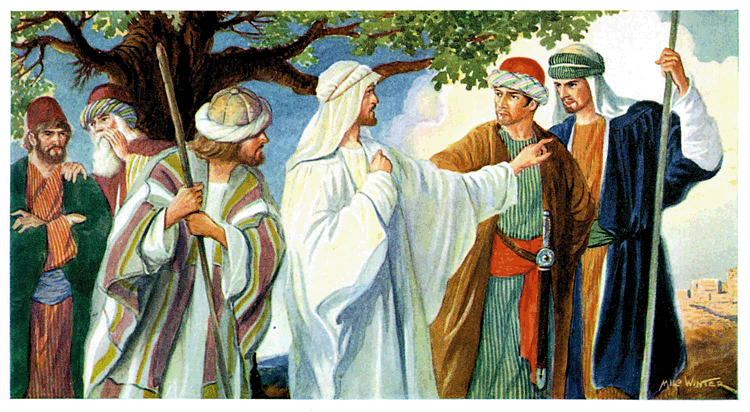
Matthew 12:1–14, On the Sabbath. (See also Mark 2:23–28; also see note on John 5:18.) From this passage, many Christians reason that since Yeshua is the Lord of the Sabbath, it was therefore permissible for him to break it. Does this passage substantiate this line of reasoning from Hebraic thought? Let’s examine this issue.
This scripture teaches us that there are levels of Torah laws, and some laws take precedence over others. For example, the priests technically violated the Sabbath during the tabernacle and temple service, but were guiltless because Torah commanded them to do certain things on the Shabbat that otherwise would have been forbidden. The Talmud explains this by saying that whenever a positive commandment and a negative commandment contradict, the positive commandment takes precedence over or supersedes the negative one (b. Shabbat 133a). What Yeshua is teaching in this passage is that the temple service trumps the Sabbath, and human need or saving life (the ox-in-the-ditch scenario) trumps the temple service. This view is confirmed by the Jewish sages (b. Yoma 85b). In verse six, when Yeshua said, Continue reading