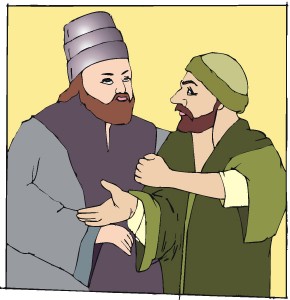
In this video, Natan discusses how Yeshua teaches that divorce isn’t YHVH intended ideal marital situation, but that due to the hardness of the human heart, Moses (obviously, with Elohim’s permission) allowed for it (under certain stringent conditions, as the Torah spells out).
Lest anyone get the idea that the Bible permits divorce for any reason (as the Pharisaical school of Hillel taught), Yeshua asserts that divorce and remarriage (often) results in an adulterous situation.
Then the Gospel writer seeming switches gears and records Yeshua’s blessing the children and encouraging this disciples to become like little children in order to enter the kingdom of Elohim.
Is Yeshua’s discussion about divorce and his blessing of the children just random and unrelated events in the Gospel narrative, or are these events strangely related employing a typically Hebraic teaching style to teach an important lesson? What this video to find out.
Tag Archives: Yeshua
New Video: Yeshua’s Triumphal Entry—Prophetic Implications
New Video: Joseph, Judah and the Two Messiahs
Are You ‘Not Far From’ the Kingdom or ‘In’ the Kingdom?
Mark 12:34, You are not far from the kingdom. Yeshua makes this complimentary statement to the scribe who had correctly and succinctly summarized the message of the Torah (both its letter and spirit intent) in verses 32–33.
However, note that Yeshua didn’t say, “You are in the kingdom of Elohim (i.e., you have eternal life).”
What was the one thing that kept the scribe from being in the kingdom? It was doubtless the same thing that kept the rich young ruler from obtaining the eternal life that he sought (Matt 19:16).
After having obeyed the Torah the best he could, the young ruler still needed to surrender all to Yeshua the Messiah, and to follow him unreservedly (Matt 19:18–22).
Not only is it difficult for humans to surrender all to the Master, and then to follow him wherever he leads, but having followed the Torah the best we can, we must still humbly recognize that without the righteousness of Yeshua in the equation, our best efforts at Torah-obedience will still miss the mark of YHVH Elohim’s acceptable standard of righteousness, thus leaving us maybe not far from the kingdom, but definitely not in the kingdom of Elohim.
From the Archives: Chanukah or Christmas, Neither or Both?
Since tonight begins the first day of Hanukkah, I thought it would be appropriate to direct you to an article that I wrote for this blog last year on Chanukah (or Hannukah) and Christmas. In this post, I contrast the two holidays and show how Christmas is about syncretism with paganism, while Hanukkah takes a stand against it. At the same time, and on the positive side, both holidays have the idea of light as their theme, which points to Yeshua the Messiah as the Light of this world. Read more about this at
http://hoshanarabbah.org/blog/2012/12/08/chanukah-or-christmas/
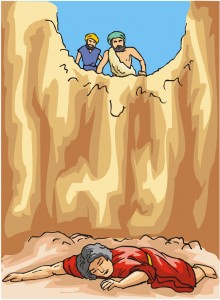
Joseph’s Life: Prophetically Points to Yeshua, the Suffering Servant
Genesis 37–41 The Life of Joseph—A Foreshadow of Messiah Ben (Son of) Yosef
The spirit of Antimessiah (Antichrist) is on a dramatic rise in this day and age. It is even alive in the Hebrew Roots or Messianic Israel Movement where some are losing their faith in Yeshua. A few are even converting to Rabbinic Judaism, which denies the messiahship and deity of Yeshua and the divine inspiration of the Testimony of Yeshua. Some of the blame for this can be laid at the feet of a few of the modern-day descendants of the non-believing Pharisees (i.e., the Rabbinic Jews) who use clever arguments to beguile unstable and unlearned souls into humanistic reasoning devoid of a living faith in Yeshua the Savior and Redeemer of man. Because of a spiritual blindness that Scripture prophesied would come upon the Jews producing hardness of heart toward Yeshua the Messiah, unbelieving Jews ignore the numerous prophetic shadow-pictures pointing to Yeshua the Messiah contained in their own Tanakh.
May the following study strengthen your faith in Yeshua, in his divine origination in the very heart, mind and essence of Elohim, and in the fact that he was foreordained to come to this earth to reconcile sinful man to his Heavenly Father through his self-sacrifice on the cross. All this was prophesied long ago in the Hebrew Scriptures. The ancient Jewish rabbis speak of a messianic figure coming called Messiah ben Yosef, the Suffering Servant, whose life and ministry would parallel that of Joseph, yet these same rabbis fail to see the connection between Joseph’s life and that of Yeshua. Let’s now chronicle the striking and uncanny parallels between Joseph and Messiah, the son of Joseph, the Suffering Servant (Many of these comparisons come from the book, Gleanings in Genesis, by Arthur W. Pink):
- Joseph had two names: Yoseph (meaning “to add, increase, do again”) and Zaphnath-panaaneah (41:45) (meaning “revealer of secrets”). How do these names point to Yeshua’s mission? To answer this, consider that the sin of the first Adam caused the depopulation of YHVH’s eternal kingdom, while Yeshua, the Second Adam, came to do what in regards to YHVH’s spiritual and eternal kingdom?
- What was Joseph’s occupation before being sold into slavery (Gen 37:2)? What was Yeshua’s spiritual “occupation”? (Not sure? Read John 10:1–18.)
- Joseph’s father loved him more than all his brothers (37:3–4). What was the relationship between Yeshua and his Father? (Read Matt 3:17; 17:5 and John 10:17.)
- Joseph was the son of his father’s old age (37:3). Relate this to Yeshua’s Father. Remember, old age is a metaphor for eternity. (Read John 1:1; 17:5; Mic 5:2; 1 Peter 1:20; Rev 13:8.)
- Joseph wore a multicolored robe of distinction and honor (37:3). What did the Roman soldiers place on Yeshua at his beating Continue reading
The Ancient Sages Taught: Two Messiahs to Come— The Same or Different Persons?
The Scriptures Reveal Two Messiahs Are to Come —
One Who Will Be Like Joseph and One Who Will Be Like David
In Jewish literature, the Messiah whose life would resemble Joseph was referred to as the suffering servant or “Messiah Son of Joseph” (Mashiach Ben Joseph), while the Messiah whose life and ministry would resemble David was referred to as warrior king or “Messiah Son of David” (Mashiach Ben David). The Jewish sages came to this conclusion because when reading the messianic prophecies in the Tanakh they saw two different, even conflicting Messiahs whose roles were very different from each other. What was not known by the ancient Jewish sages, and was a subject of much debate, was which Messiah would come first, when he would come, would he be the same person or two different individuals, and how much time would separate the two comings.
For believers in Yeshua, this does not seem like a dilemma, for we look back in time and can see clearly that Yeshua fulfilled the Suffering Servant role at his first coming, and will fulfill the Conquering King role at this second coming. But two thousand years ago, without the benefit of historical perspective, this was not so easy a matter to figure out. Even the disciples were at times in a quandary as to which mission Yeshua was to fulfill as evidenced by their last question to him before his final ascension, “Will you at this time restore again the kingdom to Israel?” (Acts 2:6).
Let’s review some of the passages in the Tanakh that point to the two different Messiahs.
Messiah Son of Joseph
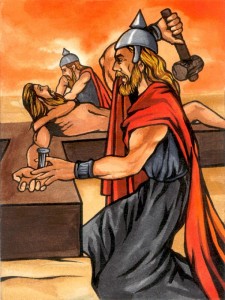
- The Suffering Servant will die a martyrs death for the sins of his people (Isa 52:13–53:12).
- In the end of times, the Jews will look upon him whom they pierced and mourn for him as one mourns for his only son (Zech 12:9–10).
- Verse one of Psalm 22 are some of the last words to come out of Yeshua’s mouth while he hung dying on the cross. This psalm predicts certain aspects of the Suffering Servant Messiah’s ministry.
- John 1:45 may be a double entendre allusion to Yeshua as being not only the (adopted) son of Joseph, the husband of Mary, but to his being Messiah Son of Joseph as well.
Messiah Son of David
- He will restore righteous government in Jerusalem (Isa 1:26)
- He shall judge the nations (Isa 2:4)
- All on earth shall worship him (Isa 2:17).
- He shall rule the earth and destroy the wicked (Isa 11:4).
- Under his rulership, all Israelites will be restored to their homeland (Isa 11:12).
- Matthew 9:27; 12:23; 15:22; 20:30, 31; 21:9,15; 22:42 are references to the expectations of the Jewish followers of Yeshua that he was Messiah Son of David.