When Confronting Our Spiritual Enemy: Battlefield or Throne Room?

When engaged in spiritual warfare prayer, consider this. Yeshua only addressed demons or Satan directly when the demon or Satan were actually manifesting. The same is true with Paul when dealing with the python spirit in the slave girl in Philippi, or with Peter when dealing with Simon the Magician. This is because at that moment they were on the spiritual battlefield, and direct confrontation with the enemy was unavoidable.

When not on the battlefield, we need to go through the courts of heaven when dealing with our spiritual enemies. To wit, I can think of no examples in the Bible of the saints speaking to Satan or his demons directly unless engaged in direct battle with them when evil spirits were actually manifesting.

Therefore, when engaged in spiritual warfare and not on the battlefield and in direct confrontation with the demonic element, we need to address our spiritual warfare issues and make our petitions known before the throne of the Almighty in the courts of heaven. It is also there that we will be given divine guidance to formulate our battle plans when the time comes to directly engage the enemy on the battlefield. We must communicate with Elohim in a way that the enemy will not overhear these strategic plans and thus be able to thwart them by mounting a defence against them ahead of time.

Yeshua instructed his disciples to be wise as serpents and harmless as doves (Matt 10:16). He also declared that, “the sons of this world are more shrewd in their generation than the sons of light”  (Luke 16:8). Therefore, we need to engage the enemy prudently, shrewdly and intelligently following strict biblical protocols if we want to experience more victories.


Call 9-1-1 in the Bible: An Uplifting Commentary on Psalm 91

Psalm 91:1 (and the rest of Psalm 91) Is the Biblical 9-1-1 to Call in Our Time of Trouble

Psalms 91:1, Secret. Heb. cether means “covering, shelter, hiding place, secrecy,” and is from the root word meaning “to hide, conceal.” When troubles comes our way like a tidal wave, the natural human reaction is to stand and fight or to flee in fear. In psychology this is known as the fight or flight response. There is a time to fight, but at all times we need to be hiding in the secret place of our relationship with our Almighty Father in heaven, to which the latter part of this verse alludes. Out of that place, and from under the shadow of the wings of the Almighty and in his throne room, we will not be cowering in fear from our enemies, but we will find the courage, will and stamina to stand firm in faith, and, if necessary, to come out and to fight the enemy not in our own strength, but in that of Elohim as led and guided by his Spirit.

Abide. Heb. luwn means “to lodge, stop over, pass the night or abide.” A lodge is a place where one temporarily spends the night. When dark times come our way, we need to stop over, spend the night, run to and abide in the throne room of the Almighty! This speaks of prayer, worship, praise and studying his Word.

Psalms 91:1, 4, Under the shadow of the Almighty…under his wings. According to the ancient Jewish sages, Moses composed this psalm for the tribe of Levi who dwelt under the shadow of the wings of cherubim that stood over the ark of the covenant in the Tabernacle of Moses—a physical representation of YHVH’s throne room in heaven. The sages go on to explain that the psalmist describes the devout man of faith who lives with Elohim in his heart, and who never leaves Elohim’s shadow. Such a man is a true biblical hero of faith to whom Elohim pledges (v. 16) he will satisfy with long life and show him his salvation (The ArtScroll Tanach Series Tehillim/Psalms Commentary on Ps 91). This psalm ends with the promise of the blessing of long life to those love and serve YHVH, and beyond that, salvation, which is the Hebrew word Yeshua—the very name of the coming Messiah who would offer his people deliverance from the ultimate enemy, namely sin and its death penalty. The result of this deliverance is the glorious divine gift of eternal life through faith in Yeshua the Messiah—the supreme gift and blessing of all! This psalm is a prophecy pointing to the Messiah.

In Jewish understanding, the Tabernacle of Moses wasn’t complete until the glory of YHVH’s presence took residence in the tabernacle’s inner chamber, the holy of holies. This was evidence that YHVH was making this habitation his own in a most intimate way. How was it possible, they ask, for the Creator of the universe to inhabit a mere tent? They explain that he focused his presence into this tiny spot. This isn’t unlike a magnifying glass that reflects the suns rays into a small but focused point on a piece of wood or paper. Were the earth closer to the sun, it would be burned up. Yet the sun’s light can be brought to the earth in a concentrated form that will not cause harm. This is exactly what Elohim did when he incarnated Yeshua into the womb of Mary. The sages had the understanding that the holy of holies is a picture of man’s heart that the Creator wants to indwell, which is the most sacred sanctuary of all.

The conception and birth of Yeshua was the fulfillment of this prophecy. The fire of the Set-Apart Spirit that came down upon the disciples on the day of Pentecost in Acts 2 was a fulfillment of this desire of YHVH of which the fiery glory cloud that dwelt in and over the Tabernacle of Moses was a prophetic portent. Yeshua promised his disciples that through this same divine fire he would dwell in their hearts after his death, resurrection and ascension. The result of this divine encounter of Elohim with those in the upper room resulted in many repenting of their sins and coming to faith in Yeshua the Messiah (Acts 2:38–41), which is the greater message of Psalm 91.

Psalms 91:3, Snare of the fowler. This is literally referring to a bird trap and the trapper. In ancient times, birds were trapped and used for food. This could be a poetic picture of Satan and his demons who fly through the air searching for human prey. A biblical example Continue reading


Lessons from Deuteronomy on Faith, Fighting and Overcoming

Deuteronomy 1:26–28, Moving forward in the face of obstacles. Many times in our spiritual walk we are just at the point of spiritual breakthrough, but we receive an evil report about some spiritual giants that is blocking our forward movement and our resolve to advance melts. It seems sometimes that if we could just see what the future holds for us that it would be much easier for us to go forward! Yet Yeshua said, Blessed are those who haven’t seen, yet still believe in YHVH’s promises (John 20:29). Do you have what it takes to go on without being deterred by the world, the flesh and the devil? How can one go forward in faith if one cannot see where one is going? It gets down to personal and intimate relationship with your Heavenly Father, through Yeshua. He directs us through his Spirit. Can you hear his voice with your spirit when he tells you, “This is the way, walk you in it,” (Isa 30:21)?

Deuteronomy 1:29, He will fight for you. How does Elohim fight for us? Let’s look at the example of the children of Israel. We can learn a lot from them (1 Cor 10:11). How many examples are there of the Israelites sitting down and doing nothing while YHVH fought for them? Few if any. What then does YHVH require? We must do our part, and he Continue reading


Spiritual Boot Camp: Entering the Ministry Means Preparing for War

Mark 1–3

22328224

It is interesting to note the order of events as Yeshua was launching his ministry. He was about to enter a war zone! After John baptized Yeshua and he received his heavenly empowerment (Mark 1:9–11), he first went through a spiritual boot camp before stepping onto the battlefield of public ministry. Once in the “war,” it’s worth noting where Continue reading


Offense Is the Best Defense…Keeping Your Spiritual Sword Sharp

Judges 3:2, Taught to war. Among other reasons, YHVH allowed some of the Canaanites to remain in the land of Israel not only as a spiritual test to the Israelites to see if they would  remain faithful to YHVH in the face of worldly pressures (Judg 3:4), but so that they wouldn’t forget how to wage warfare.

knight

Once a person or a people have received their inheritance, it’s easy to become soft, lazy and complacent. If they don’t fight to hang on to their inheritance, they will usually end up losing it. This often happens to those who become the beneficiaries of sudden wealth (e.g., through inheritance or the lottery). They have never learned how to appreciate and to manage properly their resources because they never had to work hard to earn it, so they don’t value it as much as someone who started with nothing from scratch.

Each new generation must learn to maintain what has been given to them and then fight to hold on to it.

Likewise, each new disciple of Yeshua must also learn the principles of spiritual warfare and how to resist the enemy, so they don’t lose the precious spiritual gifts YHVH has given them through Yeshua the Messiah. If they take their spiritual inheritance for granted and become complacent, YHVH will allow their enemies to rise up and to test them.

Some disciples who have drifted away from YHVH will pass the test and defeat the enemies and return to YHVH. Others will continue down the slippery slope of drifting away from YHVH and will slowly “intermarry” with the enemy. This is what happened to the majority of Israelites during the time of the judges as we see in verse six of this chapter.


Sun Tzu’s “The Art of War” and the Biblical Principles of Spiritual Warfare

Okay, this is a big one. I wrote what’s below on Sunday under the inspiration of the Spirit of Elohim.

This week we’re reading in 2 Corinthians 10:4–6 on spiritual warfare. It says,

For the weapons of our warfare are not carnal but mighty in Elohim for pulling down strongholds, casting down arguments and every high thing that exalts itself against the knowledge of Elohim, bringing every thought into captivity to the obedience of Messiah, and being ready to punish all disobedience when your obedience is fulfilled.

I got inspired to read Sun Tzu’s The Art of War. The Ruach nudged me to then do a commentary on it in light of what the Bible has to say about spiritual warfare. Perhaps I could learn something from an expert on physical warfare and then apply it spiritually to us. Needless to say, the saints are in a battle for their lives worldwide against the forces of evil. The Bible prophesied this would be the case in the end times. Largely, the church in the West is asleep! It’s time to wake up. I for one refuse to be caught unprepared. I refuse to lie down for the enemy of YHVH Elohim. As a watchman on the wall, I must sound the alarm and help prepare the troops. So here’s my latest contribution to this effort. I hope it helps someone! 

Enjoy…
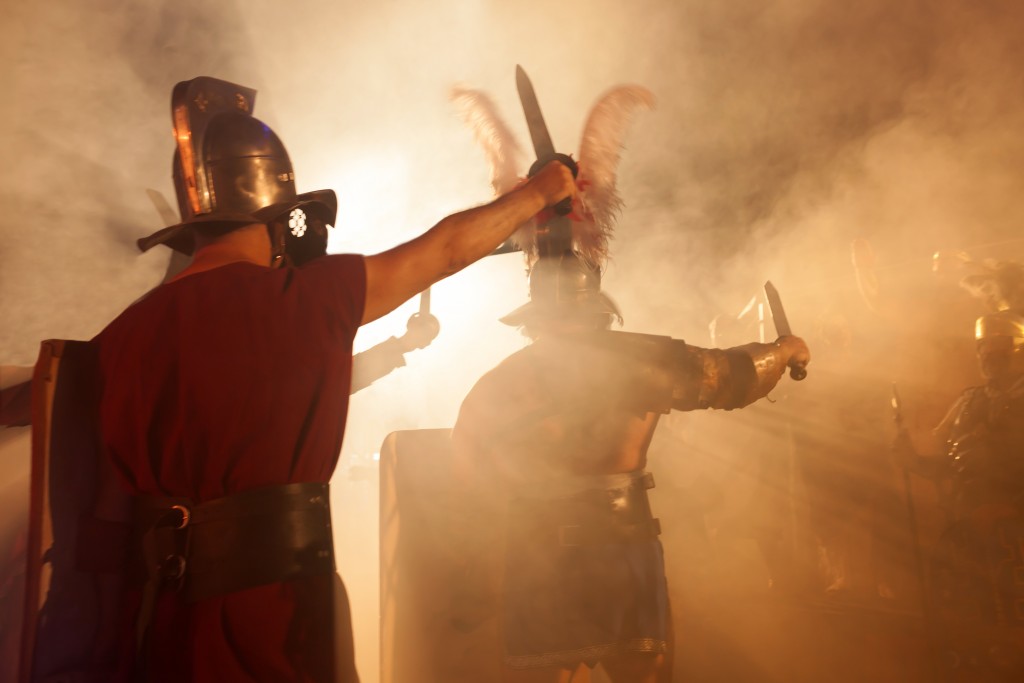
Roman soldiers at attack with swords in the right hand.

A Guideline to Spiritual Warfare

Natan Lawrence’s The Art of War — An Analysis of and Commentary on Sun Tzu’s The Art of War

Based on the Biblical Principles of Spiritual Warfare

The extracts below of The Art of War are taken from Lionel Giles Translation (www.artofwarsuntzu.com)

Sun Tzu was a Chinese military general, strategist, and philosopher who lived between the sixth and fifth centuries B.C. in ancient China. His work, The Art of War was unearthed in 1972, and since then has become a classic on the art of warfare. It is even used by the U.S. military.

The following are excerpts from this ancient work along with commentary from a biblical perspective giving the spiritual warrior in YHVH Elohim’s (the LORD God’s) army guidelines on how to be victorious over YHVH’s spiritual enemy.

I. — LAYING PLANS

1. Sun Tzu said: The art of war is of vital importance to the State.

2. It is a matter of life and death, a road either to safety or to ruin. Hence it is a subject of inquiry which can on no account be neglected.

3. The art of war, then, is governed by five constant factors, to be taken into account in one’s deliberations, when seeking to determine the conditions obtaining in the field.

4. These are: (1) The Moral Law; (2) Heaven; (3) Earth; (4) The Commander; (5) Method and discipline.

5,6. The Moral Law causes the people to be in complete accord with their ruler, so that they will follow him regardless of their lives, undismayed by any danger.

Comment: The moral law is the biblical Torah and the rest of the Word of Elohim as contained in the Bible. The Torah-word of YHVH Elohim (the God of the Bible) are his instructions, precepts, teachings or laws. The Torah is the foundation of truth for the rest of the Scriptures that follow. YHVH Elohim is the Creator and Supreme Ruler of the universe and is thus the originator of moral law. Since Elohim is the Creator and Sovereign Ruler of all the universe, it is the require of every human (and all the more so of those who claim to be his followers) to follow and obey him regardless of their lives, undismayed by any external threats or danger. Continue reading