Genesis 41

Genesis 41:9–10, The chief butler spoke. Here the chief butler is recounting the events to Pharaoh of how he ended up in prison as if Pharaoh weren’t aware of these facts. It is quite possible that this was a new Pharaoh, and the Pharaoh who had put the butler in prison was now dead. If so, then this new Pharaoh was very young, since in Genesis 45:8 Joseph, who by now would have been at least in his late 30s, refers to himself as “a father to Pharaoh.”
YHVH’s timing was perfect for his larger plans to be fulfilled in Joseph’s life. Do you have the trust in YHVH to believe the same for your life? Had the chief butler remembered Joseph prior to this time, it is likely that YHVH’s plans for Joseph may not have worked out to his benefit. Would he have had the chance to interpret Pharaoh’s dream? Would he have returned to Canaan? How would the history of the nation of Israel been different?
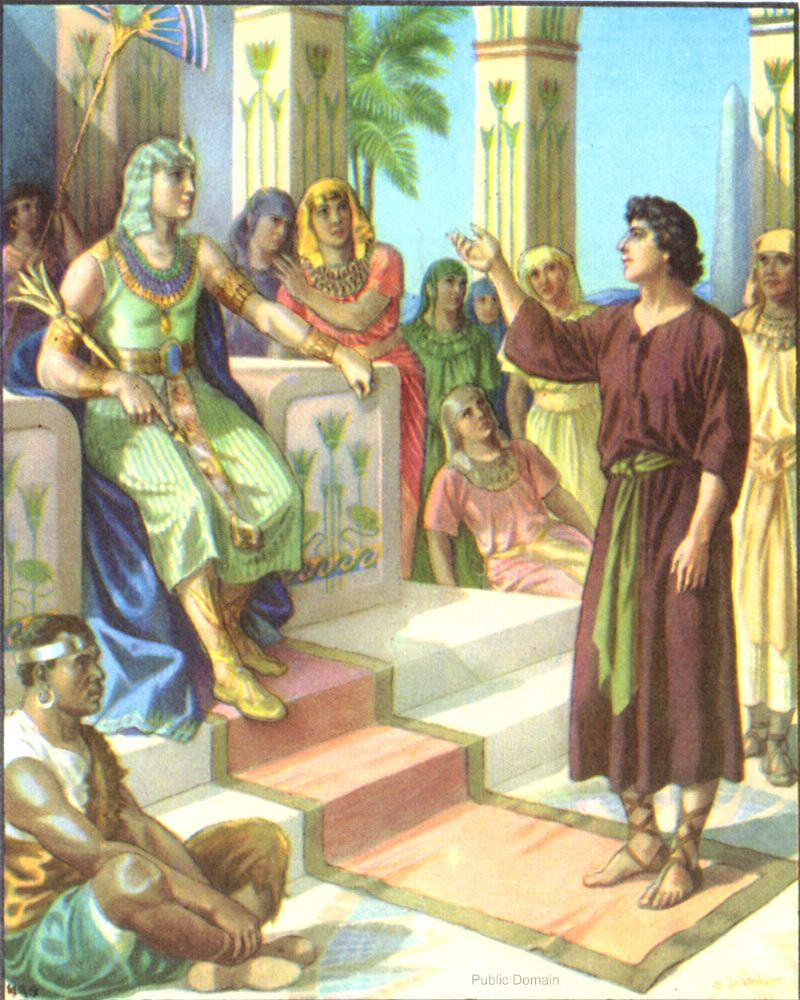
Genesis 41:16, Elohim. By this time, Joseph had endured multiple false accusations, murder attempts, enslavement and imprisonment on false charges. A man of lesser spiritual stature than Joseph might have lost his faith in Elohim along the way. What can we learn from Joseph about enduring and overcoming faith in our Maker in the face of adverse circumstances in life?
In this verse, what is the evidence that he hadn’t given up hope in his Heavenly Father, and that he had not lost sight of the prophetic promises that YHVH had made to him many years earlier? Simply this. Even though Joseph was standing before a king, who had the power of life and death over him, he still had faith that Elohim would give him the interpretation to the king’s dream. Not only did Joseph believe this, but openly declared his faith to Pharaoh. What does this teach us about boldly proclaiming our faith even in the face of possible death? In Revelation 12:11, we learn that the end time saints will overcome the Evil One by the word of their testimony and that they will not love their lives the death. Elsewhere Yeshua declared to his disciples, “Whosoever therefore shall confess me before men, him will I confess also before my Father which is in heaven” (Matt 10:32). Now is the time to start putting our faith to work in the small areas, so that we will pass the larger tests that will inevitably come our way later.
As a form of witnessing to those around you, do you give honor to YHVH whenever you can—even to strangers and potential enemies as Joseph did?
The fact that Joseph was able to proclaim his faith in Elohim in front of one of the most powerful monarchs of his day is evidence of his strong and abiding faith in and fear of YHVH even in spite of years of mistreatment and false accusations. Joseph is a powerful and encouraging example to the down-trodden saints of the world, who have been persecuted for the their faith. Joseph is proof that it is possible to maintain faith in YHVH even in spite of dire, even life threatening circumstances.
Genesis 41:38, A man in whom the Spirit of Elohim is. Would this be the testimony of those heathens around you about you? If not, why? What changes in your life can and should you make to insure that it would be?
Genesis 41:45, Poti-phera.Apparently, this was none other than Potiphar, Joseph’s former slave master and the one who wrongfully imprisoned Joseph. Joseph being permitted to marry Potiphar’s daughter was YHVH’s way of vindicating him in the eyes of the Egyptians (The ArtScroll Stone Edition Chumash, p. 299; The ArtScroll Tanach Series Bereishis/Genesis Commentary, vol 1b., p. 1665).
Genesis 41:46, Thirty years old. Joseph was in Egypt as a slave and a prisoner from roughly from age 17 (Gen 37:2) to age 30. Despite being falsely accused of sins he had not committed, during this time, he still did not lose faith in Elohim.
Genesis 41:50–52, To Joseph were born. Joseph was blessed in Egypt with an Egyptian wife and two sons. Therefore, his sons were not full-blooded Israelites. This was prophetic. Eventually Joseph’s descendants went into captivity into foreign nations, as happened to Joseph himself, where they would mix their seed with those of non-Israelite blood resulting in mixed children racially (Hos 7:8 and 8:8.) Prophetically, YHVH accept would accept these children of mixed race marriages to be grafted in to the olive tree of Israel to become full citizens with equal standing and rights as full-blooded Israelites (Rom 11:13–24). Who does Paul say these Gentiles who were grafted into the olive tree of Israel? Please read Romans 9:25–26 and then read the Hosea passage Paul is quoting from Hosea 2:23. Paul refers to these people as Israelites and literal offspring of Abraham (Eph 2:11–19; Rom 4:16; 9:8, 11; and Gal 3:7, 9, 14, 28, 29)!
Genesis 42
Genesis 42–46 Two Brothers and the Two Houses of Israel in End-Time Prophecy
Biblical Types and Antetypes
A major key to understanding biblical prophecy is to recognize the relationship between types and antetypes in the Scriptures of which there are a plethora. This means that an event or a series of events occurred once, was recorded in the Scriptures, and then at a later time a similitude of the event repeats itself sometimes more than once, but with different characters and scene. The Jewish sages have long recognize the phenomenon of biblical cycles that repeat themselves over the millennia.
More specifically, an antetype is an event that occurs before the main event to which it prophetically points actually occurs (sometimes incorrectly referred to as an antitype, which means “an opposite type” rather than “a prior type”). In other words, the first event predicts or points prophetically to the future event. This is a way for the Creator to give clues and hints about future events that will come to pass. Those who are ardent students of YHVH’s word and “who have (spiritual) ears to hear” will pick up on these clues and gain a sense of what the Creator is going to do at some future date. In this way, those who diligently seek him are rewarded with understanding or “inside information” about what he is planning to do in the future. At the same time, his divine plans and purposes will be obscured from those who don’t have a diligent heart to seek him and his truth, and who could then possibly misuse the truth, if they were to discover it, for self serving or malevolent purposes.
Similarly, the Gospels record that Yeshua explained deep spiritual truths via parables not to make the meaning clear to the general public, but rather to obscure it. His teachings were meant to be understood only by those whom he had called that they might know the mysteries or secrets of the kingdom of Elohim (Matt 13:10–11; Luke 8:9–10).
For thousands of years, the prophets of the Bible, as well as biblical students, scholars and sages have understood the concept of antetypes and types and it has helped them to understand Bible prophecy and future events.
Biblical antetypes are identified in three ways. First, the Scriptures themselves identify events as being antetypical. Examples would be:
- The life of Moses pointed to Yeshua (Deut 18:15–19; Heb 3:3–6).
- The serpent on the pole pointed to Yeshua’s crucifixion (John 3:14).
- The rock from which the Israelites drank prefigures Yeshua (1 Cor 10:4).
- The manna the Israelites ate prefigures the Word of Elohim or flesh of Yeshua (John 6:32, 48–51).
- Aaron as the high priest was antetypical of Yeshua’s high priesthood (Heb 5, 7 and 8).
- The sacrificial system pointed to Yeshua’s atoning death on the cross (Heb 9 and 10).
- Jonah in the whale is a prophetic picture of Yeshua’s death and resurrection (Matt 12:40).
- Melchizedek was an antetype of Yeshua (Heb 7).
- The first exodus (or redemption of Israel out of Egypt) was prototypical of a second exodus or redemption of Israel out of the world in the end times (Isa 11:11; Jer 23:7–8).
The Jewish sages from antiquity have also identified antetypes. Examples would be:
- The difficulties surrounding Jacob’s return to the Promised Land after 20 years of exile in Babylon (under Laban, Gen 31–33) is antetypical of the difficulties surrounding the return of Jacob’s descendants to the land of Israel in the last days, which the Scriptures call “Jacob’s Trouble” (Jer 30:7).
- The life of Joseph prefigured that of a Messiah Son of Joseph, the Suffering Servant.
- The life of David prefigured that of a Messiah Son of David, the Conquering King.
- The seven-day week is antetypical of the seven thousand years of man’s tenure on this earth.
- Christian Bible teachers have identified antetypes in the Scriptures as well. Examples would be:
- The Passover lamb was antetypical of Yeshua’s crucifixion.
- Isaac’s near sacrifice and the ram caught in the thicket in Genesis 22 was antetypical of Yeshua’s death.
- The tabernacle of Moses pointed in all aspects to the ministry of Yeshua as Savior and Redeemer.
Finally, some Hebraic-Christian Bible teachers have identified antetypes in the Scriptures. Examples would be:
- The biblical feasts point to the steps in YHVH’s plan of salvation for mankind centering around the first and second comings of Messiah.
- The stages of the biblical wedding point to YHVH’s plan of salvation for mankind.
- YHVH’s judgments on Egypt point prophetically to his judgments on Babylon the Great in the last days.
In like manner, the story of Joseph’s interacting with his brothers (starting in Genesis chapter 37 through 46) is antetypical of future events that are to happen on a national level with the children of the patriarchs.
In this study, we will examine the events of Joseph and Judah in Egypt to see how they relate to the houses of Joseph or Ephraim (broadly speaking, the Christians) and Judah (broadly speaking, the Jews) in the last days. Remember that although the events and details of antetypes and types correlate, they do not match each other perfectly in every detail. There should, however, be enough similarities between the two that to the rational and biblically astute mind the juxtaposition of the two is not a logical stretch. Some of these parallels the writers of Scripture tell us about, while others we must arrive at through our own diligent and careful analysis of the Scriptures.
Joseph and Judah (the Two Houses of Israel)
In what follows, we will see several types and shadows that point to the end-time reunification of the two houses of Israel (Joseph, Ephraim or the Christian church and Judah or the religious Jews), and to Yeshua the Messiah whose role it would be to regather and reunite the two houses of Israel by laying his life down as a ransom or substitute for his brothers. In this study, we will discuss the following themes:
- reuniting lost family members
- reconciliation and healing of wounds and offenses between families
- forgiveness of past wrongs, offenses and misunderstandings
- prophetic shadows of Yeshua the Messiah
Let’s now analyze the events in the life of Joseph (and to a lesser degree that of Judah as well) as they occurred chronologically to see how they pointed forward to events that would occur in the future including the end times.
Joseph Taken as Captive to a Gentile Nation (Gen 37)
Continue reading