The Golden Calf Incident: A Prophetic Picture of the Church

Exodus 32, On Shavuot (the Feast of Weeks or Pentecost), at Mount Sinai, YHVH entered into a marriage covenant with the children of Israel, but they were not ready to live up to the terms of that covenant. Those terms, simply stated, involved the Israelites being faithful and obedient only to YHVH, Israel’s Elohim (God) and spiritual husband, and to his instruction in righteousness, the Torah. This Israel quickly demonstrated they were not willing to do, for they had hardly said “I do” to their marriage vows (Exod 24:3, 7) when they turned their hearts away from YHVH and began worshipping the golden calf—a pagan deity from Egypt. After the golden calf incident and up until Yom Teruah (the Day of Trumpets or Shofar Blasts) when Moses received the second tablets of stone from YHVH containing the Ten Commandments, the children of Israel, the bride of YHVH, prepared herself not only to receive YHVH’s instructions again, but this time to be faithful to her marriage vows. This Israel did. She remained faithful to YHVH for approximately 38 years while trekking through the wilderness of Sinai, after which she entered the Promised Land and “stayed the course” until after the death of Joshua.
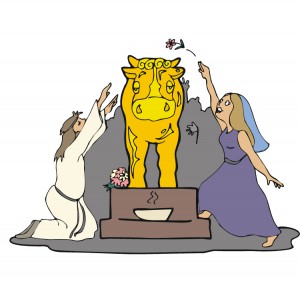
Golden Calf 6 21409020

Sadly, the cycles of history often repeat themselves. This time, it involved the descendants of the children of Israel who were at Mount Sinai. In the early first century A.D.,  the redeemed Israelite followers of Yeshua received the Torah written on the fleshly tablets of their hearts by the finger of the Spirit of Elohim on the Day of Pentecost (Shavuot) as recorded in Acts 2. But starting at about A.D. 70 with the destruction of the temple in Jerusalem and continuing up through the Second Jewish Revolt of A.D. 135 until the time of Emperor Constantine (in the fourth century), the first-century spiritual bride of Messiah had, for the most part, abandoned YHVH’s Torah-commandments and turned, to one degree or another, to a mixed form of worship (of which ancient Israel’s worship at the golden calif was a prophetic foreshadow) where some pagan practices were assimilated into the early churches’ belief system (most notably, Sunday replaced the Sabbath, and Christmas, Easter and other paganistic holidays replaced the biblical feasts).

Moses’ descent of Mount Sinai on Yom Teruah with the second set of tablets containing the Torah prophetically foreshadows Yeshua’s second coming. As Moses renewed YHVH’s Continue reading →


Who Is the Revelation 12 Woman?

The Bride of Yeshua in the Wilderness 

Who is the woman that is mentioned in Revelation 12 that is taken into the wilderness for three-and-one-half years (Rev 12:14), which occurs just before the second coming of Yeshua? I believe that is a reference to the end times saints who are the bride of Yeshua. (Not all saints are the bride of Yeshua. Some are foolish virgins [Matt 25:1–13], or lukewarm believers who will have to go through fiery trials to become approved of YHVH [Rev 3:14–21]. Some are still rebels in respect to his Torah [Ezek 20:37]. The end times bride will be Torah submissive [see Rev 12:17; 14:12].) Let’s explore some answers to this question.

When the Scriptures speaks of the wilderness (Heb. midbar), it is referring to anywhere outside of the land of Israel.

Wilderness

Ezekiel 20:33–41 says that YHVH will bring the house of Israel out of their captive nations with an outstretched arm and with fury poured out (in a time of YHVH’s judgments) (vv. 33–34, as when he brought them out of Egypt). YHVH will bring his people into “a wilderness of the people.” This could be a literal wilderness as with the children of Israel, or a spiritual wilderness in the midst of a wicked and perverse generation in which Israel is called to live and be a light. There he will plead with Israel face-to-face like he did in the wilderness of Sinai (vv. 35–36). This seems to be another reference to the second exodus (v. 36). In that wilderness, YHVH will purge out those who are rebels and those who transgress (or sin; i.e., violate his Torah, see 1 John 3:4) against YHVH (v. 38). This YHVH did with ancient Israel for 40 years. During this time of testing and purging, the house of Israel will not be returning to the land of Israel (v. 38) until they have put away their idols (v. 40), then all the house of Israel will be acceptable to YHVH and will serve him on his holy mountain (v. 40–41). Israel not to return until they loath their spiritual pollution (v. 42-44). Continue reading →


New Video: The Feast of Pentecost and the Bride of Yeshua

In this brief video, Natan Lawrence shows the relationship between the feast of Pentecost (or Shavuot), the marriage of YHVH to the children of Israel at Mt. Sinai, the wedding chuppah (canopy), the holy of holies, and the upper room experience on the day of Pentecost, and the marriage of Yeshua the Bridegroom to redeemed believers in the Song of Solomon.