Celebrate Shavuot / Pentecost With Us!

YOU ARE INVITED!

Memorial Day weekend (May 25–27) this year also happens to be the biblical Feast of Weeks, Shavuot or Pentecost—one of YHVH’s commanded festivals (Lev 23:15–22, Acts 2:1; 20:16). 

You are invited to join us in Canby, Oregon (just south of Portland) for this weekend-long event. For details and registration, go to http://shavuotnw.org/.


Counting Down the Omer—From Slavery to Divine Empowerment!

From the Depths of Slavery to a Kingdom of  Priests

YHVH’s command for us to count the omer as a countdown to the Feast of Weeks or Shavuot (or Pentecost, Lev 23:15–16 and Acts 2:1) memorializes the Israelites journey from spiritual babyhood to adulthood. During this 49-day count, Israel ascended from out of the depths of slavery and suffering in Egypt, was baptized in the Red Sea, and then arrived at Mount Sinai—a place of a spiritual standing before YHVH as a kingdom of priests (Exod 19:6). It was there that YHVH gave them his instructions in righteousness—the Torah on Shavuot. This time period represents Israel’s passage from slavery to freedom. They came out of slavery permeated with the leaven—the sins, values, and pagan concepts—of Egypt leaving it all behind as pictured by the Feast of Unleavened Bread. YHVH gave Israel 49 days to overcome and to get rid of the impurities of Egypt, and to  become the nation Israel—a holy priesthood (Exod 19:6) and the bride of YHVH (Ezek 16:8; Jer 2:2; 31:32). There, at the foot of Mount Sinai, YHVH wanted them to become his ambassadors to this world of his heavenly kingdom and truths.  Continue reading →


Blog Scripture Readings for 5/6 – 5/12/12

Aside

For the fifth week of seven weeks of the 50-day count of the omer.

Numbers 12–19; Jeremiah 43–52; Ezekiel 1–4; and Psalms 38–44

Most of this week’s blog discussion points will be on these passages. The full year’s Bible Reading Schedule can be found on the right sidebar under “Helpful Links.”

If you have general comments or questions on the weekly Scripture readings not addressed in a blog post, here’s a place for you to post those. Just use the “leave a reply” link below.


The Aaronic Blessing

Numbers 6:22–27, The Aaronic Blessing is about the power of blessing and the power of our words. The Scriptures teach us that our words can heal, build up and encourage, or kill, tear down and curse, that the power of life and death is in the tongue. What kind of words come from your mouth—especially to your spouse and children? Charity begins at home. How often do you speak blessings over your children and spouse? Do you bless those who curse you?

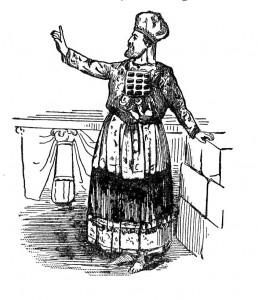
The Levitical priesthood was one of YHVH’s blessings or marriage gifts to his bride, Israel. It was given to her at the time of their marriage to him at Mount Sinai. The Aaronic or Priestly Blessings of Numbers 6:22–27 indicate that the priests were to be a conduit of YHVH’s blessings to his people. The ArtScroll Stone Edition Chumash correctly states it this way: “[The priests did not] have any independent power to confer or withhold blessings—only God can assure people of success, abundance, and happiness—but that part of their Temple service is to be the conduit through which God’s blessing would be pronounced on His people” (p. 762). Hirsch in his commentary on the priestly blessing states that it is Jewish tradition for the human instrument conveying the blessing to raise his hands (vertically and not horizontally) to heaven while reciting this blessing so as not to give the people the impression that the priest is conveying the blessing, but that it is coming from heaven (The Pentateuch Numbers, p. 99, Judaica Press). The Jewish sages further note that in Numbers 6:22–23, the Torah uses the word saying three times to emphasize the fact that the blessings flow from YHVH to the Israelites and are to be passed on to subsequent generations. We are YHVH’s priesthood now (“a chosen generation, a royal priesthood, a kadosh nation, a peculiar people,” 1 Peter 2:9). Are you an instrument of blessing everywhere you go? Do you ask YHVH to use you every day to spread the light of his truth and his love to others?

The Aaronic Blessing can be subdivided into three sections:

(a) The First Blessing: May YHVH bless you and safeguard you. The Jewish sages take this to refer to the material and physical blessings that Torah obedience brings as enumerated in Deuteronomy 28:1–14. This includes good health, wealth, divine protection and victory over enemies. YHVH’s blessing and his safeguarding of those blessings from those who would kill, steal and destroy them go hand-in-hand. The sages teach that “the best way for someone to preserve his wealth is to use it for charity and good deeds. That assures him of God’s continued blessing” (Ibid. p. 763).

(b) The Second Blessing: May YHVH illuminate his countenance for you and be gracious to you. The sages teach that this illumination refers to the light of the Torah and they cite Proverbs 6:23, “For the commandment is a lamp and the Torah is a light.” Compare this with what John said about Yeshua in John 1:1–14; 8:12; 9:5. YHVH’s grace involves him granting his people Torah knowledge, wisdom and understanding to utilize Torah properly and fully; to use the insights gained therefrom to comprehend his purposes (Ibid. p. 763).

(c) The Third Blessing: May YHVH lift his countenance and establish peace/shalom for you. In Hebraic thought, the idea of YHVH’s face or countenance shining toward his people is a metaphor of divine grace and favor. Contrariwise, when his face is turned against his people, this represents divine disapproval and shame upon his people (For examples of this in the Scriptures see Pss 4:6; 31:16; 67:1 cp. Lev 17:10; 20:5, 6, 17; Deut 31:17; 2 Chron 30:9; Ps 34:16 ; Jer 44:11; Ezek 7:22.). The sages note that peace is an essential component of the other blessings, for what good is physical blessings and spiritual insight if one’s life is devoid of peace? What is the Jewish concept of peace? It is balance, which is the absence of strife between the opposing forces in one’s life. Sin disrupts this balance and causes strife and warfare as well as creating a barrier between YHVH and his people (Read what Yeshua, the greatest Rabbi of all, taught about this in Matthew 5:23–24.). When such strife and barriers exist causing the negation of peace, what are some things one must do to restore the peace? After all, Yeshua said, “Blessed [Happy] are the peacemakers …” Does peace just happen or is it necessary to exert effort to create it? Can there be peace where there is sin (i.e., Torahlessness)? Does it logically follow that the more our ways line up with the Torah of YHVH, the more our ways are pleasing to him, the more peace we will experience in all our relationships? (Read Proverbs 16:7.)

Within this priestly blessing, is it possible to discern the voices of the Father, the Son and the Set-Apart Spirit? For example, in verses 22 and 23, the word “saying” occurs three times, and this blessing is divided into three parts.


One Law for All!

Numbers 9:14, You shall have one ordinance, both for the stranger and the native of the land. (Cross reference with Exod 12:49; Lev 24:22; Num 15:15, 16, 29). In this verse and in other Torah references, YHVH is clear: There is only ONE Torah-law for the Israelites, and those Gentiles who attach themselves to Israel. Stated otherwise, YHVH has ONE standard of righteousness for all people—not one for the Israelites and a different one for the Gentiles.

This is not what many of the false teachers in the church teach, however! They teach that YHVH gave one set of laws to the Jews, and that somehow, many of these same commandments don’t apply to “Gentile” Christians.

This is incongruous with the clear teachings of the prophets, Yeshua and the apostles!

The Torah and the prophets, in many places, spoke of the Gentiles (or the peoples of the nations) being drawn to the light of Israel, which is the Torah (including the Messiah of Israel, who is the Living Torah). They also prophesied that lost and scattered Israel (who become Gentiles) would repent of their Torahless ways and return to the Torah in the end times. They also predicted the time when the Torah would be written on the hearts of his people when he would make a new covenant with them.

Moreover, Yeshua said that not one jot or tittle of the Torah would pass away as long as the heavens and earth still existed, and that the righteous would be judged on the basis of the Torah to determine their eternal rewards.

The apostles confirmed the words of the Torah, calling it holy, just and good. Even Paul strongly stated that the message of grace in no way invalidates the Torah as the standard of righteousness for the saints. The writer of Hebrews (quoting Jeremiah the prophet) declares that YHVH will write the Torah on the hearts of his people. Then John in the Book of Revelation describes the end-times saints as those who keep YHVH’s (Torah) commandments and have the testimony of Yeshua.

Despite all this, for nearly 2000 years, numerous false teachers in the church have been saying the opposite. They have devised a plethora clever and mind-numbing arguments that twist the clear word of Elohim to say the opposite—that there are two laws for YHVH’s people: one for the Jews and one for the Christians. These doctrines of men by which the word of Elohim has been made of none-effect became institutionalized and cast into the concrete foundation of the Catholic Church and passed on to her many offshoot daughters.

Many of you have had to deprogram yourself from this way of thinking—that YHVH has two standards of righteousness—one for the Jews and one for the rest of the us.

Would you care share your testimony about your spiritual journey in this regard?


The Old Vs. the New Covenants

According to Jeremiah 31, the new covenant will be made after YHVH has gathered (or redeemed, v. 11) all the families of Israel (v. 1; i.e., the houses Ephraim or Israel [i.e., Christians] and Judah [i.e., the Jews], vv. 9, 20, 27, 31) who will be returning from the north country, the coasts of the earth and the isles (vv. 8, 10) back to Zion with joy, singing and dancing (vv. 12–13, 24). This will occur after Ephraim repents (v. 20) of Torahlessness, and YHVH’s daughter turns away from her backsliding (vv. 21–22), and upon coming out her captivity in the end times (v. 23; in spiritual Egypt or Babylon the great).  At that time, YHVH will make a new covenant with the two houses of Israel (vv. 31–33), and all Israel will know Elohim from the least to the greatest. This prophecy has yet to be fulfilled.

The author of Hebrews quotes Jeremiah 31:31–33 (Heb 8:7–13) asserting that the new covenant is the same covenant about which Jeremiah prophesied. From that author’s perspective (Heb 8:13), the new covenant isn’t fully in place yet, and the first covenant is decaying (wearing out), growing old and vanishing away (disappearing). The implication is that the old covenant has not totally gone away yet (see also 2 Cor  3:11).

We know that Yeshua initiated the new covenant at his Passover seder called the last supper (Luke 22:20). This covenant has been given to believers in Yeshua, but it hasn’t been universally applied to all Israel yet. This will occur when the two houses of Israel will return to the Promised Land after they have been set free from spiritual Babylon at Yeshua’s second coming.

YHVH’s Word tells us that no man can add to or subtract from the terms of the old covenant (Gal 3:15). Although YHVH made this covenant with men, it is a divine covenant, and YHVH himself (not men) determines its terms and conditions! When Yeshua initiated the new covenant at his Passover, the old covenant and the Torah were still in force, and not one jot or tittle will be removed from the Torah until heaven and earth pass away (Matt 5:18). The Torah determines the terms of both the old and new covenants. Any traditions that have come into the Christian (Sunday, Christmas, etc.) or Jewish religious systems that are contrary to the Torah are men’s additions, and are therefore invalid and irrelevant.

Even as there was a gradual process of phasing into the first (or old) covenant, the same is true of the new covenant. With the former covenant, the Israelites put the blood of the lamb on their door posts at Passover, prepared themselves to meet YHVH at Mount Sinai (Exod 19), were then presented with the terms and conditions of the Sinai covenant at Shavuot (Exod 20–23), and then the covenant was ratified (Exod 24). After that, subsequent generations of Israelites automatically entered into that covenantal agreement as they were born (Deut 29:12–15) even as Americans, for example, are still bound to the U.S. Constitution many generations after its ratification.

Similarly, Yeshua initiated the new covenant with Israel in his day when his blood was put on the door posts (the cross) at Passover, then wrote his Torah (the terms and conditions of the new covenant) on their hearts by his Spirit on Pentecost. This began the process of regathering scattered and adulterous Israel back to YHVH through the blood of Yeshua the Lamb of Elohim.

When the process of regathering Israel is finally completed (during the Millennium). YHVH will finalize his new covenant agreements with them. It will be called the everlasting covenant (Jer 32:40; Ezek 37:26; Isa 55:3) or the covenant of peace (Isa 54:10; Ezek 34:25; see also 59:10; Hos 2:19–19).

 

Blog Scripture Readings for 4/29–5/5/12 Midrash

Aside

For the fourth week of seven weeks of the 50-day count of the omer.

Numbers 5–11; Jeremiah 29–42; and Psalms 31–37

Most of this week’s blog discussion points will be on these passages. The full year’s Bible Reading Schedule can be found on the right sidebar under “Helpful Links.”

If you have general comments or questions on the weekly Scripture readings not addressed in a blog post, here’s a place for you to post those. Just use the “leave a reply” link below.