Which Bible(s) Do I Personally Use?

Other Bibles on My Recommended List

There was a great deal of interest in a previous post entitled, “Which Bible Translation Do I Use?” The readership numbers spiked, I received a number of good comments. May YHVH be blessed!

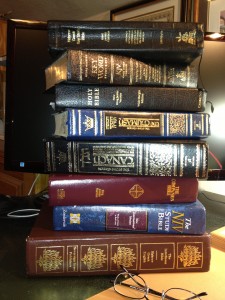
Now I would like to share with you some other Bibles that have been a blessing to me in my scripture studies. These can be divided broadly into two categories: Christian and Jewish.

IMG_0040

Christian Bibles

The Bibles listed below are my favorites, although there are many good ones out there besides the ones listed. (I have dozens in my library!) As with all Bibles that have notes and commentaries, eat the fish and spit out the bones—separate the wheat from the chaff. After all, you do that every time you read a book, newspaper or magazine, hear a news story, watch a television documentary, see a billboard, hear someone speak no matter the subject, or look something up on the internet. Continue reading →


Redemption: The Strong Arm of YHVH to Save His People (pt 1)

Exodus 6:6–8, I will. In this passage, YHVH reveals to Moses the seven steps of Israel’s redemption, which are actually promises of what YHVH will do for Israel.

Wherefore say unto the children of Israel, “I am YHVH, and I will bring you out from under the burdens of the Egyptians, and I will rid you out of their bondage, and I will redeem [Strong’s H1350, ga’al meaning “to buy back, ransom for money”] you with a stretched out arm, and with great judgments, and I will take you to me for a people, and I will be to you an Elohim, and you shall know that I am YHVH your Elohim, which brings you out from under the burdens of the Egyptians. And I will bring you in unto the land, concerning the which I did swear to give it to Abraham, to Isaac, and to Jacob; and I will give it you for an heritage: I am YHVH.” (Exod 6:6–8, emphasis added)

23353287

Here we find listed the seven steps of redemption YHVH lays out for Israel. YHVH uses his covenant name (YHVH) three times during the seven promises: at the beginning, middle and end. He wraps his covenant promises in his covenant name for emphasis.

YHVH is telling Moses (and us, too!!) to just believe him! Believe his Word; trust that he is who he says he is (which is what his covenant name implies: I am who I am, or I will be what I will be; i.e., I will be your All Sufficient One and will meet your every need … So just trust and believe!)

Redemption involves three things.

First, Continue reading →


Blog Scripture Readings for 1/6 through 1/12/13

Aside

Parashat Va’eira — Exodus 6:2 – 9:35
Haftarah — Isaiah 66:1 – 24
Prophets — 1 Kings 5:1 – 12:33
Writings — Psalms 92:1 – 98:9
Testimony — Luke 8:26 – 11:54

Most of this week’s blog discussion points will be on these passages. If you have general comments or questions on the weekly Scripture readings not addressed in a blog post, here’s a place for you to post those. Just use the “leave a reply” link below.

The full “Read Through The Scriptures In A Year” schedule, broken down by each day, can be found on the right sidebar under “Helpful Links.” There are 4 sections of scripture to read each day. One each from the Torah, the Prophets, the Writings, and from the Testimony of Yeshua. Each week, the Torah and haftarah readings will follow the traditional one-year reading cycle.

Weekly Blog Scripture Readings for 1/6 through 1/12/13.


Designer Labels of the Pharisees

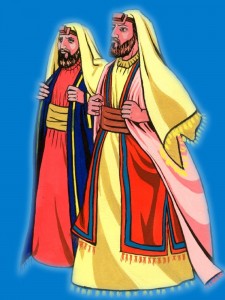
Luke 7:36–37, The Pharisees… a woman… who was a sinner. The name Pharisee itself tells much about this sect or denomination within the first-century religious Jewish landscape. It derives from the Hebrew word perushim meaning “separatist,” and was born out of the fact that Pharisees didn’t associate with Am Ha-Eretz  or the common people (Yeshua: a Guide to the Real Jesus and the Original Church, p. 86, by Ron Mosely), who in their view who were impure by the standards of the Levitical law (The Jewish Background of the New Testament, p. 203, by J. Julius Scott Jr.), and their high standards of holiness (Mosely, p 86).
Pharisee-3 16958369

Acting like an elite religious fraternity (The Sketches of Jewish Life, p. 208, by Alfred Edersheim), the Pharisees were known for their strict observance of the Torah or the law of Moses, as well as numerous additional laws or “traditions of the elders” that were added to the Torah along the way (From the Maccabeees to the Mishnah, p. 149, by Shaye J. D. Cohen; Scott, pp, 206–207; Edersheim, p. 217).

Though this sect probably numbered only 6,000 at the time of Yeshua (Cohen, p. 146), they wielded a great deal of power and influence in Jewish society, since they were viewed as the most accurate interpreters of the Torah (Scott, p. 203; Mosely, p. 92), and they were the leaders and teachers of the masses in the local synagogues (Cohen, pp. 147, 148).

For the Pharisee, personal holiness was a badge of honor. To remain a member of this elite sect, one was required to maintain a high standard of holiness relating to tithing, piety, cleanliness and ritual purity, or one would face demotion within the social status of this community, or worse yet, face excommunication and shunning (Mosely, p. 86).

It can be safe to say that the Pharisaic religious system promoted an elitist and holier-than-thou religious demeanor among many of its members who hyper-focused on legalism and religious form and trappings. The result was “a system of pure externalism, which often contravened the spirit of those very ordinances, the letter of which was slavishly worshipped” resulting in hypocrisy (Edersheim, p. 217).

For these reasons, this may be why the woman in Luke 7:37 was labeled as a sinner. It wasn’t that she was a sinner any more than anyone else, but that she was not part of any recognized religious sect that labeled her as being righteous as opposed to being a sinner. Because she was probably outside of the accepted religious system of her day, she was automatically given the label of a sinner. In our day, this would be like a church-going Christian viewing a non-church going person as a heathen.

The problem is this. Can we know for certain the condition of a person’s heart and their relationship with the Almighty simply because of their external religious involvements? This is what Yeshua is addressing in this passage—the condition of the heart. To Yeshua, the woman who was labeled as a sinner was much more righteous, in a certain sense, than those of the most preeminent religious club of the day. Look at her humble and repentant demeanor at the feet of Yeshua!

Yeshua was known for shining the sharp light of truth on a situation and then turning that situation on its head. The end result was that those who thought they were in first place spiritually, were now in last place, and those who were in last place were first. This gives added meaning to Yeshua’s words, “In the regeneration, when the Son of Man sits on the throne of his glory…many who are first will be last, and the last first” (Matthew 19:28–30).

 

YHVH—Memorial Name of God

Shabbat shalom to everyone from our family to yours! 

Here’s a  little Sabbath treat for everyone. Enjoy…

Exodus 3:14–15, I AM THAT I AM.The name YHVH is Elohim’s memorial name forever. It reflects that fact that he is; that he is undefinable in human terms, and that he has always existed. This is the name by which he is to be remembered (not forgotten as is the case with the ineffable name concept of the rabbinic Jews whereby the names of deity or forbidden to be used). Exodus 3:14 and 15 read as follows:

14 And Elohim said unto Moses, I AM THAT I AM (EHYEH ASHER EHYEH YHVH RAT YHVH): and he said, Thus shalt thou say unto the children of Israel, I AM (EHYEH YHVH) hath sent me unto you. 15 And Elohim said moreover unto Moses, Thus shalt thou say unto the children of Israel, YHVH the Elohim of your fathers, the Elohim of Abraham, the Elohim of Isaac, and the Elohim of Jacob, hath sent me unto you: this is my name [Heb. shem] for ever, and this is my memorial [Heb. zeker] unto all generations.

slide.001

Here are some examples of how various Bible versions translate the name of YHVH:

  • I Am That I Am (KJV)
  • I Am Who I Am (NAS, NIV, NKJV
  • I Am That Which I Am (YLT)
  • I Shall Be As I Shall Be (The ArtScroll Stone Edition Tanach)
  • I Will Be What I Will Be (The Gutnick Edition Chumash, JPS)
  • I Will Be There Howsoever I Will Be There (The Schocken Bible)
  • I Am the Being (LXX, Brenton)

Exodus 3:15 states that YHVH is the name Moses was to use when referring to I AM THAT I AM. Both the former and latter are forms of the Hebrew verb hayah meaning “to be.” YHVH instructed that YHVH was to be his memorial name forever. In other words, humans were to use YHVH to remember him by. There is no indication here that it was YHVH’s intention that his name was to be forgotten or hidden through euphemisation. The word memorial is the Hebrew word zeker (Strong’s H2143) and means “remembrance, memory.”

It must be noted here that we don’t refer to YHVH as I Am, for were we to do so it would be necessary to say “I Am,” and in all reality, we aren’t the I Am, but YHVH is the I Am. Just so there is no confusion when communicating YHVH’s name in every day speech, the Bible uses, not the Hebrew ehyeh meaning “I Am,” but the form of the verb which means “He Is.” In this way, every time we say his name we’re glorifying him, and not inadvertantly glorifying ourselves.

In writing, I use the Hebrew letters yud, hey, vav, and hey (or in English YHVH). Why is this? Because there are many possible ways to pronounce YHVH when transliterating it into English, and I don’t want to offend anyone by not spelling it your favorite way. So I just use the consonants as found in the Scriptures.

However, for those who are curious, I pronounce YHVH as Yehovah, or Yehowah. Many say Yahweh. I used to also, until it become clear to me that Yehovah seemed more correct. This can become a matter of discussion and debate, but I don’t choose to go there. Study out the subject for yourself and do what you think is right. Just keep an open mind, and be gracious to others who are of a different opinion.

Blessings to you all!


Let’s Go to the Movies: Torah Paradigm

At this movie, you’ll have to get your own popcorn and soda—hey, but the price is right! The admission is free. Plop yourself down into favorite chair, get a cup of hot stuff and sit back and get spiritually fed for some no-guilt entertainment. Okay, it’s not exactly brainless entertainment, but it’ll hopefully be a sweet dessert for your spirit man.

24709821

The marquis on this billboard reads as follows:

Torah Central—A New Spiritual Paradigm Through Which to View the Bible

Here’s the description:

Do your spiritual glasses obscure or improve your view of the Bible? Do you view the Bible through the perspective of the church and its traditions of men, or through the lens of the heart and Spirit of YHVH Elohim, the God of the Bible? This teaching discusses viewing the Bible through the paradigm of Torah—both the Written Torah and Yeshua the Living Torah as revealed in Genesis 1, Psalms 119 and Revelation 21 and 22.

This is our third video. Each one, hopefully is getting a tiny bit better in quality. It’s our desire that the content will make up for the lack of cinematic sophistication. Nonetheless, I’m playing with camera angles and lighting, and critiquing myself on my delivery and trying to improve in that department as well. Constructive suggestions from the audience—especially from those who have some background in filmmaking—would be appreciated.

Our next flick will hopefully be a live presentation at our congregation this coming Shabbat.

When watching the video, and check out the rooster.

Enjoy.


Can You Heal All the People All the Time?

Can you heal all the people all the time, or just some of the people some of the time? That’s the questions we’ll answer today from the example of Yeshua’s healing activities as recorded in the Gospels.

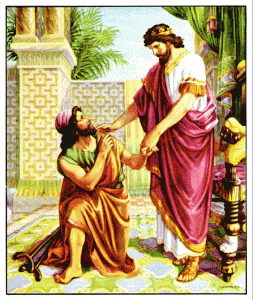
Yeshua heals cripple

Luke 5:17, The power [Gr. dumanis] of YHVH was present. Let’s explore the healing activities of Yeshua.The Greek word dunamis means “strength, power, ability” or as often used in the Testimony of Yeshua, “miraculous power.” This is an interesting statement pertaining to the dynamics of Yeshua’s healing activities. Did Yeshua heal all people all the time, or only when the power of Elohim was present for him to do so? This verse, at least in this case, would indicate the latter. Elsewhere, we read that Yeshua “healed many that were sick” (Mark 1:34), but not all that were sick. On other occasions, the Gospels record indicates that Yeshua did in fact heal all the sick who were brought to him (Matt 4:23–25; 9:35; Luke 6:19).

The Gospels reveal some other interesting facts about Yeshua’s healing activities that we often pass over. On at least one occasions, Yeshua prayed to heal someone and they were only partially healed. After he prayed for them the second time, they were completely healed (Mark 8:22–25).

Often Yeshua healed people after he was “moved with compassion [love and pity]” for someone who was sick (Matt 14:14; Mark 1:41; Luke 7:13–15). The Greek word for compassion, literally means “to be moved in one’s bowels,” or in the deepest areas of one’s emotions.

Some people simply touched Yeshua’s clothing as he was walking by, and the miraculous power (Gr. dunamis) of Elohim flowed from him and healed them (Matt 9:20; Mark 6:56; Luke 8:44 cp. Luke 6:19).

Elsewhere, it appears that Yeshua’s healing activities were hampered by the presence of those who ridiculed him and exhibited doubt and unbelief, which is why, on one occasion, he put the unbelievers out of the room and closed the door behind them when he raised the little girl from the dead (Mark 5:40–42).

Similarly, in his hometown of Nazereth, Yeshua “could do no mighty works there” except for healing a few sick people, “because of their [the townspeople’s] unbelief” (Mark 6:5–6; also Matt 13:58). Matthew’s account adds that the people of Nazareth were offended (literally, scandalized) by Yeshua, or that they stumbled over (or judged unfavorably, distrusted) Yeshua. Because of their low esteem for him, they lacked the faith to receive healing, which is why he healed so few people in that town.

The Bible reveals that the miracle of healing is still for today, and that not only were Yeshua’s disciples of old given the power and authority to heal the sick, but that his disciples nowadays can do the same thing (Mark 16:18; 1 Cor 12:9; Jas 5:14–16). In fact, many of us have received many miraculous healings during the course of our walk with Yeshua. Maybe I’ll tell you about some of mine someday. I’m literally a walking miracle!