Egypt’s Plagues—A Lesson for Us?

Exodus 7:14, The ten plagues. The ten plagues were Elohim’s judgment against the gods and idols of Egypt (Exod 12:12; 33:4; Num 33:4). Here are the list of plagues and possible suggestions as to which gods of Egypt YHVH was judging. Modern man worships these same false gods, and YHVH will bring his judgements against them in the last days.
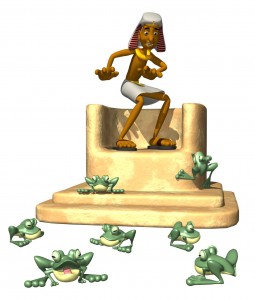
Frogs plague 33397973

  • The first plague was the water turning to blood. This was a judgment against abortion (the Egyptians threw their babies into the Nile for sacrificial purposes) and against materialism (since fewer children mean fewer expenses for a family, and the Nile River was the source of Egypt’s prosperity).
  • The second plague was frogs. This was a judgment against pride (frogs puff themselves before they croak) and environmentalism or animal worship. In America, for example, after 9/11, how many bumperstickers did we see that had the words “pride” on them, and “God bless America” as if YHVH is duty-bound to bless America? How can YHVH bless a nation that refuses to repent and turn from its arroant and wicked ways?
  • The third plague was lice. This was a judgment against pride and narcissism (self worship), since the Egyptians were highly focused on their personal appearance and hygiene, their appearance and in shaving of body hair.
  • The fourth plague was flies, which was a judgment against devil worship, occultism and witchcraft (i.e., the whole religious system of Egypt). A biblical name for Satan was Beelzebub, or lord of the flies (Matt 2:25–27; Luke 11:15–19).
  • The fifth plague was the death of the livestock. This is a judgment against transportation and commerce.
  • The sixth plague was boils, which was a judgment against the Egyptians obsession with their bodies and faith in medical science.
  • The seventh plague was hail, which was a judgment against their agriculture industry and earth worship.
  • The eighth plague was locusts. This was a judgment against Egypt’s food production. The Nile River and its delta was one of the bread baskets of the ancient world and a source of great wealth to Egypt.
  • The ninth plague was darkness. This was a judgment against Egypt’s intelligentsia and religious system, which was spiritually devoid of the light of truth.
  • The tenth plague was the death of the firstborn, which was a judgment against Egypt’s future and posterity.
  • The destruction of Pharaoh and his armies in the Red Sea was a judgment against Egypt’s political and military might.

Is YHVH Elohim bringing America and other “Christian” nations under judgment for the sins they have committed against him even as he brought judgment against the gods of Egypt? What are the similarities between gods of ancient Egypt and those of western and Christian culture? In America, for example, in recent years, there has been a marked increase in adverse weather conditions, natural catastrophes, terrorism, bank and financial failures, personal and corporate bankruptcies, high unemployment and inflation rates, and high foreclosure rates on homes just to name a few possible judgments against a nation that has turned its back on Elohim and the Bible.

Exodus 8:22; 9:4, 26, YHVH separated the children of Israel from the Egyptians in that he spared them from the last seven plagues.

What does this teach us about the judgments of Elohim? The Israelites were made to go through the first three plagues only. Do YHVH’s people ever experience trials and tribulations? (Read 2 Tim 3:12; Heb 11, the entire chapter; Rev 7:9–14.) Do the saints need spiritual refinement in order to be the bride of Yeshua who is without the spot and wrinkle of sin? (Read Eph 5:27; 1 Cor 3:9–17.) The saints may go through tribulation, but will they have to experience Elohim’s wrathful judgments unto death upon a wicked world? (Read 1 Thess 1:10; 5:9 cp. Rev 6:17; 7:2–3.)

Other examples of the saints going through tribulation, but then being delivered before Elohim poured out his wrath upon the wicked include Lot in Sodom, and Noah at the flood.


 

New Video: How to Survive and Thrive During the Hard Times

Preparedness is a hot topic these days. In this latest video, we learn, from YHVH’s Word, the Bible, how to weather the storms of the end times.

32262111

The Bible prophesies hard times just before the coming of Yeshua the Messiah. Learn how to prepare spiritually so that you will not only survive, but also thrive during the end-times’ economic woes, loss of freedom, persecution, wars, diseases, famines and natural disasters.

Stay in YHVH’s river of life even in hard times by activating his divine laws of protection and provision.

To watch this video:


Blog Scripture Readings for 1/13 through 1/19/13

Aside

Parashat Bo — Exodus 10:1 – 13:16
Haftarah — Jeremiah 46:13 – 46:28
Prophets — 1 Kings 13:1 – 20:43
Writings — Psalms 99:1 – 105:45
Testimony — Luke 12:1 – 15:32

Most of this week’s blog discussion points will be on these passages. If you have general comments or questions on the weekly Scripture readings not addressed in a blog post, here’s a place for you to post those. Just use the “leave a reply” link below.

The full “Read Through The Scriptures In A Year” schedule, broken down by each day, can be found on the right sidebar under “Helpful Links.” There are 4 sections of scripture to read each day. One each from the Torah, the Prophets, the Writings, and from the Testimony of Yeshua. Each week, the Torah and haftarah readings will follow the traditional one-year reading cycle.

Weekly Blog Scripture Readings for 1/13 through 1/19/13.


Don’t Pass the Offering Plate!

Luke 11:33, No one when he has lit a lamp. As Jonah witnessed to Nineveh proclaiming the message of repentance (Luke 11:29–32), even so, Yeshua is teaching us that we must do the same to our generation.

Greedy dogs!

Greedy dogs!

Furthermore, if when proclaiming the gospel message of repentance (turning from sin or Torahlessness and turning to Yeshua) our eye is evil—a Hebraism for greedy or covetous—then our whole message will be compromised or tainted. How is this? If we have been called to preach the good news or gospel of the kingdom of Elohim, and we’re in it to make money, then those hearing our message may view it as suspect because they see behind our preaching potential ulterior motives. Are we preaching the message out of pure altruism and seeking no financial gain or other personal benefit, or do we have a hidden agenda—namely, personal enrichment? If the latter, are people going to believe our message more or less? How is this going to reflect on the message itself—favorably or negatively? Is this going to help bring people into the kingdom of Elohm or keep them out of it?

Sadly, many in the church system have perfected the nefarious art of taking people’s money, while attempting to legitimize it scripturally. Some approaches are more blatant than others, but taking people’s money out of coercion has basically become part of the institution and culture of the church.

For example, you’ve all probably been in churches where the preacher disparages “the law of Moses that was against us. Thank God it was nailed to the cross and done away with,” they’ll opine, “and that Yeshua did it it all for us, so now we don’t have to.” And then they’ll continue, “And now Sister Malarkey will play a piece on the organ as we pass the plate to take up your tithes.” So what’s wrong with this picture? Can you see the logical disconnect here? Simply this. The tithing command is in the Torah-law the preacher just said was done away with! “Away with the Sabbath, the dietary laws, and those terrible Jewish feasts that YHVH hates, but don’t forget to drop your tithes in offering plate as it comes around!”

Not only this, but too many preachers have even learned how to con people into even feeling good about handing over their money to these greedy and misguided ministers. This is the evil eye or dark eye to which Yeshua was referring in this passage.

Because of this unbiblical approach that is rooted in greed and covetousness, many heathens not only want nothing to do with the church and Christians, but since we (i.e., the examples of our lives) may be the only Bible some people will ever read, many spiritually lost folks have rejected the gospel message itself along with the Bible and Yeshua altogether because of us.

People need to be able to give financially into ministries that preach the gospel and to help support those who are doing so, but out of freewill, love and from a willing heart, not due to mental and emotional manipulation by silver-tongued preachers with gold-filled pockets. Giving into YHVH’s ministers is just, righteous and biblically encouraged, but at the same time Yeshua’s disciples must preach the gospel whether they are remunerated for doing so or not. This is our reasonable service—something we owe to Yeshua our Master who bought and paid for our sins with his own blood.

So don’t pass the offering plate! Instead, leave it in the back of the room for those who want to give cheerfully from a willing heart, and not out of compulsion!


Redemption: The Strong Arm of YHVH to Save His People (pt 2)

Exodus 6:6–7, I will. Now let’s explore the concept of redemption as it applies to the four cups of wine drunk during the Passover (Pesach) Seder. The first four “I wills” of Exodus 6:6–7 are central to the Passover Seder. The four cups in the Passover Seder represent the four I wills that YHVH declares over Israel:

Yeshua the Redeemer is the Lamb of Elohim

Yeshua the Redeemer is the Lamb of Elohim

1. “I will bring you out” is represented in the Cup of Sanctification.

2. “I will rid you out of their bondage” is represented in the Cup of Deliverance.

3. “I will redeem you” is represented in the Cup of Redemption.

4. “I will take you to me” is represented in the Cup of Praise or Completion. This last cup is marriage language. He is taking Israel to be his bride. We still use this type of language in our modern marriage ceremony.

The Abrahamic Covenant has seven “I wills” from YHVH as well:

“And I will make my covenant between me and you, and will multiply you exceedingly.” And Abram fell on his face, and Elohim talked with him, saying, “As for me, behold, my covenant is with you, and you shall be a father of many nations [Strong’s H14871, goyim]. Neither shall your name any more be called Abram, but your name shall be Abraham, for a father of many nations have I made you. And I will make you exceeding fruitful, and I will make nations [goyim, or “a nation, people, a confluence, a body politic”] of you, and kings shall come out of you. And I will establish my covenant between me and you and your seed after you in their generations for an everlasting covenant, to be an Elohim unto you, and to your seed after you. And I will give unto you, and to your seed after you, the land wherein you are a stranger, all the land of Canaan, for an everlasting possession; and I will be their Elohim.” (Gen 17:2–8, emphasis added)

The Renewed Covenant of the Testimony of Yeshua also has seven “I wills” from YHVH:

“Behold, the days come,” says YHVH, “that I will make a new covenant with the house of Israel, and with the house of Judah; not according to the covenant that I made with their fathers in the day that I took them by the hand to bring them out of the land of Egypt, which my covenant they break, although I was an husband unto them,” says YHVH, “But this shall be the covenant that I will make with the House of Israel after those days,” says YHVH, “I will put my law [or Torah] in their inward parts, and [I will] write it in their hearts; and will be their Elohim, and they shall be my people. And they shall teach no more every man his neighbor, and every man his brother, saying, ‘Know YHVH,’ for they shall all know me, from the least of them unto the greatest of them, says YHVH, for I will forgive their iniquity, and I will remember their sin no more.” (Jer 31:31–34, emphasis added)

This last covenant is the one that Yeshua is in the process of making with redeemed Israel. He started the process at his last supper (Matt 26:28; 1 Cor 11:25). This process continues to this day (Heb 8:8–13), and will be finalized after Yeshua’s second coming (Ezek 34:25; 37:26; Jer 32:40; 50:5). This covenant is Yeshua’s marriage covenant with his blood-bought bride—redeemed Israel, the saints.

Please note that each successive covenant YHVH makes with his people is based on and is an expansion of the previous covenant/s. The concept of YHVH redeeming his people from sin is an ancient one, yet is constantly expanding and extending into the future. YHVH’s love and outreach to his people knows no limits!


Did Yeshua Allow His Disciples to Eat Anything?

Luke 10:8, Eat such things.  Does this passage give believers the freedom or even enjoin them to eat whatever is placed before them if, for example, they are in someone else’s home even if the food is non-kosher?

71991062

Understanding context is vital to understanding the true meaning of the Scriptures. When verses are taken out of context they can not only lose their meaning, but can take on an entirely different meaning to the writer’s original intent.

As Hebrew roots teacher Dr. Daniel Botkin points out in an article entitled God’s Dietary Laws: Abolished in the New Testament?,

“Yeshua spoke these words when he sent out the seventy. These were seventy Torah-observant Jews who followed a Torah-observant Rabbi. … Rabbi Yeshua had told his disciples, ‘Go not into the way of the Gentiles, and into any city of the Samaritans enter ye not; but go rather to the lost sheep of the house of Israel,’ (Matt 10:6).

“It is obvious from this statement that the disciples would be lodging in Torah-observant Jewish homes, where the kosher laws were followed. It is ridiculous to suppose that the disciples might have been offered a pork chop in one of these Jewish homes. Even if this very unlikely possibility had occurred, the disciples would have had enough sense to know that this is not what their Master meant when he said to ‘eat such things as are set before you.’ He simply meant to be content with the food which your host provided” (Gates of Eden magazine, Nov.–Dec. 1997 issue).

Though similar to Yeshua’s passage, Paul’s passage in 1 Corinthians 10:27 has an entirely different context. The issue here is not clean versus unclean meat (e.g. beef versus pork), but meat (e.g. beef) that was sacrificed to idols that was later sold to the public in the meat markets of Greek cities (for context read 1 Cor 10:19–29).

Botkin points out that four times in the Testimony of Yeshua believers are forbidden to eat meat sacrificed to idols (Acts 15:20; 21:25; Rev 2:14, 20), yet the dilemma was that when one bought meat in the public markets it was not known whether it had been sacrificed to idols first or not. So for conscience sake Paul instructed the Corinthian believers to buy the meat and to not ask about its origination (1 Cor 10:25). However, if a person knew that it was meat sacrificed to idols (1 Cor 10:28) for their own conscience sake and that of others who might be watching them then they were not to eat of it (ibid.).

The same principle applied to those eating in someone’s house as a guest. If one knew that the meat was offered to an idol then they were forbidden to eat it. However, if they did not know, then it was not necessary to ask. Again, it was not a matter of clean or unclean meats (i.e., beef versus pork), but whether meat had been sacrificed to idols or not.


My 1790 Bible

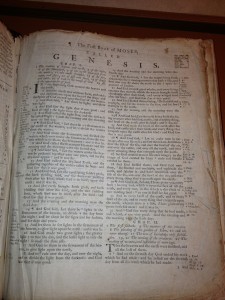
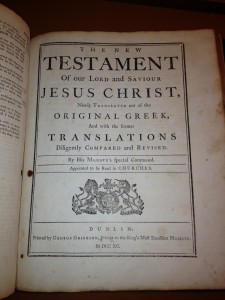
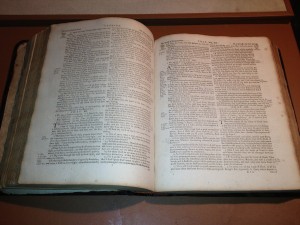
Here’s the story of my 1790 KJV Bible:

In 2008 my family and I were visiting friends in Vancouver, British Columbia in Canada. My friend Ed and I decided to escape the noise of the house (6 kids and our 2 wives) and do what guys like us love to do. No, not sneak out to a sports bar to watch a game and have a beer! We headed for the used book stores in search a rare or hard to find biblical books—something you never have enough of!

We came to this old bookstore with several floors of musty smelling books. Let me emphasize the word musty! I checked out the religious section and found nothing I couldn’t live without. I then went down into the basement where there multiple piles of thousands of old books that weren’t even shelved or catalogued. After checking the shelves along the perimeter and finding nothing, I began quickly scanning the stacks of old books laying on tables that were covering the entire center of the floor of the basement. It would have been impossible to read so many titles quickly, so I simply programmed my eyes to look for anything that looked old.

Suddenly in the middle of one pile, an old book caught my eye. I wondered if it might be a Bible. I dug it out, and sure enough it was. I looked for a publishing date, and found some Roman numerals. It’s not often that I have to read Roman numeral dates, and at first I thought it said 1740. Wow! I thought. This is way cool.

I grabbed the book and headed upstairs to the counter. The clerk told me that the Bible’s date was 1790 and that I could have it for $125. “Deal,” I said, and out I went with my new treasure. It’s a KJV Bible from England, and when it was printed, George Washington had been the president of the United States for just one year.

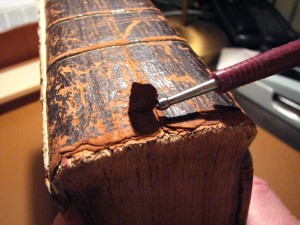
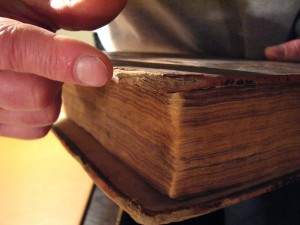
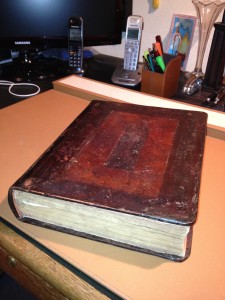
A couple of years later, I had a friend restore the Bible. Here are the before and after photos. Enjoy!

Before Restoration

IMG_5612


IMG_5611IMG_5615


After Restoration

IMG_0042IMG_0043

IMG_0044

IMG_0045