Blog Scripture Readings for 2/23 through 3/1/14

Aside

THIS WEEK’S SCRIPTURE READINGS FOR STUDY AND DISCUSSION:

Parashat Pekudei — Exodus 38:21 – 40:38
Haftarah — Exodus 30:11 – 16; 2 Kings 12:1 – 17**
Prophets —Isaiah 6:1 – 12:6
Writings — Psalms 138:1 – 144:15
Testimony — John 7:25 – 10:21

Most of this week’s blog discussion points will be on these passages. If you have general comments or questions on the weekly Scripture readings not addressed in a blog post, here’s a place for you to post those. Just use the “leave a reply” link below.

The full “Read Through The Scriptures In A Year” schedule, broken down by each day, can be found on the right sidebar under “Helpful Links.” There are 4 sections of scripture to read each day. One each from the Torah, the Prophets, the Writings, and from the Testimony of Yeshua. Each week, the Torah and haftarah readings will follow the traditional one-year reading cycle.

**A different Haftarah is read when it is a special sabbath in Jewish tradition. This Shabbat is traditionally known as Shabbat Shekalim and Exodus 30:11-16 is read.

Weekly Blog Scripture Readings for 2/23 through 3/1/14.


New Video: What is the meaning and significance of the name Elim?

In Exodus 15:27 we see that upon leaving Egypt, the children came to the desert oasis of Elim with its 70 palm trees and 12 wells. Elim and its name have many prophetic implications, which is why we named our congregation after it. This video explains these things.


New Video: What is the Purpose of Biblical Rituals?

What is the purpose of biblical rituals like baptism and communion? How about the Sabbath, the biblical feasts, fringes, mezuzahs, or praise and worship services? There are good and bad rituals. In this video, learn how biblical rituals bring us closer to YHVH Elohim in heaven.


Are you a picky eater?

John 6:54, Flesh…blood. This is a Hebrew idiom for “the whole person” (see Matt 16:17; 1 Cor 15:50; Gal 1:6; Eph 6:12; Heb 2:14). This relates to Moses’ instructions that “man shall not live by bread alone…but by every word that proceeds from the mouth of YHVH” (Deut 8:3). This applies to Yeshua who was that Word of Elohim who “became flesh and dwelt among us” (John 1:1 and 14).

20101995

When one puts their faith in or believes in Yeshua (John 6:29 and 5:24), then one must also believe him — that is, not only accept him as the Son of Elohim and one’s Savior, but also follow and obey (or “eat”) him who is the Living Manna-Word of Elohim from heaven. This involves believing his words by loving him and keeping his Torah-commands (John 14:15, 23 cp. Exod 20:6), which are his words.

This is why YHVH instructed the Israelites to eat the whole Passover lamb, and to leave nothing left over (Exod 12:10). This teaches us that we are to “eat” all of Yeshua — his whole Person as represented by the bread and the wine at communion on Passover. We are to accept the totality of his Word, not just the parts that suit us, or fit with our conventional religious viewpoints as per the traditions of men.

Many claim to eat all of his flesh and drink all of his blood, yet through their anti-Torah Continue reading →


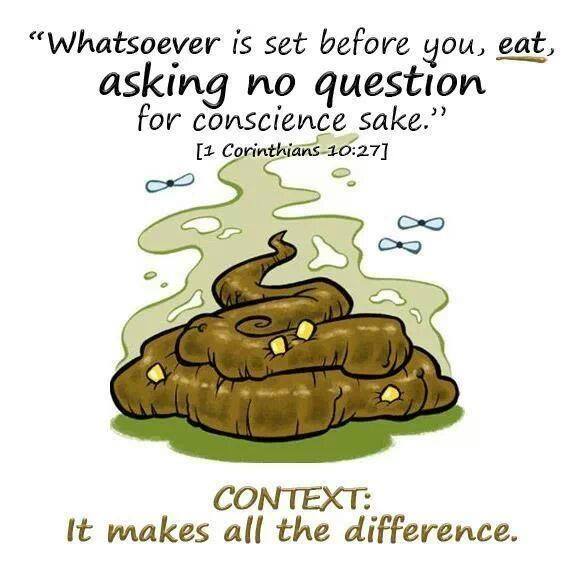
Eat whatever’s put before you!??!?? (Yeah right!)

Do you really think that Paul the apostle meant we should eat whatever is put before us when he made this statement (see graphic below) in 1 Cor 10:27, even if it violated the biblical dietary commandments? Yet many in the church will use this Bible verse to attempt to prove the biblical dietary laws — along with the rest of the Torah-law of  Moses — have been “done away with.” Hey church, it’s time to start using your noggins a little instead of thinking with your belly!

1798011_615486091852101_885740190_n

(This graphic was sent to me via Facebook and was too good to pass up, yet I don’t know whose graphic it is. If someone knows, please let me know, so I can properly attribute it.)


Traditions of Men Vs. Believing Moses (and Yeshua)

John 5:46–47, Believed Moses. These two verses at the end of chapter five can easily be overlooked, but their implications are huge.

Quite simply, Yeshua is saying that those who don’t believe the writings of Moses (i.e., the Torah) won’t believe the words of Yeshua who himself uphold the Torah and taught its validity in the lives of his disciples.

Moses 10 Cs 1

This then begs the question, “Where does this leave all those who claim to be followers of Yeshua, but who believe that the law of Moses was abrogated?” It’s hard to be absolutely black and white on this matter, since only YHVH can judge the heart condition of each individual, for undoubtedly many who claim the law was “done away with” still adhere to many of the law’s tenets (e.g., you shall not steal, murder, lie, commit adultery, worship idols and you shall honor your parents, etc.) and are thus obedient to the law to one degree or another. However, we can safely say that it’s a matter of degrees: To the degree that we don’t believe the words of Moses, we don’t believe the words of Yeshua who was a proponent (and, in reality, as the Word of Elohim, the Originator) of the Torah-law of Moses.

John makes a similar statement in his first epistle from which we can deduce the following: Continue reading →


Blog Scripture Readings for 2/16 through 2/22/14

Aside

THIS WEEK’S SCRIPTURE READINGS FOR STUDY AND DISCUSSION:

Parashat Vayakhel — Exodus 35:1 – 38:20
Haftarah — 1 Kings 7:40-50
Prophets — 2 Kings 24:1 – 25:30; Isaiah 1:1 – 5:30
Writings — Psalms 131:1 – 137:9
Testimony — John 5:1 – 7:24

Most of this week’s blog discussion points will be on these passages. If you have general comments or questions on the weekly Scripture readings not addressed in a blog post, here’s a place for you to post those. Just use the “leave a reply” link below.

The full “Read Through The Scriptures In A Year” schedule, broken down by each day, can be found on the right sidebar under “Helpful Links.” There are 4 sections of scripture to read each day. One each from the Torah, the Prophets, the Writings, and from the Testimony of Yeshua. Each week, the Torah and haftarah readings will follow the traditional one-year reading cycle.

Weekly Blog Scripture Readings for 2/16 through 2/22/14.