Blog Scripture Readings for 3/2 through 3/8/14

Aside

THIS WEEK’S SCRIPTURE READINGS FOR STUDY AND DISCUSSION:

Parashat Vayikra — Leviticus 1:1 – 5:26 (6:7)*
Haftarah — Isaiah 43:21 – 44:23
Prophets —Isaiah 13:1 – 19:25
Writings — Psalms 145:1 – 150:6; Proverbs 1:1-33
Testimony — John 10:22 – 13:38

Most of this week’s blog discussion points will be on these passages. If you have general comments or questions on the weekly Scripture readings not addressed in a blog post, here’s a place for you to post those. Just use the “leave a reply” link below.

The full “Read Through The Scriptures In A Year” schedule, broken down by each day, can be found on the right sidebar under “Helpful Links.” There are 4 sections of scripture to read each day. One each from the Torah, the Prophets, the Writings, and from the Testimony of Yeshua. Each week, the Torah and haftarah readings will follow the traditional one-year reading cycle.

* Verse numbers in parenthesis refer to the verse number in Christian Bibles, which can at times differ from verse numbers in Hebrew Bibles.

Weekly Blog Scripture Readings for 3/2 through 3/8/14.


If Yeshua Calls You a Priest Then Act Like One!

Shabbat shalom everyone!

Here’s a long, meaty teaching for you to chew on today that will hopefully bring you into a closer spiritual walk with YHVH Elohim by giving you a deeper understand of his ways and expectations of us. Understanding the Tabernacle of Moses and the Levitical priesthood is the focal point of this teaching. It’s amazing how much we can learn from history and how it applies to us!

Scripture reveals that the saints are to be a holy or set-apart (kadosh) priesthood, not a profane (worldly and polluted) one. Which are you? Kadosh or profane?

YHVH Is Preparing His Saints to Be a Kingdom of Priests

In his Word YHVH revealed that ancient Israel’s destiny was to become a kingdom of priests (Exod. 19:6) and as such become a light to the nations to lead them to YHVH (Deut. 4:6-8). This is why YHVH in his sovereignty positioned the nation of Israel at the crossroads of the major trade routes of the ancient world—between three continents: Africa, Asia and Europe. Israel did not fulfill this prophetic destiny because of sin and rebellion. They desired to conform their lives to the standards of the wicked nations around them rather than conform to YHVH’s standards of righteousness as revealed in the Torah-law.

580176

Those who come to faith in Yeshua the Messiah become children of Abraham and are thus Israelites (Rom. 4:16; 9:8-11; Gal. 3:7, 9, 14, 28-29) who have been grafted in to the olive tree of Israel (Rom. 11). Ancient Israel never fulfilled its divine calling to a kingdom of priests and a light to the nations of the world. YHVH’s calling and purposes for Israel are without repentance (Rom. 11:29). What ancient Israel failed to accomplish because of disobedience, rebellion and faithlessness will be left to grafted in Israel—the one new man in Yeshua the Messiah—to accomplish. Yeshua commissioned his disciples to preach the Good News (Gospel) of the kingdom of Elohim to the world (Mark 16:15; Acts 1:8). But more than that, his disciples were to become that kingdom of priests that ancient Israel missed the opportunity to become.

We read in the Testimony of Yeshua (New Testament) that the Saints of YHVH will be called kings and priests (or a kingdom of priests) of YHVH-Yeshua the Messiah and will reign with him during the 1000-year Millennium or Messianic Age. Continue reading →


Moshe and Moshiach: Prophetic Shadows and Fulfillments

Moses Was a Type of Messiah Yeshua

Scripture infers that Moses was a figure who prophetically foreshadowed Yeshua the Messiah. Perhaps the most notable scripture in this regard is the Deuteronomy 18 passage where Moses, speaking to the Israelites, prophesies that, “YHVH your Elohim will raise up unto you a prophet from the midst of you, of your brethren, like unto me, unto him you shall listen” (verse 15). Below we have compiled a list of similarities between Moses and Yeshua, which are too numerous to be merely coincidental (the majority of these insights are from the book Gleanings In Exodus by A. W. Pink).

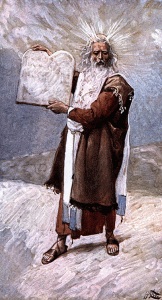
Moses' shining face

  • Both were Israelites.
  • Both were born while their nations were under the dominion of a hostile power.
  • As infants the lives of both were imperiled by the reigning king.
  • Both were adopted.
  • Both spent their childhood in Egypt.
  • Both were filled with deep compassion and sympathy for the plight of Israel.
  • Both renounced their kingly glory and took on the form of a servant.
  • Both were rejected by their brethren.
  • Both were shepherds (Exod 3:1 and John 10:11, 16).
  • Before entering into their ministry calling both spent time in seclusion in the wilderness: Moses for 40 years and Yeshua for 40 days.
  • Both were commissioned by YHVH to set the captives free.
  • The commission of both was confirmed by signs and miracles.
  • Moses’ first two miracles were power of the serpent and leprosy (Exod 4:6–8. After commencing his public ministry Yeshua’s first miracles were power over the serpent (Matt 4:10–11) and over leprosy (Matt 8:3).
  • Both delivered Israel.
  • The children of Israel were baptized into Moses (1 Cor 10:1–2) and redeemed believers into Yeshua (Rom 6:3). Continue reading →
 

“Yeshua Slept Here”

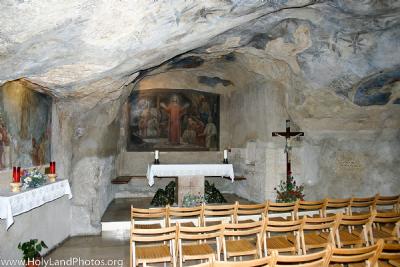
John  7:54, And everyone went to his own house. But Yeshua went to the Mount of Olives.

Below is a picture of the cave at the base of the Mount of Olives called the Grotto of Gethsemane, which is where Yeshua on occasion may have slept at night. This cave is a short five minute walk from the Temple Mount.

470_IJNTMOCG03_400


“Image courtesy of www.HolyLandPhotos.org


How do you best describe YHVH in one word?

Exodus 39:30, A crown of pure gold. What words were written on this golden crown that the high priest wore? Why did YHVH command that these words be written on the crown? To answer that question, think of this: What one word best describes who YHVH is? Most Christians would say that love is YHVH’s chief attribute. But is this what the Scriptures teach? Is there an attribute of YHVH’s that is even higher? Think of this: What are the six-winged seraphim declaring about YHVH Elohim day and night before his throne? (See Isa 6:5; Rev 4:8.)

Now consider this. YHVH made man in his own image (Gen 1:26), and wants man to become like him in character (note Lev 11:44,45; 19:2; 20:7). Now read Revelation 14:1 and compare this with Revelation 7:3. What does YHVH put on the heads of his end-time servants? What are the two noteworthy characteristics of YHVH’s end-times saints? (Note Rev 12:17; 14:12.) Holiness, Torah-obedience and a faith in Yeshua all go hand-in-hand. Now let’s bring this brief discussion full circle. As the high priest of old wore a gold crown inscribed with the words “Holiness to YHVH,” what does YHVH expect of his end-time saints? (See Heb 12:14; 1 Pet 1:15.) What does Peter call the saints of the Holy One of Israel? (See 1 Pet 2:9.) What will YHVH’s saints become in Yeshua’s millennial kingdom? (Read Rev 1:6; 5:10; 20:6.)

The word holiness (Heb. kadosh) as used in the Scriptures simply means “set-apart or the state of that which belongs to the sphere of the sacred, and which is distinct from the common or profane.” Elohim as the Creator is transcendent above his creation or that which is profane, earthly or worldly. Being kadosh isn’t only a positional consideration, but an ethical one as well.

The Torah is a reflection of the ethical qualities of Elohim, and is man’s ethical code book showing him how to be holy, set-apart or kadosh as Elohim is. Holiness in the Torah involves what we think, what we say, and what we do. This code of holiness which is a pathway to a relationship with our Father in heaven teaches us how to worship (or love) Elohim, and how to treat (or love) our fellow man. Yeshua, the Living Word or Torah of Elohim (John 1:1, 14) showed us how to walk out the Torah perfectly, and he then empowers us through his Spirit to live out the Torah’s holiness code, but this is another discussion.


Put on you holy under and outerwear

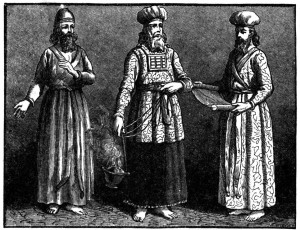
Exodus 39:1, The holy garments for Aaron. The vestments of the high priest (kohen hagadol) are symbolic of the robes of righteousness that saints should be wearing in preparation for the return of the Messiah.

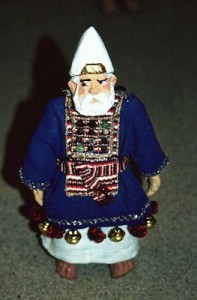
High Priest

Gold symbolizes purity of heart. Blue symbolizes heaven and spirituality. White linen pictures robes of righteousness. White symbolizes purity and sinlessness. Red represents blood—the blood of Yeshua that cleanses from sin.

The high priest wore a belt that represents truth, according to Paul (Eph 6:14).

White linen pants represented sexual purity.

The white turban represented purity of thought and humility (the opposite of conceit).

He wore a gold crown inscribed with the words, “Kadosh l’YHVH” meaning “Set-Apart to YHVH.”

The dangling pomegranates represented the fruits of our lives be they good or bad.

The golden bells jingled when the priest walked. As we go through life people hear us and see us. Our actions speak loudly and clearly. Also, Yeshua said that our words reveal the true condition of our heart (Luke 6:45). How do people really view us? What are we like in secret when no one else is around—our thought life and our words—our secret life? Is there a discrepancy between our secret and public lives? If so why? How set apart and righteous are we … in reality?

If we are called to be a set-apart priesthood then hadn’t we better get busy cleaning up our act?

Jewish tradition tells us that a rope was tied to the leg of the high priest in Second Temple times so that while ministering in the innermost sanctuary of the temple if he was impure and YHVH struck him dead (as happened to Nadab and Abihu, the sons of Aaron, when they offered up strange fire) the corpse could be dragged out by the rope.

Doesn’t all this show us that we should take being righteous and set apart seriously? Remember Hebrews 12:14: “Follow peace with all men, and holiness, without which no man will see the Master.”


Proof of America’s Slide into Neo-Barbarism

The Bible tells us that a person has a soul, and that the soul has three main subdivision: the mind, the will and the emotions. This is who a man is and what makes him a unique individual. The Bible also teaches us that each man has a conscience, and that within that conscience indigenously is a basic sense of right and wrong. On the day of Elohim’s judgment, those who follow their moral conscience and do what is right will be judged more favorably than those who don’t (Rom 2:13–16).

1658554

As a man has a conscience, so does nation, which is comprised of many men. Several words reflect the conscience of a nation. For example, the word mores is “the essential or characteristic customs or fixed morally binding customs or conventions of a community.” Another word would be ethos, which means “the characteristic spirit of a culture, era or community as manifested in its beliefs and aspirations.” Based on the mores or ethos of a people-group, that group, community or nation will form laws by which it will govern itself. In America, from its founding 240 years ago until recently, the Bible and Christianity influenced the conscience of individuals and the collective conscience of the nation. America’s founding documents — the Constitution and state constitutions — reflected a definite biblical, if not Christian, world-view. This was the ethos of the society.

America, presently, has been described by many as a “post-Christian” nation. It would seem that those who assert that it is still a Christian nation are focusing on America’s past state rather than her present state. That is not to say that there are not still many Bible believers who walk out their faith in America. They are just no longer the majority; a Christian or biblical world-view is no longer the dominant ethos reflecting the core mores of the majority of Americans. The proof of this is to simply look at the spiritual and moral values those individuals our society votes into office to rule over them from the president on down.

Now let’s define another term that is becoming more and more apropos to the times in which we are living. That word is barbarism. Barbarism (derived from the word barbarian), is defined as “the condition to which a society or civilization may be reduced after a societal collapse relative to an earlier period of cultural or technological advancement. This term may also be used pejoratively to describe another society or civilization which is deemed inferior in some way.”

Is America descending into a culture of neo-barbarism or heathenism? Let’s look at some indication that show this is likely the case. Continue reading →