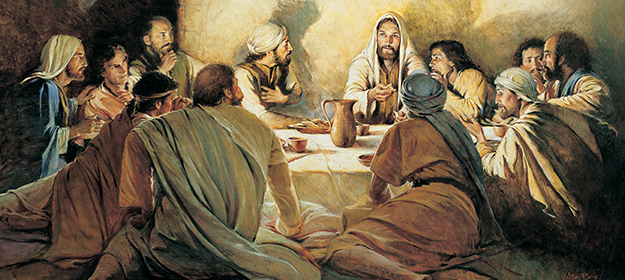
Luke 14:1, House of one of the rulers. Yeshua was invited to a Sabbath meal at the home of a Pharisee who was a ruler (likely a wealthy member of the Sanhedrin). Had Yeshua been a typical man, he would have engaged in the customary small talk of a polite and gracious dinner guest not wanting to offend his host. Yet Yeshua was not there to schmooze—to curry anyone’s favor in an effort to gain personal influence. As he required his own disciples to maintain a salty or spicy demeanor at all times (Matt 5:13; Luke 14:34–35), he was definitely up to the task to lead his disciples by example. The following discussion that Yeshua initiates is what some may consider to be a prime example of how to insult one’s host and the other guests. First Yeshua confronts a controversial issue head on by asking a question, and then by healing one of the other invited guests on the Sabbath, which was a Pharisaical taboo, though not contrary to the Scriptures (Luke 14:2–6). Next, Yeshua takes some of the guests to task who were prideful social climbers and religious status-seekers. He challenges them to humbles themselves and let Elohim exalt them in the eyes of men (Luke 14:7–14). Yeshua raises the discussion around the table to a higher level when he tells the Parable of the Great Supper (Luke 14:15–24). Doubtless, a few of the guests were made to feel awkward, since they likely resembled some of the characters in Yeshua’s story. There was no small talk of sports, the weather, one’s job or tidbits of gossip going on around the table at this dinner party. Yeshua was showing us how to be salt and light wherever we.g. even at the risk of offending one’s hosts, but all for the greater good of expanding the kingdom of Elohim in the lives of men.
Luke 14:18–24, Make excuses. This passage is a continuation of Yeshua’s previous Continue reading →
Exodus 24:1, Worship you far off. This verse clearly tells us that man can approach to worship YHVH only on the basis of the blood of the Passover lamb, but not on the basis of his own works of the law, since YHVH had not yet given the full Torah to the Israelites (that would occur later at Mount Sinai in Exod 24:12).
That is not to say that the works of the Torah are not essential in one’s spiritual walk. Rather, they simply are not the basis of our salvation, but rather a guide to lead us in the paths of righteousness once we are saved, and to keep us on the path of righteousness until we die (Eph 2:8–10).
For by grace you have been saved through faith, and that not of yourselves; it is the gift of God,
not of works, lest anyone should boast.
For we are His workmanship, created in Christ Jesus for good works, which God prepared beforehand that we should walk in them.
Furthermore, Yeshua taught that our works will determine our level of rewards in his kingdom (Matt 5:19), though not our initial salvation.
Some have misunderstood Paul’s teachings to mean that since we are not saved by keeping the law, we therefore no longer need to keep the law. This is not what Paul taught! In numerous places in Paul’s writings, he upheld the validity of the Torah in the life of the redeemed believer, and even confessed that he was obedient to the law in his own life.
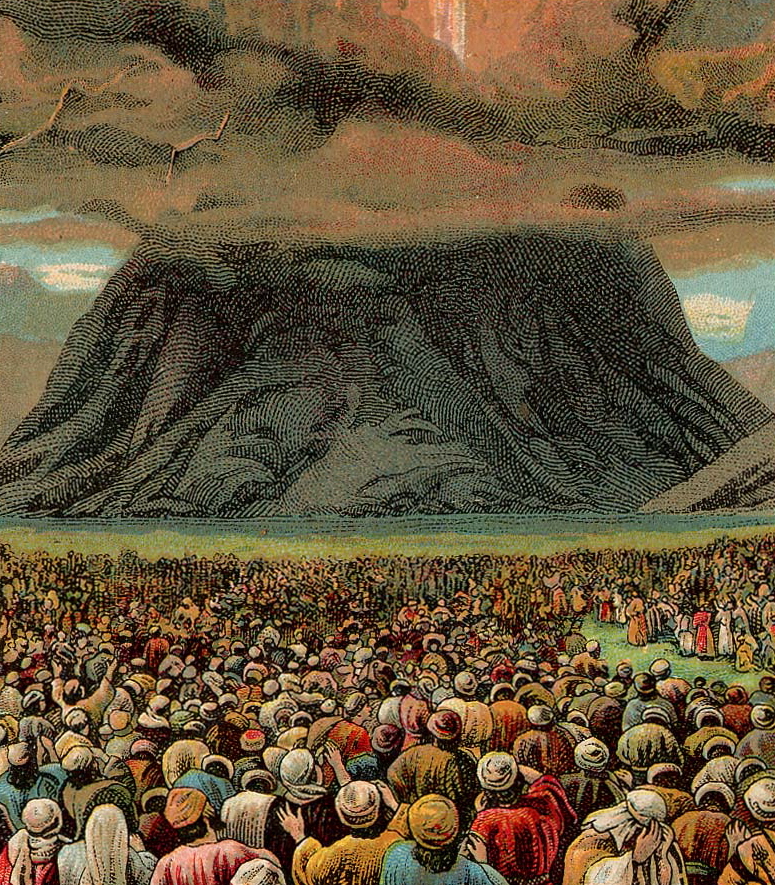
Exodus 24:1–2, Worship you from afar…shall come near. YHVH stipulated that Aaron, his sons and the elders of Israel were permitted to worship him, but from afar, while he would allow Moses to come near to worship him.
At the same time, the people of Israel could worship him from their camp at the base of the mountain, which was further removed from the presence of Elohim. Each of these three location indicates a higher location on the mountain of YHVH—a picture of his heavenly throne room.
Most saints are at the foot of the mountain, a few are on the mountain but low, while even fewer are actually climbing higher toward the top. These three venues or positions of worship portend the three subdivisions of the tabernacle—the outer courtyard, the holy place and the holy of holies. This points to the fact that different people are in different places in their spiritual journey toward or walk with Elohim, and where they are at in that journey determines the level of intimacy that they can experience with our Father in heaven.
In biblical Hebraic and ancient religious cultures and mythologies, mountains have always traditionally symbolized heaven or the place of Elohim or the gods, and ascending mountains is a picture of drawing close to deity. This is why churches, temples (including the temple in Jerusalem) and religious shrines are often located on hills or mountains, so that people have to go up to them as if ascending to heaven.
President Donald J. Trump walks across the South Lawn of the White House Sunday, March 25, 2018, returning home from his trip to New York. | (Official White House Photo by Andrea Hanks)
President Donald Trump and Vice President Mike Pence are blasting the Democratic Party for its support of late-term abortion amid a national outcry over statements in support of a proposed Virginia late-term abortion bill.
“Democrats are becoming the Party of late-term abortion, high taxes, Open Borders and Crime!” the president tweeted Thursday morning.
His words come on the heels of Virginia Governor Ralph Northam, a Democrat, who in a WTOP radio interview Wednesday defended a proposed bill from state delegate Kathy Tran, also a Democrat, that would have allowed abortions to be performed until the moment of birth.
In video footage of a discussion among legislators that rocketed around the Internet earlier this week, Virginia House of Delegates majority leader Todd Gilbert, a Republican, asked Tran if a woman could ask for an abortion as she was going into labor, delivering a full-term baby. To the horror of many, Tran responded that such a request would be allowed under her bill.
“I thought it was terrible,” Trump said of Tran’s statements in an interview with the Daily Caller Wednesday.
“Do you remember when I said Hillary Clinton was willing to rip the baby out of the womb? That’s what it is, that’s what they’re doing, it’s terrible,” he added, referencing his words in the third presidential debate prior to the 2016 election.
Gilbert’s office said Wednesday that the bill will not move out of subcommittee and no action will be taken on it.
Responding to the fallout, Northam said that when speaking about third-trimester abortions, “these are done with the consent of obviously the mother, with the consent of the physician — more than one physician, by the way — and it’s done in cases where there may be severe deformities. There may be a fetus that’s non-viable.”
“If a mother is in labor, I can tell you exactly what would happen,” the Virginia governor said. “The infant would be delivered. The infant would be kept comfortable. The infant would be resuscitated if that’s what the mother and the family desired, and then a discussion would ensue between the physicians and the mother.”
Like the video of Tran’s admission that her legislation permitted abortion until moments before birth, Northam’s comments went viral as conservative and pro-life advocates accused him of promoting a form of infanticide.
“I have devoted my life to caring for children and any insinuation otherwise is shameful and disgusting,” Northam, who is trained as a pediatrician, saidWednesday, responding to the fallout.
Virginia Attorney General Mark Herring stated Wednesday that President Trump and Virginia Republicans were “trying to spread shameful lies” about Tran and the governor.
Pro-life legislators and advocates around the world were not moved, given the video tape of his comments and many were quoting him verbatim.
“What’s shameful is that you’re too cowardly to say point blank that it’s wrong to leave babies to die after birth,” said U.S. Sen. Ben Sasse, R-Nebraska, in a statement Thursday.
“You could have said that yesterday. But because you’re terrified of an extremist pro-abortion lobby that now defends even infanticide, you’re still ducking.”
Pro-life senators Marco Rubio, R-Florida, Marsha Blackburn, R-Tennessee, Josh Hawley, R-Missouri, and Ted Cruz, R-Texas, all decried the Virginia bill.
Nigerian pro-life activist Obianuju Ekeocha, author of Target Africa and founder of Culture of Life Africa, did not withhold her disgust.
“Everyone that voted for this man @GovernorVA should wear sackcloth and remorsefully cover their heads in ashes, they should weep for putting power into the hands of a man that defends infanticide,” she said Wednesday, tweeting his radio interview.
In a Thursday National Review opinion piece, Vice President Pence weighed in, noting that the proposed Virginia bill follows similar legislation that was signed into law in New York, something that was celebrated with cheers in the state Senate chamber in Albany and illuminated pink lights atop One World Trade Center in New York City and other landmarks.
“[A]t the base of the same One World Trade Center that was bathed in pink last week to mark the passage of New York’s law, is the September 11th memorial,” Pence noted Thursday. “There, the names of all who died in the horrific terrorist attacks 18 years ago are etched in stone — including the eleven unborn children we lost along with their expectant mothers.”
“This shameless embrace of a culture of death is startling to every American who cherishes life. Not too long ago, the Democratic party’s stated position was that abortion should be ‘safe, legal, and rare.’ It was this widespread rejection of late-term abortion that led a large bipartisan majority in Congress to pass the partial-birth-abortion ban in 2003. But now look at how far the Democratic party has fallen.”
The pushback to the Virginia bill led one Democratic lawmaker to withdraw her support for it, saying she had not read the proposed legislation’s content closely enough.
“Had I researched each line of removed language, I would have seen that, and known that there was more research to be done. None of this changes that I believe women must have safe legal options for abortion; but I also would have seen the utility of language that provides guidelines for how to ensure this,” wrote state delegate Dawn Adams, a Democrat who represents a suburban district outside Richmond, in a letter to her constituents Wednesday.
“I made a mistake, and all I know to do is to admit it, tell the truth, and let the chips fall where they may.”
Adams is a first-term delegate who won a close victory in 2017 and may face a competitive re-election campaign this year.
The mainstream media, however, framed the events as an unkind attack on Tran.
A Thursday headline in the Washington Post read: “Until this week, Del. Kathy Tran was known for nursing her daughter on the House floor. Now Republicans are calling her a baby killer.”
Tran deactivated her Twitter account soon after she was seen on tape talking about her bills allowance for abortions up until birth, but then reactivated it Thursday sayingthat misinformation had been spread, arguing that her bill does nothing to change the fact that women can request abortions under certain circumstances as long as medical doctors approve it.
The United States House Committee on Natural Resources voted on Wednesday, January 31, 2019, to keep the phrase “so help you God” in the oath. | Twitter/Jason Calvi
The Democrat-controlled House Natural Resources Committee will not remove “so help you God” from the oath taken, reversing course on a proposed rules draft that would have done so.
Fox News reported earlier this week on a draft of proposed rules for the Democrat-controlled committee that showed the phrase “so help you God” being deleted from the oath. However, on Wednesday both Democrat and Republican members of the House committee agreed to keep the phrase in the oath.
Democrat Representative Jefferson Van Drew of New Jersey, a member of the committee, said in a statement that it would be “hurtful and harmful” for the committee “to go out of our way to take it out.”
However, Democrat Representative Jared Huffman of California argued against the inclusion of God in the oath, saying that it violated the separation of church and state.
“All of these trappings of religion and God in these oaths certainly have not kept an awful lot of people from lying under oath,” stated Rep. Huffman, as reported by EWTN.
Headed by Democratic Congressman Raul Grijalva of Arizona, the Committee on Natural Resources seeks to help preserve the environment and defend the rights of indigenous populations.
When news broke about the proposed removal of God from the oath, many, including Representative Liz Cheney of Wisconsin, a Republican committee member, denounced it.
“They really have become the party of Karl Marx,” said Rep. Cheney to Fox News. “It is incredible, but not surprising, that the Democrats would try to remove God from committee proceedings in one of their first acts in the majority.”
In his “Washington Update” on Wednesday, Family Research President Tony Perkins referred to the oath controversy as proof that House Speaker Nancy Pelosi and other elected Democrats have a “God problem.”
“In a nation whose motto is ‘In God We Trust,’ it is a sad commentary on the mindset of House Democratic leadership that removing God would even be considered,” stated Perkins.
“Although the House committee has reversed course, I believe it’s important that Speaker Pelosi be put on notice that as Americans, we want and need the presence of God in our government.”
Many federal oaths reference God. However, the oath of office for the president of the United States does not include the phrase; instead, figures taking the oath have added it by tradition.
Exodus 23:14–19, Three times you shall keep a feast. The Scriptures teach us that during the three biblical pilgrimage festivals of Passover/Unleavened Bread, Pentecost and Tabernacles all Israelites were to leave their places of individual isolation and were to go up to where the presence of Elohim of Israel was. This sacred rendezvous was to occur according to the festival cycle or circle (Heb. chag) around the common sanctuary (where YHVH had chosen to place his name, Deut 16:2, 11, 15).
In fulfilling this command,each Israelite would become conscious in a real way that he was connected to all the other members of the nation of Israel, with YHVH Elohim, and with the Torah (The Pentateuch—Deuteronomy, p. 310, by S. R. Hirsch).
In biblical times, the Israelites would gather wherever the tabernacle had been placed. When the temple was built in Jerusalem, this city became the destination point for the Israelite pilgrims during these three biblical feasts.
For the saints who celebrate the biblical feasts now, there is no temple in Jerusalem to gather around. The saints are now the spiritual temple of the Spirit of Elohim (1 Cor 3:16). Moreover, Yeshua has promised to be in the midst of his people when they gather together Continue reading →
Exodus 23:13, Make no mention of the name of other gods, neither let it be heard out of your mouth. (See also Ps 16:4.) Not only is YHVH against the worship of pagan deities and wants their names to be destroyed (Deut 12:3), but he says that he will take from the lips of his people the names of pagan deities (Hos 2:17), and eventually, he will restore a pure language (presumably one that is free of pagan names) to his people (Zeph 3:9).
Obeying this Torah principle today is difficult, since so many common words such the days of the week and some of the months of the year are named for pagan deities making normal communication without using these names difficult.
Nevertheless, the redeemed righteous of YHVH will endeavor to be mindful of this command and speak as cleanly as possible.
Since this commandment immediately follows commands regarding the weekly Sabbath and the biblical feasts, which are times YHVH has commanded his people to assemble, this is a clear remez or hint that YHVH’s saints should guard against mentioning the names of pagan gods when they gather together to worship Elohim. To mention the names of pagan deities is a slap in the face of the one and only true Elohim!
If one trains ones mind and mouth to use the biblical Hebrew names of “God,” then one will be fulfilling this command. Here is a list of the common English names for deity and their biblical Hebrew equivalents: