
Natan’s gardening rejoicing on the seventh day Sabbath—the only day of the week that YHVH Elohim sanctified!










Natan’s gardening rejoicing on the seventh day Sabbath—the only day of the week that YHVH Elohim sanctified!

How do we bring glory to Elohim, live in his river of life and help to advance his kingdom initiatives on earth? By receiving his spiritual gifts and then learning to exercise them.
The spiritual gifts Elohim gives to his children are essential in all aspect of our lives from the time we receive the gift of salvation, but beyond that as well. They establish us in him as a fully functioning and important part of his kingdom being advanced on earth. They help us to be his hands, feet and mouth to reach many people for him.
We must know what our spiritual gifts are so that instead of being a side-lined pew warmer, we are a fully functioning member of the body of Yeshua. Knowing our gift and then functioning in most importantly brings glory to Elohim, and as a by-product gives our life meaning, purpose and direction.
The Gifts (Gr. Charismahtohn) of the Spirit
Having then gifts differing according to the grace that is given to us, whether prophecy, let us prophesy according to the proportion of faith. (Rom 12:6)
So that ye come behind in no gift (charisma); waiting for the coming of our Lord Yeshua Messiah. (1 Cor 1:7)
For I would that all men were even as I myself. But every man hath his proper gift (charisma) of Elohim, one after this manner, and another after that. (1 Cor 7:7)
There are diversities of gifts, but the same Spirit. (1 Cor 12:4)
But covet earnestly the best gifts [charisma]: and yet shew I unto you a more excellent way. (1 Cor 12:31)
Follow after charity, and desire spiritual gifts (lit. spirituals), but rather that ye may prophesy. (1 Cor 14:1)
Neglect not the gift (charisma) that is in thee, which was given thee by prophecy, with the laying on of the hands of the presbytery.(1 Tim 4:14)
Wherefore I put thee in remembrance that thou stir up the gift (charisma) of Elohim, which is in thee by the putting on of my hands. (2 Tim 1:6)
As every man hath received the gift, even so minister the same one to another, as good stewards of the manifold grace of Elohim. (1 Pet 4:10)
Spiritual Gifts (Charisma) in a General Sense
For the wages of sin is death; but the gift (charisma) of Elohim is eternal life through Yeshua Messiah our Lord. (Rom 6:23)
But the free gift is not like the transgression. For if by the transgression of the one the many died, much more did the grace of Elohim and the gift by the grace of the one Man, Yeshua the Messiah, abound to the many. The gift is not like that which came through the one who sinned; for on the one hand the judgment arose from one transgression resulting in condemnation, but on the other hand the free gift arose from many transgressions resulting in justification. (Rom 5:15–16 NAS)
Salvation Is Elohim’s Greatest Gift to Man
For I long to see you, that I may impart unto you some spiritual gift[Gr. charisma], to the end ye may be established. (Rom 1:11)
The Purpose of Spiritual Gifts
Spiritual gifts help to establish, make firm, make stable, place firmly a person in the body of Yeshua or kingdom of Elohim. They give one a purpose and function. If you know what your gift is, you’ll better understanding your spiritual call and purpose. This will give your life meaning and direction. This glorifies Elohim, helps to advance his kingdom and keep you in his perfect will and in his river of life for you.
I thank my Elohim always concerning you for the grace of Elohim which was given to you by Messiah Yeshua, that you were enriched in everything by Him in all utterance and all knowle.g. even as the testimony of Messiah was confirmed in you, so that you come short in no gift, eagerly waiting for the revelation of our Master Yeshua the Messiah. (1 Cor 1:4–7)
Spiritual gifts from Elohim enrich our lives in all that we say and think.
Misc. Spiritual Gifts (Charisma)
For the gifts and calling of Elohim are without repentance. (Rom 11:29)
Israel was YHVH’s chosen and gifted people.
Do not neglect the gift that is in you, which was given to you by prophecy with the laying on of the hands of the eldership. (1 Tim 4:14)
Ministry gifts come by prophecy and the laying on of hands by the elders.
Word Definitions
The Greek word for gifts (as in spiritual gifts, see Rom 6:23; 2 Cor 12:4, 9, 28, 30, 31; 14:1; 1 Pet 4:10) is charisma and means the following:
From the study notes found in The Spirit Filled Life Bible in an article entitled“The Holy Spirit and Power,” (by Paul Walker), we learn the following things about spiritual gifts from heaven:
Romans 12:3–8 Lists Seven Gifts from the Father
All born again or redeemed believers should have one or more of these gifts. Often they are innate character traits a person already possesses naturally, but once they are born again by the Spirit of Elohim, these traits will often be employed for ministry purposes. These gifts are basic life purpose or residential motivational gifts that a person is gifted with for the benefit of others.
1 Corinthians 12:8–10, 28 Lists Nine Gifts from the Spirit of Elohim
Continue reading

1 Corinthians 9:20
And unto the Jews I became as a Jew, that I might gain the Jews; to them that are under the law, as under the law, that I might gain them that are under the law; to them that are without law, as without law, (being not without law to Elohim, but under the law to Messiah,) that I might gain them that are without law. To the weak became I as weak, that I might gain the weak: I am made all things to all men, that I might by all means save some.
What does Paul mean when he says “under the law to Messiah”? The answer should turn the theology of the whole mainstream Christian church with regard to its view of the Torah-law totally on its head! It is evident that when Paul uses the phrase, “under the law” in his writings, he at times infuses different connotations into this phrase. Only by studying the context of the surrounding passages in which this phrase is imbedded can we understand the exact connotation that Paul is attaching to the term “under the law.”
In this passage, the phrase “under the law” is found four times, and doesn’t connote “under the penalty of the law,” (as is the case with Paul’s usage of the term in Romans). The first three times this phrase is found here it means “in subjection to a legalistic perversion of the Torah” (as David Stern translates it in his Complete Jewish Bible and then explains reasons behind this translation in his Jewish New Testament Commentary). Here Paul identifies several groups of people, each of which had its own view of the Torah. These groups were (a) ethnic Jews, (b) those (ethnic Jews or otherwise) who had come under a legalistic view of the Torah in that they believed, for example, that circumcision was a precondition for salvation (certain Pharisees believed this [see Acts 15:1], and Paul was dealing with this doctrinal perversion in the first several chapters of Romans), (c) those (presumably Gentiles) who had no knowledge of the Torah, and (d) those new believers who were still weak and unstable in their faith.
In Paul’s final usage of this phrase in this passage he adds to the phrase under the law” [Gr. ennomos meaning “in the law”] the two words “in Christ.” This changes the whole meaning of the term under the law. As we have noted above, “under the law,” as Paul uses it can mean “under the [penalty of] the Torah,” or “under a legalistic perversion of the Torah,” but here Paul is referring to Torah obedience in the context of a faith in Yeshua. Is Paul referring here to Christians who keep the Torah? Yes! This is what the first century redeemed believers were, and what Paul confesses here about himself (1 Cor 9:21). Paul’s pro-Torah stance is totally consistent with other apologetic statements he makes concerning the Torah along with his confession to being totally Torah-obedient himself (e.g. Rom 3:31; 7:12, 22, 25; 1 Cor 7:19; Acts 21:24; 24:14; 25:8). Torah obedience was also to be a normative attribute of the life of the redeemed believer then and now (e.g. Acts 21:20; 22:12; Rev 12:17; 14:12; 22:14).
So what specifically does the phrase “not being without the Torah toward Elohim, but “under or in the law toward Messiah” mean? Simply this. There is a keeping of the Torah that is done through men’s legalistic efforts that is devoid of trusting faith toward Elohim, whereby one hopes to earn Elohim’s grace or merciful kindness through human effort. This approach Paul proves in Romans 3 and 4 was never how Elohim intended men to come into a spiritual relationship with him, since it is impossible for men to keep the righteous requirements of the Torah perfectly without sinning. Thankfully, salvation is by the grace of Elohim through faith in Yeshua (Eph 2:8–10). It is through Elohim working through his Holy Spirit through our relationship with Yeshua that we can do the good works (Eph 2:10) of loving Yeshua by keeping his Torah commandments (John 14:15; 1 John 2:3–6; 3:24; 5:2–3). When Yeshua and his apostles use the term commandments in their writings, how do we know that they’re referring to the Torah-commandments? In Luke 18:19–20, Yeshua answers this question when he connects the word commandments (Gr. entole) with the laws of Torah (in this case, the Ten Commandments, which is the cornerstone of or the basis for all the other 600 plus commandments in the Torah).
Therefore, when Paul says “not being without the Torah toward Elohim, but under [or, in] the law toward Messiah,” he is referring to Torah obedience within the paradigmatic context of Elohim’s grace toward us (which covers our past sins and delivers us from the penalty for violating the law, which is death), and to Yeshua living in the redeemed believer’s life through his Set-Apart Spirit, which enables one to love Yeshua by obeying his Torah (John 14:15).

Extramarital sex is so common place nowadays that almost no one thinks anything about it. It hasn’t always been that way though. Currently I’m reading a biography on Sir Isaac Newton, one the greatest scientific and mathematic geniuses to have ever lived. For many years during the late 1600s, he studied at England’s Cambridge University where he became a professor. Interestingly, one of the conditions to being a student and fellow at that prestigious university was that no sexual fornication was allowed. If one was caught giving in that sinful passion, they were expelled from that institution. How times have changed from then until now on college campuses and in society at large!
Numbers 25:1, Commit whoredoms. Sexual immorality has the downfall of many a saint who considers themselves to be strong, righteous and impervious to sinful temptation. There is a terrible price to pay for falling to sexual immorality as the Israelites found out.
The enemy (the world, the flesh and the devil) knows our weaknesses and will do its best to capitalize on them for our destruction. Romans 13:14 says, “But put on the Master Yeshua Messiah, and make not provision for the flesh, to fulfill the lusts thereof.”
What doors of immorality have you kept open in your life to gratify the immoral cravings of the flesh? What spiritual stronghold exists in your life that the enemy can use to keep you under its thumb and from walking in the joy and freedom of the will of YHVH? It is time to cry out to YHVH for help and deliverance and to repent.
Setting immovable boundaries in one’s heart and mind ahead of time is a major key to resisting sexual temptation successfully. It’s important to decide how far we can go without violating the spiritual guidelines the Scriptures lay out for us to stay righteous sexually, and then not allow ourself too get too close to those limits. For example, if you find yourself in a potentially compromising situation, flee that situation to alleviate the possibility of falling prey to moral compromise (2 Tim 2:22).
Young people who are endowed with strong sexual urges need to bathe their minds in the godly admonitions found in Proverbs chapters one through nine (also note Eccl 11:9–10 and 12:1–14). Learning the ways of wisdom and the fear of Elohim as revealed in these chapters in Proverbs is a vital component to staying strong morally and being triumphant over the wicked temptations of the world, the flesh and the devil.

In Matthew 24 and elsewhere, Yeshua warned his disciples to beware of false prophets coming in the end times claiming to be anointed and have the word of Elohim from heaven and deceiving many—even the saints. Many of these false prophets have started false religions and cults, but can be found lurking about in the Christian church itself. There are many people running around claiming to speak for Elohim, but who are coming in the spirit of Balaam. Beware! That’s why it behooves us to study about Balaam the false prophet!
Then many false prophets will rise up and deceive many. (Matt 24:11)
For false christs and false prophets will rise and show great signs and wonders to deceive, if possible, even the elect. (Matt 24:24)
Beware of false prophets, who come to you in sheep’s clothing, but inwardly they are ravenous wolves. (Matt 7:15)
Numbers 23:4, Seven altars. Rashi, the Jewish Torah scholar, says these seven altars refer to the altars built by Israel’s ancestors—four of which were built by Abraham (The ArtScroll Sapirstein Edition Rashi/Numbers, p. 288). Whether this is true or not, this story can serve to teach us a lesson. Perhaps Balaam superstitiously thought that by returning to some place where humans in times’ past had encountered the Presence of YHVH he could actually find YHVH there. Matthew Henry in his commentary on this verse states, “Oh the sottishness of superstition, to imagine that God will be at man’s beck!” To resort to programs, rituals or methodologies to “conjure” up the Presence of YHVH can lead to idolatry and witchcraft. What “attracts” the Spirit of YHVH? Is it worship, praise, a repen tant and humble heart, faith in him with obedience to his Word, and love for him or rituals, charms, incantations and religiosity? You know the answer.
Numbers 23:21, Perverseness in Israel. Balaam tried to find some iniquity, or some perversion in Israel that would give him legal grounds to curse Israel, but could find none. Remember, a curse causeless shall not land (Prov 26:2). Satan, the accuser of the brethren (Rev 12:10) has no legal grounds with which to attack the righteous of Yeshua who are submitted to the authority, will, Word and Spirit of YHVH (Jas 4:7), and who are under the blood of Yeshua, the Lamb of Elohim (Rev 12:11). How do we stay in such a spiritual state so that the attacks of the enemy have no legal ground to stick in our lives, and so that the fiery darts of Satan are instantly quenched? (Read compare and discuss Eph 6:10–18; Col 2:15; Luke 9:1; 10:19.)
Numbers 23:15–25, The arrogant hypocrisy of Balaam. Balaam calls YHVH “the Most High” and “the Almighty.” He had great respect for YHVH (as does Satan as we learn from James 2:19, “You believe that there is one Elohim, you do well: the devils also believe and tremble.”), but he did not have enough fear of, faith in and love for YHVH to obey him. Does this describe you? How much do you hold back loving YHVH with all your heart, soul, mind and strength?
Numbers 23:19, El is not a man that he should lie.Read the rest of this verse, which speaks about the immutable character of Elohim. (Also see Mal 3:6; Heb 13:8.) From the beginning in the Garden of Eden (thanks to the lies of Satan the serpent, see Gen 3:1–4), man has been under the spiritual delusion that Elohim changes his word, laws or commandments and that he doesn’t really mean what he says. That is to say, when YHVH gives a command, later on he may change his mind and his commands are no longer applicable to subsequent generations or people-groups. Down through the ages, church leaders have bought in to this lie of the enemy with regard to validity of the Torah as pertaining to the life of the redeemed believer. But by saying that the Torah is “done away with,” “has been nailed to the cross” “has been fulfilled in Jesus” meaning “he did it for us so that we don’t have to do it,” isn’t this really calling Elohim a liar? Now consider the numerous places throughout the Bible, the Word of Elohim, where the Torah is revealed as YHVH’s unalterable standard of righteousness for all time and for all people everywhere. (In this regard, read the following scriptures: Ps 119:44, 142, 144, 160, 172; Matt 4:4; 5:18–19; Rom 3:31; 7:12.) Who is really the liar? Man or Elohim?
Numbers 23:36, Balaam the man-pleaser. Balaam is desirous of pleasing Balak, even though he pretends to please YHVH. At heart Balaam is a man-pleaser, not a YHVH-pleaser. Yeshua castigated the religious hypocrites of his day for the same thing (John 12:43). What truly motivates you? Do you care more what men think when it comes to obeying the truth of YHVH? Do you often take the easy way out and the path of least resistance, which pleases the flesh and those around you rather than YHVH?
Numbers 24:2, The Spirit of Elohim came upon him.We see from the Scriptures that the Spirit of YHVH can come on just about anyone, but this doesn’t mean that the Spirit dwells in them, leads them, or that such a person has a heart to love, serve and obey Elohim. For example, the Spirit of Elohim came upon King Saul who prophesied (see 1 Sam 10:9–11; 19:20–24), but Saul didn’t serve YHVH with his whole heart and eventually became a murderous, apostate occultist. Not only does the Bible warn us to beware of prophets who prophecy falsely (e.g. Deut 13:1–5; Jer 23:9–40; Ezek 13:2; 22:24; Isa 28:7; Matt 24:4–5; 2 Pet 2:1–3), but to beware false prophets or unrighteous individuals who YHVH may use to prophecy correctly—not because they are filled with the Spirit of Elohim, but simply because the Spirit of Elohim temporarily comes upon them to accomplish YHVH’s purposes.
Numbers 24:3, Balaam…hath said.In this statement, we see revealed another character flaw of Balaam. Here he gives YHVH no credit for his prophetic word, but seeks his own glory. It’s as if he is saying, “I have heard the word of Elohim” with emphasis on himself rather than on Elohim, the source of the word. What caution does the Word of Elohim give us in this regard? (See Jer 9:23–24.)
Numbers 24:17, A Star out of Jacob.To what notable, kingly biblical figure is this prophecy referring? (See Matt 2:2; Rev 22:16 cp. Ps 2:1–12; Rev 17:14; 19:16. See also Rev 2:27; 12:5; 19:15.) This prophecy can have a double meaning in that it also pointed to King David who smote the Moabites and took possession of Mount Seir, the land of the Edom (vv. 17–18 cp. 2 Sam 8:2,14).
However, both Christian and Jewish scholars have recognized the Messianic implications of this verse. For example, Akiva Ben Yosef, the rabbinic Jewish leader of the second century, applied this verse to Simon Bar Kosiba (whose name he changed to Kokhba meaning “son of the star” after the Star Prophecy of Num 24:17) who presumed to be the Messiah when he unsuccessfully attempted to defeat the Romans in the Second Jewish revolt. Additionally, Adam Clarke notes in his commentary on this verse that Moses Ben Maimon (or Maimonidies), the Medieval Jewish Torah scholar applied this verse to the future Messiah as do the Onkelos Targum and Jerusalem Targum (the ancient Jewish Aramaic translations of the Tankah). Rashi (the medieval JewishTorah scholar) and Sforno (the renaissance Jewish Torah scholar) in their Torah commentaries note the Messianic implications of the star of Balaam’s prophecy as well (Sforno Commentary on the Torah, ArtScroll Mesorah Series).
One thing is certain, only Yeshua the Messiah can make the claim to having fulfilled this biblical prophecy!
Balaam—A Subverter of Divine Gifts and a Prophet of Babylon
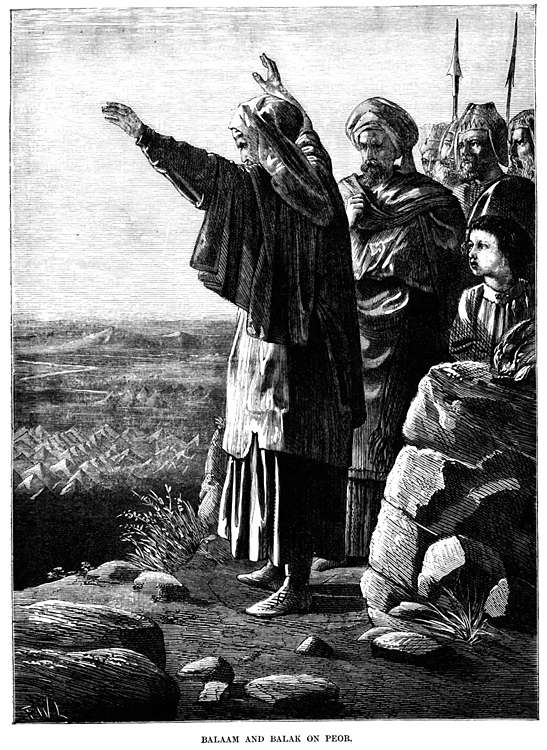
The name Balaam means “destruction of people.” The Hebrew word bela means “destruction, confuse, confound.” The Hebrew word am means people, tribe, nation. The name Balak means “waster, to annihilate.” He was king of Moab; distant cousins to Israel through Lot, Abraham’s nephew. The world, as well as the modern Christian church, is full of such prophets.
Continue reading

Numbers 22
Numbers 22:5, Pethor…by the river. Balaam was from the land of Pethor, which is “by the River.” This is a reference to the Euphrates River, the great river of Babylon (The ArtScroll Stone Edition Chumash, p. 857). Thus Balaam was a Babylonian, although he may have been a transplanted Edomite according to some Jewish scholars (see The ArtScroll Bereishis/Genesis Commentary on Gen 36:32).
One of the aspects of Babylon of the last days is her religious system (Rev 13:11ff) the head of which is the false prophet (Rev 16:13; 19:20; 20:10). The Babylonian religious system of the end days is a blend of both good and evil (reminiscent of the tree by that name in Eden from which the serpent beguiled Adam and Eve away from YHVH’s path of truth and righteousness into a false religious system).
In the last days, YHVH is calling his people out of that false religious system (Rev 18:4) with its false prophets who prophesy a mixture of good and evil.
Is not modern traditional Christianity a mixture of good and evil, truth and error (i.e. doctrines and traditions of men along with some paganism mixed in)? Reflect on the implications of this. To what degree have you heeded YHVH’s call to “come out of her”—namely, any man-made religious or church systems that has components that are contrary to the Word of Elohim?
Like many in mainstream Christianity, the Scriptures seems to indicate that Balaam had some knowledge of the truth of YHVH, but he refused to wholeheartedly submit to YHVH’s word and will (2 Pet 2:15).
Let us not forget Yeshua’s warning about false prophets arising in the last days who might deceive the very elect (Matt 24:24).
Numbers 22:10ff, Crossing over. Many carnal people—especially those playing at religion—want to be like YHVH’s saints, and to be the recipients of the blessings of Israel, and to be numbered among YHVH’s chosen, but few want to walk the difficult walk of holiness and righteousness required to receive these blessings and privileges. These may very well be the spiritual tares that surreptitiously exist along side the saints within their congregations.
Continue reading

Numbers 21 and the Wilderness Journey: Salvation, Overcoming and Victory!
21:4–9, Initial salvation. The bronze serpent on the pole is a prophetic picture of salvation at the cross of Yeshua from the sting of death brought on by sin (John 3:14–15; 1 Cor 15:55–57). This is a picture of the believer’s initial salvation.
21:10–22:1, The wilderness trek. Here is a recounting of the Israelites’ wilderness trek before entering the Promised Land. For the Israelites, this was a time of testing, refining, building of faith, and learning obedience. This is a picture of the spiritual walk of the believer through the wilderness of this physical life.

21:14–35, The wilderness struggle. While crossing the wilderness, the Israelites had to fight and overcome the enemy—that is, those who would keep them from fulfilling their YHVH-ordained destiny to possess the land and inheritance he had promised them. First came the fighting and overcoming, followed by the victories. The life of the believer is one of spiritual struggle, as well, against the world, the flesh and the devil. (See Rom 7:14–25; 2 Cor 10:3–5; Eph 6:10–18.)
21:10, 14–18, Salvation in the wilderness. Here we read how Israel was refreshed with water from the rock. Isaiah speaks about the wells of salvation (Isa 12:3). There is a springing up of joy and praise (verse 17) that comes as victory is experienced, and as YHVH makes rivers to flow out of seemingly dry and barren situations (verse 18). We, too, are called to come to the rivers of salvation, the river of life and to become a river of life ourselves to all those with whom we come into contact (John 7:37–39). Yeshua is the source of that living water; he is the spiritual Rock and source of water that never runs dry (John 4:10, 13–14; 1 Cor 10:4).
Numbers 21:4–9, Fiery serpent. The plague of fiery serpents was a righteous judgment Elohim brought upon Israel for murmuring and unbelief. Israel had “sharpened their tongues like a serpent” (Ps 140:3) and “their throat [was] an open sepulcher; with their tongues have…used deceit; the poison of asps [was] under their lips” (Rom 3:13). All this was directed at Elohim and Moses. As a result of their sin, they reaped what they had sown. Elohim loosed fiery serpents upon the Israelites to bite and sting to death the unbelieving murmurers.
The wilderness Elohim led the Israelites through was full of fiery serpents and scorpions (Deut 8:15), yet this is the only account in the Torah of these creatures ever attacking Israel. YHVH had protected them to this point, but this one time he pulled back his hand of providential protection and grace allowing them to experience the due recompense of their sinful actions.
Continue reading