The Jewish sages teach that the commandment (mitzvah) of the red cow is “beyond human understanding.” Like the afikoman (the middle broken matzah that is “buried” and “resurrected,” which is a picture of the death, burial and resurrection of Yeshua) in the Passover (Pesach) Seder, the meaning of which to this day remains unclear to the Jewish scholars, the red cow is a ritual that makes sense only when Yeshua the Messiah is added to the picture.
While the symbolism of the red heifer was, to Jewish Torah scholars, admittedly incomprehensible to human reason, by the second temple era they began to speculate about its spiritual significance in their aggadic literature. Some felt that it was an atonement for the sin of the golden calf (The Encyclopedia of Jewish Religion, Massada – P.E.C. Press, 1965, p. 327; The ArtScroll Chumash, p. 839). Others viewed it as somehow relating to the azazel or scapegoat and the bullock sin offering of Yom Kippur, since all were sacrificed outside the camp of Israel (Lev 16:27).
The sacrifice of the red heifer was for the purpose of purifying someone who had become ritually impure or polluted through contact with the dead, or for purifying metal war booty (Num 31:21ff). This sacrifice was to be made outside of the camp of Israel, and later occurred outside of the walls of the city of Jerusalem on the Mount of Olives, not far from the Temple. The concept of the camp signifies outside of or away from the divine presence or shekinah of YHVH meaning outside the tabernacle courtyard (The ArtScroll Chumash, p. 839).
The heifer was to be three to five years of age and totally red in color, blemish free and to have never born a burden and, according to Jewish tradition, to be without a single black or white hair on its body. The animal was slaughtered with the priest sprinkling its blood seven times toward the tabernacle’s entrance (later this occurred at the temple in Jerusalem). The entire carcass (hide, entrails and meat) was then burned on a wood pyre. Into the fire were tossed cedar wood, hyssop and a scarlet thread. The ashes were then divided into three portion: one part was kept in a secure place on the Mount of Olives (during the second temple period), one part was kept in the area immediately outside the wall of the temple courtyard, and one part was divided among the priests throughout the land of Israel to be used, as needed, in purifying the people (Mishnah Parah 3:11). The ashes to be used in the temple service were then mixed with fresh water (in Jerusalem, from the Pool of Siloam), and then called “waters of separation” (meyi nidah; nidah means “impurity, filthiness, menstruous, set apart, ceremonial impurity”), and were ritually sprinkled over something or someone that was impure. Numbers 19:9 states that the waters of sprinkling were for purification. The Hebrew word for purification is chatat, which according to some rabbinic interpreters is a reference to a sin offering (Ibid.). Others disagree arguing that the plain (pashat) meaning of the text does not speak of the red heifer atoning for sin (see Rashi’s commentary on this verse). This is an interesting debate, but regardless of what the Jewish sages think, the ritual of the red heifer shows striking parallels to Yeshua’s salvific work at the cross, as we discuss below.
The crucifixion implications of the red heifer were not missed by the Jewish-Christian scholar Alfred Edersheim. He links the Yom Kippur scapegoat, which was to remove the personal guilt of the Israelites (Lev 16), with the red heifer, which was to take away the defilement of death that stood between man and Elohim, with the “living bird,” dipped in “the water and the blood,” and then “let loose in the field” at the purification from leprosy (Lev 14:1–7), which symbolized the living death of personal sinfulness, were all, either wholly offered, or in their essentials completely outside the sanctuary. He then observes that the Old Testament sanctuary had no real provision for spiritual wants to which they symbolically pointed; their removal lay outside its sanctuary and beyond its symbols (The Temple and Its Ministry, pp. 280–281). This is why Yeshua had to be sacrificed outside of the temple area. Additionally, he had to be the sacrifice for sin outside of the temple area (Heb 13:12), which symbolized the shekinah or divine presence of YHVH. This speaks of the fact that the Father looked away, turned his back on and forsook Yeshua while he bore the sins of the world on his shoulders (Isa 53:4–6; Matt 27:46).
The writer of Hebrews understood the greater implications of the red heifer as it pointed to Yeshua when he wrote:
Which stood only in meats and drinks, and various washings, and carnal ordinances, imposed on them until the time of reformation. But Messiah being come an high priest of good things to come, by a greater and more perfect tabernacle, not made with hands, that is to say, not of this building; neither by the blood of goats and calves, but by his own blood he entered in once into the holy place, having obtained eternal redemption for us. For if the blood of bulls and of goats, and the ashes of an heifer sprinkling the unclean, sanctifies to the purifying of the flesh: how much more shall the blood of Messiah, who through the eternal Spirit offered himself without spot to Elohim, purge your conscience from dead works to serve the living Elohim? And for this cause he is the mediator of the renewed covenant, that by means of death, for the redemption of the transgressions that were under the first covenant, they which are called might receive the promise of eternal inheritance. (Heb 9:11–15, emphasis added)
Eighteenth-century Christian commentator, Matthew Henry, asks why does the Torah make a corpse a defiling thing? He answers that it is because death is the wages of sin, which entered into the world by it, and reigns by the power of it. The law could not conquer death, nor abolish it, as the gospel does, by bringing life and immortality to light, and so introducing a better hope. As the ashes signified the merits of Messiah’s perfect sin-free life, so the running water signified the power and grace of the blessed Spirit, who is compared to rivers of living water; and it is by his work that the righteousness of Messiah is applied to us for our cleansing (Matthew Henry Concise Commentary on the Whole Bible, p. 137, Moody).
At age 60, I just made my final and seventh ascent of Mount Hood—Oregon’s tallest peak at 11,250 feet. I guided my sons to the summit on June 25, 2020—a mountain climbing tradition my grandfather and professional mountain climber and guide started on this mountain in 1914.
This was my 18th ascent of major Cascade peaks. My first ascent was Mount Saint Helens in 1972 when I was 12—eight years before it blew its top.
The Bible is full of notable mountains and mountain climbers. Abraham guided Isaac to the top of Mount Moriah when he was more than 100 years old and met YHVH there. Jacob encountered YHVH on Mount Moriah or Sion as well. Moses was 80 when he climbed Mount Sinai and met YHVH there. He was 120 when he climb Mount Nebo and saw the land of his promised inheritance. Elijah defeated the prophets of Baal on Mount Carmel and then hiked down to and climbed Mount Sinai to meet Elohim. Yeshua and his disciples climbed a few mountains and had some divine encounters also.
Mountains are special places! Please enjoy these photos. A video documentary is coming. Stay tuned.
While this was my final climb of glaciated mountains, I am waiting with great anticipation and faith on YHVH for my next spiritual mountain climbing assignment and adventure!
Natan and his sons, Aaron, Jared and Kaleb, on the summit of Mount Hood with Washington State’s Mount Adams and Mount Rainier in the background.
Our new annual Scripture Reading Schedule for 2019-2020 with daily readings is available to download and print. If you are still working through 2018-2019’s Scripture Reading Schedule, the link will still be available on the right sidebar under “Helpful Links”. If you are using a mobile device or tablet, the link may be below, meaning you’ll need to scroll down instead.
Most of this week’s blog discussion points will be on these passages. If you have general comments or questions on the weekly Scripture readings not addressed in a blog post, here’s a place for you to post those. Just use the “leave a reply” link or the “share your thoughts” box below.
The full “Read Through The Scriptures In A Year” schedule, broken down by each day, can be found on the right sidebar under “Helpful Links.” There are 4 sections of scripture to read each day: one each from the Torah, the Prophets, the Writings, and from the Testimony of Yeshua. Each week, the Torah and haftarah readings will follow the traditional one-year reading cycle.
Weekly Blog Scripture Readings for 6/28 through 7/4/2020.
Many Christians will casually read this Bible statement by Paul and assume that the Torah-law was done away with. Is this really what Paul is saying here and does such an interpretation line up with the rest of Paul’s writings as well as the truth of the entire Bible? Let’s look at this statement logically and in the larger context of Scripture to see what the truth really is.
1 Corinthians 6:12–13, All things are lawful. When Paul said that all things are lawful to him, what do you think he meant? It’s now all right to murder, commit adultery, lie, steal, have sex with animals, practice witchcraft, and we can also add break the Sabbath, eat pork, etc., etc.? Obviously, violating the commands of Elohim wasn’t what he meant here, for doing such is, by biblical definition, sin (1 John 3:4), and those who love Yeshua will not be sinning, but will keeping his commandments (John 14:15). Moreover, it was our sin that put Yeshua on the cross, so why should we mock Yeshua’s death by continuing to practice sin? In fact, prior to 1 Cor 6:12, Paul listed a number of sins that will prevent one from entering the kingdom of heaven including drunkenness, sexual immorality, theft and so on. So obviously, breaking the laws of Elohim was not what he meant in verse 12. If Paul is here permitting the eating of unclean meat that the Bible forbids and calls an abomination, then he is also permitting sexual immorality—a sin which he juxtaposes in verse 13 with the eating of certain foods.
So if Paul wasn’t opposing the biblical dietary laws in verses 12 and 15, what was he really saying? According to David Stern in his Jewish New Testament Commentary, Paul was coming against the sexually libertine attitudes of the saints in Corinth whereby they had permitted the man who was having sexual relations with this stepmother and even allowing the sinner to remain in fellowship with the saints there. Stern goes on to say that the phrase, “All things are lawful to me…Food for the stomach…” is really analogous to the modern phrase, “If it feels good, do it”—a concept which Paul strongly opposes. Beale and Carson concur with Stern on this in their commentary on this verse (Commentary on the New Testament Use of the Old Testament, p. 713). In verse 15, Paul goes on to make the point that our bodies are the temples of the Set-Apart Spirit of Elohim and that we need to treat them as holy vessels by not engaging in sinful practices (whether sexual immorality or eating unclean meats).
Keener agrees with Stern that Paul was here confronting the ungodly and licentious Greek philosophers who would excuse their libertine carnal appetites by saying “I can get away with anything.” Paul, on the other hand, counters this by saying, “Maybe so, but ‘anything’ is not good for you” (The IVP Bible Background Commentary of the NT, pp. 464–465). Keener goes on to say that “‘Food for the stomach and the stomach for food’ was a typical Greek way of arguing by analogy that the body was for sex and sex for the body….That God would do away with both reflected the typical Greek disdain for the doctrine of the resurrection (chap 15), because Greeks believed that one was done with one’s body at death [which is why they reasoned that it was permissible to do whatever you pleased with your body now]. Paul responds to this Greek position with the Old Testament/Jewish perspective that the body is for God and he will resurrect it” (i.e. in v. 14, ibid.).
Paul then goes on to explain why a philosophy that excuses sinful behavior is not acceptable to Elohim or beneficial to the saint.
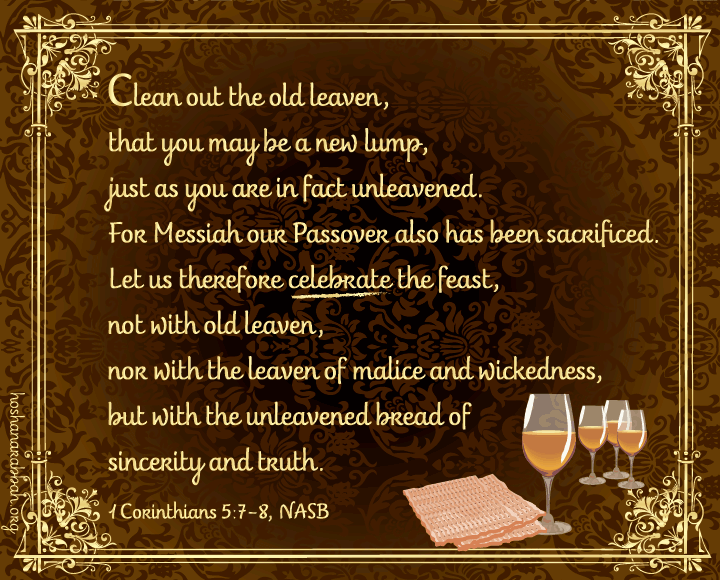
In 1 Corinthians 5 Paul the apostle of Yeshua the Messiah instructs the early Jewish and non-Jewish believers about the spiritual ramifications and significance of the Passover and the biblical Feast of Unleavened Bread. Then in verse eight, he assertively declares, “Let us keep the feast not with the old leaven of malice and wickedness, but with the unleavened bread of sincerity and truth.”
You who call yourselves Christians and who don’t celebrate the biblical feasts including the Feast of Unleavened Bread, what about this command do YOU not understand? How can anyone declare that the YHVH’s biblical feasts were done away with, or were for the Jews only, when the apostle in this letter is addressing the non-Jews as well? How can we justify substituting non-biblical holidays such as Christmas and Easter for YHVH biblical holidays and call ourselves Bible believers and followers and imitators of Yeshua and the early book of Acts church? These are serious questions that many of us need to ask ourselves if we’re serious about our faith walk before YHVH Elohim and Yeshua the Messiah.
1 Corinthians 5:6, Purge out. The greater context of this passage is about putting sin out of our life (which is the temple of YHVH’s Holy Spirit, 1 Cor 3:16–17), which collectively form the spiritual body, church or the greater temple of Yeshua’s spiritual body (John 2:21). Therefore, sin that defiles the temple of Elohim must be put out of the church. In this letter to the Corinthians, Paul is especially concerned about the sin of sexual immorality that the church in Coringh had allowed to come into its midsts (1 Cor 5:1ff). From the context of this passage in light of Paul’s discussion about Passover and the Feast of Unleavened Bread, it would appear that he wrote this letter just prior to the spring festivals (1 Cor 5:6–8). He is urging the church to remove the leavening of sin from its midsts prior to keeping the Feast of Unleavened Bread, which he, by the way, urges the Corinthian believers to do. In fact, Paul’s admonition to “keep the Feast [of Unleavened Bread]” in verse eight, is the strongest imperative command in the Testimony of Yeshua (or NT) to keep the biblical festivals, and from this it’s evidence that in the mind of the apostle the biblical festivals were still relevant to Yeshua’s followers well past the middle of the first century, which means they’re relevant to the saints of today as well.
In his admonition to the Corinthian believers, it’s possible that Paul had in mind two examples in the Tanakh where spiritual revivals occurred after Hezekiah and Josiah cleansed the temple in Jerusalem of the filth of idolatry in preparation for Passover. Similarly, Ezra finished completion of the rebuilt temple in time to celebrate Passover (Ezra 6). These examples teach us that YHVH commands us to cleanse or deleaven our spiritual temples (individually and collectively) of sin annually in preparation for celebrating Passover and the Feast of Unleavened Bread. This spiritual spring house cleaning at the beginning of the biblical new year sets the tone spiritually for the rest of the year to go forward in a sin-free state.
1 Corinthians 5:7, Messiah our Passover. In the Bible, the term Passover refers to both the appointed time or moed and to the sacrifice that was made on that day.
1 Corinthians 5:8, Let us keep/observe the feast. This verse proves several things. First that Paul (a Jewish believer) kept the biblical feasts, that non-Jewish believers kept the feasts, and that all believers could keep the feasts outside of Jerusalem.
Even as Korah rebelled against divinely installed lawful civil and spiritual authority, while at the same time attempting to raise himself up to replace that, similar trends have been occurring in the formerly Christian western nations of the world. Secular humanistic philosophies in their various permutations (evolution, Marxism, socialism,dialectical materialism, leftism, atheism, moral relativism and various other attacks on the Judeo-Christian values that have formed the bedrock of western culture) now dominate all aspects of western society and culture and are in an all out war against biblical values, morals and ethics. When we study the life and tactics of Korah and his band of malcontents, we see similarities between the forces of darkness and rebellion then and now.
Num 15:30 — Wilful sin defined. Penalty for wilful sin is being cut off from Israel (i.e. a death penalty).
Num 15:32–35 — Example of wilful sin given; i.e., a man wilfully violating the Sabbath.
Num 15:37–41 — Wearing tzitzit is an outward visible reminder to help keep one from sinning (violating YHVH’s commands).
Num 16:1 — The rebellion of Korah and company is an example of what wilful sin looks like on a societal level.
Num 16:2 — Korah et al rose up in pride like the Lucifer—the spirit of pride (of sin) and rebellion against YHVH’s commandments (Isa 14:12–17).
Num 16:7 — Pride of those who rise up against YHVH and divinely appointed leadership. In this case, it was pride and rebellion against Moses, who is a prophetic picture of Yeshua, godly leadership, the biblical leadership and the word and commandments of Elohim.
Num 16:10 — This is the cry of the new agers, political leftists, some atheists, Satanists, God-haters and those who are under the control of the spirit of Antichrist. They ardently and petulantly declare that “we’re all the children of God. We’re all holy. We all have the divine within us. We are all gods and goddesses. Follow the cosmic Christ consciousness in you. Each of us can choose to follow our own will, the god within us, and do our own thing. Do what thou wilt is the whole law. If it feels good, do it.”
Num 16:10 — This is the cry of those in our time who are rebellious and antagonistic against YHVH, his word and Messiah and don’t want Elohim to rule over them.
Num 16:19 — Like Korah did, Satan in the end times will gather his rebellious Antichrist forces to oppose forcefully YHVH and Yeshua the Messiah in a final and epic showdown encounter called the battle of Armageddon.
Num 16:20, 24–25 — This verse is analogous to YHVH’s statement in Revelation 18:4 calling for his saints to come out of Babylon the Great in order to escape his judgment against her.
Num 16:25 — As Moses called for the Israelites to separate themselves from rebellious Korah, YHVH is calling his people to do the same now. Similarly, Yeshua called his disciples to the same to follow him (Matt 10:16, 26–39).
Num 16:30 — Those who rejected Moses’ authority including the Torah have really rejected YHVH. Similarly, those who rejected the saints who have, in obedience, placed themselves under Elohim’s authority have not only rejected the saints, but Elohim as well.
Num 16:31–34 — When YHVH returns to judge the earth, he will first judge Satan by casting him into the bottomless pit.
Num 16:35 — After Satan is judged at the end of the last days, then those who rebelled against YHVH, His Torah–word and the Messiah will be cast into the lake of fire (Rev 20:11–15). These spiritual rejects are the wilful sinners who refuse to repent and to submit.
Num 16:41–43 — These Israelites weren’t rebellious per se. They were merely examples of typical, complaining, spiritually lukewarm people. If these lukewarm Laodiceans refuse to repent (Rev 3:14–21), YHVH will consume some of them as he did the Israelites in this story.
Num 16:46–48 — Prayerful intercession saves people. Aaron is a prophetic symbol of Yeshua, or Great High Priest, who is presently at the right hand of Elohim interceding for the saints against Satan, who is the accuser of the brethren. As Aaron risked his life by placing himself between Elohim’s judgment and the people, Yeshua did the same when his gave his life over to death on the cross as he suspended between heaven and earth between humanity and Elohim our Divine Judge.
Num 17 — Aaron’s rod is a picture of the cross. As life came from Aaron’s staff—a piece of dead wood, the same came from the cross and the dead body of Yeshua. Moreover, the almond is the first tree to sprout forth in the land of Israel in the early spring, and is therefore a prophetic picture of life from the dead and fruitfulness. Interestingly, the Jewish sages have a tradition that both the tree of life and the menorah were an almond tree. Both are a picture of spiritual life in Messiah Yeshua.
As we watch the rise of violent rebellion and civil disobedience in western—formerly Christian—nations (and elsewhere), it would behoove us to determine what is at the root and core of this movement, so that we can determine its source and what our response should be.
Human nature has never changed from the beginning of human history to the present. What is happening today has happened before. Only the actors, costumes and theater venues have changed, but the story’s plot is the same from the tree of knowledge in the Garden of Eden until now.
This ever-repeating and sad never-ending story goes like this: Elohim the Creator laid down certain rules and guidelines for humans to follow for their own blessing and well-being. Along came a snake in a tree to dissuade humans to rebel against Elohim’s rule of law, and rebellious and malcontented humans egged on by the same God-hating snake (that is, Satan the arch-rebel) have been marching to the same drum beat ever since.
We see the modern manifestations of this same satanic rebellion in the various current leftist movements that like the many-headed Hydra of ancient Greek mythology have many faces: leftism, atheism, secular humanism, moral relativism, socialism, the rise of the nanny-state, the rise in democratic mob rule, race wars, the attack on Judea-Christians values, the rise of false and Antichrist religious systems, evolution, rebellion against western culture and history and so on.
This is not to say that western culture is perfect and that there aren’t systemic problems that need fixing and that some of the issues of the leftist malcontents aren’t legitimate. There are problems that need fixing, but left’s solution of destroying the biblical foundations of the west is not the answer to the problem. The problem is that the left generally wants to kill, steal and destroy in its effort to supposedly correct the problems in western societies that despite their weaknesses have generally done more good than harm in improving the human condition when held up against the backdrop of human history. And the left has no solutions to the problems of western civilization. Their only solutions is societal upheaval—to kill, steal and destroy. They can’t point to one example past or present where their ideologies have worked. In the wake of leftist ideals there as always been mass bloodshed, anarchy, mayhem, repression, loss of freedom, enslavement and loss of social liberties. Always!
To understand the evil spirit that is behind modern leftism, let’s go back to the Bible to one of the earliest leftists—Korah the malcontent. When we study his character, life and methods of operation, we will see many parallels between him and and the modern rabble rousers who are trying to turn society on its head and usurp authority for themselves.
The Spirit of Korah
The spirit of Korah is currently alive and well on planet earth. The righteous must discern, identify and then oppose this evil spirit. Everywhere in every way, this demonic spirit of rebellion is attempting to destroy the work of YHVH Elohim on earth.
The spirit of Korah is the spirit of rebellion against YHVH and his divine authority and biblical truth. In our society, it is manifested in the philosophies of secular humanism, atheism, the New Age Movement, radical environmentalism, earth worship, progressivism, socialism, Marxism, evolution, which are all aspects of the Babylon the Great, New World Order political-religious system that will oppose the saints of Yeshua and Yeshua himself at this second coming. We also see this spirit at work, supported and encouraged in international politics, in our own government, in our educational systems, in the media, in the false religions of the world, and in the apostate church where foundational Judeo-Christian biblical values are being rejected and even demonized.
The spirit Korah, the rebel, has even worked its way into the modern church system where it is attempting to subvert and pervert the truth of Elohim as revealed in the Bible, and to undermine legitimate, YHVH-ordained authority. Every man becomes his own spiritual leader, refuses the accountability afforded by authentic godly spiritual leadership, and basically chooses to do what is right in his own eyes. Many modern churches are going so far as to water down or reject core biblical truths and values and instead emphasize ecumenism, New Age thought, one-world spirituality and a social activist paradigm. Ultimately, this is a rejection of the divine truth of YHVH Elohim as revealed in the Scriptures.
The rebellion of Korah and his comrades against Moses and Aaron and Elohim’s resulting judgment against them is a prophetic picture of what will happen in the end times against all modern Korah-like rebels. In fact, it is a picture of the judgment of Elohim that will happen to ALL sinners who choose to rebel against YHVH, his will, his Word and truth, his plans and purposes and those on this earth who are carrying out his will.
The spirit of Korah continues to manifest itself in uprisings against godly authority both within the church, and globally as the New World Order, which the Book of Revelation calls Babylon the Great, takes a more strident and virulent stand against Elohim, the Bible and the saints.
The fate of Korah and his band of rebellious malcontents is a prophetic picture of YHVH’s end time judgments against all those who dare to stand against him. The second chapter of Psalm speaks about this:
Why do the heathen rage, and the people imagine a vain thing? The kings of the earth set themselves, and the rulers take counsel together, against YHVH, and against his anointed, saying, “Let us break their bands asunder, and cast away their cords from us.” He that sitteth in the heavens shall laugh: Adonai shall have them in derision. Then shall he speak unto them in his wrath, and vex them in his sore displeasure.… Thou shalt break them with a rod of iron; thou shalt dash them in pieces like a potter’s vessel.
The Spirit of Korah Under a Microscope
Although Korah was a Levite, the grandson of Levi, and therefore a cousin to Moses and Aaron, he was not a priest, but he coveted the priesthood given to Aaron and his sons.
Dathan, Abiram and On were sons Reuben who was the disinherited firstborn son of Jacob and coveted the leadership role over Israel that YHVH had given to Moses and Aaron.
In their minds, this group of men had legitimate and legally based grounds for being discontent. Korah was a Levite and Dathan and his friends were leaders of the firstborn tribe of Israel.
In their minds, they had legitimate gripes against Moses and Aaron. On that basis, they
Numbers 16:4, and accused Moses saying, “You take too much upon yourselves.”
These are the steps that a rebellious malcontent takes in coming against YHVH-ordained authority.
There are biblical or godly ways for the righteous to respectfully redress grievances to authority when they feel injustices have been committed. The daughters of Zelophehad were shining examples of how to do this (Num 36:19). Yeshua also addresses this in Matthew 18 (compare with Matt 5:38–42) as does Paul in 1 Timothy 5:19.
The Scriptures reveal that there are four spheres of YHVH-ordained authority on this earth against humans will typically rebel. One can find the spirit of Korah at work in all of these spheres attempting to usurp authority and foment rebellion. These spheres are:
Parental
Ecclesiastical (church)
Governmental
Employers
Lucifer Was the Original Rebel
Satan is the originator of all rebellion against YHVH-ordained authority. He was the original Korah, and the one behind the Korah’s rebellion. Scripture tells us that Satan
Coveted YHVH’s position of authority,
Gathered together malconent angels to oppose YHVH,
Rose up in rebellion against YHVH,
Falsely accused YHVH to Adam and Eve.
Isaiah records the steps Satan took in rebelling against YHVH’s authority.
How art thou fallen from heaven, O Lucifer, son of the morning! how art thou cut down to the ground, which didst weaken the nations! For thou hast said in thine heart, I will ascend into heaven, I will exalt my throne above the stars of God: I will sit also upon the mount of the congregation [i.e., Mount Moriah], in the sides of the north: I will ascend above the heights of the clouds; I will be like the most High. Yet thou shalt be brought down to hell, to the sides of the pit. (Isa 14:12–17)
Notice all the rebellious “I wills” statements in this passage. Satan the original rebel against YHVH’s rule is the originator of humanism, which is the exaltation of man’s will and authority over that of YHVH.
“Korah” at the Garden of Eden
Satan the serpent was the original Korah. Such rebellion had its roots in the Garden of Eden at the tree of knowledge where the serpent, the archenemy of YHVH enticed man to rebel against YHVH’s divine law, and purported to exalt man to a position to be able to determine for himself what is right and wrong. The roots of modern secular humanism are to be found in the lies of the serpent at the tree of knowledge. For example, the serpent lied when he told humans that they could chart their own course and determine their own ethics or lack thereof without YHVH’s guidance. This approach has led to all the sin and misery on earth to this day!
In modern politics, the democracy movement is a manifestation of the spirit of Korah. In this case, the majority of the people determine what is right or wrong and not the Bible. The problem is that the will of the people is constantly changing with the times, and is dictated by the carnal, fallen, rebellious and sinful natures of humans, and not by the unchanging and divinely revealed truth of Elohim. There are no set standards that determine what is right or wrong, no immovable boundaries, and no points on a compass to guide people in the right direction.
The spirit of Korah ultimately proclaims, “POWER TO THE PEOPLE! GOD IS DEAD or he is at least irrelevant!” In reality, it isn’t power to the people. This is just a smoke and mirrors lie. In reality, it is only power to a small ruling elite who, once in power, lord it over the people, and enslave the people for their own evil and selfish purposes, which invariably involve personal enrichment and the accrual of power to that minority. So, in the end, the people are no better off than they were before—usually worse off. They bought the big lie, and they lost. Satan always promises much, and delivers little, if anything. The results are bondage, misery and ultimately death. This is what Satan, the serpent, did to Adam and Eve, and his tactics have never changed.
The Roots of Babylon the Great—Nimrod Was a “Korah”
The Bible reveals in Genesis chapters ten and eleven that Nimrod collectivized people into cities and founded Babylon. This city state later became a great empire. This was the prophetic forerunner of the end times Babylon the Great of the Book of Revelation.
He put himself in a place where he was before (in front of) YHVH (Gen. 10:9).
Nimrod endeavored to exalt man through human efforts to the level of YHVH by building a tower that would reach to heaven (Gen 11:4).
Nimrod wanted man to make a name (fame, reputation, glory, a memorial) for himself vis-à-vis YHVH. He promoted the self exaltation of man and the diminishing YHVH (Gen 11:4).
As YHVH judged ancient Babylon—it is now an uninhabited desert wasteland in modern Iraq, so YHVH will destroy modern Babylon the Great.
YHVH’s Judgment Against the Spirit of Korah
YHVH will render judgment against those who come under the spirit of Korah. He will not tolerate his plans, purposes and will to be subverted by self-appointed, egomaniacs who go about fomenting discontent and rebellion against Elohim-ordained authority.
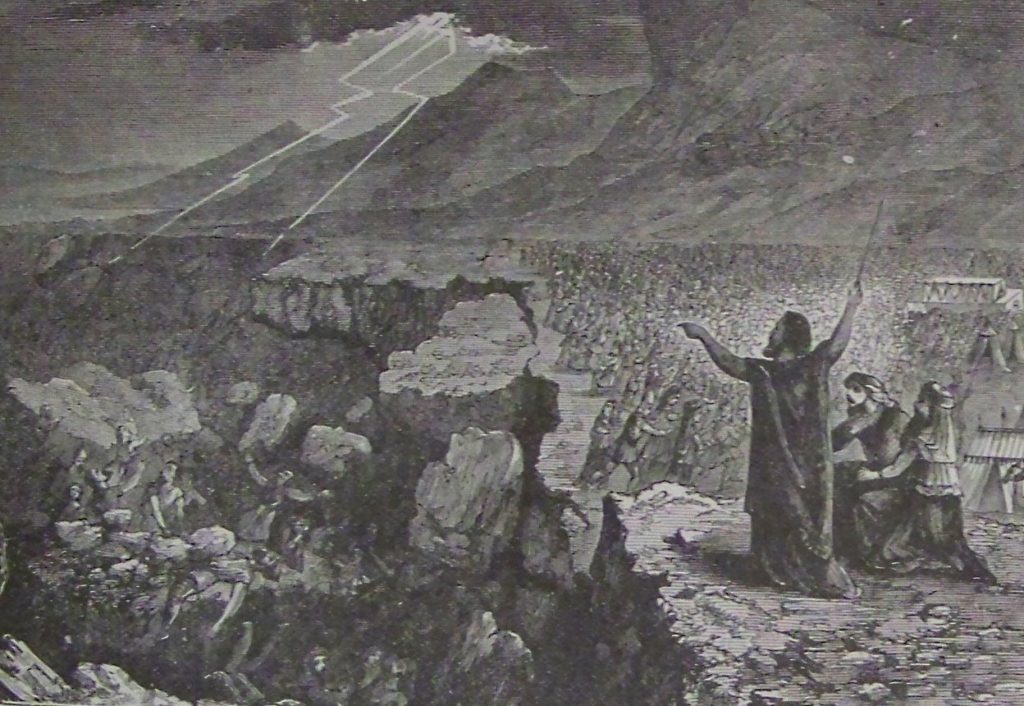
YHVH let us know what he thought of Korah’s rebellion when he caused the earth to open up and swallow Korah and his band of rebels (Num. 16:32). Before judgment came upon Korah, YHVH told those around him twice to separate themselves from Korah (Num 16:21, 24), so that they wouldn’t come under Korah’s judgment. Likewise, in the end times, YHVH is calling his people to separate themselves from Babylon so that they don’t come under the plagues of that end time Antichrist system (Rev 18:4).
Those rebels who were part of Korah’s rebellion who didn’t perish in the pit, were destroyed by fire from heaven (Num 16:35). Similarly, at the end of the age, Yeshua will return to the earth to judge the wicked—those who come under the influence of Satan have attempted to take over the earth and subvert righteousness and enforce their evil agendas upon mankind. What will be their fate? Satan will also be thrown into the bottomless pit as were Korah and many of his followers, and the beast and false prophet will be cast into the lake of fire, even as fire destroyed the rest of the Korah’s rebellious malcontents. At the end of the Millennium, fire will come down from heaven to destroy those from Gog and Magog who under Satan’s influence will attempt to dethrone Yeshua (Rev 19:7–10). After this incident, the white throne judgment occurs where all rebels who have ever lived will be cast into the lake of fire (Rev 19:11–15).
The Book of Jude: Story of Rebellion and Moral Perversion
Jude in his short epistle equates Cain with humanism (i.e., my way, not YHVH’s way), Balaam with greed (the love of money) and Korah with rebellion and lust for power.I advise the reader to review the whole book of Jude in this light.
The main point of Jude is how men rebel against divine authority and turn from the common salvation message of Yeshua and the gospel, which is the faith once delivered to the saints (Jude 3), and embark on a downward path of moral and spiritual decay. The result is that the “grace of Elohim is turned into lasciviousness”(unrestrained moral looseness; verses 7–8). The spirit of Korah uniting with the spirits of Cain (humanism) and Balaam (greed and lust) is about discarding spiritual and moral restraint and turning to moral and spiritual perversion. The modern liberal Christian churches have already given in to this spirit by accepting pedophile and homosexual priests, ordaining of homosexuals, and accepting adultery, divorce, fornication and abortion. The next step on the downward spiral is “denying the Master Elohim and the Master Yeshua the Messiah” (verse 4). These moral and spiritual perverts and apostates do not want Yeshua to be their Lord or Master and to tell them what to do or what is right or wrong. They defy his laws and make up their own humanistic laws. They are so full of lust and perversion that they will deny Elohim before they will reign in their lustful perversions and repent of their evil sin. This is the state of our society religiously and culturally today in the western church!
The message of Jude is a prophetic warning to the end-times saints not to go buy into the lies of the serpent, and to not rebel against the laws of Elohim, the Creator. In Jude 11, YHVH says, “Woe” to those who go in this direction in following the examples of the evil and rebellious malcontents: Cain, Balaam and Korah.
A Call To Action
What should be the end-time saints response to this epic battle that is occurring between the followers of the serpent and those who choose to obey YHVH? Those who love YHVH’s Torah-instructions and have faith in Yeshua (Rev 12:17 and 14:12) are taking a stand against the spirit of Korah et al when they are returning to the ancient paths of Torah-righteousness. Those who are on this path must dedicate themselves to working tirelessly by being spiritual lights shining in the darkness by obeying YHVH and helping others to see this same light. We must resolve to “earnestly contend for the faith once delivered” (Jude 2) and to “keep yourselves in the love of Elohim, looking for the mercy of our Master Yeshua Messiah unto eternal life” (verse 22). We must determine to be instruments in YHVH’s hands to save others who are sliding downward spiritually. “And others save with fear, pulling them out of the fire; hating even the garment spotted by the flesh” (verse 23).