No, we’re (my wife and I) not asking for money. As many of you know, after 30 years of continuous ministry including 25 years as a pastor, I have never taken an income from the ministry. We use the few gratefully received donations from the beneficiaries of our ministry like you to cover ministry expenses, and we give everything away for free without charge. Rather, I’m asking for your important help in something else—and it is something that you can easily do.
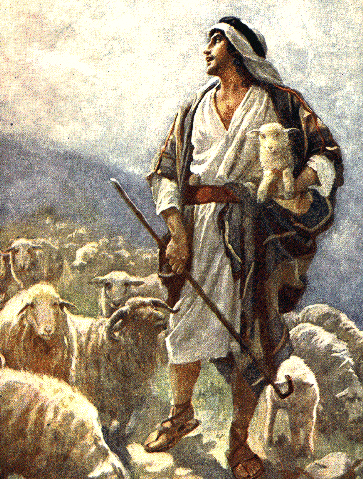
Many years ago, I started this Bible study blog. I put a lot of time into it. Some 20 years ago, YHVH told me to feed his sheep. Growing up on a sheep farm, it was my job to care for the flock as a shepherd—yes, a real, live sheep shepherd of real sheep, so I know what what YHVH meant by feeding his sheep. Currently, this blog, the most active part of our ministry, has been a big part of my helping to feed his sheep.
Over the years, the daily readership of this blog has grown from a few to many hundreds up to a thousand or two per day. It has been a slow, gradual climb. Now I’m not a numbers watcher. I do the same thing in obedience to YHVH’s command to feed his sheep regardless of the size of the floc—something learned on the farm years ago. But the numbers do give one an impression of how many lives are being touched the Kingdom of Elohim, and for this, we give YHVH all the glory!!!
However, last year a strange thing happened. From the fall of 2018 until the spring of 2019, the number of daily readers on this blog was growing each week tremendously until we were averaging 1,200 to 1,500 readers per day. Now considering the population of the planet, that is not very many people, but considering the niche market in which we find ourselves, that is not too bad. Then overnight, in about one day, the numbers of readers suddenly dropped by about two thirds. Whoa, I exclaimed. What just happened? Did algorithms suddenly change? Am I being shadow-banned? Is that even possible on a WordPress website where our website isn’t even hosted by WordPress? Questions and more questions, but not answers.
Well, we licked our wounds and got back to work putting up Bible teachings as always. By the fall of 2019 our numbers were back up there. By spring of 2020, the numbers of daily readers were surpassing those of the previous year. HalleluYah! We’re reaching more lives for the kingdom of heaven and the glory of Elohim. We were reaching nearly 2,000 readers daily. Then all of a sudden, the same thing happened this past spring as happened in the spring of 2019. Almost overnight, our numbers of daily readers dropped by 75 percent or more and have more or less remained at that level until now with perhaps a slight increase. So what’s going on? Don’t know. The message of this blog hasn’t changed. The content is still the same, so it must be something “out there” going on.
Whatever the case, it is all in YHVH’s hands and he can use this blog in any way he chooses. He’s the one who opens doors that no one can shut and shuts doors that no one can open, so my faith and eyes are totally on him. I give it all to him. Frankly I don’t care. I just want his will to be done for his glory. Nothing more or less.
But here now is my request for YOUR help. It’s a simple one. If this blog is a blessing to you, please refer it to others who you think may be blessed by it. That’s all.
Love and blessings to you all in Yeshua the Messiah. — Natan Lawrence
The Babylon the Great New World Order is on the march!
The Bible is as relevant today as it was when it was written. Prove this, you may say. Go read Revelation chapters 13, 17 and 18 which were written 2,000 years ago. These ancient prophecies predict what the world will be like just before the second coming of Yeshua the Messiah (Jesus Christ). What it predicts is a Satanic global government that will dictatorially control the people of the earth through a tyrannical, fascistic system involving economic, religious, mass media drug enslavement run by a cabal of business and government leaders. Go read these chapters in Revelation and discover these truths for yourself; it is all there!
The Bible only gives us the end results of this global takeover by the forces of Antichrist and not the complete details as to how exactly these Satanic elements will impose this end times system upon the people of the earth. It is only common sense that they will do so incrementally so as not to provoke alarm among the masses resulting in a major revolt which they would be powerless to stop. The leftist globalists know that people have to be slowly indoctrinated with the ideology of Antichristism (another term for Leftism and Luciferianism ). This has been occurring in most of our countries for many decades through gradual mass indoctrination via our educational systems, the mass media, entertainment, many liberal churches and government policies and legal actions action at all levels as they imposes their leftist and globalistic ideologies and laws upon the masses slowly enslaving their minds. Once men’s minds are enslaved, then the globalists can begin to impose engineered societal changes upon the duped masses until we have the system in place that the book of Revelation describes.
This one world system that the globalist “elites” (or more accurately Luciferian scumbags) call the New World Order or which the book of Revelation refers to as Babylon the Great is the very system that will persecute the saints resulting in many martyrs in the end times. Yeshua the Messiah will destroy this system and avenge the blood of his saints when he returns to set upon his millennial rule.
Again, the book of Revelation predicts this all to occur. Sorry folks, but there is no pre-tribulation rapture. The “We’re Outa Here Doctrine When YOU Know What Hits the Fan” is an unbiblical lie and a myth. This lie and doctrine of men that has been promoted by those who are ignorant of Scripture, and by those who have something to sell because they do not understand the order of end times events that have been prophetically laid out by YHVH’s seven annual biblical feasts or holidays.
The following article is but one example that could be given of how the globalists are endeavoring to impose their one-world system upon you and me. To accomplish this, they must have a compliant and subservient citizenry. Those who resist them and refuse to comply will be made an example of and the government will persecute or destroy them into silence.This is how leftist totalitarians systems have always operated. Nothing has changed. Go read your history book; it is all there. Read the following article prayerfully and go check out the prophecies of the book of Revelation chapters 13, 17 and 18 and see what I’m talking about.
From Lockdown to Police State: The “Great Reset” Rolls Out
On August 2, lockdown measures were implemented in Melbourne, Australia, that were so draconian that Australian news commentator Alan Jones said on Sky News: “People are entitled to think there is an ‘agenda to destroy western society.’”
The gist of an August 13th article on the Melbourne lockdown is captured in the title: “Australian Police Go FULL NAZI, Smashing in Windows of Civilian Cars Just Because Passengers Wouldn’t Give Details About Where They Were Going.”
Another article with an arresting title was by Guy Burchell in the August 7thAustralian National Review: “Melbourne Cops May Now Enter Homes Without a Warrant, After 11 People Die of COVID — Australia, This Is Madness, Not Democracy.” Burchell wrote that only 147 people had lost their lives to coronavirus in Victoria (the Australian state of which Melbourne is the capital), a very low death rate compared to other countries. The ramped up lockdown measures were triggered by an uptick in cases due to ramped up testing and 11 additional deaths, all of them in nursing homes (where lockdown measures would actually have little effect). The new rules include a six week curfew from 8 PM to 5 AM, with residents allowed to leave home outside those curfew hours only to shop for food and essential items (one household member only), and for caregiving, work and exercise (limited to one hour).
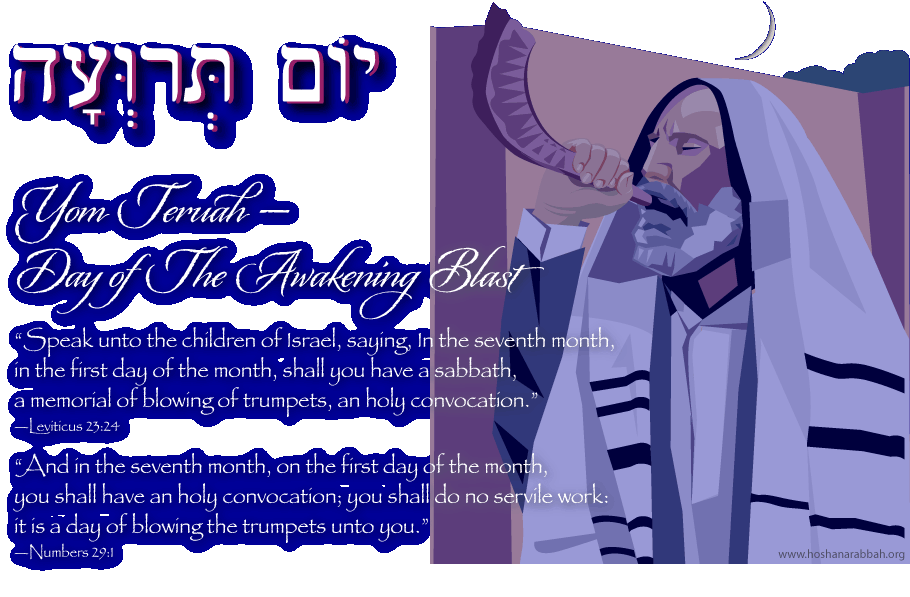
This weekend (likely on Shabbat/Saturday—if the new moon is spotted in Israel, which it likely will be) will be the biblical feast called Yom Teruah or the Day of Shouting/Shofar Blasts. I will be celebrating it along with members of my family. Yom Teruah is one of YHVH’s seven commanded biblical feasts, and the first feast of the fall season. Ten days after Yom Teruah comes Yom Kippur (the Day of Atonement), then five days after that comes Sukkot (the Feast of Tabernacles), and finally the next day after the end of Sukkot is Shemini Atzeret (the Eighth Day). All of these feasts are prophetic with regard to future events that were to or will occur, and each one is a progressive step in YHVH’s plan of salvation for the saints. Below is all you ever wanted to know about Yom Teruah and then some. Please enjoy!…
“Arise thou that sleepest, and arise from the dead, and Messiah shall give thee light.” (Eph 5:14, also 8–16)
Yom Teruah—The Day of Trumpets or Shofar Blast
The Historical Roots of Our Faith, Present Relevance for Believers and Prophetic End-Time Implications
Yom Teruah or the Day of Shouting; the Shofar Blasts (commonly called “Rosh Hashana”) occurs at the end of the summer months and marked the beginning of the fall harvest or festival season for the ancient Hebrews. Prophetically, the summer months between the spring feast of Shavuot/Weeks (Pentecost) and the fall feast of Yom Teruah is a spiritual picture of what is often called the “Church Age,” which is the period of time from the Feast of Pentecost in Acts 2 until the return of Yeshua the Messiah at the end of the age and lasting for approximately 2000 years. For many, especially those living in hotter climes, summer is a time of leisure, vacation, weariness and fatigue due to the excessive heat. Likewise, many Bible believers have fallen asleep growing spiritually weary while waiting for the return of the Messiah. Yeshua discusses this issue in the Parable of the Ten Virgins (Matt 25) who all grew weary and fell asleep awaiting the coming of the Bridegroom (Yeshua).
This all changes on the first day of the seventh month of the biblical Hebrew calendar when off in the distance the sound of a shofar blast suddenly pierces the atmosphere and registers in the eardrums of those who have fallen asleep. Not only does this shofar blast signal the beginning of the seventh month when the new crescent moon is sighted, but it announces the return of the Bridegroom (Yeshua) coming for his bride (the virgin saints). As in the Parable of the Ten Virgins, the cry went forth that the bridegroom was coming and all awoke from their slumber to prepare for his arrival. In these end days, that cry is going forth even now for all to hear, to awake and to prepare for the arrival of Yeshua the Messiah.
In the biblical calendar, the visible sighting of the crescent new moon always marks the beginning of the month and is announced by the shofar blast (Ps 81:3). Likewise, on the first day of the seventh month of the biblical calendar, the arrival of the new moon (called Rosh Chodesh) when the shofar sounds marks the beginning of Yom Teruah. This is the first day of the fall (festival) harvest season and is the time when the call goes out for the spiritual drowsy to awake, and to hear the voice of YHVH, to be invigorated by the breath or voice of the shofar, which is symbolic of YHVH’s prophetic word or oracle going forth across the earth in the last days.
Furthermore, the ram’s horn shofar is bent into a curved shape to represent the contrite heart of both the blower and the hearer. This is the season for the righteous to bend their hearts in humility and contrition before YHVH and repent of spiritual lassitude and lukewarmness and to awake to spiritual action and preparation, for the fall feasts point to awesome end time events that will occur at some point in time in the near future. It is a time to be refreshed by the breath of YHVH, and a time of new beginnings. Let YHVH breathe on you, revive you and empower you as you enter into the fall biblical festival season, and as you prepare to meet your King and Redeemer, Yeshua, in the air.
Yom Teruah also begins a season that prophetically speaks of war and battle, for in ancient times the shofar was a weapon of warfare in Israel, and it will be used again as such in the end times. It was used to call Israel to battle, to defeat her enemies with the help of YHVH. The shofar was then used to proclaim victory after the battle was won and to worship YHVH who had given them the victory. The battle against Israel’s enemies still rages on—even in the end times. Today, the enemies of the redeemed Israelites are mostly spiritual. They are the world, the flesh and the devil (Jas 3:15; Eph 2:2–3). Through faith in Yeshua the Messiah who defeated death, hell and the grave, we can have victory over mortality, sin, the devil and this world (1 Cor 15:51–57; Rom 8:27; 1 John 4:4; 5:4; Rev 12:11). As we hear the sound of the shofar calling us to arise from spiritual slumber, YHVH is telling his people to become overcomers, so that they may be worthy to partake of the glories of his eternal kingdom (Rev 2:7, 11, 17, 26; 3:5, 12, 21).
Yom Teruah is also the time of the reaping of the summer harvest. Spiritually speaking, this period will be the time of the reaping of the righteous to their reward (Rev 14:4) and the harvest of the wicked to the great winepress of Elohim’s wrath (Rev 14:14-20). It is the time of the resurrection of the dead in Messiah Yeshua at the end of the tribulation (Matt 24:29) and the beginning of Elohim’s wrath being poured out upon the nations (see Joel 3:11-13). This begins the wrath of Elohim time pictured by Yom Kippur (the Day of Atonement, which occurs ten days after Yom Teruah) before which time the dead saints will have been resurrected and given their spiritual, glorified, second Adam bodies.
The Bible explicitly and implicitly delineates certain standards that must be met before one can assume leadership roles over the people of YHVH. Israelites should know what the Word of Elohim demands of leaders, and should expect leaders to meet those biblical standards. If they don’t, Israel should reject such individuals.
These standards must apply to leaders over and within congregations. Many individuals who are in ministry are not associated with a congregation, so it may be questioned whether these standards should apply to them as well. It seems self-evident that the same biblical standards that apply to leaders within a congregational context should also apply to itinerate minsters, while not connected to or holding leadership in a local congregation, yet they minister to local congregations, and therefore, are perceived to be leaders and elders within greater Israel by those they teach. Therefore, we take the approach that these ministry standards apply to all leaders within the spiritual body of Yeshua whether they are connected to a local body or not. The body of Yeshua is a interconnected, and all must be playing by the same rules, and be held to the same standards.
We draw, furthermore, from the whole counsel of YHVH’s Word (i.e., Genesis to Revelation) guidelines for leadership qualifications. YHVH’s standards of righteousness for his leaders has not changed over the ages, for he has not changed. His character is inviolate and immutable, and what he requires of those whom he has appointed as servants over his people has not changed and is based on his character, which defines his standards of righteousness.
Prevalent Non-biblical Standards for Leadership
Within the Christian church and, as an offshoot of that, within the Messianic Israel, Messianic Jewish or Hebrew Roots movements, there are many non-biblical standards that, in the eyes of many people, qualifies a person for leadership roles within the body of Yeshua. These “qualification,” in fact, may or may not meet YHVH’s standards of leadership. Some of these “qualification” include:
Self-appointment resulting in the formation of a “successful” ministry.
The use of ecclesiastical titles, the earning of academic degrees.
Popularity among men.
Oratory and public presentation skills.
Professional-looking packaging of persons, ministries, websites and materials to merchandized.
The size of one’s following, mailing list, ministry, or all the material trappings associated with the ministry.
Length of time in the ministry.
Acceptance among peers and within the church.
Financial success.
The number of books published, the number electronic media one has been on.
The Bible nowhere indicates that any of these criteria necessarily qualify one to be in a leadership role. In fact, the biblical record clearly shows that usually the more popular (among men) and successful (by worldly standards) religious leaders were, in fact, more unpopular with YHVH. Yeshua, for example, when addressing the religious leaders of his day, emphatically stated that that which is highly esteemed (uplifted, eminent, exalted, influential or honorable) of men is an abomination (a foul thing, detestable or idolatrous) in the sight of Elohim (Luke 16:15). Why is this? Because YHVH looks at the heart of man, not on the outward appearance of things (1 Sam 16:7; Isa 29:13; Matt 15:8). YHVH sees the true content of a man’s character, which is often hidden under the false facade of appearance.
Biblical Standards of Leadership
What are some of the more obvious biblical standards that must be applied to all spiritual leaders in our day? Those leaders who reject any of these criteria we reject them as not meeting the biblical standards of leadership. The following is a list of criteria that one must meet in order to meet the qualifications of biblical leadership.
What follows is based on my personal experience of pastoring for more than 25 years 18 of which I was the head elder of the congregation my wife and I founded. I hope that you will find this information to be helpful. — Natan
Over the years, many people around the world have asked for my advice about starting a Hebraic home fellowship or congregation. I tell them all the same thing: I learned to pastor through the school of hard knocks with guidance from no one, although I sough it to no avail. Sadly, I had no one to mentor me. As a result, I made a lot of mistakes and learned by trial and error. Therefore, I’m happy to advise people in any way I can, so that they don’t make the same mistakes that I made. That is the purpose of the following article.
My wife and I started and pastored a Hebraic congregation in 1998 that met in our home for more than two years. When we outgrew our home, we rented a church building for another 15 plus years until the fall of 2016.
As a result of our experience, dozens of folks have asked my help in mentoring them in starting Hebraic fellowships. To date, I have put nothing in writing on this subject until now. Perhaps some of the questions and suggestions below will be of value to those people daring enough to start a fellowship.
A Word to Those Desiring to Start a Fellowship
Before giving instructions to Timothy about the qualifications for being an elder, Paul had this to say about those desiring to serve as leaders in the congregation of the saints:
This is a faithful saying: If a man desires the position of a bishop, he desires a good work. (1 Tim 3:1)
Desiring to start a fellowship is not a bad thing—especially if the Spirit of Elohim is leading you to do it. If not, forget it. What’s not of YHVH will fail. If the Spirit is directing you, and you’re not being led by the dictates of your own carnal heart, then there are some things you need to consider first before launching out.
Are You Willing to Pay the Price?
Before starting a fellowship, one must ask oneself some hard questions. One must first count the costs; it’s going to “cost” you more than you think. Are you willing to pay the price?, Yeshua taught his disciples.
For which of you, intending to build a tower, does not sit down first and count the cost, whether he has enough to finish it… (Luke 14:28)
Now let’s read the full context of Yeshua’s statement.
“If anyone comes to Me and does not hate his father and mother, wife and children, brothers and sisters, yes, and his own life also, he cannot be My disciple. And whoever does not bear his cross and come after Me cannot be My disciple. For which of you, intending to build a tower, does not sit down first and count the cost, whether he has enough to finish it—lest, after he has laid the foundation, and is not able to finish, all who see it begin to mock him, saying, ‘This man began to build and was not able to finish.’ Or what king, going to make war against another king, does not sit down first and consider whether he is able with ten thousand to meet him who comes against him with twenty thousand? Or else, while the other is still a great way off, he sends a delegation and asks conditions of peace. So likewise, whoever of you does not forsake all that he has cannot be My disciple. (Luke 12:27–33)
It is true that Yeshua was specifically speaking about evangelizing the lost, and not leading a congregation, but many of these same instructions still apply for those in pastoral ministry. For example, one never knows whether that person who is walking into your congregation is even saved, whether they are demonized or are just plain troubled people or flat-out troublemakers. A pastor will have to deal with all of the above…
To his disciples, when he first commissioned them to go out two by two to preach the gospel, Yeshua additionally said,
“Behold, I send you out as sheep in the midst of wolves. Therefore be wise as serpents and harmless as doves. But beware of men, for they will deliver you up to councils and scourge you in their synagogues.…Now brother will deliver up brother to death, and a father his child; and children will rise up against parents and cause them to be put to death. And you will be hated by all for My name’s sake. But he who endures to the end will be saved.… A disciple is not above his teacher, nor a servant above his master. It is enough for a disciple that he be like his teacher, and a servant like his master. If they have called the master of the house Beelzebub, how much more will they call those of his household! (Matt 10:16–17, 24–25)
Now you may want to start a fellowship that involves only your spouse, some family members and a few close friends with whom you already get along and agree, but what happens when other people want to join your group who you don’t know? What happens when these new folks have different ideas of how a congregation should be run, have conflicting biblical understandings and doctrinal views and turn out to be vocal, complainers, contentious or outright wolves in sheep’s clothing? What then? You’re happy little group is no longer!
Over the years, we experienced this countless times, and over the past 20 years I have advised dozens of pastoral leaders who were going through the same trials. Don’t think it won’t happen to you; it will. You are not exempt from this trial by fire, for people are people. Yeshua experienced it, as did the apostles as well as the prophets before them all the way back to Moses in his struggles leading the children of Israel through the wilderness. This is because people are people, and the devil is working behind the scenes to steal, kill and destroy anything that is good.
One more thing: are you willing to have even those of your own household turn against you? Yeshua declared that his disciples must be willing to give up all to serve him.
“Do not think that I came to bring peace on earth. I did not come to bring peace but a sword. For I have come to ‘SET A MAN AGAINST HIS FATHER, A DAUGHTER AGAINST HER MOTHER, AND A DAUGHTER-IN-LAW AGAINST HER MOTHER-IN-LAW’; and ‘A MAN’S ENEMIES WILL BE THOSE OF HIS OWN HOUSEHOLD.’ He who loves father or mother more than Me is not worthy of Me. And he who loves son or daughter more than Me is not worthy of Me. And he who does not take his cross and follow after Me is not worthy of Me. He who finds his life will lose it, and he who loses his life for My sake will find it. (Matt 10:34–38)
The problem is that nearly everyone thinks that they’re an exception to the rule—that what Yeshua predicted would happen to his disciples who choose to serve him won’t happen to them. Before I started pastoring, I didn’t take Yeshua’s warnings seriously. How could I? I didn’t know what I didn’t know! No one ever told me what to expect, except Yeshua, and, honestly, I thought that, for some strange reason, his warning wouldn’t come to pass in my own life. I was sure mistaken! Moreover, I doubt seriously that few professors in Bible college teach this either. This is probably because they have little or no real world experience leading a congregation. That’s why they know little about the real price that pastors and leaders have to pay to be true disciples of Yeshua.
Consider this. How did Yeshua’s apostles view themselves after having served him for years? As his bondservants (or slaves; Rom 1:1; 2 Cor 4:5; Gal 1:10; Eph 6:6; Phil 1:1; Col 4:12; Tit 1:1; Jas 1:1; 1 Pet 2:16; 2 Pet 1:1; Jude 1:1). Yes slaves! This is not a bad, but a good thing. Would you rather be a slave to the world, the flesh and the devil or to Yeshua? It’s either one or the other; there’s no middle ground in this game! There are great spiritual rewards for serving Yeshua, but most of them will be in the next life. The price is high, the cost is much, but the rewards are worth it to be a servant, yes, a slave, of the Master.
Some Hard Questions to Ask Yourself
Before starting a fellowship, ask yourself these hard questions:
Let the Truth of YHVH’s Word ring clearly like a bell in the hearts and minds of Truth-seekers everywhere!
What follows you have probably never heard before. Hopefully the truth of it will ring loudly like a bell in your heart and mind!
What is the main theme of the Epistle to the Hebrews? For certain, The the author is not debating about the validity of the Torah-law of Elohim. To say that he is to miss the whole point of the book. Rather he is discussing whether the Levitical system with its sacrifices and various rituals involving the Tabernacle of Moses (and later the temple in Jerusalem) is still valid or not.
Why is this such an important issue in the author’s mind? Simply for this reason: the temple is about to be destroyed or has already been destroyed along with its Levitical and sacrificial systems. This begs the question: How are the saints of Yeshua now to view the temple with its rites?
There is debate among scholars as to when this epistle was written, but it is commonly accepted that it dates to around A.D. 70, which is when the Romans destroyed the temple in Jerusalem along with its sacrificial system and Levitical priesthood. Therefore, of paramount importance in the mind of the author is the issue of the relevance, if any, the Levitical and sacrificial systems had in the life of the disciple of Yeshua. We see throughout this epistle that it is the author’s position that these systems in every way pointed to Yeshua and were thus fulfilled by his life, death, resurrection and current intercession on behalf of the believer at the right hand of his Father’s throne in heaven.
Again, what is not an issue in the author’s mind is whether YHVH’s Torah-law is valid or not. This was never the issue in this epistle, even though the mainstream church has erroneously and traditionally made it the issue as its advocates twist and mangle the Scripture to say what they want it to say instead of what it actually says. Just because a thousand, million or billion people scream in unison that two plus two equals five, that man descended from the cousins of apes or that the earth is flat does not make it so. The same is true when Christian theologian existing in an echo chamber of their own construction scream and declare that the book of Hebrews is in some way invalidating the Torah.
True, the Levitical system was an aspect of Torah, but it was given to the children of Israel after YHVH had initially revealed his Torah-law to them at the foot of Mount Sinai. The Levitical and sacrificial systems were temporarily added to the overall Torah (Gal 3:19) after the golden calf incident as a way to help the Israelites spiritually by preventing them from falling into idolatry again. It was designed to guide them in the path of righteousness. The Levitical system was, therefore, a temporary parenthetical subordinate subset of the Torah in place until the Messiah would come to which the whole system pointed. Whether it was no permissible to steal, murder, lie, commit adultery, worship idols, practice witchcraft, have sex with animals, keep the Sabbath and biblical feasts was never the issue of this book or anywhere else in the Bible including Paul’s epistles.
At issue in the author’s mind is whether the temple service was still needed some forty years after the death and resurrection of the Messiah, who himself predicted the demise of the temple along with its sacrificial system. Was the impending destruction at the hands of the Romans the fulfillment of Yeshua’s prophecy? Until that time, the temple in Jerusalem had played such a central role in the lives of religious Jews everywhere including, to some degree, the apostles (as the book of Acts indicates) that the idea of its irrelevance is an issue of extreme importance and to be carefully considered. The author of Hebrews is wrestling with this whole idea and because the temple’s destruction is imminent (assuming Hebrews was written before A.D. 70), or had just happened (if the epistle was written just after A.D. 70), he has to convincingly make the point, from Scripture, that the temple and its rites are now irrelevant for the disciple of Yeshua. Therefore, in ana effort to prove that the Levitical and sacrificial systems are now longer needed, the whole book of Hebrews is about transferring the believers’ focus away from a physical and earthly temple with its rites and ceremonies and, instead, to lift the focus of the saints’ collective gaze into the heavens where the true and eternal temple of Elohim exists (after which the earthly tabernacle and temple were patterned) and where Yeshua the Messiah is currently ministering as our Great High Priest. This is the whole purpose of the Epistle to the Hebrews—to glorify Yeshua the Messiah and to fix our attention on him and him alone!
Our new annual Scripture Reading Schedule for 2020-2021 with daily readings that begins 10/11/20 is now available to download and print. The link to the current 2019-2020’s Scripture Reading Schedule will still be available on the right sidebar under “Helpful Links” into next year. If you are using a mobile device or tablet, the link may be below, meaning you’ll need to scroll down instead.
Most of this week’s blog discussion points will be on these passages. If you have general comments or questions on the weekly Scripture readings not addressed in a blog post, here’s a place for you to post those. Just use the “leave a reply” link or the “share your thoughts” box below.
The full “Read Through The Scriptures In A Year” schedule, broken down by each day, can be found on the right sidebar under “Helpful Links.” There are 4 sections of scripture to read each day: one each from the Torah, the Prophets, the Writings, and from the Testimony of Yeshua. Each week, the Torah and haftarah readings will follow the traditional one-year reading cycle.
Weekly Blog Scripture Readings for 9/13 through 9/19/2020.