James 2:20–24, Faith without works is dead. James is referring here to the works of faith, not the works of the law. No man can live a good enough life to be saved by his Torah-obedience or the works of the law (Rom 3:20, 28; Gal 2:16; 3:11).
At the same time, faith in Elohim is more than just mental ascent—“a knowing in your heart.” It has to be backed up by action (and we’re not talking about the works of the law). For example, when Elohim told Abraham to leave Babylon or to sacrifice Isaac, he obeyed by leaving that country and moving to Canaan.
Moreover, many were healed in Yeshua’s ministry because they had faith in the Master and backed that faith up with corresponding action, which was the evidence of their faith. This faith-action continuum had nothing to do with Torah-obedience per se, but had everything to do with “putting your money where your mouth is” by backing up your faith or belief with action.
It is this kind of faith that James is talking about here, and this in no wise contradicts the teachings of Paul who said that no man is justified by the works of the law. When Paul declares in Ephesians 2:8–9, “For by grace you are saved through faith, and that not of yourselves; it is the gift of Elohim, not of works…,” he was correct and not opposed to James. What’s more, Paul goes on to say in verse 10, “For we are [Elohim’s] workmanship, created in Messiah Yeshua for good works…that we should walk in them.” These good works (i.e. obedience to the Torah) are the fruits, evidence or proof of our salvation and are the works that back up our faith.
So, in summary, the Bible teaches that we need the faith (a heart that believes and wants to obey Elohim) to lead us to salvation, as well as the works of faith after we have received Elohim’s free gift of salvation as evidence that we are saved. This fact in no way contravenes the reality of salvation by grace through trusting belief in Yeshua the Messiah, which is apart from the works of the Torah-law.
Leviticus 25, in part, lays out Israel’s social welfare and economic system. Basically, it was a free market capitalistic economic system where private individuals owned property and small businesses and controlled the means and productions of goods and services, and the central government’s involvement in the lives of people was minimal. This is not the case in a purely socialistic (a Marxist or communistic) economic system where the government owns much or most of the property and controls, to one degree or another, the means and distribution of goods and services, and where government regulation of people’s lives is tremendous. The capitalistic system that YHVH gave to Israel, however, contained some quasi-socialistic checks and balances in that greedy or even exceptionally gifted and ambitious individuals couldn’t become excessively rich at the expense of the poor.
Socialistic economic philosophy demands that the wealth of the nation be equally distributed among everyone including the poor. This may sound good in theory, but it doesn’t work. In reality, socialism stifles individual initiative by punishing (often through taxation and other means of wealth confiscation and redistribution by the government) those who, through hard work, sacrifice, initiative, and inventiveness have become wealthy. So, it stands to reason, why should the wealthy work hard if the fruits of their labors will only be confiscated and be given to the poor or the “have nots, ” or to those who refuse to work?
At the same time, capitalism is also a flawed system, since in time, the wealthy often end up owning much of the land and control most of the wealth. Human nature being what it is, the greedy wealthy will turn a capitalistic system into oligarchic capitalism where only a few rich capitalists control nearly everything including the economic and political systems. This is the end times system that is described in Revelation 13 and 18 and is called Babylon the Great. Such a system ends up enslaving people through economic and political means, thus creating a veritable feudalistic-type serfdom where rich and powerful business oligarchs who control the government are the new nobility (see Rev 18:13, 23).
With these things in mind, as you are reading through chapter 25, notice how YHVH instructed the poor to be cared for. There was no government welfare system based on taxing the producers and giving to the non-producers. Everyone worked for their living. In fact, the Torah commands everyone to work for six days, and then to rest on the seventh day (Exod 20:9). Sloth and laziness weren’t optons. Even the extremely impoverished were expected to harvest food from the agricultural fields. At the same time, those who owned the fields were to leave the corners of their fields unharvested and not to glean their fields, so the poor would have something to harvest (Lev 23:22; the Book of Ruth). In the Testimony of Yeshua, fathers were expected to provide for their households. Those who didn’t were considered worse than heathens (1 Tim 5:8). Similarly, widows under the age of 60 were expected to support themselves through their own work, while those over the age of 60 could be supported by the local church, but they had to recompense the church through acts of service (1 Tim 5:9–14). Once again, the Bible in no way allows for or promotes a system of government handouts. Except in rare situations, everyone was expected to work.
In this chapter, we also see how the Bible handles the issue of debt, and how it requires people to work to pay off their debts. Bankruptcy wasn’t an option. The Torah allows those in debt to sell themselves into servitude to their debtors through a system called bond service. The debtor would work for the lender until the debts were paid and at the end of seven years all remaining unpaid debts had to be forgiven. This system taught fiscal responsibility to debtors, yet at the same time, it required lenders to show mercy and grace to the poor. Again, the Bible in no way promotes a system of government welfare handouts. Everyone had to work. If you didn’t work, you didn’t eat (2 Thess 3:10). Only the extremely poor who were unable to make a living (e.g. widows and orphans) were cared from the public coffers (Deut 14:28–29; 26:12–13). The Levites were care for publicly as remuneration for caring for and teaching the people spiritually. They also worked as farmers and tradesmen.
Notice how the jubilee year prevented the wealthy from acquiring all the land, and how every 50 years there was a redistribution of land, so that those who through sloth, mismanagement of their resources, or through unfortunate circumstances lost their land could get their land back. Such individuals were mercifully given a second chance to start over again and to learn from their past mistakes. Lending to the poor was encouraged, and the charging of interest to them was prohibited.
As you read through this chapter, consider how YHVH deals with the perennial social and economic ills that have plagued the world from time immemorial compared to how men currently deal with these same problems, and usually end up making matters worse.
Though it would be difficult to implement such a system in our highly collectivized and industrialized society of today, it is likely that in the future, during the Millennium, when the Torah will be the rule of the earth and an agrarian society will likely be the dominant economic paradigm, that such a Torah-based system will once again be put in place.
Leviticus 25:2, When you come into the land. TheStone Edition Chumash, translates Leviticus 25:2(b) as follows, “When you come into the land that I give you the land shall observe a Sabbath rest for [YHVH].” Note the emphasized portion. Though the Jewish sages say this does not imply that YHVH rests, it acknowledges the fact that as YHVH “rested” after his creation of the world, so too Israel was to rest in the seventh year from its agricultural work (an activity that allows the created [i.e. humans] to share with the Creator in the act of creation) to commemorate Elohim’s act of creation (The ArtScroll Rashi Leviticus, p. 318). The Jewish sages also note that the comparison between the jubilee and the Sabbath is that both bear testimony to Elohim’s creation of the universe in six days and his rest on the seventh. They further note that the seven years of the shemittah (sabbath year) cycle allude to the six thousand years of history that will be climaxed by the seventh millennium, which will be a period of peace and tranquility (TheArtScroll Stone Edition Chumash, p. 697).
Note how everything ancient Israel did in their day-to-day life brought them into worshipful relationship with their Creator by causing them to recall both what he had done for them (past tense) and what he would do for them prophetically (future tense).
Leviticus 25:4, A sabbath of rest unto the land. The land sabbath teaches us that our means of producing an income belong entirely to YHVH. He gives us life, breath, land, health, eyesight, physical and mental abilities and everything else that we need to survive. Now imagine losing, say, your health or your eyesight? Or due to an illness, suppose through a stroke or an injury to the head, you became mentally impaired. Where would you be financially? We belong to YHVH and he gives us everything we need with which to work our land, do our job, raise our family, educate ourselves, and to exist. Are we as grateful to him as we should be?
Leviticus 25:9, Jubilee. The word jubilee is the Hebrew word yovel (KcUh) meaning “ram’s horn trumpet.” The ram’s horn would be sounded at special events as a proclamation of great joy and jubilation such as would be the case at the commencement of the Jubilee Year when all debts were forgiven, all indentured servants were set free, all land was returned to its original owners, and all agricultural activity ceased for a year of rest. The arrival of the Jubilee Year was announced on Yom Kippur (Day of Atonement) with the blast of a shofar called the shofar hagadol or the great or final shofar blast (to be distinguished from the first and second shofar blasts that occur on the feasts of Shavuot (Pentecost) and Yom Teruah (Day of Trumpets or Shofar Blowing or Shouting) respectively. This same event prophetically corresponds with the return of the exiles (the “lost ten tribes”) to the land of Israel (which is an aspect of what the Jewish sages call the “final redemption”) and the return of Yeshua the Messiah.
Leviticus 25:21, And I will command my blessing.The land sabbaths forced the Israelites to depend totally on YHVH to bless them triple-fold in the sixth year of the seventh seven-year cycle (i.e. the forty-ninth year) of the 50 year jubilee cycle, so that they would have enough food to last in the seventh year (i.e. the forty-ninth year) as well as during year one of the next cycle while awaiting the harvest of that year’s crops. Observing the land sabbath and the Jubilee year was a major act of faith on the part of the farmer, who had to trust that YHVH would bless his crops so abundantly that he could take a year or more off from farming.
Though Israel was given YHVH’s laws concerning the land sabbaths, and though YHVH provided his people with a glorious opportunity to demonstrate incredible faith in him by blessing them abundantly in the sixth year, and see his miraculous provision, thereby strengthening their faith, thereby receiving even more blessings from YHVH the next time, thus strengthening their faith to even a higher level bringing of more blessings, Israel never kept the land Sabbaths for 490 years. Israel took the path of least resistance, which was not to trust YHVH’s Word and his promises, but to trust in themselves and their own reasonings—to follow the dictates of the carnal hearts. This led to the demise of their nation and ultimate captivity for 70 years—one year for each of the 70 land sabbaths they missed during that 490 years. What is our point? All of YHVH’s laws, even the seemingly least important ones, are important and effect not only our lives, but those of future generations, for they set laws of cause and effect into motion that YHVH has spiritually programmed into the universe. When we disobey YHVH, even in the slightest areas, we and our descendants will pay the price for our sins. In our modern godless economic system, observing the jubilee isn’t possible. On an individual basis, however, farmers can practice the land sabbath law as a way to care for the land and to show respect for and trust in the Creator of it.
Leviticus 25:35, If your brethren become poor. What do you do to help the poor? Treating them fairly and helping them when it is in your power to do so is very important in YHVH’s spiritual economy. (In this regard note, how the Testimony of Yeshua defines “pure religion” in Jas 1:27; also see Matt 25:34–46; Gal 6:10; 1 John 3:17–19; Isa 1:17; 58:6–7; Deut 15:7–8.)
Leviticus 25:42, Slaves. The Hebrew word slaves or bondmen is ebed meaning “slave, servant, man-servant, worshiper (of Elohim), servant (of Elohim, e.g. Levite, priest or prophet).” Ebed derives from the basic Hebrew root word and verb, abad, meaning “to work or serve.” The word abab refers to service that can be directed toward people, things or Elohim. In biblical usage, if directed toward things, abad can refer to tilling the earth, dressing a vineyard, working flax or constructing a city. When abad is used in reference to serving YHVH it can refer to Levitical and priestly service. In Hebraic thought, such service is considered joyous, not bondage. This same service can be directed toward pagan deities as well. When used in reference to serving another man, abad transforms into the noun ebed meaning “slave or servant.” As discussed below and as pointed out by The TWOT, the concept of Hebrew slavery isn’t akin to the modern concept of slavery where the slave possesses no basic human rights. This was not the case in ancient Israel. The Hebrew slave, on the other hand, occupied a position of status involving rights and trust. The Torah required this to be case as this and other Torah passages demonstrate.
Leviticus 25:45, You may buy.
Biblical “Slavery” Explained
This passage advocates “slavery” (more like a form of Medieval serfdom) among the Israelites. Yet, this is not the slavery the American Negroes, for example, experienced prior to the Civil War. Moreover, it must be remembered that slavery was rife in the ancient world. Make no mistake, is it still with us today in various forms including in the sex trafficking of both adults and children, in some branches of Islam and elsewhere.
In ancient times, however, often slaves were able to own homes and livestock and to maintain families as was the case with the Israelites in Egypt and the Jews in Babylon. In this case, these slaves were more like servants or feudal serfs. For example, in Israel, the Gibeonites became the slaves of Israel, but they continued to dwell in their own cities, and enjoy Israel’s military protection (Josh 9).
Also, it must be remembered that when Israel conquered an opponents’ land or army, they often inherited slaves from those countries or slaves from other countries the conquered country itself had enslaved. What were the Israelites to do with these people who had been dispossessed of their lands? Send them back to countries that no longer existed, or to which they were no longer welcome? Send them back into heathen situations? Instead, YHVH allowed Israel to bring these captured people into Israel where they could live among a Torah-obedient people who worshipped the God of Israel, YHVH Elohim, and where they would be taught to love Elohim totally and their neighbors as themselves. In time, these slaves would be assimilated into the tribes of Israel through intermarriage and become part of Israel and thus be elevated in their social status. In this sense, slavery was a means of not only assimilating foreigners and illegal aliens, but evangelizing those who found themselves in the lowest echelons of the ancient world. Biblical slavery was ostensibly a way eventually to bring such people into the ways of the Torah and giving them a respected position and inheritance in the land of Israel among the people of Elohim thereby elevating them spiritually and socially from their previous enslaved heathen condition.
Leviticus 25:55, Are my servants [or slave.] Here YHVH declares that “the children of Israel are my slaves [or servants, Heb. ebed], whom I have taken out of the land of Egypt—I am YHVH, your Elohim.” Here YHVH states dogmatically that he brought or redeemed the Israelites out of slavery to Egypt so that they could become his slaves. Does this trouble you? Being a slave o
Over the past 20 years, I, along with the help of my wife, have put together an abundant array of resources to help you to understand and then to celebrate YHVH’s biblical feasts. Here is a list of these FREE resources and the links to find them. Happy studying and then doing for the glory of YHVH, the advancement of his heavenly kingdom and for YOUR spiritual growth and development into the fullness and stature of Yeshua the Messiah!
Happy studying and may you be filled with joy as you learn more about the ways of YHVH and how to step deeper into the river of life in serving and obeying him!
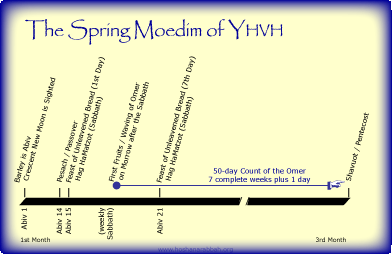
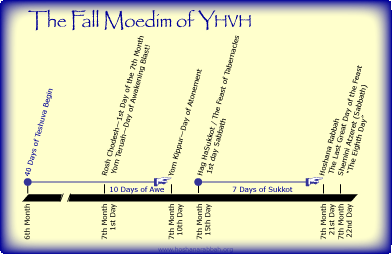
Leviticus 23:2,My feasts [Heb. moedim]. YHVH calls these feasts his feasts. They’re not men’s feasts or the Jewish feasts! They came from YHVH and belong to him. When men pervert YHVH’s feasts by mixing in pagan traditions, they’re no longer YHVH’s feasts, but men’s feasts (e.g. Isa 1:13–15; Amos 5:21; Hos 2:11). When men pollute his feasts and appointed times, YHVH says that he hates them because they’re no longer his feasts (Isa 1:14–15).
In Ezekiel 20, we see that YHVH’s feasts (or sabbaths) are a covenantal sign between YHVH and his people (Ezek 20:12) that they were to live by (Ezek 20:11), yet which Israel, in rebellion, refused to do while in the wilderness. Instead they defiled his sabbaths by, presumably, not doing them and doing other things on those holy days (Ezek 20:13). Israel’s rebellion against YHVH with regard to their refusal to keep his sabbaths brought upon them YHVH’s judgments (Ezek 20:13).
In other words, it was YHVH’s will for the Israelites to keep his sabbaths in the wilderness, but because of their idolatrous rebellion, they refused to do so. In fact, YHVH calls refusing to observe his sabbaths idolatry and for this sin (along with other sins), the Israelites had to wander in the wilderness for forty years (Ezek 20:15–16). In profaning his sabbaths, YHVH accuses the Israelites of despising his Torah (Ezek 20:16). YHVH then goes on to urge his people to not follow the example of their rebellious forefathers, but rather to walk in all of his Torah commands (including his sabbaths, Ezek 20:18–20). Because of their profaning his sabbaths, he punished them by scattering them in exile among the heathens. Those modern saints who refuse to keep YHVH’s Sabbath and feasts are walking in the same sin as the ancient Israelites. Often people who refuse to keep YHVH’s feast days holy do so because the feasts conflict with their secular activities (such as their jobs). YHVH calls this idolatry and being like the heathen (Ezek 20:30, 32). In the end times, YHVH is going to separate his people out from the heathen and bring them back into covenantal agreement with him including obedience to his sabbaths (Ezek 20:33–38). He will purge from his people those rebels who refuse to obey him including keeping his sabbaths (Ezek 20:38), which are a sign of his covenantal relationship with them.
In Genesis chapter one when Elohim created the sun and moon, he called the former “the greater light” and the latter “the lesser light” (Gen 1:16). The former rules the day and the lesser rules the night (ibib.). This is prophetic of the role of Yeshua and the saints in the world.
Yeshua the Messiah is the Light of the world (John 1:6–9; 8:12; 9:5) or the Sun of Righteousness (Mal 4:2) or the Greater Light to show man the path of spiritual light in the darkness of this world. The saints are like the moon or the lesser light that reflects the light of the sun or the greater light into the darkness of this world. Yeshua shines his spiritual light onto his disciples who then take that light and evangelize those lost in spiritual darkness with the message of the gospel. This is the great commission!
The biblical feasts are calculated based on the lunations of the moon. The seven biblical holidays speak of YHVH’s plan of salvation to show man the way to Yeshua who is the Greater Spiritual Light as represented by the sun. The feasts are like a tract or sermon by which the saints preach the gospel message of salvation to the world. The saints as the lesser light reflecting the message of salvation through Yeshua the Greater Light into the darkness of this world through their adherence to the biblical feasts. This is one reason why the moon—the lesser light—is so pivotal to YHVH’s calendar and feasts.
The traditional calendar currently used by the non-believing, rabbinic Jews is off; it’s not in accordance with the moon though the Jews erroneously purport it to be. At the same time, they’re not bringing the gospel message of Yeshua to the world—only the doctrines of men and men’s traditions. Their whole message is askew and fails to reflect the Greater Light of Yeshua.
Similarly, the mainstream church tries to preach the gospel, but without understanding the moon, feasts and biblical calendar their message of the gospel is only a partial one and is also off spiritually.
A time may come in the future when the calendar and feasts will go strictly off the sun and not the moon. This may occur when there is a new heaven and a new earth when Yeshua is ruling on this earth and he will be the only Light of the world. That time isn’t yet, though, for it’s still the saints’ job as the lesser light to be like the moon to reflect the truth of Yeshua, the Greater Light, to this world through a lunar-based calendar upon which the biblical feasts are based.
Exploring the Concepts of Sacrifice, Blood-Letting and Eating Blood
The sacrificing of animals as an act of worship or for any reason is a foreign concept in our modern, secularized society, but this was not the case in the ancient biblical world. Concomitant with sacrifices is the idea of freewill offerings,which, in the ancient world, were often made together as an act of worship to various deities.
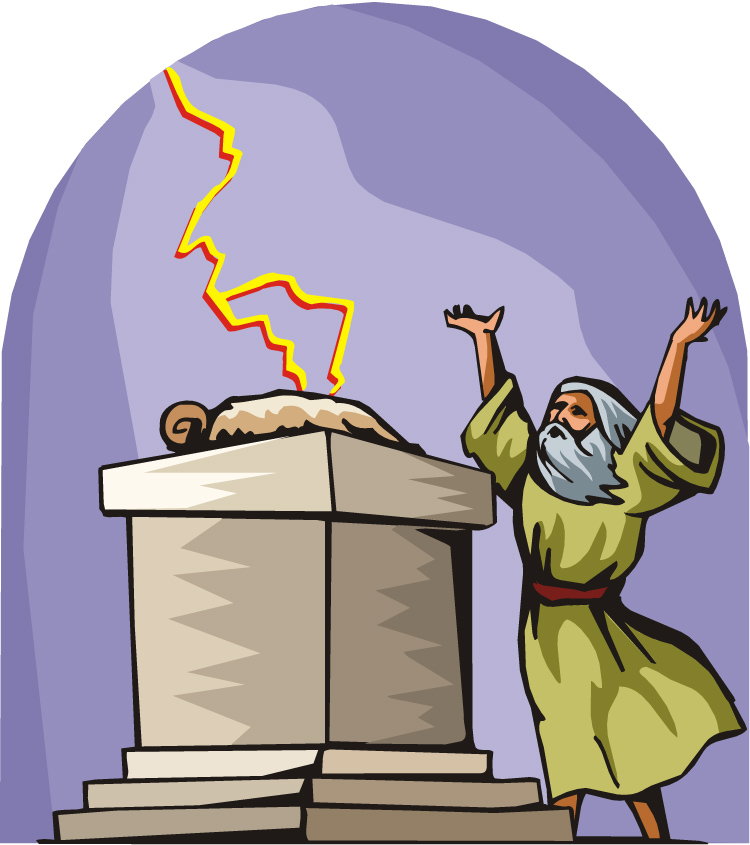
With regard to sacrifices, man’s first act of worship outside the Garden of Eden was to make offerings and sacrifice to Elohim (Gen 4:1–4). Making a sacrifice to Elohim was also Noah’s first act of worship after the flood (Gen 8:20). The same is true of Abraham upon receiving the covenant from Elohim (Gen 12:6). At key points in his spiritual journey, Abraham repeated this same act of worship (Gen 12:8; 13:3, 18). The same is true of the Israelites who after having received the Torah at Sinai made a sacrifice to Elohim as they entered into a covenantal agreement with him (Exod 24:4). Subsequently, YHVH instructed the Israelites to establish an entire sacrificial system as a means to be reconciled to him. Similarly, animal sacrifices and offerings being made to various deities was an important aspect of the heathen cultures of the biblical world. Even in the first century, the Greeks were still sacrificing animals in their pagan temples to their gods and goddesses (1 Cor 8:1–13; 10:20) as were the Jews prior to the destruction of their temple in A.D. 70 (Acts 21:24 cp. Num 6:13–21).
So, in the mind of the ancients, what was the purpose of sacrifice? The ritual killing and offering of an animal was part of a religious ritual either to appease or to gain the favor of a deity.
With this concept in mind, several points should be noted. Man’s rebellion and sin against Elohim in the Garden of Eden caused man to be cut off from his Creator and incur his judgment against man’s sin. The Garden of Eden and the fall of man event is part of the mythos of many ancient civilizations (e.g. Mesopotamian, Summerian, Greek, Indians, Moslem and apparently the Babylonians, Chaldeans, Persians, Egyptians, Assyrians, Ethiopians, Mexicans and Chinese as well), and thus this idea of man’s separation from deity because of his sin informed the ancients of their need to be reconciled to a deity or deities.
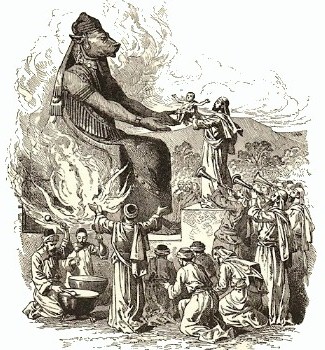
However, it stands to reason that as we move forward in human history and away from the original sin of man in Garden of Eden, where YHVH revealed to man his need for an atoning blood sacrifice, the pure worship of Elohim through sacrifice at the same time became blurry in men’s minds and corrupted by demonic incursions and influences (e.g. Gen 6:2–5). Through subversive activities of Satan the Adversary and his minions, the practice of Elohim’s true religion became perverted and even counterfeited. As a result, men began to worship counterfeit deities of their own concoction that ran cross grain to or were in outright antithetical rebellion to the commandments of YHVH Elohim with regard to the making of offering and sacrifices. Instead of men making sacrifices and offerings to be reconciled to Elohim because of sin, the heathens exchanged the worship of the true Elohim for that of Satan and his evil minions. This resulted in men making sacrifices to appease the anger of their false demon-gods and, at the same time, to curry their favor (for fortune, fame, spiritual power and long life). Over time, man’s sin and his need to be reconciled to the Creator was no longer the focal point of the sacrifice or offering at all. The Israelites, under YHVH’s guidance, on the other hand, kept the true purpose of sacrifice in view. It was for the purpose of atonement for sin in order to reconcile sinful and fallen man to his Creator as Leviticus 17:11 states.
As the biblical narrative reveals, the ancient Israelites were all too easily swayed by the heathen, Canaanite, Baal-worshipping cultures around them whose gods had moral stringencies much less demanding than those of Elohim, and who instead of forbidding sinful acts not only tolerated but often promoted them, even incorporating them into their cult rituals (e.g. ritual temple prostitution and other forms of sexual deviancy including homosexuality). This is why YHVH’s Torah included strict commands against Israel’s fraternizing in any way with the neighboring Canaanites or adopting any of their religious rituals—especially those involving blood and sacrifice, since the Creator originally designed these rituals only for worship, atonement and reconciliation purposes. With this historical backdrop in view, it hopefully should be easier to see why YHVH was so adamant that the Israelites adhere to his strict protocols with regard to making animal sacrifices, while at the same time he prohibited them from following the heathen’s perverted versions of these rituals—rituals that had devolved into outright demon worship (Lev 17:7).
Acts 17:6, Turned the world upside down. Can it be said of us that we have turned the world around us upside down for Yeshua with the message of the gospel? Has the reputation that we are “Bible thumpers” and “Jesus freaks” preceded us as it did these saints in the book of Acts? Are we, as they were, persecuted and badly treated because of the witness of our faith?
Acts 17:11, Searched the Scriptures daily. Let us not forget that the only Scriptures the saints at this time was the Tanakh or Old Testament, which, in itself, contains the entire gospel message and all that humans need for salvation. The Testimony of Yeshua or New Testament is simply “frosting on the cake” in that it merely confirms the Truth of the Tanakh and is the only divinely inspired commentary on the Tankah.
Acts 17:17, Reasoned [discussed or disputed]…in the marketplace. What is our modern market place? With whom in the public arena are we discussing the gospel on a regular basis? Are we being lights on a hill and being salt and light to the world as Yeshua instructed? Let’s be honest. There is always room for improvement in our fulfilling Yeshua’s command, known as the great commission, to go ye therefore into all the world and to preach the gospel.
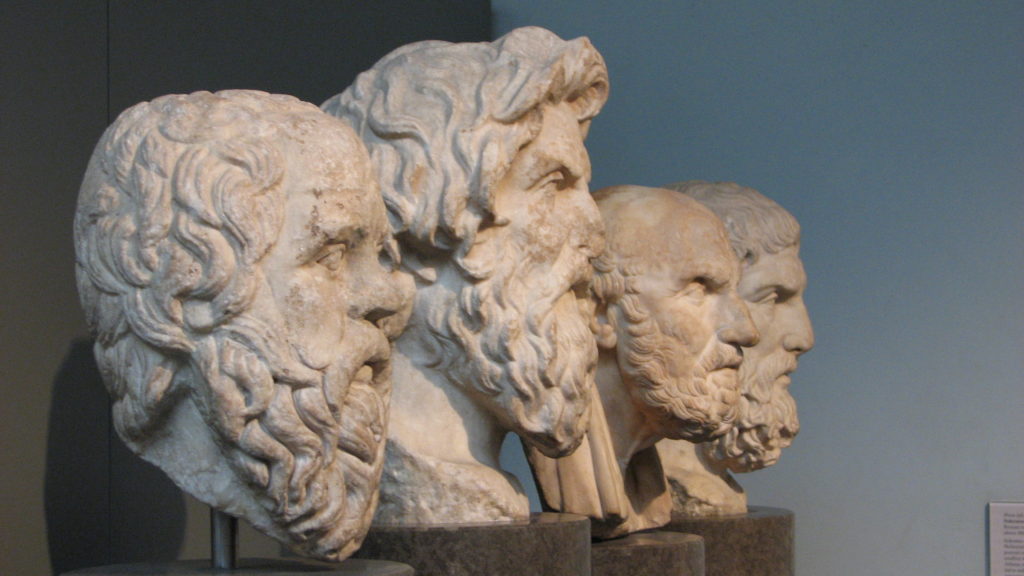
Epicurean and Stoic philosophers. The missionary minded saints of Athens placed themselves in the marketplace of ideas where they reasoned or disputed with the proponents of the leading philosophies of the day including Epicureanism and Stoicism. By that day, belief of divine influence (i.e. god and goddess worship) was waning and humanistic philosophies involving individualistic paths of spirituality were the fad of the day that were replacing organized religion and the superstitious belief systems that accompanied religious systems. This is not unlike our day where church attendance is down and people are seeking spiritual alternatives to fill the void that irreligious lifestyles and secular mindsets leaves in their wake. The saints’ response to this religious confusion in society was to preach the gospel and to reason with those who were lost and confused.
In light of this present societal condition, what is the evangelistically mind saint supposed to do?
Before answering this question, an issue first needs to be discussed. A problem exists in our day that did not exist in the days of the first century believers. The secular Greeks had never heard the gospel message before, and so it was a new and potentially exciting philosophy. We, now, are confronted with the reality that most people have heard of Christianity, about the Christian church and know something about the gospel, even though it may only be a sparse tidbit of information or some twisted caricature of the truth. Nevertheless, most people, based on this scanty or misguided perception, have chosen to reject the message of Yeshua the Messiah, and so preaching the gospel to those who have wilfully closed and hardened their hearts and minds to the good news provides a challenge to those seeking to fulfill the great commission of Yeshua to preach the gospel to the world.
Upon closer look, the philosophies of ancient Greece are not all that dissimilar than many of the prevailing and popular spiritual and philosophical paths that people are following in our day. For example, Epicureanism was a philosophy that sought to enjoy this physical life to the fullest without going to extremes. It championed the idea of self-fulfillment and trying to be a basically good person, while, at the same time, indulging the physical senses and satiating the basic pleasures of the flesh. Does that not sound like a lot of people we know who try to live a good life while having fun and refusing to be constrained by the strict and rather archaic values and morals of the Bible? Its chief competitor was Stoicism, which can be summed up as rolling with the punches while trying to be a good person. Let’s look at these philosophies a little closer and then compare them with what we see going on around us today.
“Epicureanism is a system of philosophy founded around 307 BC based upon the teachings of the ancient Greek philosopher Epicurus. Epicureanism was originally a challenge to Platonism. Later its main opponent became Stoicism… Epicurus was an atomic materialist, following in the steps of Democritus. His materialism led him to a general attack on superstition and divine intervention. Following the Cyrenaic philosopher Aristippus, Epicurus believed that the greatest good was to seek modest, sustainable pleasure in the form of a state of ataraxia (tranquility and freedom from fear) and aponia (the absence of bodily pain) through knowledge of the workings of the world and limiting desires. Correspondingly, Epicurus and his followers generally withdrew from politics because it could lead to frustrations and ambitions which can directly conflict with the Epicurean pursuit for peace of mind and virtues…Although Epicureanism is a form of hedonism insofar as it declares pleasure to be its sole intrinsic goal, the concept that the absence of pain and fear constitutes the greatest pleasure, and its advocacy of a simple life, make it very different from “hedonism” as colloquially understood…Epicureanism flourished in the Late Hellenistic era and during the Roman era, and many Epicurean communities were established, such as those in Antiochia, Alexandria, Rhodes, and Herculaneum. By the late 3rd century CE Epicureanism all but died out, being opposed by other philosophies (mainly Neoplatonism)” (https://en.wikipedia.org/wiki/Epicureanism).
The other prevailing Greek philosophy was Stocism. This philosophy is also alive and well in our day, even as Epicreanism is. Defined, “Stoicism is a school of Hellenistic philosophy founded by Zeno of Citium in Athens in the early 3rd century BC. It is a philosophy of personal ethics informed by its system of logic and its views on the natural world. According to its teachings, as social beings, the path to eudaimonia (happiness, or blessedness) is found in accepting the moment as it presents itself, by not allowing oneself to be controlled by the desire for pleasure or by the fear of pain, by using one’s mind to understand the world and to do one’s part in nature’s plan, and by working together and treating others fairly and justly. The Stoics are especially known for teaching that “virtue is the only good” for human beings, and those external things—such as health, wealth, and pleasure—are not good or bad in themselves (adiaphora), but have value as “material for virtue to act upon”. Alongside Aristotelian ethics, the Stoic tradition forms one of the major founding approaches to virtue ethics. The Stoics also held that certain destructive emotions resulted from errors of judgment, and they believed people should aim to maintain a will (called prohairesis) that is “in accordance with nature”. Because of this, the Stoics thought the best indication of an individual’s philosophy was not what a person said but how a person behaved. To live a good life, one had to understand the rules of the natural order since they thought everything was rooted in nature” (https://en.wikipedia.org/wiki/Stoicism).
As we can see, the influences of Epicureanism and Stoicism are still with us today. Should we be surprised? After all, there is nothing new under the sun!
So now returning to our original question, what is the saint to do in light of the societal trend to abandon the Christian religion, church and biblical values for any one of a number of popularly trending philosophies or admixtures thereof that are bobbing about on the seas of human ideas and vicissitudes? The bottom line is that in reality nothing has changed. Humans are still humans. They are still sin-bent, still have a hunger for spirituality, while at the same time rebelliously disinclined to submit to the instructions and laws of the Creator as found in the Bible. At the same time, Yeshua’s marching orders to his disciples have never changed: preach the gospel message of hope and love, be salt and light to those around us, love one another and those around us by manifesting the fruit of the Spirit, lift up the name of Yeshua and the message of the cross, and be a spiritual seed planter wherever one goes. Let YHVH through his Spirit do the watering and fertilizing of that seed by convicting the world of sin, righteousness and judgment. YHVH will bring in the harvest to his kingdom how and when he wants. It is our job to be our Father’s business and to leave the rest to him.
Acts 17:24–32, Paul’s model for one-on-one evangelism. In Paul’s encounter with the Greek philosophers on Mars Hill, he uses the five step evangelistic approach that Yeshua used as recorded in his encounter with the rich young ruler in Mark 10:17–22). This five-step approach is as follows:
Paul first establishes the character and nature of the one true YHVH Elohim who is the Creator of all things and man should seek him, for man owes all to him (vv. 24–28).
Then Paul shows how the Greeks have not been following the true Elohim, but have been sinning by worshiping false gods (i.e. idolatry), which is a violation of the Torah (v. 29).
Next, Paul further alludes to the Torah by establishing that Elohim’s divine nature or character (which is revealed in the Torah) transcends idols, material possessions or anything else devised by men whether artistic or philosophical in nature (v. 29). These things were the chief false gods of the ancient Greeks, for which Paul was taking them to task.
Paul then tells the Greeks that Elohim is calling men to repentance for ignorantly following man-made idols and philosophies, (which is sin, or Torahlessness, 1 John 3:4) (vv. 30–31).
After this, Paul points the Greeks to Yeshua (vv. 30–31).
From this evangelistic encounter, Paul gained some converts (v. 34).