The Tabernacle of Moses and the Deification or Theosis of Man

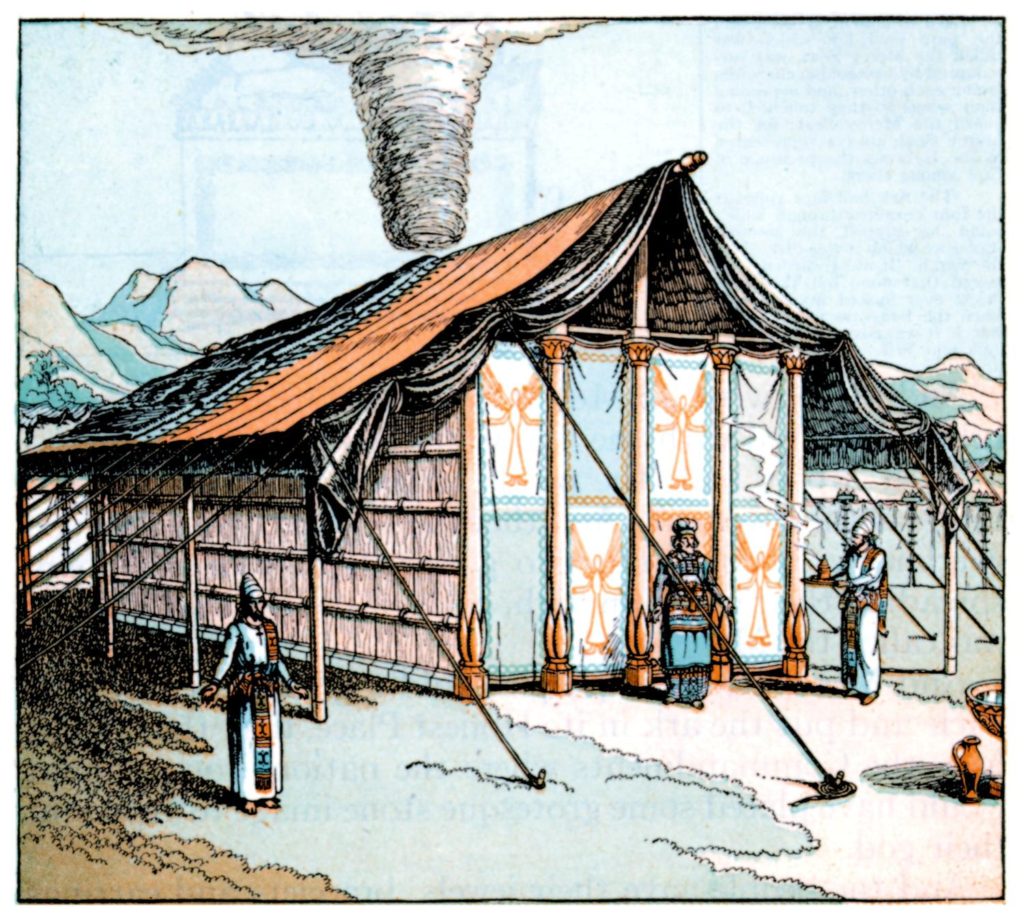
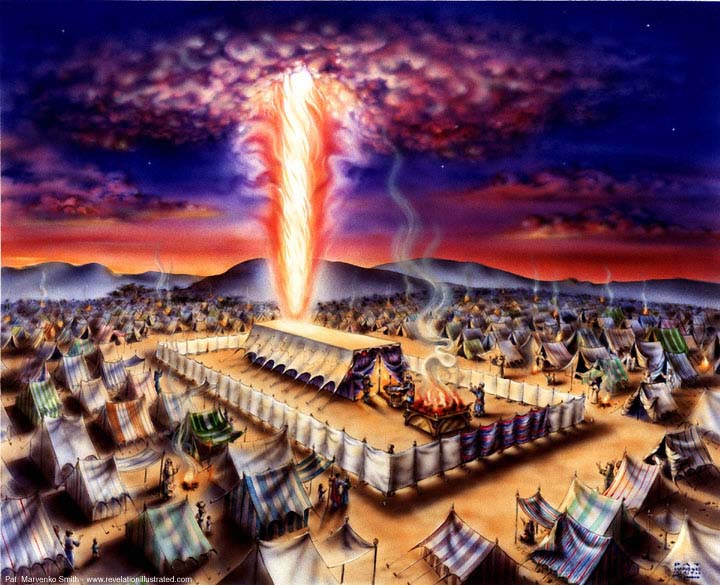
The Tabernacle of Moses from its front to back represents one’s progression in their spiritual journey starting with their initial salvation leading to the glorification of the physical body and eternal life in YHVH’s eternal spiritual kingdom. Entering through the front door of the tabernacle and progressing to the holy of holies is from the human perspective as one moves toward Elohim; it is the perspective of moving from the human to the spiritual plane of existence or that of the earthbound looking heavenward. However, from YHVH Elohim’s view from the glory cloud that has hovering over the holy of holies just above the ark of the covenant, the perspective was different. It was from the inside looking out, or from heaven looking downward. We will discus the contrasting viewpoints between the human and divine in a moment.

In the outer court of the tabernacle, all the rituals and furnishings pointed to death and judgment, as well as to washing or cleansing. These prophetically foreshadowed salvation through Yeshua’s atoning death on the cross, with Yeshua being the door to salvation, and one’s need to accept his death on the cross for one’s sins followed by the need of baptism for the remission of sins. In the set-apart (kadosh or holy) place inside the tabernacle, everything pointed to life, light, food, fragrant incense, the fruits and gifts of the Set-Apart Spirit—or life in a spiritual relationship with Elohim subsequent to one’s taking the beginning steps in the salvation process. The outer court speaks of basic salvation for the redeemed believer in Yeshua, while the holy place speaks of spiritual growth and maturity, of moving from spiritual babyhood and then growing into spiritual adulthood or maturity. 

To understand this process of growing in spiritual maturity, it is necessary to comprehend the tripartite composition of the human being. Paul speaks of man being subdivided into three parts—body, soul and spirit (1 Thess 5:23). The tabernacle’s outer court seems to relate more to the physical or bodily realm of the person, while the holy place speaks more of the soul or intellectual, volitional and emotional aspects of one’s inner or psychological makeup. Finally, the holy of holies portrays man approaching YHVH through the realm of a person’s inner or personal spirit. 

As one progresses into the tabernacle, it is as if YHVH is drawing a person into an ever deeper relational walk with him starting at the most basic level progressing upward until one is finally communing with YHVH on a Spirit-to-(human personal)-spirit level (in the most holy place). It is the Father’s desire that his children progressively grow until each of us is communing with him at the highest spiritual level (see John 4:23–24). 

As noted earlier, this forward progression from the tabernacle’s entrance to its innermost room is but one way to view a person’s spiritual progression into the realm of the Spirit of Elohim. From YHVH’s perspective looking from the inside of the tabernacle outward, the view changes. Although one has to enter the tabernacle through the outer gate and then go through various rites and rituals relating to a cleansing process before being allowed into the tabernacle itself, at the same time, we see YHVH starting to work with the person from the inside out. When a person initially comes into a spiritual relationship with his Creator, YHVH first regenerates the person spiritually by putting his Set-Apart Spirit in the spirit of the person. In a sense, if the tabernacle is a picture of the tripartite subdivision of a person’s life (body, soul and spirit), then YHVH starts working from the inside out in one’s personal spirit, which is one’s personal holy of holies that is inside of them, if you will. From there, the Set-Apart Spirit goes to work on the person’s soul (mind, will and emotions) to transform it spiritually into the image of Yeshua (Rom 8:28–29). This process will last a person’s lifetime. Finally, at the resurrection at Yeshua’s second coming, the saint’s will receive their redeemed and glorified or god-like body (1 John 3:1–2). At this time, they will become full-fledged, immortal spirit-children of Elohim (John 1:12). Though the Bible teaches that humans can become sons of Elohim and be like him as part of his divine family, man will never be equivalent to Elohim in a full sense (Isa 45:5, 6, 12, 18–19, 21–23). Only Elohim is the Creator, is without a beginning, and is all powerful, all knowing and all present. Man will never attain to this level.

The process of man going from being a physical and human creature to becoming an immortal and glorified child of the Most High, in theological terms, is called theosis. This is an ancient Christian concept that is still held by the Eastern Orthodox Church and refers to the spiritual process that occurs resulting in the deification of man. The goal of theosis is to become “like” (though not equal to) Elohim and to become eventually united with him spiritually. Theosis is the biblical concept of a redeemed or spiritually regenerated individual “becoming a partaker YHVH’s divine nature” (2 Pet 1:4), and being adopted into the family of Elohim (see the verses below). It is about man becoming like Elohim—becoming part of the family of Elohim as a child of Elohim (John 10:34; Ps 82:1; 1 John 3:1–3).

This is our theosis, that as the Ruach haKodesh (the Set-Apart Spirit) identified Yeshua as the Son of Elohim at his baptism, so we take the first steps of becoming a son of Elohim at our baptism when we become a new creation through Yeshua and the work of the Set-Apart Spirit (Gal 2:20; 2 Cor 5:17). At that time, one is begotten into the family of Elohim, and when one receives one’s glorified body at the resurrection one will be fully born or adopted into the family of Elohim as a full-fledged son of Elohim, for, as the Scripture says, we will be like him, for we will see him as he is (1 John 3:1–3).

Paul refers to theosis in several places when he uses the term adoption.

For you have not received the spirit of bondage again to fear; but you have received the Spirit of adoption, whereby we cry, Abba, Father. (Rom 8:15)

And not only they, but ourselves also, which have the firstfruits of the Spirit, even we ourselves groan within ourselves, waiting for the adoption, to wit, the redemption of our body. (Rom 8:23; also 9:4)

To redeem them that were under the law, that we might receive the adoption of sons. (Gal 4:5)

Having predestinated us unto the adoption of children by Yeshua the Messiah to himself, according to the good pleasure of his will… (Eph 1:5)

The apostolic writers make further reference to theosis in several other places as well.

Continue reading
 

Shabbat Bible Study and Fellowship With Natan and YOU

Join Natan Lawrence of Hoshana Rabbah’s Bible Study Blog via Skype for a review of this week’s Torah portion and selections from the Gospel of John at 8 AM US Pacific Coast Time (minus one hour for daylight savings time) or 15:00 UTC (i.e. Coordinated Universal Time or Greenwich Mean Time). You can connect to Skype (even without a Skype account) through any smart phone, laptop computer or tablet by clicking on the link below.

This will be a moderated and guided discussion on the Scriptures, with a question and answer time at the end. Meet your friends of like mind from around the world who love Yeshua the Messiah and his Torah-Word (those who do not love Yeshua and his Torah-Word are not welcome!)

Here is the link to join the conversation: https://join.skype.com/LCkVYFIJU0Sh


Exodus Chapters 33 to 34—Natan’s Commentary Notes

Exodus 33

Exodus 33:1–2, YHVH…my Angel/Messenger.Who is YHVH and who is the Angel? If YHVH is the preincarnate Yeshua, then who is this Angel?

Exodus 33:7, Moses took his tent.There comes a time when the anointed servant of the Most High can no longer tolerate the sinfulness and faithless of the people he is leading. Even Yeshua, in frustration, despaired on several occasions at his disciples for their lack of faith. Once, in desperation, he cried out, “O faithless and perverse generation, how long shall I be with you? how long shall I suffer you?” (Matt 17:17). Holy men (and women) of Elohim are in a different place spiritually than the people they lead. As anointed and divinely appointed leaders, to lead YHVH’s people higher, they must be ahead of the people and their walk should be a little, if not a lot, higher. Their job is to lead people into a higher and deeper walk with YHVH. Sometimes, in frustration when they feel they have been less than successful in their mission, they must remove themselves from the people for a season to draw closer to YHVH for strength, wisdom, guidance and spiritual renewal as Moses did in this case.

A man who is holy or set apart unto YHVH can’t abide in an unholy situation. It’s anathema to him and causes every fiber in his being to cry out in frustrated disgust. He is in a different, higher world that carnal people know nothing about. This is why Moses had to separate himself from the Israelites—a stiffnecked and rebellious people who didn’t have a heart to follow Elohim.

Exodus 33:12–13, Grace.The mainstream church places a great deal of emphasis on the message of grace. The biblical doctrine of grace finds its roots in this chapter in the Torah and not in the apostolic writings as the mainstream church teaches. 

The noun grace (Heb. chen) is found six times in chapters 33 and 34. The adjective gracious (Heb. chanan and channuwn)as an attribute YHVH’s character is found three times in chapters 33 and 34. Six is the number of man and three is the number of Elohim. That is to say, the grace of the entire Godhead covers man completely even when his children turn away from him and give into golden calf worship. His grace for his people rejoices or triumphs over his fiery and consuming judgments (Exod 33:4; Jas 2:13; Pss 85:10; 89:14; Mic 7:18; Eph 1:7; Rom 5:8) that they deserve for their stiff-neckness and sinful rebellion against his commands (Exod 33:3).

The Hebrew word for grace is chen/IJmeaning “favor, grace, charm, acceptance.” The Hebrew word chen (found 69 times in the Tanakh), which is translated as grace, in this verse is equivalent to the Greek word charis/cariV, which is found 156 times in the Testimony of Yeshua and is translated as grace 130 times in the KJV.The equivalency of these two words is confirmed by the translators of the Septuagint (the Greek Tanakh) who used charis in place of chen when translating the Hebrew Tanakh into Greek beginning in the third century b.c. 

According to The TWOT, in the vast majority of occurrences of chen in the Tanakh, the focus of attention is not on the giver, but on the recipient. The emphasis is on the relationship of the superior to an inferior (e.g. a king to his subjects). What this teaches us is that despite sin and rebellion against him, YHVH (the king) is gracious (to humans, his subjects). Contrary to what many in the church have been led to believe, the grace of Elohim is a very prominent theme in the Tanakh. Examples of this include Noah who found grace in YHVH’s eyes (Gen 6:8), or the children of Israel although dead in their sins in Egypt and deserving of YHVH’s wrath, they were saved by the blood of the lamb. There are a number of other references to the grace of Elohim in the Tanakh as well (Gen 18:3; Exod 3:21; 33:16,17; 34:9; Ps 84:11; Zech 12:10).

Exodus 33:14, My Presence will go with you.YHVH’s Presence led the Israelites through the wilderness and into the Promised Land. Yeshua will lead his people through the wilderness of life and into the Promised Land of their eternal inheritance in his kingdom. Where is his Presence today in and among his people?

Continue reading
 

John Chapters Eight to Ten—Natan’s Commentary Notes

John 8

John 7:53–8:1, His own house…Yeshua went. While everyone went to their own homes for the night, Yeshua, the Son of Elohim had nowhere to lay his head. Furthermore, he did not even carry the money bag; Judas did. So Yeshua likely had no money to rent even a hotel room. Undaunted, this rugged outdoorsman and man of the earth simply walked the short distance from the Temple Mount across the Kidron Valley and spent the night at the base of the Mount of Olives—perhaps in the Garden of Gethsemane Grotto, which tradition tells us is where Yeshua and his disciples often slept. This is possibly the place where Yeshua’s disciples fell asleep the night he was betrayed. This underground grotto would have provided warmth during the winter and coolness during the summer. The same grotto is now a Catholic chapel.

John 8:6, Wrote on the ground. Jeremiah declares that those who depart from YHVH (i.e. commit spiritual adultery) shall be written in the earth because they have forsaken YHVH, who is the fountain of living waters (Jer 17:13; presumably a reference to the bitter waters of spiritual adultery, and allusion to heathenism and the divine judgments such apostasy brings). Could the writing in the earth of the names of those who had forsaken YHVH (i.e. committed spiritual adultery) be what Yeshua was doing in John 8:6? Interestingly, it was dirt from the earth (the floor of the tabernacle, Num 5:17) that was placed in the bitter waters of the woman suspected of adultery, which she was forced to drink. (For more on the ritual of the adulterous woman, see notes at Num 5:11–31.)

John 8:7, He who is without sin. Here Yeshua in a very oblique way is saying that we are all like that adulterous woman in that each of us has turned away from Elohim, our Heavenly Bride, and committed spiritual adultery by turning away from Elohim and followed the gods of the world, the flesh and the devil, which is sin.

John 8:11–12, Sin no more…I am. The entire message of the Bible is contained in these two verses. Like the adulterous woman, all humans have sinned and deserve the death penalty. Yeshua’s merciful grace caused the woman to be spared. He then admonishes her to stop sinning or violating the Torah, which is sin (1 John 3:4). After this, Yeshua declares that he is the light of the world and instructs the woman to follow him out of the darkness of her sinful past and into the light of Torah-righteousness leading to the abundant life and eventually to immortality. This is a terse yet timeless message to every human everywhere who has ever drawn breath. 

John 8:14, You do not know. Yeshua seems to be making an oblique reference to his virgin birth and incarnation here.

John 8:32, Know the truth. “The truth shall make you free” is an often-quoted axiom, but few understand its deeper biblical implications. When Yeshua made this statement to Jews, what did he mean? To Yeshua what is truth? Two verses later, he mentions being a slave to sin. What is sin, and what does that have to do with truth? As many times as you have heard this axiom, have you heard anyone explain verse 32 in the larger context of Yeshua’s statement? We will now do so below. 

We violate the sanctity of Scripture if we impose on it our own meanings. This is a cavalier and presumptuous approach to understanding the Bible and can hardly be called “rightly dividing the word of Elohim” (1 Tim 2:15).This practice of  faulty biblical interpretation often occurs with this verse. To do so is to twist the meaning of the Scriptures to fit our own human vicissitudes, agendas and biases. This is humanism and insults the mind, will and sovereignty of the Almighty as divinely revealed in his Holy Word. 

To properly understand this verse, we must look solely to the Bible for the keys to understanding it. We can start this process by first asking the question, what is truth? 

The Bible defines its own terms when it calls the Torah truth (Ps 119:142 and 151). The truth of Torah (i.e. the law of Moses) will set a person free, for when one hears and obeys the Torah, one ceases sinning (i.e. violating YHVH’s Torah-law; 1 John 3:4), and therefore doesn’t come under the penalty of the Torah-law’s judgment for breaking it, which the Bible calls sin and which leads (ultimately) to eternal death (Ezek 18:4; Rom 6:23). When one is not under the judgment of sin, one is free. With freedom comes life. 

Yeshua the Messiah himself is also the truth (John 14:6), for he is the Living Torah-Word of Elohim (John 1:1, 14). When we place our trusting faith in Yeshua and follow him, his spiritual life in the form of his Set-Apart Spirit will then flow through us and empower us to walk away from sin and follow the spiritual light of his Torah, which will keep us sin-free. This is the path that leads us toward the ultimate freedom from eternal death resulting in everlasting life (John 8:52). As such, sin will no longer have any legal claim on us, and thus we will not come into condemnation, but will pass from death into everlasting life (John 5:24). This is possible because Yeshua has taken upon himself our past sins (Rom 3:25), paid the legal penalty of them, and wiped our spiritual slate clean and has given us a fresh start in life (Gal 2:20; 1 Cor 5:17) to walk sin-free (in accordance with his standards of righteousness, which is the Torah). This is the result of knowing the truth and experiencing the freedom that comes therefrom. 

It’s astounding how so many people have been taught to believe the exact opposite of the truth—that the laws of Elohim will place you under bondage instead of setting you free!

Now that you have been set free from the traditions of men, which make of none effect the word of Elohim, you now have the freedom to understand the fuller, biblical meaning of Yeshua’s statement, “And you shall know the truth and it shall make you free.”

Continue reading
 

Golden calf worship is alive and well in the Christian church today!

Exodus 32

Exodus 32:1, Moses delayed coming. Moses is a prophetic picture of Yeshua. Moses’ descending from Mount Sinai is a prophetic picture of Yeshua descending from heaven to the earth the first and second time. When the people presumed that Moses delayed his coming, they fell to the temptation to syncretize with the heathen religious system around them by yielding to their baser nature giving in to the lusts of their flesh as expressed in golden calf worship. Heathen, man-made religious systems have lower moral and spiritual standards than those of YHVH. In many respects, the mainstream church has done the same thing as the ancient Israelites by acting as if Yeshua has delayed his second coming, and by conforming to some of the world’s standards and customs. This is a form of golden calf worship, which is a mixture of Torah-truth and pagan practices. Yeshua warned his disciples against this proclivity of humans to grow impatient and spiritually cold wile waiting for his return (Matt 24:48).

Exodus 32:2, Break off the golden earrings.The Christian people have generously given the mainstream church much gold and other wealth over the past 1900 years. In the mean time, with that wealth, the church system has constructed many huge religious monuments. These are monuments, in part, to the gods of materialism, and is a form of golden calf worship. Neither Yeshua nor his disciples needed vast sums of money, resources or monuments to spread the gospel message. What they lacked in material resources they made up with passion for the gospel message and with the anointing of YHVH to proclaim that gospel with miraculous power. What the mainstream church largely lacks in passion and the anointing to spread the gospel, they now, sadly, substituted with wealth and religious monuments.


The Golden Calf Incident: A Prophetic Picture of the Church

The golden calf as described in the book of Exodus

On Shavuot (the Feast of Weeks or Pentecost), at Mount Sinai, YHVH entered into a marriage covenant with the children of Israel, but they were not ready to live up to the terms of that covenant. Those terms, simply stated, involved the Israelites being faithful and obedient only to YHVH, Israel’s Elohim (God) and spiritual husband, and to follow his instruction in righteousness, the Torah. This Israel quickly demonstrated they were not willing to do, and the subsequent golden calf incident is proof of this.

The proverbial ink was barely dry on the marriage certificate between YHVH and the children of Israel, or otherwise state, the children of Israel had hardly said “I do” to their marriage vows (Exod 24:3, 7) when they turned their hearts away from YHVH and began worshipping the golden calf—a pagan deity from Egypt. After the golden calf incident and up until Yom Teruah (the Day of Trumpets or Shofar Blasts) when Moses received the second tablets of stone from YHVH containing the Ten Commandments, the children of Israel, the bride of YHVH, prepared herself not only to receive YHVH’s instructions again, but this time to be faithful to her marriage vows. This Israel did. She remained faithful to YHVH for approximately 38 years while trekking through the wilderness of Sinai, after which she entered the Promised Land and “stayed the course” until after the death of Joshua. What can we as Bible believers learn from ancient Israel that applies to us today?

Sadly, the cycles of history often repeat themselves. This time, it involved the descendants of the spiritual children of Israel who were at Mount Sinai. In the early first century a.d., the redeemed Israelite followers of Yeshua received the Torah written on the fleshly tablets of their hearts by the finger of the Spirit of Elohim on the Day of Pentecost (Shavuot) as recorded in Acts 2. But starting in about a.d. 70 with the destruction of the temple in Jerusalem and continuing up through the Second Jewish Revolt of a.d. 135 until the time of Emperor Constantine (in the fourth century), the first-century spiritual bride of Messiah had, to a large extent, abandoned YHVH’s Torah-commandments and turned, to one degree or another, to a mixed form of worship (of which ancient Israel’s worship at the golden calif was a prophetic foreshadow) where some pagan practices were assimilated into the early churches’ belief system (most notably, Sunday replaced the Sabbath, and Christmas, Easter and other paganistic holidays replaced the biblical feasts). 

Moses’ descent of Mount Sinai on Yom Teruah with the second set of tablets containing the Torah prophetically foreshadows Yeshua’s second coming. As Moses renewed YHVH’s covenant with the repentant Israelites after the golden calf incident and the Israelites remained faithful for a long time afterwards, even so, Yeshua, at his second coming, will establish a renewed covenant with his faithful end time saints who have come out of golden calf-type religious systems.

In our day, YHVH is calling out a remnant of people from the church who are leaving behind the pagan traditions of golden calf worship and who are returning to the ancient blessed paths of YHVH’s Torah-instructions in righteousness. The book of Revelation speaks of a group of end-time saints who will say “I do” to YHVH (Rev 14:4), and whose identifying mark is their faith in Yeshua the Messiah (i.e. the gospel message) and yet who faithfully keep YHVH’s Torah-commandments (Rev 12:17 and 14:12). 

When Yeshua returns on or near Yom Teruah at the end of this age, he will be ready to marry a bride that is without spot and wrinkle and who has come out of the end-times Babylonian religious whore system (Rev 18:4). This bride who will be wearing the robes of righteousness of Torah-obedience (Rev 12:17; 14:12; 19:7–9) will be ready to enter into a new covenantal agreement—a wedding contract or ketubah—with Yeshua (Heb 8:7–13), the Bridegroom, ever to remain faithful to him and never again to return to Baal or golden calf worship. He will lead his wife into the Messianic Age or Millennium, even as Joshua, a prophetic foreshadow of Yeshua, led the younger generation of wilderness Israelites into the Promised Land.

Golden Calf Worship Among YHVH’s People Today

Let’s look at the series of events that occurred as the children of Israel were leaving Egypt, which have major relevance to what is occurring in mainstream Christianity in our day. If we fail to learn the lessons of history, we’ll likely repeat the mistakes of history. It has to do with golden calf worship.

Continue reading
 

Only ignorant or irreverent humans invalidate YHVH’s Sabbaths!

Exodus 31:13–17, My Sabbaths you shall keep. Note that Sabbaths is plural. This is a reference not only to the weekly Sabbath, but to the feast day Sabbaths as well. However, the seventh day Sabbath remains central to YHVH’s spiritual economy for his people. In fact, it was so central to the spiritual life and YHVH’s people that he designated it to be a visible and outward sign of the special relationship between him and his people. Let’s explore this idea.

Why did YHVH designate it as a sign (“signal, distinguishing mark, banner,” Exod 31:12) between him and Israel? As YHVH’s set-apart people, Israel was distinguishing itself from the surrounding nations who did not keep the Sabbath. What distinguishes the saints today as YHVH’s set-apart people from the non-believing heathen around them? Certainly our love for one another is a distinguishing mark, according to Yeshua (John 13:35). Yeshua also said that if we love him we will keep his Torah commandments (of which the Sabbath is the fourth of the ten commandments, John 14:15; Exod 20:8). John was inspired to write that those who say they know Elohim and don’t keep his Torah-commandments (of which the Sabbath is a foundation stone) are liars and the truth is not in them (1 John 2:3–6). And finally, Yeshua told those who were Torahless (i.e. workers of iniquity or lawlessness) to depart from him, that he didn’t know them even though they claimed to be his followers and had done many religious works in his name (Matt 7:21–23). Although the Sabbath and the biblical feasts may not be the exact sign of the Renewed Covenant, Elohim’s Sabbaths are foundation stones of the Torah, and the keeping of them remains to this day for the saints of Elohim (Heb 4:9).

The ArtScroll Stone Edition Tanach translates verse 15 as follows:

For six days work may be done and the seventh day is a day of complete rest, it is sacred to [YHVH]…(emphasis added)

What is complete rest? What is the connection between “complete rest” and the idea of sacredness or being set-apartness or kadosh? The people of YHVH are called to separate the kodesh from the common or profane:

Her priests have violated my Torah, and have profaned my set-apart/kodesh things: they have put no difference between the kodesh and profane [common, polluted] neither have they showed difference between the unclean and the clean, and have hid their eyes from my Sabbaths, and I am profaned among them. (Ezek 22:26)

And [the priests] shall teach my people the difference between the kodesh and profane, and cause them to discern between the unclean and the clean. (Ezek 44:23)

What is common or profane is that which is commonly done on the other six days of the week.

Exodus 31:14, Sabbath…profanes it. Profaning or polluting the Sabbath with secular activities is a sin. Sabbath desecration is as much a capital offence in YHVH’s eyes now as it was then. The wages of sin is still death (Ezek 18:4; Rom 6:23). 

Exodus 31:18, Written with the finger. The Sabbath was ordained by Elohim and written by his finger. How dare men subsequently declare that the Sabbath was changed and that what YHVH wrote with his finger in tablets of stone is now irrelevant or passé! What hubris and arrogance on men’s part to counter the will and laws of Elohim with silly, specious and vacuous justifications for man-made and unbiblical teachings that deign to nullify the validity of YHVH’s Sabbath. Such edicts of men will not stand, but will blow away like lowly dust in the wind, will be burned to ashes in the fiery judgment of Elohim, and will fall by the wayside like all the other traditions of men, which have dared to make the word of Elohim of no effect!


Update on Natan’s Bible study and conversation on Skype

This past Shabbat at 12 noon at US Pacific Standard Time (minus one hour for daylight savings time) about a dozen of us gathered together through Skype for a video fellowship where we feasted upon the manna from heaven—the Word of Elohim. Thank you to those who participated. It was a blessing.

The Word of Elohim is our manna from heaven!

We started our study by tagging some bases in the week’s Torah portion, then moved into the Gospel of John as per the Hoshana Rabbah Bible reading schedule. We also prayed for some needs of those in the study group.

Realizing that people from around the world in different time zones read this blog, we will be having our Bible study at different times of the day in an attempt to accommodate everyone wherever they may be, so that as many folks as possible can participate.

I am thinking that our next meeting will be this coming Shabbat early in the morning (my time). I will post the time and the link to click on to participate later on this week. Sometimes I will have a Friday evening meeting, sometimes an early Shabbat morning meeting, and sometimes an afternoon meeting, and sometimes a late Shabbat meeting. We will see which times are the most popular and go from there.

Stay tuned…