Deuteronomy 14–16 on a Peculiar, Kosher, Generous, Feast-loving people

Deuteronomy 14

Who me? Peculiar??

Deuteronomy 14:2, A peculiar people.The saints are called to be the kadosh (set apart) and peculiar or treasured people of YHVH. What we eat (verse 3ff) is a key factor in being set-apart unto YHVH. After all, if we are returning to the Hebrew roots of the Christian faith and learning to study, “eat” and live YHVH’s Torah, learning to live by the “whole counsel of the Word of Elohim” (Acts 20:27), and coming away from certain paganized practices of the mainstream Christian church, how then can we still eat unclean (both physical and spiritual) food? Eating kosher spiritual food goes hand-in-hand with eating kosher physical food. Are you still eating “any abominable thing” (verse 3)? These are not the my words, but YHVH’s words—or commands! What excuses and rationalizations have you contrived in your thinking (i.e. strongholds and altars to pagan gods) to keep your belly as your god (Phil 3:19)?

Deuteronomy 14:2, You are…a peculiar/treasured people unto himself. The term treasured people/am segulah is used several times in the Torah. For example, in Exodus 19:5–6 when YHVH betrothed himself to and married the people of Israel they became his am segulah or “treasured possession among all the peoples of the nation, a kingdom of priests and a kadosh or set-apart nation.” Moses restates this same idea to the younger generation of Israelites about to enter the Promised Land in our present verse, and again in Deuteronomy 26:17–19 where he again calls them his “treasured people” and admonishes them to keep his Torah-commands that he might “make you high above all the nations which he has made, in praise, and in name, and in honor, and that you may be a set-apart people unto YHVH your Elohim.” What passage in the Testimony of Yeshua does this remind you of? (Read 1 Peter 2:9.) Note that YHVH has chosen us from among all the peoples of the earth. As A Torah Commentary For Our Times points out, “This idea that God selects or designates the people of Israel as an am segulah remains a central belief in Jewish tradition. The prophet Malachi (3:17) uses the term. So does the Psalmist who, singing in the Jerusalem temple, praises God for having ‘chosen Jacob—Israel—as a treasured possession’” (135:3–4; p. 132). With humility, contrition and gratefulness, do you own this identity? Is it a part of your innermost being? If you know that you are a special treasure and a called-out people destined for great things in the kingdom of Elohim will not the reality of who you are and whose you are and what you are to become affect your walk of righteousness here and now? Does this not inspire you to walk a little higher, a little more set-apart, a little closer to YHVH, and to be a better spiritual light through your words, thoughts and deeds to the heathens around you?

Deuteronomy 15

Deuteronomy 15:4, Except.The implication here seems to be that when lending to someone who is not poor, it is acceptable to expect them to pay you back after the seven year time limit. This is because the rich person doesn’t really need your money, but is likely using it like a business loan to make more money.

Deuteronomy 15:7, Among you a poor man. 

Charitable Giving Vs. Government Socialistic Welfare Handouts

Multiple times, the Scriptures enjoins those who have been blessed materially to help those who are poor. In fact, YHVH even has a special place in his heart for a special class of individuals who have fallen into poverty, namely, the widows and the fatherless (Deut 14:29; 16:11, 14; 24:19; 26:12–13; 1 Tim 5:3). Let’s now discover some biblical guidelines about charitable giving.

Yeshua declared that the poor would always be among us (Matt 26:11), so there will never be a lack of opportunity for the so-called haves to help the have-nots. Furthermore, YHVH promises to bless us when we give to the poor (Ps 41:1–3) as well as to those who have dedicated their lives to serving YHVH’s people through the ministry (Deut 14:29; 16:14; 26:12–13). 

In Deuteronomy 15:7, we discover that there are levels of priorities in our charitable giving. Our first responsibility is to help a poor person who is a brother, that is, who is a member of our immediate family, or someone who is like a brother to us. Second, we are to help those in need who reside in our gates, or are a member of our immediate community. Finally, and last, our charitability is to go toward those who are in need in our own land or country. The idea here is that our charitable giving is to go first to those who live the closest to us, and then go out from there geographically as we are able to do so financially. Too many churches have it backwards. They support to poor in other countries through evangelistic outreach, while neglecting the mission field or charitable giving on their own backyard.

In the Torah, there is a social welfare system in place to help the needy, but it comes with strict guidelines. For example, YHVH instructed the Israelites to set aside a certain portion of their income to help the poor. (Deut 14:28–29). For the ancient Israelites, this was a sort of social welfare system whereby those who had been blessed materially were commanded to help those who weren’t and were in need. 

Moreover, the Torah had other social mechanisms whereby those who had fallen into poverty had the means to work themselves out of that economic state. There was no such thing as sitting idly and expecting a handout from society! For example, a poor person could sell themselves into servitude for a period of time until they worked themselves out of debt (Exod 21:2; Lev 25:39–55). Every seven years, debts were forgiven (Deut 15:1–2). Those who had an abundance financially and were in position to loan money to a poor person were forbidden from charging the lender any interest (Lev 25:35–38). Moreover, a poor person who had land could also sell their land to raise money; however, at the end of the 50 year jubilee cycle, that land would be given back to them (Lev 25:8–17). 

Laws were in place where the poor wouldn’t starve to death. Two Torah laws insured this. Those who had agricultural lands were neither to glean their fields after their initial harvest, nor were they to reap the corners of their fields. The poor were allowed to come back into the fields after the harvest and to reap anything that remained (Lev 19:10; 23:22; Deut 24:19–21), and to eat freely of the agricultural produce every seventh year (Exod 33:11). In fact, the entire book of Ruth is the story of how this system worked such that the well-to-do helped the poor. There was no system in place where the government gave a person vouchers to receive free food; you still had to go out and work for it.

There is one key fact stands out in the Torah’s social welfare system however. The poor had to work for their food. In fact, most Bible students are aware of the fourth commandment, which tells us to rest on the seventh day of the week—the Sabbath. However, many people overlook the rest of this command; namely, everyone is to work for the six days prior to resting on the seventh-day Sabbath. Working is a biblical command. In the Bible, there was no such thing as retirement, or sitting back idly and waiting for a government welfare check to show up in your mailbox while you sat around watching television, playing video games or doing social media!

A lazy couch potato

The idea of sitting back and collecting public assistance for doing nothing was unheard of in the Bible and is contrary to the Torah. This is a socialistic and an evil Marxist concept and a form of wealth redistribution, which is a form legalized theft, and disincentives one from working. This is not “a workers paradise” despite the propaganda that tells us otherwise. This concept is anathema to the biblical concept of hard work, personal responsibility, and thievery. In fact, socialism, which Karl Marx, the father of modern socialism, is considered to be one of the steps to a complete communist “utopia.” Such a system has proven to be a miserable failure everywhere it has been tried: the Soviet Union, Cuba, Communist China, North Korea Cambodia, Venezuela and many more countries. Who wants to live in such places? It it’s so great there, why Marxist-socialistic governments have to construct walls to keep their people in, and why do people risk their lives trying to escape? 

Continue reading
 

Ecclesiastes Chapters 3 and 4—Natan’s Commentary

Ecclesiastes 3

Ecclesiastes 3:1–8, There is a season. A major aspect of coping with and even finding some happiness in one’s life while, at the same time, a prisoner to this physical time-space continuum called life on earth is having an understanding of the right timing of things, that is, knowing when and when not to do something. Many activities in life may be acceptable to do at one time, but not at another time. The consequences of doing the right thing at the wrong time can blow-back disastrously on a person. Therefore, learning the difference between when and when not to act is essential to finding some happiness in this life and requires knowledge, wisdom and understanding.

There Is a Time…and There Is Not a Time

There is a time and season for everything (Ecclesiastes 3:1). This sounds like an innocuously bland and self-evident statement, but not really as we are about to discover.

There is a time do to things, as the wise preacher informs us in his famous Ecclesiastes three passage, which begins with the famous words, “To everything there is a season, a time for every purpose under heaven: A time to be born, and a time to die…” and so on.

But the more the years and decades slide past me and am not in the grandparenting season of my life, the more I realize that there is, perhaps, more importantly, a time not to do a lot of things that I might have done at an earlier time in my life. There are battles not to fight, things not to thing (for a Scripture declares elsewhere, “As a man thinketh, so is he”—a scary thought!) things not to do, and definitely things not to say. There are several reasons that immediately come to mind for not doing these things. 

First, and, perhaps, most importantly, it’s about priorities. As one reaches the top of the hill of one’s life and begins the descent on the other side toward death, one can see more circumspectly one’s past life as well as that which remains whether it be a long or a short time. With the stark reality of one’s life in full view and the idealizations of past expectations unfulfilled gone like dust in the wind, that which remains in one’s life suddenly becomes as valued treasure. Add to this the unexpected deaths of loved ones and friends around you, which, to any young people reading this, occurs more frequently the older one gets, suddenly, every breath and heartbeat becomes a cherished gift from the Creator.

The second reason for not doing or saying many things that I might have in earlier years has to do with following the leading of the Set-Apart Spirit of Elohim more precisely instead of jumping unquestioningly in lockstep to the demanding impulses of my impatient, impetuous and sin-oriented flesh. This too has to do with priorities—desiring to be in the perfect will of the Almighty by seeking first the kingdom of Elohim as Yeshua instructed his disciples to do instead of seeking all those other carnal and earthly things.

The third reason for adding the negative adverb not to the statements in Solomon’s famous Ecclesiastes three passage is that the older one gets, one starts getting a little more tired if not physically, at least emotionally from chasing the wind and ending up with little or nothing to show for it. Many things become, as the Preacher in Ecclesiastes definitively declares repeatedly, is vanity of vanities. Suddenly one wakes up and discovers the wisdom of working smarter, instead of harder. This is wisdom, which only comes with age and perspective. It’s wise to conserve energy and to save it for those things that are worth the time and effort, and for which there is a payoff especially in the next life. All else is little more than emptiness and chasing the wind.

Fourth, so much of what we do and say is an expression of human pride and vanity. We are all guilty, so raise your hand. I’ve got mine up! As I get older, I agree with the preacher’s words in Ecclesiastes verse two of chapter one, “‘Vanity of vanities,’ says the Preacher; ‘Vanity of vanities, all is vanity.” When one gets brutally honest with oneself and analyses most of one’s words and actions, human pride and vanity is the pathetic though realistic label that must be applied to most of it. So what does the Almighty have to say about this? What reasons will we give to him on judgment day as to the motives behind most of what we have said and done? What legacy of value are we really leaving to the next generation? Will we be leaving behind a grandiose frozen-in-time, stone cold and lifeless monument to ourselves, or will we have sown seeds into the fertile ground of the lives of those around us that will hopefully bring forth fruit that will not only make the world a better place, but that will also serve to expand the kingdom of Elohim at the expense of the kingdom of darkness? 

Make no mistake, every one of our thoughts, words and deeds is a pebble dropped into the vast ocean of our existence; the ripples go forth and touch many lives for good and for bad much more than we can know or imagine. We have no idea of this! The ripples travel beyond the horizon. So act and speak wisely on the front end, for who knows what the end consequences will be. This is another good reason not to do and say a lot of things.

Another reason to say less is this: Did you every wonder why we have two ears and two eyes but only one mouth? One learns more by listening and observing than by talking. Some people never stop talking! You ask them a simple yes or no or a one sentence question expecting an equally short answer and you get an epistle. I’ve been guilty of this on more than one occasion! A mark of wisdom is to speak volumes with few words. Yeshua the Messiah was the master of this approach. His longest sermon was only three chapters long and only takes a few minutes to read, yet these few words have turned the world on its head!

Add to all these reasons why there is a time not to speak and do is this one: The older I get, the more I realize that most people don’t care what you have to say or think anyway. They’re too preoccupied with their own stuff and too self-absorbed to care beyond that. So why waste the time, energy and breath saying it if only to hear yourself talk? This too is vanity of vanities! Those who do care—who have ears to hear—will seek you out. You don’t have to have to go after them. I found this out the frustrating way after 18 years of pastoring a local congregation and more than 30 years in continuous ministry.

Finally, you learn more by being a receiver than a transmitter. Currently, my receiver is pointed heavenward. This means waiting patiently on Yehovah to transmit. The older I get, the more I realize how much I don’t know. To be sure, this is humbling. At the same time, the more I realize that others don’t know as well. Those who act like they have all the answers and know it all usually have something to sell you. Follow the money! Most of them, too, are fools (like the rest of us), but they’re too proud to admit it. This too is vanity of vanities.

Now that you’ve read this far, do you really want to really know what’s going on? It’s this. The world is currently in a state of hyper confusion induced by godless men under the spell of secular humanism and demonic antichrist concepts and agendas, which the Bible prophesied would occur prior to the second coming. We live in gross darkness, and there are no human spiritual leaders to guide us through this Satanic black hole cesspool. Where are they? Most are too busy making money and building their empires, and they’re clueless. It’s business as usual. That leaves the rest of us searching for answers and direction. We’ve never been this way before, for we are in the last days after all! There’s only one direction to look for guidance, and that’s up. We have only the Word of Elohim and his Set-Apart Spirit to guide us at this point, since we’re in uncharted territory. That means shutting up and listening. You can’t receive directions from heaven if you’re transmitting via your big yap and listening to yourself speak!

Let me leave you with these words of David,

I will lift up my eyes to the hills—from whence comes my help? My help comes from YHVH, Who made heaven and earth. He will not allow your foot to be moved; He who keeps you will not slumber. Behold, He who keeps Israel Shall neither slumber nor sleep. YHVH is your keeper; YHVH is your shade at your right hand. The sun shall not strike you by day, nor the moon by night. YHVH shall preserve you from all evil; He shall preserve your soul. YHVH shall preserve your going out and your coming in From this time forth, and even forevermore. (Psalm 121:1–8)

Unto You I lift up my eyes, O You who dwell in the heavens. Behold, as the eyes of servants look to the hand of their masters, as the eyes of a maid to the hand of her mistress, so our eyes look to YHVH our Elohim, Until He has mercy on us. Have mercy on us, O YHVH, have mercy on us! For we are exceedingly filled with contempt. Our soul is exceedingly filled With the scorn of those who are at ease, With the contempt of the proud. (Psalm 123:1–4)


Ecclesiastes 3:11, Everything beautiful. Beauty and happiness can be found, even in this life of vanity resulting in emptiness and nothingness, if everything is done at the right time; therefore, finding the right timing is a major key to happiness.

Continue reading
 

Natan’s Notes on Deuteronomy 11–14

Deuteronomy 11

Deuteronomy 11:1, Love YHVH … and keep…his commandments.Compare this verse with what Yeshua said in John 14:15. When we understand that Yeshua is “YHVH your Elohim” does that not give us a new perspective about not only who Yeshua was/is, but his teachings in the Gospels? Does this shed new light on the issue when Paul said to “follow me as I follow the Messiah” (1 Cor 11:1)? What did Paul mean by this? Was Paul really pro-Torah?

Deuteronomy 11:8, That you may be strong.Obeying YHVH by keeping his Torah-commandments keep us strong. Strong is the Hebrew word chazaq meaning “to be strong, grow strong, to prevail, to be firm, be caught fast, be secure; to grow stout, grow rigid, to restore to strength, give strength, sustain, encourage, make bold, encourage, to repair, to withstand.” Obedience to YHVH’s commandments make a people strong morally and spiritually, so they have the fortitude to conquer the spiritual land that YHVH has given them for their inheritance—to expand the kingdom of Elohim with boldness.

Deuteronomy 11:13, If you will hearken.Stale versus fresh manna. In the Hebrew, this phrase literally reads, “If hearken, you will hearken….” Rashi (the Medieval Jewish Torah scholar) interprets the double usage of this verb to mean, “If [you] listen to the old, you will listen to the new” meaning that if one listens to what one has already learned by taking care to review and understand it, one will gain new insights or fresh insights into the Torah (The ArtScroll Sapirstein Edition Rashi—Devarim, p. 110; The ArtScroll Stone Edition Chumash, p. 995). 

What does this teach us about studying YHVH’s Word consistently and regularly? YHVH gave the Israelites fresh (not stale) manna every day, even as he watered the land of Israel with the early (fall) and latter (spring) rains (a symbol for spiritual refreshment), so that the land would be fruitful without the need of man-made irrigation systems. Manna and rain both came from heaven and are used as figures of speech Hebraically to represent Torah-truth. 

Is your life being renewed regularly with fresh revelation and insights into the Word of YHVH, into his very heart and character? Does this not refresh, nourish and sustain the ground of your life, so that it yields an abundant spiritual crop of joy, shalom, intimacy with the Father and anointing? Is your life a place of fresh manna and constant rain, or a place of stale bread and drought? If so, what changes do you need to make in your life to change this situation?

Deuteronomy 11:14, Grain [wheat and oats]…wine…oil.(See also Gen 27:28; Ps 104:15.) These were the three most important agricultural crops in ancient Israel. These three foods represented  what are known today as the three basic nutritive elements: proteins, carbohydrates and fats. The yield of these crops were easily stored for long periods in the hot, dry climate, and kings laying in supplies at forts and strongholds for possible siege and war included these crops (e.g. 2 Chron 11:11; 22:28; Golden Jerusalem, by Menashe Har-El, p. 11).

Deuteronomy 11:18–21, Teach them to your children.Homeschooling One’s Children. This is a repeat of the second third of the shema, which is found in Deuteronomy 6:4–9. This is a reiteration of the biblical mandate for parents to give their children a Torah-based homeschooling education. This command takes precedence over that of any civil government’s laws requiring a parent to give their children a publicly sanctioned education. In fact, parents aren’t active to one degree or another in educating their own children are being disobedient to this clear Torah command and are therefore sinning. The majority of Christians in the mainstream church have egregiously missed the mark on this one!

Deuteronomy 11:18–19, Lay up these words. Read and meditate on this passage. Look at the phrases: in your heart, in your soul, between your eyes, teach and speak. How are you walking these commandments out in your life? Are you doing so with consistency, or only here and there?

Deuteronomy 11:26–28, A blessing and a curse. Each person must choose which path he will take. This passage begins with the words, “Behold, I set before you this day a blessing and a curse; a blessing, if you will obey the commandments of YHVH your Elohim, which I command you this day; and a curse, if you will not obey the commandments of YHVH your Elohim, to go after other gods, which you have not known” (Deut 11:26–28). YHVH sets before each person two paths: the path of blessing and the path of curses. Each person individually must choose which path he will follow.

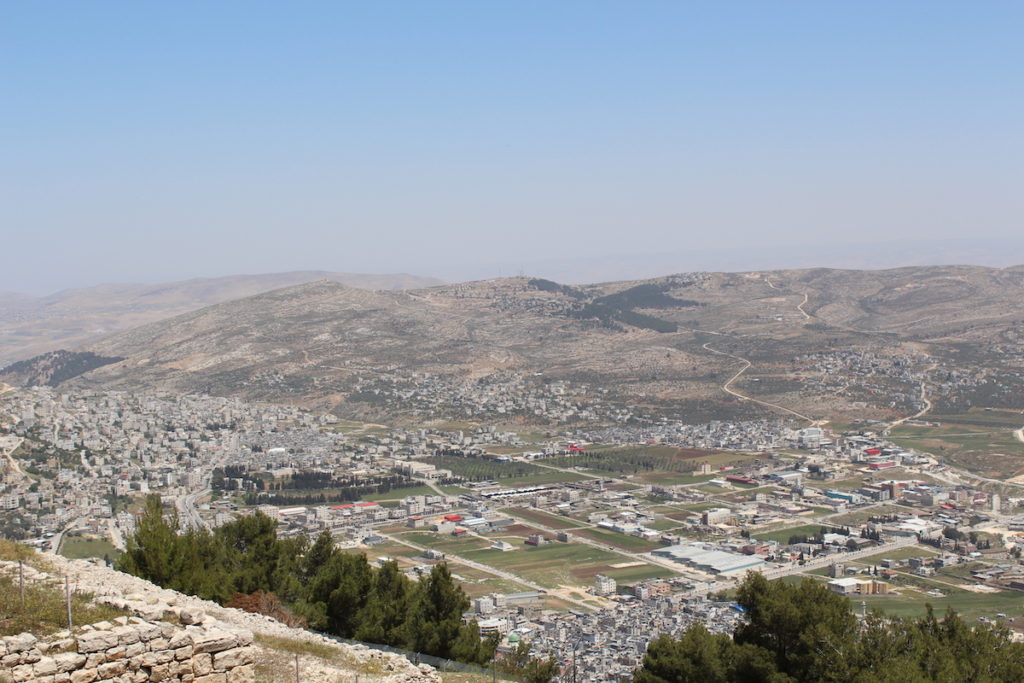
After this, in verse 29, YHVH instructs the Israelites that upon entering the Promised Land, they are to stop between the mountains of Gerizim and Ebal, which are located at the entry point of the land. The former mountain represents a blessing, while the later represents a curse. The town of Shechem is located between the two mountains. The Hebrew word shechem means “shoulder” or “back”. The shoulder supports the head, which through the disposition of the mind and the direction in which the head is pointed, determines the path a person will walk whether good or evil. 

It was at Shechem, between the two mountains representing good and evil, that Israel renewed its covenant with YHVH before entering the Promised Land (Josh 8:30–35). The power of the covenant that the people made with YHVH on that day thousands of years ago is still visible in the modern land of Israel: Mount Ebal is bare and devoid of vegetation, while Mount Gerizim is lush and green with foliage. This fact stands as a loud testimony and reminder to man today to the power of blessing and cursing, and to the reality and validity of YHVH’s Torah, its covenants and its ability to bless or curse us depending on whether we obey it or not.

Continue reading
 

Natan’s Notes on Philippians

Philippians 1

Philippians 1:11, The fruits of righteousness which are by Yeshua the Messiah.

Yeshua in Us: The Power to Obey Torah

It is impossible for a man to keep the Torah on his own strength as Yeshua’s encounter with the rich young ruler proves (Matt 19:16–22). When the young man asked Yeshua what he must do to have eternal life, Yeshua seems to set the man up for a fall when he declares, “If you want to enter into life, keep the commandments.” Yeshua is not being disingenuous here. Were one to keep the Torah perfectly without sinning, hypothetically, one would not fall under the death penalty for violating the laws of Elohim (i.e. sin). If this were so, then presumably one could earn eternal life by one’s own good works. But no man has ever accomplished this superhuman feat except the superhuman Yeshua! So when the young ruler proudly declared his perfect Torah obedience, Yeshua showed him that he was, in fact, violating the Torah in at least one area—covetousness and greed. Yeshua shows him how to come into Torah compliance, and then admonishes him to come and to follow him. What Yeshua is teaching us here is that it’s impossible to keep the Torah perfectly without factoring Yeshua, the Living Torah, into the equation. The point that we can’t keep the Torah without Yeshua directly intervening in our lives, I hope to conclusively demonstrate below.

One way that Yeshua helps his followers obey the Torah is by sending us his Spirit as an internal spiritual force into our hearts to nudge and lead us into Torah-obedience. 

What’s more, Yeshua also gives us the divine gift of his grace to accomplish the same thing. His grace removes the guilt, stain and penalties for our past sins, and with a clear conscience and a clean spiritual slate before YHVH, minus the past baggage of sin weighing us down, we are able to go forward under the power of YHVH’s Spirit to walk in accordance with his Torah. Praise Yeshua! An illustration of this would be a runner who trains wearing a backpack filled with rocks. Once the weight is removed from his back, when he runs, he feels as if he were flying through the air. 

Our faith in, love for and continual abiding in Yeshua is the key to receiving his systemic spiritual empowerment to walk a life that mirrors Yeshua. Paul invites us to imitate Yeshua as he himself imitated Yeshua (1 Cor 11:1). In fact, the word Christian means “little Christ,” that is, “one who follows what Christ did and taught.” One follows Yeshua by abiding in him as a branch abides in or is attached to a vine (John 15:4–5). A branch that is attached to a tree naturally, through no effort of its own, receives energy from the tree and produces fruit. The energy of life just naturally flows into the branch. When we abide in Yeshua, we will naturally produce the fruit of the Spirit. Love is the first and foremost fruit out of which all the other fruits subdivide. How do we walk in love toward YHVH and love toward our neighbor? The biblical answer is simple: by keeping his Torah commandment, which show us how to love. As Paul tersely declares, “Love is the fulfilling of the Torah-law” (see Rom 13:8–10). 

Our abiding faith in Yeshua automatically attaches us to that spiritual tree that is a metaphorical picture of him; it is the tree of life, which leads to eternal life in the kingdom of Elohim. As we abide in him, we will produce fruits of righteousness, which is adherence to the Torah of Elohim. Yeshua extends his grace to us, and our faith in Yeshua, and Yeshua living in us produces righteousness leading to eternal life (Rom 5:21).

As sap flows from a tree into the branches, so the Spirit of life in Messiah Yeshua flows out of Yeshua, who is the tree of life, into us freeing us from the spirit of Torahlessness,which leads to death. Not only did Yeshua free us from the wages of sin (or Torahlessness), which is death, but his life in us now fulfills the righteous requirements of the Torah. He empowers us to no longer walk according to the sinful flesh, but according to the Spirit of Truth (or Torah, Rom 8:1–4, 10). It is for this reason that Paul could exuberantly proclaim that “if Elohim is for us, who can be against us?” (Rom 8:31), and, “In all things we are more than conquerors through him [Yeshua] who loved us” (Rom 8:37).

Having previously been an unloving, even hate-filled, legalistic Torah-keeping Pharisee, Paul knew that it was impossible to fulfill the righteous requirements of the Torah by his own strength. Before coming to faith in Yeshua, he had tried to keep the Torah by his own strength and failed. He learned that he could serve Elohim only through the power of the Spirit of Elohim, not in the old manner through human will and determination. The Spirit-empowered mind is able to keep the Torah, something the natural flesh man is incapable of doing. Obedience is only possible through faith in Yeshua and the gift of his Spirit (Rom 7:6, 25 cp. 8:6–8; 9:30–33). 

In many other places, Paul indicates that without Yeshua it is impossible to fulfill the righteous requirements of the Torah. For example, he states that he is in no way promoting Torahlessness, but a Torah-obedience through Yeshua’s empowerment (1 Cor 9:21). The Holy Spirit in us, Paul declares, produces righteousness (i.e. conformity to the Torah, note Ps 119:172) by our faith in Yeshua through love (Gal 5:5–6). What’s more, we’re saved through faith in Yeshua who is the Living Torah-Word of Elohim (as was Abraham when he had faith in the preincarnte Yeshua and obeyed his word). As a new spiritual creation in Yeshua, we produce and walk in good works (i.e. Torah-obedience) through faith in Yeshua, the Living Torah (Eph 2:6, 10). Or stated another way, we’re a new man or new creation in Yeshua who lives in or through us (Gal 2:20; 2 Cor 5:17); we’ve been renewed in the spirit of our mind for true righteousness and holiness (i.e. Torah-obedience, Eph 4:22–24). Elsewhere, Paul encourages us to be filled with the fruits of righteousness (or Torah-obedience, Ps 119:172) through Yeshua (Phil 1:11). He further tells us that Yeshua redeemed us from Torahlessness (or sin, 1 John 3:4) and is working to purify for himself his own special people who are “zealous for good works” (i.e. Torah-obedience, Tit 2:14), and is making us complete in every good work do to his will” (Heb 13:21).


Philippians 1:15–16, Some indeed preach. “Good will”(Gr. eudokia) also can mean “kindly intent, benevolence.” “Selfish ambition/contention” (Gr. eritheia) means “electioneering or intriguing for office, a desire to put one’s self forward, a partisan and fractious spirit which does not disdain low arts, partisanship.” 

Continue reading
 

Pearls from Deuteronomy 6 and 7

Deuteronomy 6

Deuteronomy 6:4, Hear [shema] O Israel. This statement (verses 4–9 coupled with Lev 19:18) is known as the “Shema” and is a statement of faith in the Jewish religion. In Mark 12:2931, Yeshua also cites the Shema as the summation of all that Torah commands humans in order to have a proper relationship with YHVH and their fellow man. The word shema means “to hear, listen, obey.” How often, when it comes to obeying YHVH do we draw near or honor him with our lips, but our hearts are far from him? (See Mark 7:6; Isa 29:13; Matt 15:8.) Though similar in spelling, the words shema and shamar have different etymologies, yet we still juxtapose them conceptually. The Hebrew word shamar is often translated into English as guard, beware or keep (see verse 12), while shema means “to hear and do.” When we guard or keep YHVH’s commandments, we will hear and do them and vice versa. The two concepts of guarding/keeping and hearing/doing go hand-in-hand and when spiritually active in our life they prevent us from falling into idolatry, which YHVH warns us against in verses 10 to 16.

Deuteronomy 6:7, 10–16, 20–25, Instruct your children in the Torah, so they don’t fall into idolatry. YHVH is constantly warning his people against idolatry; idol worship is anything that gets in the way of our relationship with him. 

If you’re not sure whether you have idols in your life, then ask yourself this question: What is of higher priority in your life than serving YHVH? What in your life takes more of your time, energy and money than serving YHVH? What draws your heart away from the study of his written Word, from prayer and fellowship? What or who hinders you from moving forward in your spiritual walk? What in your life keeps YHVH from getting out of a spiritual box in your life? This is idolatry!

Our children follow our example more than our words. By our actions, if YHVH isn’t first in our life our children will follow our example and will be prone to perpetuate our idolatrous ways down the generational line.

Several times YHVH instructs the children of Israel to be certain to instruct their children in the ways of Torah-righteousness. In the Shema, YHVH commands, “And you shall teach them [i.e. his Word] diligently to your children, and talk of them when you sit in your house, and when you walk by the way, and when you lie down, and when you rise up” (6:7). Then in verses 20–25 of the same chapter we read, 

“When your son asks you in time to come, saying, ‘What is the meaning of the testimonies, the statutes, and the judgments which YHVH our Elohim has commanded you?’ Then you shall say to your son: ‘We were slaves of Pharaoh in Egypt, and YHVH brought us out of Egypt with a mighty hand; and YHVH showed signs and wonders before our eyes, great and severe, against Egypt, Pharaoh, and all his household. Then He brought us out from there, that He might bring us in, to give us the land of which He swore to our fathers. And YHVH commanded us to observe all these statutes, to fear YHVH our Elohim, for our good always, that He might preserve us alive, as it is this day. Then it will be righteousness for us, if we are careful to observe all these commandments before YHVH our Elohim, as He has commanded us.’”

Too often in the church-system, the children have had to take the backseat when it comes to discipleship and ministry. They get a few table scraps thrown at them called “Vacation Bible School” (once a year), an on a weekly basis, a Sunday school class with a Jonah and the Whale-type teaching accompanied by some, often inane, craft project. Seldom does the head pastor of the church bother with the children’s ministry. Usually, this function is relegated to the younger associate pastor. Typically, the position of “Youth Pastor” is viewed as nothing more than a stepping stone to the “top dog” position of “Head Pastor.” Furthermore, seldom do parents spend any meaningful time during the week instructing their children in the ways of YHVH. 

As redeemed Israelites, it is our opportunity to follow the Torah and to place the highest ministry priority on instructing our children in the Truth of the written Torah, as well as the Truth of Yeshua the Living Torah, and in the fundamentals of who we are as members of the commonwealth of Israel (Eph 2:12), and in preparing ourselves for the kingdom of Elohim. If we do not do this, then who will? As parents, what are you doing on a regular basis to diligently instruct your children all day, every day? As grandparents, aunts and uncles and members of a gospel-orientated Torah community, what are you doing to help in teaching the children? What was the attitude of the disciples when they attempted to shoo the children away from Yeshua? What was Yeshua’s response? Read and compare Matthew 19:13–15 with 18:1–5 and go and do likewise, for they are our future and our legacy!

Deuteronomy 7

Deuteronomy 7:12, Because you listen. This verse shows the conditional nature of the Mosaic or Sinaitic Covenant. Blessings from heaven are conditional upon obedience to YHVH’s Torah instructions in righteousness. It was each person’s choice to obey YHVH or not. Either way, the law of cause and effect would come into play: blessings for obedience and curses for disobedience. The same is true with the New Covenant. If we place our faith in Yeshua the Messiah,who is the Living Torah, and love him by keeping his commandments (John 14:15, 21), we will not only be blessed physically blessed here and now, but we will be blessed with eternal life (Matt 5:19). Those who refuse to place their faith in Yeshua and obey his commandments will receive the fruit of their disobedience now, and will also perish in the lake of fire (Rev 20:11–15). The law of cause and effect still applies to both the Mosaic Covenant and the New Covenant, and humans will reap the consequence of their actions based on the choices they make whether good or bad. It’s that simple.

Deuteronomy 7:17–18, Dispossess them…not be afraid.Do we walk by faith or by sight (i.e. relying strictly on our human logic or intellect instead having faith in the Word and Truth of Elohim)? Was it logical to think that Israel could dispossess a fortified land full of people mightier and greater in number than themselves? Fear and logic are often the enemies of faith in YHVH’s Word and promises. Without faith it is impossible to please YHVH (Heb 11:6), and the just shall walk by faith (Heb 10:38). What is faith? (See Heb 11:1.) 

By faith the physical creation came into existence (Heb 11:3), therefore, faith preceded the physical creation and is the “mother” of it. From the “womb” of faith, if you will, came forth all that we see and know. That “womb” is the very heart, character and mind of YHVH Elohim. It is spiritual. 

We live in a physical dimension. The new heaven, new earth, and the Jerusalem from above, for which we look, will be of a spiritual dimension. Those who plan on living forever in that dimension after their physical lives have come to an end must learn to walk in the spiritual dimension here and now by trusting in the Word and promises of YHVH for all of their needs. What lessons can we learn from the Israelites in this regard?

Deuteronomy 7:18; 8:2, 11, Remember… forget not. An essential element of a strong faith in the promises of YHVH (e.g. ­prosperity, verse 13; fruitfulness of the womb, verse 14; healing, verse 15; victory over enemies, verse 16; etc.) is to remember YHVH’s past accomplishments in your life: how he has healed you, prospered you, answered your prayers, transformed your life, delivered you from your enemies and troubles, given you meaning, hope and purpose to your life. In the last days, many people are becoming lukewarm in their faith, are turning away from Yeshua the Messiah (who is also YHVH of the Tanakh, see Acts 7:36–38; 1 Cor 10:4, 9; and compare John 14:15 with Deut 11:1 and Exod 20:6), and are turning to idolatry, doubt and unbelief, secularism, materialism, hedonism, and false religions because they have forgotten what YHVH-Yeshua did for them. Have you forgotten? To forget is a slippery slope that can lead to spiritual oblivion. Take a moment to recall the wonderful things he has done for you. Write them down. Remember them. Thank and praise him for them.

Deuteronomy 7:20–24, YHVH will go before you. Do you really believe that YHVH is leading you into your spiritual Promised Land? What is your mission, calling, destiny and purpose in life vis-à-vis helping to advance the kingdom of Elohim? As he promised to be with the Israelites and to go before them (Deut 7:20–24), so his promise commandments and faithfulness are for a thousand generations (Deut 7:9), which means they are for you! If you do not have a mission, goal or purpose (the Israelites’ goal and mission was to enter and to possess the Promised Land) then you will wander aimlessly in the wilderness indefinitely.

Deuteronomy 7:25, Carved images of their gods. This shows the link between the two commands contained in the ten statements or commandments relating to idolatry. The prohibition against the worshipping of false gods and making graven or carved images is actually one command with two parts. Men tend to worship idolize what they can see or make.


Blog Scripture Readings for 7-25 Through 7-31-21

Aside

Parashat Eikev — Deuteronomy 7:12 – 11:25
Haftarah — Isaiah 49:14 – 51:3
Prophets — Ezekiel 37:1 – 43:27
Writings — 1 Chronicles 3:1 – 8:40
Testimony — Philippians 3:1 – 4:23; Colossians 1:1 – 4:18; 1 Thessalonians 1

Our annual Scripture Reading Schedule for 2020-2021 with daily readings that began on 10/11/20 is available to download and print. The link to the previous 2019-2020’s Scripture Reading Schedule will still be available on the right sidebar under “Helpful Links” into next year. If you are using a mobile device or tablet, the link may be below, meaning you’ll need to scroll down instead.

Most of this week’s blog discussion points will be on these passages. If you have general comments or questions on the weekly Scripture readings not addressed in a blog post, here’s a place for you to post those. Just use the “leave a reply” link or the “share your thoughts” box below.

The full “Read Through The Scriptures In A Year” schedule, broken down by each day, can be found on the right sidebar under “Helpful Links.” There are 4 sections of scripture to read each day: one each from the Torah, the Prophets, the Writings, and from the Testimony of Yeshua. Each week, the Torah and haftarah readings will follow the traditional one-year reading cycle.

Weekly Blog Scripture Readings for 7/25 through 7/31/2021.