Our current annual Scripture Reading Schedule for 2020-2021 with daily readings that began on 10/11/20 is available to download and print. The new annual Scripture Reading Schedule for 2021-2022 that begins on 9/26/21 is now available to download and can be found on the right sidebar under “Helpful Links”. If you are using a mobile device or tablet, the link may be below, meaning you’ll need to scroll down instead.
Most of this week’s blog discussion points will be on these passages. If you have general comments or questions on the weekly Scripture readings not addressed in a blog post, here’s a place for you to post those. Just use the “leave a reply” link or the “share your thoughts” box below.
The full “Read Through The Scriptures In A Year” schedule, broken down by each day, can be found on the right sidebar under “Helpful Links.” There are 4 sections of scripture to read each day: one each from the Torah, the Prophets, the Writings, and from the Testimony of Yeshua. Each week, the Torah and haftarah readings will follow the traditional one-year reading cycle.
** A different Haftarah and/or Maftir is read when it is a special sabbath in Jewish tradition. This week it is Shabbat Shuva on the traditional calendar. Otherwise, Isaiah 55:6 – 56:8 would be read.
Weekly Blog Scripture Readings for 9/5 through 9/11/2021.
Hebrews 8:2, 5,The true tabernacle…heavenly things. The Tabernacle of Moses was merely an earthly or physical replica of the one that exists in heaven where Yeshua is no ministering as our Great High Priest before the throne of YHVH Elohim the Father (see Heb 9:11, 23–24; Rev 8:3–5; 9:13; 14:17, 18; 16:7, 17; 11:19; 15:5, 6).
Hebrews 8:6,Better covenant … better promises. (See Heb 9:11–15.) In the Greek, the word better is kreitton meaning “more useful, more serviceable, more advantageous, more excellent.” The Renewed Covenant is a better covenant for the reasons discussed in the notes in verse eight. In 2 Cor 3:7 calls it “the ministry of the Spirit” and refers to it as “more glorious” than the former covenant. The Renewed Covenant comes with Yeshua’s promise that from within our heart the Set-Apart Spirit will empower and lead us into all truth. Moreover, under the Renewed Covenant, the promise of salvation resulting in eternal life in the kingdom of Elohim is spelled out more clearly. The Renewed Covenant also carries with it relief from the penalty of the law, which is death, for those who put their faith in Yeshua’s atoning and substitutionary death (see notes at 2 Cor 3:7). Through the Spirit and blood of Yeshua, one’s sin conscience is now cleansed in that the guilt from sin is removed (Heb 9:14). Also, as discussed in the verse eight notes, the covenant (or contract) is the actual agreement between two parties. The terms and conditions of a covenant (or contract) are something else. Torah was the terms and conditions of YHVH’s agreement between himself and his people. When the author here uses phrase like “better covenant,” this in no way implies that the Torah has been abrogated. If this were true, then this flies in the face of what is said elsewhere in the Testimony of Yeshua to the contrary (e.g. Matt 5:17–19; Acts 21:24; 24:14; 25:8; Rom 3:31; 7:14; 1 John 2: 3–6; 3:4; Rev 12:17; 14:17; 22:14).
Hebrews 8:8, Finding fault with them. What was the fault of the first covenant? The Torah-law of Elohim, or the people who failed to abide by the terms of the covenant, i.e, the Torah? The next verse gives us the answer: “because they continued not in my covenant…” The Israelites were at fault.
YHVH gave Israel his Torah-laws (or instructions in righteousness) to teach them how to love him and to love their neighbors (Mark 12:29–31). If they followed his Torah-instructions, he promised to bless them (Deut 28:1–14), and declared that all would go well with them (Deut 4:30). Of course, we know the sad history of ancient Israel and how they rebelled against YHVH again and again. There was nothing wrong with his Torah laws, which said, you shall not murder, steal, commit adultery, lie, covet, kidnap, commit homosexuality or incest, worship false gods, take YHVH’s name in vain, keep his Sabbaths, don’t practice divination, honor your parents and so on. What’s wrong with these? Nothing. The fault was with the people who failed to abide by these standards of righteousness, and this is exactly what the author of Hebrews is saying here. Because the people broke their contractual or covenantal agreement with YHVH and literally abandoned him for false gods, he was forced to make a new covenant with other people who would have the heart and love and obey him. This is exactly what Jeremiah prophesied would occur, and the writer of Hebrews is simply quoting Jeremiah in this passage. What is the main difference between the first and second covenants? As the Israelites of old didn’t have the heart to obey YHVH because of the hardness (or carnality) of their hearts (Heb 3:8, 15; 4:2, 7), YHVH promised through Jeremiah to renew his covenant with the descendants of the ancient Israelites (i.e. the house of Israel and the house of Judah, Jer 31:31; Heb 8:8), but this time, by his Spirit, he would write his Torah-laws on their hearts and in their inward parts, so they wouldn’t resist obeying him, but would desire to be pleasing in his sight. So the fault was with the hard-hearted Israelites, not with YHVH standards of righteousness called his Torah-laws!
New covenant. (For a discussion on the etymology behind the phrase new covenant see notes at Matt 26:28.)The (renewed) covenant of Jeremiah 31:31 is the same covenant to which the writer of Hebrews makes reference in Hebrews 8:7–13. From the author’s perspective, the renewed covenant isn’t fully in place yet, and the former covenant is decaying (wearing out), growing old and vanishing away (disappearing). The indication is that it has not totally gone away yet.
Yeshua initiated the renewed covenant at his last Passover supper (Luke 22:20). The renewed covenant has already been presented for believers in Yeshua, but it hasn’t been universally applied to all Israel yet. This will occur when the two houses of Israel will return to the Promised Land after they have been set free from spiritual Babylon.
YHVH’s Word tells us that no man can add or subtract from the terms of the renewed covenant (Gal 3:15). When Yeshua initiated this covenant at his Passover, the Torah was in force then, and not one jot or tittle was removed from the Torah, which are the terms of the former and renewed covenants. Any traditions that came into the Christian (Sunday, Christmas, etc.) or Jewish religious systems which are contrary to the Torah are men’s additions, and are therefore invalid.
Even as there was a gradual process of phasing in the former or first (old) covenant, the same is true of the renewed covenant. With the former covenant, the Israelites put the blood or the lamb on their door posts at Passover, prepared themselves for to meet YHVH at Mount Sinai (Exod 19), were then presented with the terms and conditions of the Sinai Covenant at Shavuot (the Feast of Weeks or Pentecost, Exod 20–23), and then the covenant was ratified (Exod 24). After that, subsequent generations of Israelites automatically entered into that covenantal agreement as they were born (Deut 29:12–15). Similarly, Yeshua initiated the renewed covenant with redeemed Israelites in his day when his blood was put on the cross at Passover, and when he wrote his Torah (the terms and conditions of the renewed covenant on their hearts by his Spirit on Pentecost. This began the process of regathering scattered and adulterous Israel back to YHVH through the blood of Yeshua the Lamb of Elohim.
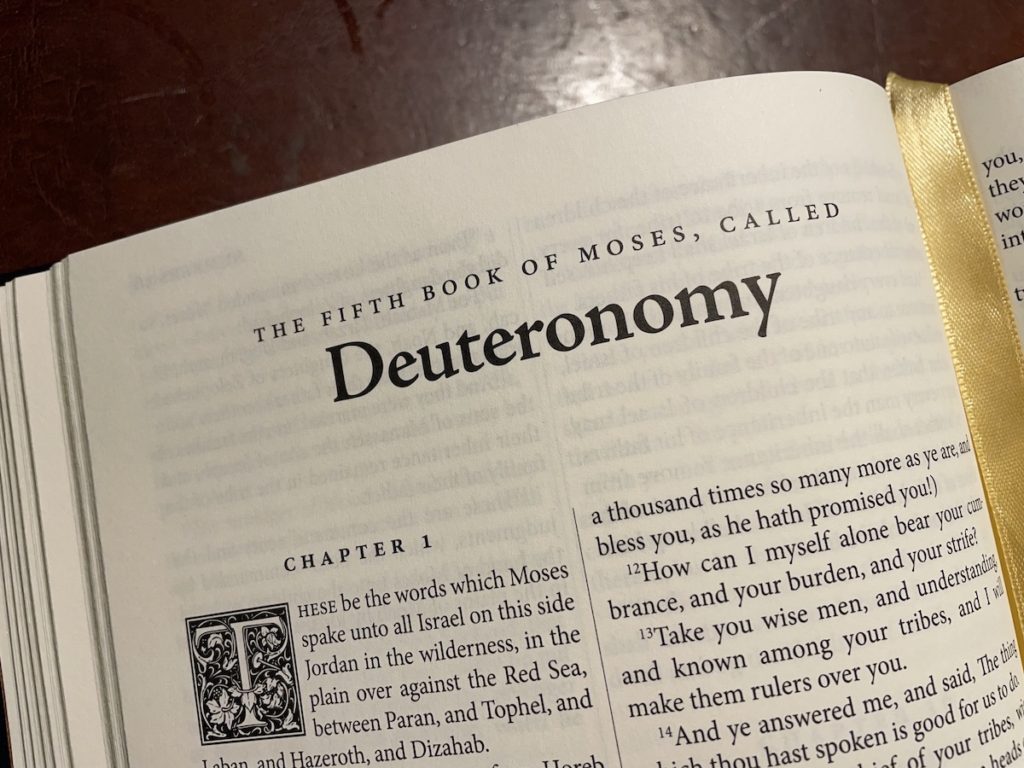
Deuteronomy 29:4,A heart to perceive.This verse prophesied the outpouring of the Spirit of Elohim en masse on humans.
Deuteronomy 29:15,Not here with us today.This verse teaches us that YHVH made his covenant not only with the Israelites present there that day, but with all those who would live in the future. What are the implications of this with regard to your life? How does it impact what you do, how you act, your attitude and relationship with your Maker to know that covenants were made 3500 years ago that have a bearing on our lives today as Redeemed Israelites or the Israel of Elohim (see Gal 6:16)?
There are those in the modern church who will say, “Since I’m not an Israelite, but I’m a Gentile Christian, therefore, I have no obligation toward the Torah, and thus the Old Testament laws mean little or nothing to me.”
My response to this argument that, with the flick of the hand and the nod of the head, dismisses two-thirds of Scripture—the Word of Elohim—is simple. The idea that a born again believer is still a Gentile—a lie that the church system has convinced most Christians to believe—isn’t biblically substantiated. The Scriptures are clear on this point. For example, Paul calls redeemed believers the “one new man” and part of the nation of Israel. And who are the ex-Gentiles that Paul talks about who were aliens to the covenants (plural, referring to the Abrahamic Covenant revealing the path to salvation, the Mosaic Covenant revealing the path of righteousness and the New Covenant, which is the previous two covenants written on our spiritually circumcised hearts) of Israel, but have now been brought into the commonwealth of Israel through the work of Yeshua? (See Eph 2:11–19.) Remember, there’s no Gentile gate in the New Jerusalem—only the 12 gates named after the 12 tribes of Israel. So what tribe are you?
Additionally, some might question whether covenants made with one’s forefathers are applicable to us today. If this is your case, then let us pose the following question: Did the founding fathers of America make laws more than 200 years ago (i.e. the U. S. Constitution) that are binding upon us today? If so, how much more applicable upon us are covenants made by our forefathers 3500 years ago with YHVH? Just because our forefathers broke their covenant with YHVH does not free us to violate YHVH’s laws any more than if someone in the past violates a nation’s constitutional law frees this frees future generations from violating that law. Think about it!
Deuteronomy 29:16–19, Emboldened to sin. As we pass through the spiritual wilderness of the world around us (verse 16) on our way to the Promised Land of our eternal inheritance, it’s easy for us sin-oriented beings to justify our personal rebellion, our sinful habits, our lustful and materialistic thoughts on the basis of carnal rationalizations. Delusions are tempting. It is all too easy to fall prey to such excuses as, “Everyone around me is doing it,” or, “It feels like it’s okay to do,” or, “If it feels good, do it,” or “YHVH’s laws don’t apply to me … that was for the people back then, not for us today,” or, “That’s not what the church I belong to teaches,” or, “Surely YHVH doesn’t expect us to keep his commandments … they’re too hard to do … we can’t really do all that stuff today,” or, “We’re under grace today … that stuff has been done away … Jesus fulfilled it … nailed it to the cross,” etc. Do these statements square with YHVH’s words of truth? If we have fallen prey to such excuses to disregard the Creator’s commandments, we have, in reality, emboldened ourselves to continue sinning. The question each person needs to ask themselves is, “Do what I believe and practice square with YHVH’s Word?” Is YHVH pleased with our excuses or our obedience? What did Yeshua say would be an identifying mark of those who would love him? (Read John 14:15.)
Deuteronomy 29:20–28, Rooted them out of their land. What was YHVH’s response to those who refused to obey him? Are some of the curses (i.e. the bad things happening to you now) in your life related to disobedience of his commandments (or YHVH’s instructions in righteousness) in the past or perhaps even now?
Deuteronomy 29:23, Whole land is brimstone. The area just west of the Dead Sea where ancient Sodom and Gomorrah likely were is to this day a barren wasteland of gypsum containing little or no vegetation, and, in places, is covered in sulfur balls (brimstone) that one can still pick up. This region is an enduring testimony to the severity of YHVH’s judgments against men’s sin, which speaking loudly to us even now in harsh and warning tones.
Deuteronomy 29:26, Other gods. This is likely referring to the demon-gods (demigod) nephilim of Genesis 6:2–4 (see The Great Inception by Derek P. Gilbert, p. 67).
Deuteronomy 29:28–30:1–20, The Final Redemption of All Israel. A time is coming when Israel, including the ten northern tribe will be redeemed and regathered back to the land of Israel after having been exiled into captivity from their land. What is the captivity from which Israel will be returning?
What Is This Captivity?
The biblical term captivity is often a reference to Samaria, the capital of the Northern Kingdom or house of Israel, being brought out of captivity by YHVH (Ezek 16:53). Also compare Isaiah 61:1 with Luke 4:18–21 where, while preaching in the region of Galilee and Nazareth (the historic homeland of the Northern Kingdom or House of Israel), Yeshua quotes the Isaiah 61 passage relating it to his ministry to the ten tribes of the lost sheep of the house of Israel (Matt 10:6). Yeshua states that it was his mission “to preach the gospel to the poor … to heal the brokenhearted, to preach deliverance to the captive and recovering of sight to the blind, to set at liberty them that are bound, to preach the acceptable year of YHVH.”
To what“captivity” is Yeshua referring? Is it a physical or spiritual captivity? Compare this with Revelation 18:4 where YHVH states that his people (the saints) are enslaved to the last days’ Babylon the Great religious-economic-political system and must come out of it. What is this religious part of this system that he is now calling his people to leave?
Deuteronomy 29:28, Cast them into another land.“This verse also alludes to the fate of [those Israelites] who had become so assimilated among other peoples that their [i.e. the Israelite’s] origins had become forgotten. When the final redemption comes, these hidden ones known only to [Elohim] will be reunited with the rest of the nation and be restored to the status of their forefathers” (The ArtScrollStone Edition Chumash, p. 1090). To whom is the author referring here? Who became assimilated among the peoples and forgot their origins? Who is it that Elohim will bring out of hiding from among the nations where he, in judgment, scattered them and reunite with the Jews (the tribe of Judah) in the end times during what the Jews refer to as “the final redemption”? In Jewish thought, what is the “final redemption”? (For the answer, read Ezek 34:13; 36:24; Isa 56:8; Matt 24:29–44; Acts 1:6; 1 Cor 15:51–53; Rev 11:15–18.)
Another land. Let’s next notice a quote from the ancient apocryphal book of 2 Esdras 13:40-45(elsewhere known as The Fourth Book of Ezra; quoted from Lange’s Commentary; bracketed phrases are from an alternate translation by James H. Charlesworth in his book entitled, The Old Testament Pseudepigrapha—Apocalyptic Literature and Testaments); Two Esdras is a Jewish work written near the beginning of the Christian era,
[T]hese are the ten tribes which were carried [led] away prisoners out of their own land [into captivity] in the time of Josia[h] the king, whom Salmanasar king of Assyria led captive, and carried them over the river and they were brought over into another land. But they took this counsel [formed this plan] amongst themselves, that they would leave the multitude of the heathen [nations], and go forth into a further country [a more distant region], where mankind never dwelt, that they might there keep their own statutes, which they had not kept in their own land. But they entered into Euphrates by the narrow passages of the river; for the Most High then wrought signs for them, and held still the waves [stopped the channels] of the river till they had passed over. But through that country there was a long journey to make of a year and a half; and the same region is called Arzareth [Hebrew for “another land”].
Arzareth or “another land” is a reference to the prophecy in Deuteronomy 29:28 which states, “And YHVH rooted them out of their land in anger, and in wrath, and in great indignation, and cast them into another land [Heb. eretz acheret], as it is this day.” Acheret in the Hebrew means “another,” but also has the connotation of “new”such as “next year”(or in the “new year,” Gen 17:12), a “another well” (Gen 26:21); “another man” (i.e. a new husband); and so on. Other Hebrew words for “new” include chodesh or chadashah, which can mean either “brand new”or “renewed”such as in “new moon, new heart, or new heaven and new earth”; tiyrowsh, which refers to “new wine” or “new fruits.” These are unique Hebrew words, which specifically describe those things and nothing else; and beriyah, which is used once in Numbers 16:30, describes the earth opening up to swallow Korah and his malcontents.
The point of this brief word study is that eretz acheret can justifiably be translated into English as “new earth,” or “new world.” The “New World” is a common historical reference to what? North America, of course. It was there that Scripture seems to indicate that the Israelites would, in part, at least, be scattered and the rabbinic writings of 2 Esdras 13:40–45possibly makes reference to this land.
Additional Comments on Deuteronomy 29:28
Israel to Be Lost Among the Gentiles
Deuteronomy 29:28 states, “And YHVH rooted them out of their land in anger, and in wrath, and in great indignation, and cast them into another land [Heb. eretz acheret], as it is this day.” How did the ancient Jewish sages understand this passage?
Rabbinic Commentary on this Verse
b. Talmud, Yevamot 17a (c. 500 C.E.) (Soncino Talmud, Soncino):
[T]hey had declared them [i.e. the ten tribes of Israel, see rabbinic footnote below]19 to be perfect heathens [or gentiles]; as it is said in the Scriptures, “They have dealt treacherously against YHVH, for they have begotten strange children.20”
A Rabbinic footnote on this passage states, “(19) The ten tribes; (20) Hos. 5:7.”
The ArtScroll Tanach Series Bereishis/Genesis (an Orthodox Jewish commentary on Genesis) states, regarding Genesis 48:19, Orthodox Jewish sage of the Middle Ages, Ibn Ezra wrote:
Many nations will descend from him [Ephraim]. That is, the word, fullness, melo, connotes “abundance,” the phrase meaning: and his seed will become the abundance of the nations (Neter; Karnei Or)” (p. 2121). According to Radak [R. Dovid Kimchi Torah, a scholar of the Middle Ages], “This refers to the Exile when the lands of others will be filled with his scattered descendants. See also Hosea 7:8: Ephraim shall be mingled among the nations (ibid.).
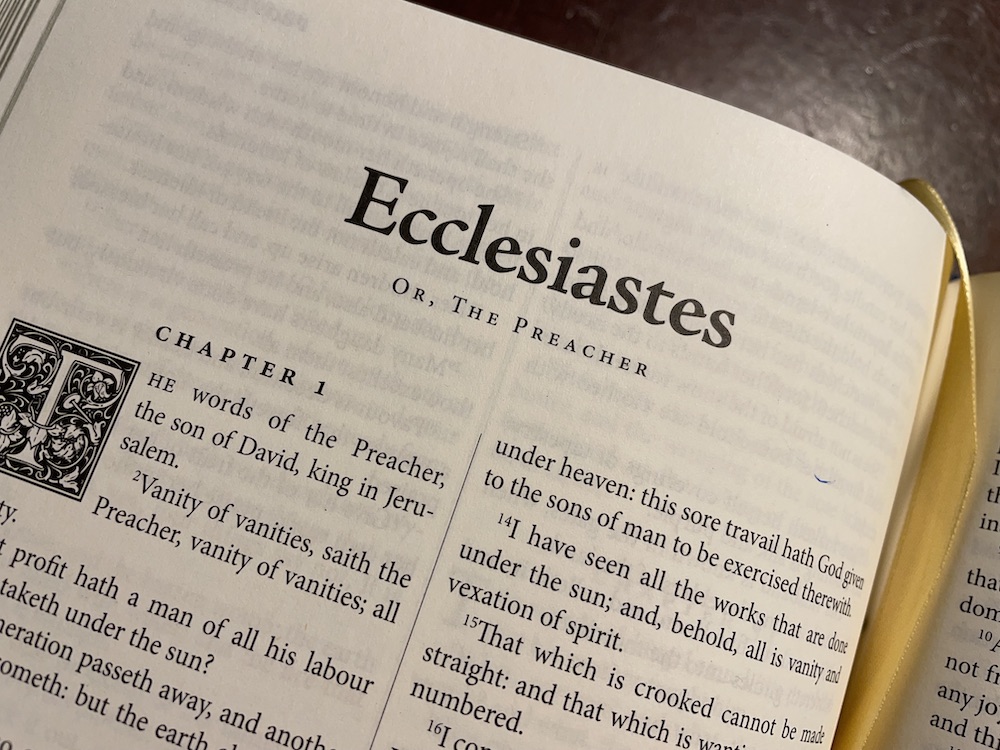
Ecclesiastes 10:1–20,More wise counsel. In this chapter, the Preacher gives his student more wise counsel on how to derive the most fulfillment out of an otherwise seemingly meaningless and pointless existence as a human being trapped in a spaceship called planet Earth.
Ecclesiastes 10:1,Dead flies. Even the smallest error, sin or folly (the opposite of wisdom) can lead to disastrous consequences and ruination, thus, a wise person will correct the small defects in his character, so that they do not ultimately ruin him. Regular self-examination leading to correcting one’s errant ways is to choose the path of wisdom. So deal with your sins and faux pas while they are still small and before they get out of hand.
Ecclesiastes 10:2,Right…left. A wise man follows the right hand path, while a fool goes in the left direction. In Hebraic thought, the right hand represents strength while the left hand symbolizes weakness. This is because most people are right handed and, therefore, they use their right hand more than the left hand making the right arm and hand stronger muscularly. Even in our modern vernacular we have the expression “the right way,” or “doing the right thing” as meaning to make the preferable choice between right and wrong, good and evil. Wisdom is strength while foolishness is weakness.
Ecclesiastes 10:3,Even when a fool. Sadly, a fool cannot help himself because he has become accustomed to his condition and willingly chosen to be blind. Those around him can see that he is foolish in the choices he makes, but since his eyes are shut, he continues blithely on his foolish path.
Ecclesiastes 10:4,Conciliation. When wrongs are committed whether real or imagined, especially in relationship to those in authority over you, be quick to make peace, for it will go much better for you in the long run. Moreover, stay small and keep a low profile when it comes to interaction with civil authorities, for such a position draws less attention to your actions and less chances of conflict and even persecution.
Ecclesiastes 10:5–7,There is an evil. Just because a person has attained a high position of authority does not mean that they are wise. Similarly, just because one has a low social status does not mean that they are a fool. This truth considered in the context of verse four teaches us something: Sometimes those in authority over you are fools who are incapable of make wise and equitable decisions, especially in the area of resolving controversies. This is all the more reason to make peace with these leaders be they foolish or wise when a matter of disagreement is small before it goes too far and gets blown out of proportion causing all sorts of mischief and grief for all involved.
Ecclesiastes 10:8–9,He who digs a pit. What goes around comes around. How we treat others, whether well or badly, will come back to us.
Ecclesiastes 10:10,If the ax is dull. A wise person learns to work smarter, not harder.
Ecclesiastes 10:11–14,The babbler. Beware of the words of a foolish blabber mouth, that is, one who talks incessantly and says little or nothing of meaning. Mischief and poison issue forth from such a person, for they are untrustworthy and their words means nothing. In our vernacular we refer to such a person as “a talker” as opposed to being “a doer.”
Ecclesiastes 10:11–15,The labor of fools. A fool is so lazy and lost in his foolishness that after working he is so enervated that he cannot even find his way back home. Foolishness not only robs a person of the energy to work hard, but also causes one to lose one’s direction in life.
Ecclesiastes 10:16–18,Woe to you, O land. A country suffers grievously when young and foolish people who want to play and party all of the time are its leaders. Blessed s the country whose leaders have a heritage of hard work and responsibility and not of slothfulness and partying. Decay and ruination are the result of sloth and laziness.
Ecclesiastes 10:19,Money answers everything. Partying and drinking may be fun, for it is full of boasting and bravado, but this accomplishes nothing. Unless one puts one’s money where their mouth is, nothing gets done. “Put up or shut up,” and “Show me don’t tell me,” as the sayings go.
Ecclesiastes 10:19,Do not curse the king…a bird. Bad thoughts lead to bad words which lead to bad actions that eventually come back to bite a person.
Moreover, this verse instructs us: “Do not curse the king, even in your thought; do not curse the rich, even in your bedroom; for a bird [Heb. owf] of the air may carry your voice, and a bird [Heb. baal] in flight may tell the matter.”
This verse is very revealing regarding what goes on in the unseen spiritual realm where Satan is the prince of the power of the air (Eph 2:2) and the ruler of this world (John 16:11).
The phrase in this verse is a parallelism—a form of Hebrew poetry where two phrases are juxtaposed and appear to be saying the same thing, but, in this case, a subtle spiritual truth is being revealed in the second phrase. In the first phrase, the word for bird is a generic Hebrew word meaning “a bird, a winged creature or a winged insect.” The second phrase reveals the subtle truth. It is telling us to be careful what you say or even think—even in private, for a god (or demon) might reveal it to its lord or king. In other words, a false god or demon spirit might convey what you’ve thought or said to its demon master, or even to Satan, who is the god of this age (2 Cor 4:4). And who knows where it will go from there.
With regard to prayer, we must remember this: “For we do not wrestle against flesh and blood, but against principalities, against powers, against the rulers of the darkness of this age, against spiritual hosts of wickedness in the heavenly places” (Eph 6:1). In light of this reality and concerning prayer, it is vital that we remember this: When making intercession for situations or people or praying against the enemies of Elohim or engaging in spiritual warfare against Satan and his plans, ask YHVH to cover your prayers under the blood of Yeshua (Rev 12:11), to bind the (demonic) strong man (Matt 12:29; Mark 3:26–27 cp. Rev 20:2), to send his angels to protect you against the enemy’s plans to thwart your prayers (Ps 91:11–12; Heb 1:14), and to send confusion to our spiritual enemies (Ps 35:4, 26; 40:14; Jer 20:11).
It is essential that we employ this strategy against our spiritual adversary, so that he will not be able to hear our prayers and thus be able to prepare a defensive plan or a punishing backlash against us to prevent our prayers from being effective. When he succeeds in this, the result is often unanswered prayers causing the saint to become discouraged, so that he prays less often rather than more—a victory for the evil one.
Perhaps this is why some of our prayers go unanswered or seem ineffective; it is because we are inadvertently revealing our plans to the enemy thus allowing him to thwart them.
Our annual Scripture Reading Schedule for 2020-2021 with daily readings that began on 10/11/20 is available to download and print. The link to the previous 2019-2020’s Scripture Reading Schedule will still be available on the right sidebar under “Helpful Links” into next year. If you are using a mobile device or tablet, the link may be below, meaning you’ll need to scroll down instead.
Most of this week’s blog discussion points will be on these passages. If you have general comments or questions on the weekly Scripture readings not addressed in a blog post, here’s a place for you to post those. Just use the “leave a reply” link or the “share your thoughts” box below.
The full “Read Through The Scriptures In A Year” schedule, broken down by each day, can be found on the right sidebar under “Helpful Links.” There are 4 sections of scripture to read each day: one each from the Torah, the Prophets, the Writings, and from the Testimony of Yeshua. Each week, the Torah and haftarah readings will follow the traditional one-year reading cycle.
* Verse numbers in parenthesis refer to the verse number in Christian English Bibles when they differ from Hebrew Bibles or the Tanakh.
Weekly Blog Scripture Readings for 8/29 through 9/4/2021.
Hebrews 6:1, Elementary principles of Messiah.What follows are the six principal doctrines of the redeemed believer, yet they are all subsets of faith in Messiah Yeshua, which is foundations upon which it all rests.
Repentance from dead works.True biblical repentance involves turning from sin or a lifestyle of Torahless behavior, since sin is the violation of the Torah-law of Elohim (1 John 3:4), and lining all aspects of our lives up with the Torah-Word of Elohim.
Hebrews 6:2, Doctrine of baptisms. (See notes at Matt 28:19.)
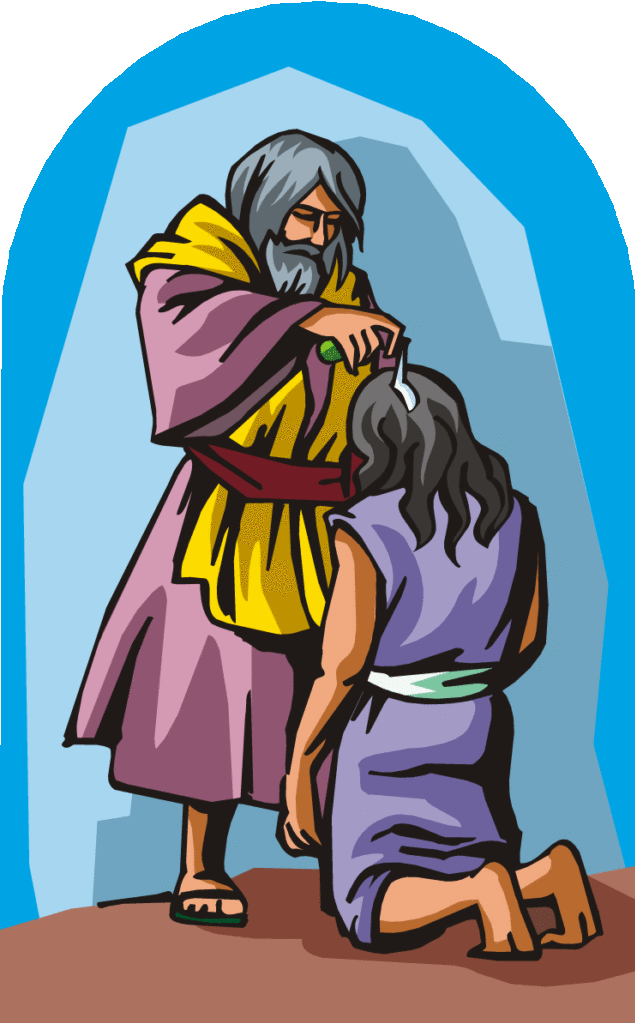
Laying on of hands. Ordination is something that YHVH instituted in the Torah when he charged Moses to impose hands upon the Levites, and instructed all Israel to do the same (Num 29:10). We also have the example of Moses anointing with oil Aaron (Exod 29:10). Of course, kings of Israel were also anointed with oil to consecrate them for their official duties by the laying on hands.
Laying on of hands/ordination was earth’s confirmation of a heavenly calling. Elohim had already called someone into ministry and men were simply confirming what Elohim had already determined. Ordination doesn’t confirm the calling, but the other way around.
In the Testimony of Yeshua, by lot, the 11 apostles chose Matthias to replace Judas (Acts 1). This was heaven’s choice, yet no mention of ordination is recorded. After that, we have the choosing of the seven in Acts 6:1. These were men who were already full of the Spirit and wisdom, so the apostles simply confirmed the work of the Spirit in them by laying hands on them (verse 6).
The same is true in the other examples of ordination in the Apostolic Scriptures. Men would be mentored by a leader/apostle, and after a period of time (“lay hands on no one suddenly” 2 Tim 5:22)—much like the five years of mentoring that occurred with a priest in training in the Torah (from age 25 to 30), and after meeting the qualifications of eldership (see 1 Tim 3:1–12 and Tit 1:5-9) they were appointed. Of course, those who were the mentors had oversight over those they mentored. It was less of a authoritatively-hierarchical system and more of patriarchal system with the older men lovingly overseeing those they had raised up—and only exercising strict authority when needed, which occurred only rarely.
Of course, there was no such thing as licensing or even denominations which issue licenses in the Apostolic Scriptures. To me, that seems more like a man-made thing for the purposes of maintaining power, control and keeping the money flowing upward.
In the entire Bible, there are no examples of or precedence for women being ordained. Paul says in 1 Timothy 5:22 “to lay hands suddenly on no man.” He is gender specific. Women did, however, minister in conjunction with their husbands—their spiritual heads, which is something Paul is very clear about in Ephesians 5:21–24. Even though in the body of Yeshua there is neither male nor female so that all are equal before Yeshua, when it comes to governance in the congregation, the Bible upholds male leadership. Now that doesn’t mean that women can’t hold high positions of authority, but always in conjunctions with their husbands. We have the example of the apostolic team of Andronicus (husband) and Junia (wife) whom Paul called apostles (Rom 16:7), Aquila and Priscilla who were co-laborers. Sometimes Priscilla’s name is mentioned first. Obviously, this husband and wife team were such a tight unit that it didn’t matter whose name was mentioned first. Of course, we have examples in the Scriptures of women prophets. Deborah, though she was a judge in Israel, seems to have been married to Barak the military general. If so, we have an apostolic-prophetic team operating together to lead the Israelite nation. Huldah was a prophetess who seemed to operate without male headship, though she hung out with other prophets in a “school” or neighborhood where the prophets lived. So there was must have been some accountability between her and the other prophets, although she was the most gifted of YHVH since hers is the only name mentioned. Then we have the daughters of Philip the evangelist who were prophetesses—again, presumably under the spiritual leadership of their father (Acts 21:8-9).
Hebrews 6:6, If they fall away, to renew.
Is the “Once Saved Always Saved Doctrine” Biblical?
Deuteronomy 28:1–68, Blessings and curses for Torah obedience. Are the curses for Torah disobedience and the blessings for obedience still applicable in the life of the redeemed believer today, or because “we’re now under grace” are these blessings and curses irrelevant to us? Or, as some preachers teach, do Christians now only receive the blessings, and not the curses of the law regardless of whether they violate the Torah or not, since Yeshua took away the curse of the law? What is the answer to this question? The short answer is this: Is the law of gravity still in effect if you jump off a cliff? For a further explanation, see my notes at 2 Cor 3:7.
Deuteronomy 28:1, Commandments. Most people with whom I have engaged in discussions about the Torah-law of Elohim have a limited understanding of the breadth, scope and purpose of Elohim’s law. If they were to understand the full ramifications of the Torah, they would likely be less inclined to dismiss its validity in their lives. When discussing the Torah with people who have a traditional Christian view of “the law,” it might be helpful to keep the following truths in mind; they help to “blow the lid” off of people’s theological boxes!
What Is the Purpose of the Torah?
(Excerpted from a larger work by Ya’acov Natan Lawrence entitled, YHVH’s Instructions In Righteousness—A Messianic Believer’s Introduction to the Torah available online at http://www.hoshanarabbah.org/pdfs/torahprimer.pdf)
The purpose of the Torah is to show man how to walk in right relationship (or righteousness) with his Creator. To do this, we must love YHVH with all our heart, soul, mind and strength (Deut 6:5; Mark 12:30) and love our neighbor as ourself (Lev 19:18; Mark 12:30). Once one is saved by grace through faith (See my teaching article entitled: The Abrahamic Covenant: The Covenant of Salvation, available at http://www.hoshanarabbah.org/pdfs/abracov.pdf.), Torah helps show man how to walk in the straight and narrow path that leads to blessings and life and avoids the curses of the law (Deut 30:15; 32:47). The Torah shows man how to avoid sin (which is the violation of YHVH’s Torah-commandments, 1 John 3:4), which is walking contrary to YHVH’s instructions in righteousness that are for our blessing and benefit.
The Torah does not set an impossible standard by which to live. We must ask ourselves, would a righteous and just Creator and a loving Heavenly Father give to his chosen people and children a set of standards that were humanly impossible to perform, and then curse them for their inability to meet these standards? Of course not! Rather, the Torah (including both the Abrahamic and Mosaic Covenants) sets a standard of faith, trusting in Elohim, and of following its system of repentance and sacrifice for obtaining forgiveness from Elohim and restoring a condition of being considered righteous in his sight. After all, Moses, the human instrument through whom YHVH revealed the Torah to the Children of Israel, states in Deuteronomy 30:11–14:
For this [Torah] commandment which I command you this day, it is not hidden from you, neither is it far off. It is not in heaven, that you should say, “Who shall go up for us to heaven, and bring it unto us, that we may hear it, and do it?” Neither is it beyond the sea, that you should say, “Who shall go over the sea for us, and bring it unto us, that we may hear it, and do it?” But the word is very near unto you, in your mouth, and in your heart, that you may do it.
Paul quotes this very passage in Romans 10:6–8 where he relates the written Torah to Yeshua, the Living Torah or Word of Elohim incarnate (in the flesh, see John 1:1, 14). He shows that they are one in the same and that Messiah Yeshua came to live and reveal to us the righteousness of the Torah-law (verse 4) that is available to us if we will but have a heartfelt faith in him (verses 4, 9–10) and allow him to live out his righteousness in us through the empowering work of the Spirit of Elohim. In verses 11 through 21, Paul goes on to relate this very truth to being the central message of the gospel that Isaiah prophesied (Isa 52:7) would be preached to redeem both houses of Israel to Yeshua their Messiah.
It might be said that in a sense that the Torah itself is neutral; neither positive nor negative, for it is like a mirror simply reflecting the image portrayed in it. Torah reacts according to human action. Those who obey it are blessed and those who disobey it are cursed. David Stern in his Jewish New Testament Commentary lists both some of the “negative” and some of the positive functions of the Torah. On the “negative” side:
1) The Torah has the capacity to stir up sin in an individual. This capacity of the Torah to make us sin is not a fault in the Torah but a fault in ourselves. A healthy person thrives in an environment deadly to someone who is ill; likewise, the Torah, beneficial to a believer living by faith, is an instrument of death to these controlled by their sinful nature (p. 375).
2) The Torah can still produce guilt feelings in a believer—as it rightly should whenever he contemplates how his behavior falls short of the standard Elohim sets in the Torah. But these feelings are not irremediable. The remedy is once-and-for-all trust in Yeshua the Messiah’s final atonement for sin (Rom 3:21–26), followed by ongoing confession of and repentance from sins (1 John 1:9) (Ibid.).
3) The Torah also provides a framework of justice by which Elohim, the Just Judge of the universe, will judge the actions of men to determine both their level of punishment for its violation and their level of reward for obedience to it.
4) Because of the righteous standards the Torah sets out, for the sinner it points out the fact that they have sinned and how far they have fallen short of the glory of YHVH (Rom 3:23) and hence their need for a Savior or Redeemer. The Torah actually points the way to Yeshua as Paul points out in the book of Galatians (3:25).
On the positive side:
1) The Torah provides a framework of grace in which one can live. As David Stern points out, YHVH’s people are to live “within the framework of” Torah, but they are not to be “in subjection to” [or under] the Torah in a legalistic fashion. YHVH’s giving of the Torah was in itself an act of grace that the New Covenant (NT) compares with his sending Yeshua (John 1:17) (Ibid., p. 374). Ariel Berkowitz, in his book, Torah Rediscovered, states it this way, “[Torah] function[s] as a protective border for the people of [Elohim].” He goes on to show that there are two opposing spiritual realities in the universe: the kingdom of light (YHVH’s kingdom) and the kingdom of darkness (Satan’s kingdom). Torah acts as a protective border to keep those wanting to abide in the kingdom of light/life/blessing/relationship with YHVH safe and secure. The Torah tells us what is truth as opposed to error, light as opposed to darkness, clean as opposed to unclean, holy (kadosh or set-apart) as opposed to profane or polluted, life as opposed to death (pp. 26–27).
2) The Torah, as understood and applied through the Spirit, thereby gives life in union with Messiah (Stern, p. 381).
3) Obeying the Torah brings us eternal rewards (not eternal life, which is by grace through faith alone, see Eph 2:8) in the world to come (Matt 5:19).
4) Obeying the Torah helps deepen a loving and intimate relationship with YHVH-Yeshua and helps us to abide in Yeshua (John 14:15; 1 John 2:3–6).
5) Obeying the Torah helps us to stay spiritually pure (1 John 3:3–6).
6) Obeying the Torah protects us from the influence of the devil (1 John 3:8).
7) Obeying the Torah-Word of YHVH helps to perfect YHVH-Yeshua’s love in us (1 John 3:6).
Deuteronomy 28:4 and 5–12, The fruit of your womb.Please note that the blessings of children are mentioned before material blessings. What does this teach us about how YHVH views children and families? Is such a view reflected in the mores of our current society? Are those with large families more respected than those who have large homes, drive expensive cars and have high social positions?
Deuteronomy 28:15, To the voice of YHVH.What is the voice of YHVH? Is his voice that which was uttered the Torah at Mount Sinai? Is it the voice of his Spirit inside of a Spirit-led, redeemed believer? Is it the voice of Yeshua as largely recorded in the red letters of the Testimony of Yeshua, or is it the entire Word of YHVH Elohim called the Scriptures? If the answer to the question is “all of the above,” then should any parts or aspects of Elohim’s voice contradict with any other? If we have a Biblical view or theology where we believe that one aspect of YHVH’s voice contradicts with and another in that we believe a part of it has been “done away with,” then what does this imply about the mind and nature of YHVH? There is a psychological term for this. It is called schizophrenia. Now in our right mind, we would never dare label YHVH with such terms, for to do so would be blasphemy, right? Yet, in reality, many of our religious beliefs make YHVH into something that he is not, and we risk become an unwitting party to attaching this blasphemous labeling to the Almighty Creator if we subscribe to these false theologies that, in one way or another, tell us one part or another of the Word of Elohim is no longer for us today. One thing is certain. YHVH is not a liar, nor does he ever contradict himself. If there seems to be a problem with inconsistency in YHVH’s Word, the problem is with OUR misunderstanding or misinterpretation of it, and NOT with the actual Word or voice of YHVH!
Deuteronomy 28:15–68, Judgment on a nation and a saint’s responsibility. Read the punishment for Torah disobedience listed in chapter 28. Are these curses coming upon America as its political leaders enact legislation and its judicial leaders make legal rulings that help to turn us away from our historic Judaic-Christian heritage, while at the same time America’s religious leaders say little or nothing against this trend? You and I do not have a large voice in this nation, though we have a small voice. What can we do to help turn the spiritual tide? What are you doing to be the salt and light in this society that Yeshua has called you to be with regard to keeping YHVH’s Torah commands?
Deuteronomy 28:47, Ungratefulness versus thankfulness. YHVH states that ungratefulness for the blessings he has given us and failure to obey him out of a joyful and glad heart will bring curses on us. Reflect on this. How much time each day do you spend thanking him for his blessings in your life? When you get up in the morning? Every time you eat? At noonday do you stop to praise him, as David did? Before you go to sleep? Not only is doing so a form of worship, but such a heart attitude and orientation helps us to keep our focus continually upon him so that we will forget not all his benefits (Ps 103:2) and fall into a state of hardened heart and forgetfulness (Deut 29:2–4). Israel forgot what YHVH had done for them, which led to their disobedience, faithlessness and explains why the older generation was not allowed to enter the Promised Land. Will we learn from their examples (1 Cor 10:11)?