From the time of Abraham to Mount Sinai, to defeating Israel’s enemies, to the prophets’ warning call, to summoning Messiah’s bride to prepare for the marriage of the Lamb, to the pouring out of the end times wrath of Elohim upon Earth’s rebellious inhabitants, to announcing the return of Yeshua the Messiah, to the resurrection of the saints, the biblical ram’s horn shofar has played a key role in the life of Elohim’s people for thousands of years to this day. When sounded, the shofar sends terror and confusion into Satan’s camp, while causing the Divine Ear of heaven to listen. It is still a potent weapon and praise instrument in the hands of today’s saints when used with wisdom and understanding as this teaching reveals.
This and other videos by Nathan are available as podcasts on Spotify and Apple podcast under “Hoshana Rabbah.”
If you are interested in participating in Hoshana Rabbah’s weekly Shabbat online fellowship (Oasis Elim Online), send an email to hoshanarabbah@earthlink.net.
The phrase “Jacob’s trouble” is a curious code term found buried deep in the prophetic writings of the ancient Jewish prophet Jeremiah who lived in the sixth century BC. Many Bible commentators have recognized that this phrase has end time prophetic implications and have attempted to decode this perplexing prophecy. Many have offered novel explanations as to its meaning. But most have fallen short. Why is this? Because unless one takes into consideration the greater contextual backdrop of this phrase, any explanation will wildly miss the target. Once the veil of mystery is lifted, this prophecy along with its Genesis 32 historical context, suddenly opens a huge panoramic window of understanding that explains the current conflict in the Middle East between the Jews and the Muslims, between the country of Israel and its surrounding neighbors as well as the tension between Islam and Christianity, plus explosive eruption of the current rise of anti-Semitism and anti-Israel sentiments worldwide.
Moreover, a failure to understand the meaning of “Jacob’s trouble” explains the current animus in some of the most unexpected places including among some so-called contemporary American Christian social media influencers and news commentators such as Tucker Carlson, Candace Owens and Nick Fuentes to name a few. If these misguided and uninformed media personalities were to understand the true biblical end time implications of Jacob’s trouble, they en masse would be stunned into silence, put a hand over their mouths, and immediately shut off their microphones for a long moment of reflection and repentance. They would quickly realize that they are on the wrong side of history, the truth and YHVH Elohim, the God of the Bible. In fact, they are taking the position of the spirit of antichrist! This may seem like a wild assertion on the part of this author, but once the facts are revealed, the pieces of the puzzle will suddenly and easily fall into a place and a huge picture of undeniable truth will form and the silly, childish babbling of the foolish Israel-haters will be once and for all silenced.
Woe be to anyone who finds themselves on the side of the enemies of the God of Israel. The Pharaoh of Egypt, the Babylonians, the Persians, the Greeks, the Romans, the Muslims, the Catholic Church, the Russian Tsar, the British Empire, Hitler, the Palestinian Authority, the Muslim Brotherhood, the United Nations, the International Criminal Court, Hamas, Hezbollah, Iran, Yemen and many more have attempted or are attempting in vain to squelch or even extinguish Jacob’s descendents from fulfilling their God-mandated Abrahamic Covenantal promises in one way or the other, and all have failed and are to this day still failing.
Now let’s learn what the phrase “Jacob’s trouble” means, and may the veil of ignorance be lifted and the scales fall off the eyes of the unbelievers and skeptics, and may the God of Abraham, Isaac and Jacob and their descendants along with the timeless truth of the Bible be vindicated(!)—sadly as if this should even be necessary.
“Jacob’s Trouble”—His Dark Night of the Soul in End Times Prophecy and YOU!
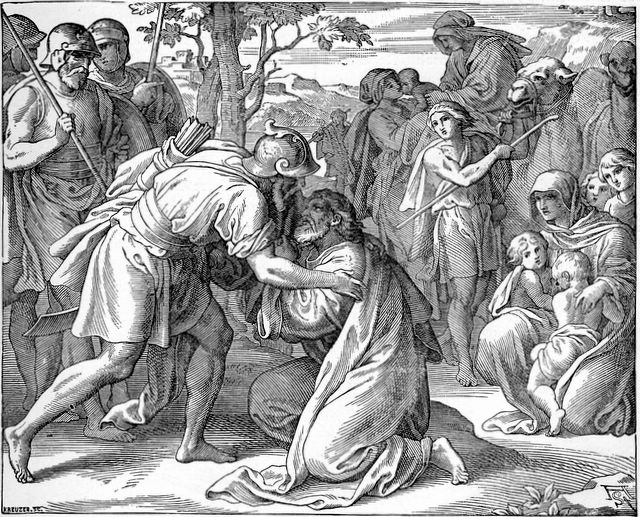
Jacob meeting Esau
You have probably heard the saying that the night is the darkest just before the dawn. Metaphorically speaking, when circumstances conspire against you and the outcome looks the bleakest, that is often when the rays of hope begin to shine through the darkest darkness and the outcome suddenly reveals itself. A way forward unexpectedly manifests itself out of the obscure gloom of apparent defeat and hopelessness. People of faith can more easily relate to such a scenario. This was exactly the place in which the patriarch Jacob found himself when returning to the land of Canaan—the future Promised Land. He had reached the pinnacles of success in his earthly endeavors, and now circumstances beyond his control in front of and behind him were conspiring to take everything away including his very life This is not only the story of his life, but each of us has likely found ourselves in similar spots as well. Deliverance and victory often emerge out of the darkest and bleakest periods of life. This is a test of our faith that, if we are to progress to the next level in our spiritual growth, we must pass.
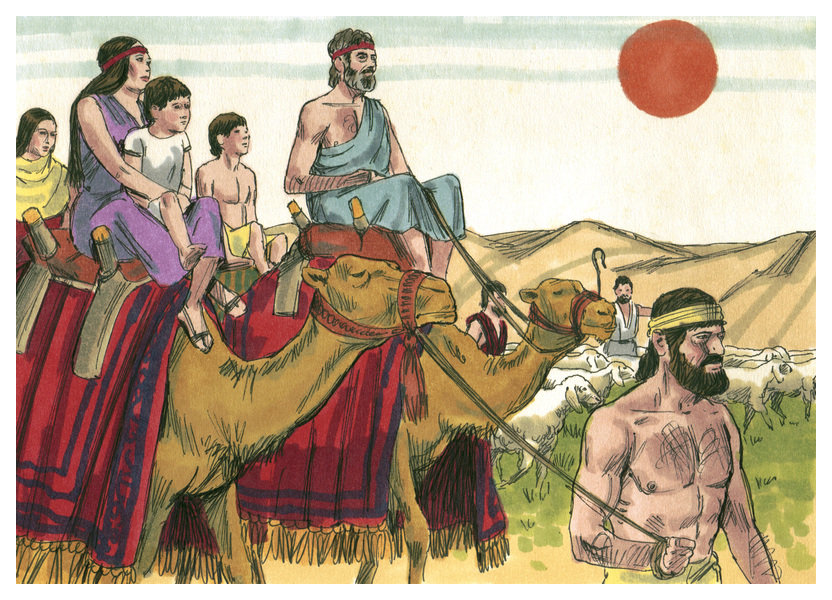
Genesis 32 is the story of Jacob’s return to Canaan after having been exiled from his homeland for 20 years. His exile occurred after he obtained his divinely promised birthright through shrewd and somewhat unscrupulous means from his brother Esau resulting in his having to flee Canaan for fear of his life due to his brothers desire lust for vengeance. Jacob took refuge in the region of Babylonia at his Uncle Laban’s home, where he married Laban’s two daughters, Leah and Rachel. After twenty years working for the greedy and treacherous Laban, Jacob had to flee Babylon with is father-in-law in angry pursuit. As if that were not enough, while Jacob and his family were returning to Canaan, they encountered Jacob’s angry brother Esau who was still angry two decades later of being cheated out of his inheritance. Esau along with a small army not only stood in Jacob’s way from entering the land of his promised inheritance, but also wanted to kill Jacob.
This account of Jacob’s personal, spiritual struggles also has prophetic, end times implications relating to the regathering out of exile of the twelve tribes of Israel (the Jews and the Christians) and their return to the Promised Land in Israel under Yeshua the Messiah at his second coming. The Scriptures refer to this time period as “Jacob’s Trouble.” This Bible verse is found in Jeremiah where we read,
Alas! For that day is great, so that none is like it; and it is the time of Jacob’s trouble, but he shall be saved out of it. (Jer 30:7)
The ancient Jewish sages believe that the encounter between Jacob and Esau (no doubt informed by Jeremiah’s prophecy) is prophetic in nature and will happen again in the end times, but this time on a much larger scale involving the numerous descendants of both Israel (or Jacob) and Esau (also called Edom). That is to say, the Israelites of the end times will be attempting to return to their ancestral homeland, while the modern descendants of Esau (the forces of Antichrist as represented by the antichrist religion of Islam and their Elohim-hating allies) will be blocking their way. As we proceed in this study, we will see whether this prophecy is beginning to come to pass in these last days.
Relating to Jacob’s descendants coming into the Promised Land, the ancient Jewish sages speak of two major redemptions in Israel’s long history. The first redemption occurred when YHVH delivered the oppressed and enslaved children of Israel out of Egypt at the exodus. History will then repeat itself in what the Jewish sages refer to as “the second or final redemption,” which will occur at the end of this present era when the Messiah will regather and then lead his exiled and scattered Israelite people back to the Promised Land in fulfillment of numerous biblical prophecies.
Rolling the time line backwards a little in the present story of Jacob, not only had Laban chased his son-in-law out of the area of Babylon, but Jacob was also being blocked from entering Canaan by his murderous brother Esau (or Edom). This is reminiscent of Pharaoh pursuing the Israelites as they were exodusing Egypt only to find their escape route blocked by the Red Sea. Pharaoh was the first Edom, if you will, or, stated otherwise, Edom is the second Pharaoh. In both instances, YHVH’s people were or will be forced to rely totally on him for deliverance from their enemies who were both in front of and behind them.
Initially, Jacob dealt with his crisis in a typically human way—by scheming and conniving “to save his own skin,” so to speak, instead of having faith in YHVH “to work things out.” He figured that by bribing his angry and bloodthirsty brother with wave after wave of gifts, he might appease and assuage Esau’s desire for murderous revenge (Gen 32:13–20).
Yet Jacob’s bifurcated response to this present danger by resorting to both appeasement and prayer was not acceptable to YHVH, who wanted Jacob to be a man of unmitigated faith, that is, to solely trust in him. Or as Job put it, though you slay me, yet will I trust you (Job 13:15).To bring Jacob to this point, a part of Jacob had to die: his prideful self-reliance and his inclination toward extricating himself from difficult situations through his own cunning ingenuity. This innate tendency of his, not unlike our own, was based on fear of death, and not on faith in YHVH. The Bible tells us that where there is fear, there is no love (1 John 4:18), and that YHVH has not given his people a spirit of fear, but of love, power and a sound mind (2 Tim 1:7). For Jacob to mature spiritually, YHVH wanted him to leave the fear and faithless aspect of his human nature on the east side of the Jordan where Babylon (a spiritual metaphor for the old carnal and sinful man and the ungodly ways of this world) was located. In its place, a faith-filled man who would totally trust YHVH in all things had to rise up. Jacob could no longer trust in his soul man (i.e., his mind, will and emotions) to determine his actions; rather, he had to rely on the Spirit of Elohim to lead him as it informed his inner man or personal spirit, which would, in turn, lead his soul forward in the walk of faith. Only a man of faith, who is mighty in the Spirit and obedient to YHVH, will be deemed worthy to enter the Promised Land (see Ezek 20:33–38, especially note vv. 37–38). The children of Israel learned this lesson the hard way too. The carcasses of older generation that lacked faith in and obedience to YHVH littered the wilderness en route to the Promised Land.
For indeed the gospel was preached to us as well as to them; but the word which they heard did not profit them, not being mixed with faith in those who heard it…Since therefore it remains that some must enter it, and those to whom it was first preached did not enter because of disobedience…(Heb 4:2, 6)
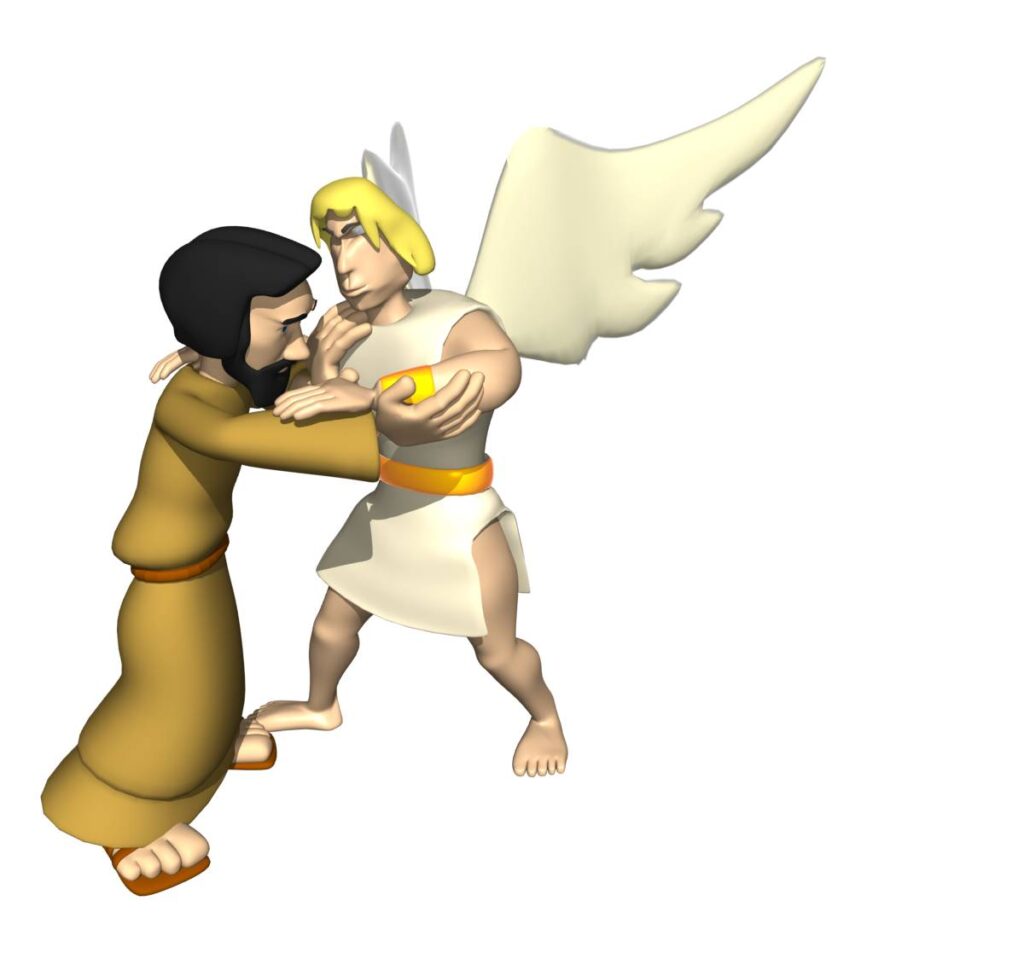
Like Jacob’s descendants later learned, he too had to discover that his old man, who lacked faith, had to die just before entering the Promised Land. But this was a difficult process. This is because Jacob had to come to grips with his own limitations and overcome the ugly side of his innate human nature that was directed by his mind, will and emotions and not by the Spirit of Elohim. This internal battle between the soul and the spirit occurred during a “dark-night-of-the-soul-encounter” when Jacob wrestled all night with the Messenger of Elohim (Gen 32:22–32).
The result was that in this struggle Jacob became permanently lame in his hip (Gen 32:32). He became physically injured, but more importantly, he became humbled in his heart. His soul man (i.e., his mind, will and emotions) became subservient to his spirit man (under the leading of the Spirit of Elohim). Out of his wrestling match, he gained a new identity, a new heart and a new name. Jacob the “heal catcher” became Israel “the prince of El [God]” or “the prevailer with El.” By wrestling with and overcoming his own soulish or carnal limitations, that is, his own pride, self-reliance on his mind to figure things out instead of trusting Elohim by walking in the faith and in the Spirit, he became a broken and changed man. By trusting in YHVH, he became a vessel that the Creator could use to further his plan of redemption as promised to Abraham, the father of our faith, for it was through Jacob that the birth of birth the nation of Israel was to occur.
Through events leading up to Jacob’s dark night of the soul, he learned a vital spiritual lesson: his carnal attempts at appeasing Esau gained him nothing except a slimmer net worth via the loss of material possessions. On the other hand, his wrestling with and surrendering to the Messenger of Elohim—who was, in reality, the preincarnate Yeshua—gained him and his descendants not only a nation and the Promised Land, but ultimately the whole world, through Yeshua the Messiah, and a place in YHVH’s eternal kingdom.
Interestingly and as part of a larger picture that would latter play out prophetically in the Bible’s pages, as a gambit to save his own skin from his vengeful brother, Jacob divided his family into two camps in the hopes that if Esau killed one group, the other would survive and vice versa. This was another one of his schemes that failed to work, but which has tremendous end-time prophetic implications. Genesis 32:2 records that Jacob called the name of the place where he split his family into two camps Mahanaim, which is a Hebrew word meaning “two camps” and is the plural of the root word machanah meaning “encampment, camp, camp of armed host, army camp, company or body of people.”This spot is near the River Jabok, which is a tributary to the Jordan River and is located on the east side of that river in the modern country of Jordan.During the time of the nation of ancient Israel, it was located in the Gilead region on either the border between Gad and Reuben or Gad and Ephraim. The Song of Solomon makes reference to mahanaim in chapter 6:13 where we read,
Return, return, O Shulamite; return, return, that we may look upon you. What will you see in the Shulamite? As it were the company [Heb. m’kolah] of two armies [Heb. mahanah].
The Hebrew word m’kolah means “dance.” I see a correlation between Song 6:13 and Genesis 32:2, since mahanaim in Genesis and machneh or “two armies” in the Song of Solomon are the same word; the former is the plural and the latter is the root word.
What is the prophetic connection between these two biblical passages? It appears that Genesis 32 is a prophetic shadow-picture of just how Jacob’s descendants will come back into the land of their inheritance prior to Yeshua’s return. This prophetic scenario is confirmed in the Jeremiah 30:7—the Jacob’s trouble prophecy. In Jeremiah’s prophecy, the context is Jacob’s end time descendants (i.e., the Christians and the Jews) returning from their captivity and exile in the nations of the world.
“For behold, the days are coming,” says YHVH, “that I will bring back from captivity My people Israel [the house of Israel who would become the Christians] and Judah [the Jews],” says YHVH. “And I will cause them to return to the land that I gave to their fathers, and they shall possess it…Alas! For that day is great, so that none is like it; and it is the time of Jacob’s trouble, but he shall be saved out of it. For it shall come to pass in that day,” says YHVH of hosts, “That I will break his yoke from your neck, and will burst your bonds; foreigners shall no more enslave them. But they shall serve YHVH their Elohim, and David their king, whom I will raise up for them. (Jer 30:3, 7–10)
Obviously, this prophecy along with a resurrected King David to rule over a regathered and reunited Israel (i.e., Christians and Jews) hasn’t occurred yet. This will happen at Yeshua the Messiah’s second coming. The corollary to this prophetic passage is Ezekiel’s Two Sticks Prophecy where, again in the end times, the two camps or houses of Israel are regathered and reunited with King David ruling over them in the sight of the Messiah (Ezek 37:13–27).
With so much evil attempting to force its way into every aspect of our culture as well as into our very thoughts and hearts, how do we stand up against this tide of satanic evil?
Evil comes in many forms: abortion, sexual perversions, destruction of marriage, the drug culture, tyrannical government, euthanasia, confusion about male and female genders, transgenderism, bodily mutilations of all kinds, the rise of the occult and satanism, the culture war against Christian and biblical values, leftism, the rise of globalism and the new world order, the worship of the god of scientism, technocratic mind control, the new age movement, new forms of racism and discrimination against white people, and the list goes on and on.
So what can you do to stop, thwart or avert this tide of evil? Is it useless to attempt to stand against it? What would Yeshua have us to do? What is our biblical model to follow? In this video, we give you some practical suggestions on what YOU can do.
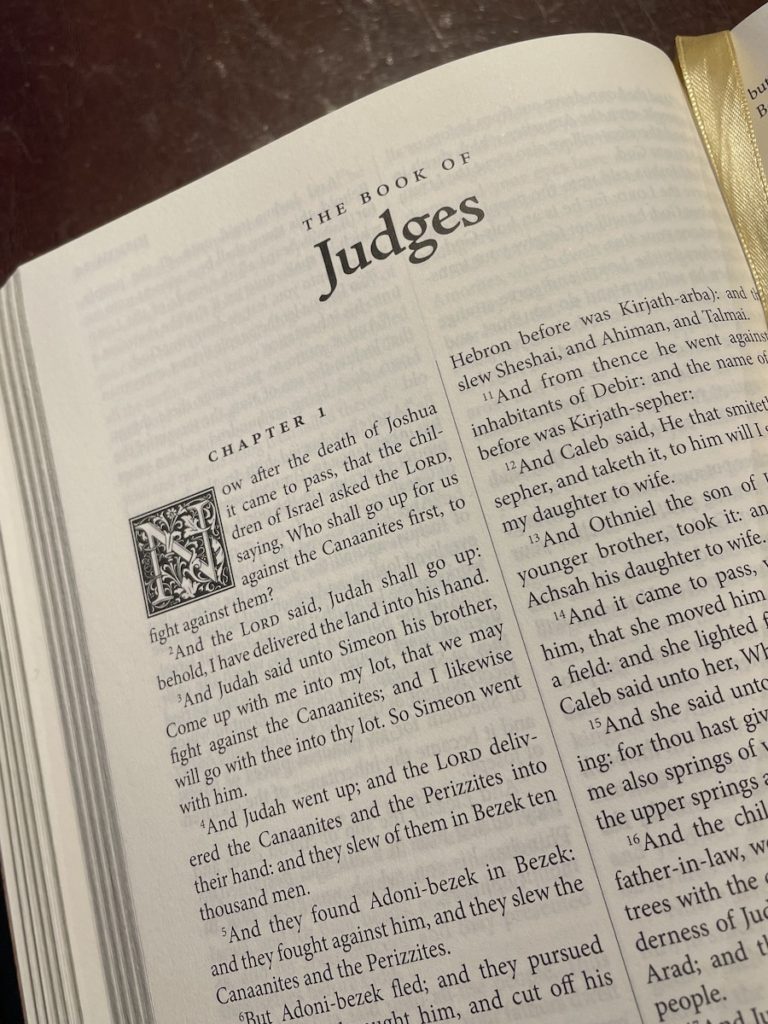
Judges 17:3, I had wholly dedicated. Micah’s mother made a foolish and unlawful vow to YHVH, as did Jephthah in chapter 11. Vows to YHVH are a serious thing and should be made in a righteous manner to righteous ends.
Judges 17:10, Be a father. For ten shekels, a suit of clothes, food and lodging, Michah hired an out of work Levite to be his own personal minister of his own manmade religion. Hireling ministers are a dime a dozen. Religious systems of men produce hirelings. This is a false spiritual paradigm that is self-sustaining and self-perpetuating.
Judges 17:13, Now I know. Michah cared nothing about serving YHVH and obeying his commandments. His only concern for religion was for self-gratification.
Judges 18
Judges 18:30–31, Manasseh…carved image. The son of Manasseh [Moshe/Moses]. The MT reads ﬣשׁמ/Moshe (Moses) with a hanging nun/נ inserted by the Jewish sages between the mem מ and the shin שׁ to make it read Manashe in an effort to hide the fact that the direct descendants of Moses became idol-worshippers. Jewish scholars readily admit this, and acknowledge the fact that the word Moshe is in the original (The Artscroll Rubin Edition Joshua-Judges Commentary, p. 223). Various versions of the LXX translate it either way. The Targums and the Syriac have Manasseh. (See Keil and Delitzsch, Adam Clarke and Bullinger in his Companion Bible for a more detailed discussion of this. The NIV, NRSV, RSV and ASV have Moses instead of Manasseh, while the NAS and NKJV have the latter, but add a footnote indicating that Moses as an alternate rendering.
Judges 19
Judges 19:24–25, Here is my virgin daughter…his concubine.This is nothing more than the degradation and abuse of women. This incident speaks volumes about the status of women in the ancient world. Even though the Torah uplifts and upholds the status of women, the neighboring pagan cultures, which the Israelites tended to follow, obviously did not. Islam and the Koran still follow these ancient practices viewing woman as property, chattel and second class citizens.
Judges 20
Judges 20:1–48, A lesson in warfare.Israel took a stand for righteousness against the sin of homosexuality. They did the right thing by inquiring of YHVH whether to go up against the Benjaminites who were harboring the sexually deviant brothers.
Twice YHVH told the Israelites to go up against Benjamin and that he would give them victory. Twice Israel was defeated losing thousands of soldiers. Each time afterwards, Israel did the right thing by humbling themselves, weeping and seeking YHVH’s counsel. The third time, Israel was victorious against Benjamin.
This begs an important question. Why wasn’t Israel victorious the first two times? Perhaps there was sin in the camp as was the case with Achan when the Israelites were defeated at Ai. The Israelites were right in punishing the unrepentant tribe of Benjamin, yet the rest of Israel wasn’t without sin either. After all, the Levite who had a concubine (a type of sex slave) in the first place, and then gave her to the mob of bisexual deviants to abuse and murder was also a guilty party. Not only that, the rest of Israel had failed to hold the Levite accountable for his sin.
What was the Levite’s sin? First, he should not have had a concubine sex slave. Second, he should have protected her from the mob. Obviously such practices were common among the Israelites—even among the Levitical leaders who YHVH had commissioned to be the guardians and teachers of the Torah—YHVH’s standard of righteous and set-apart living.
If the leaders of nation are morally and spiritually compromised, what is to become of the rest of the nation? Moreover, how is YHVH to bless such a nation by delivering them from their enemies when they themselves are sin-laden?
When expecting YHVH’s help and deliverance from our enemies and before engaging our enemies, we must clean our own house spiritually by repenting of sin. If not, we shouldn’t expect victory, or at best, only a partial victory, which is also a partial defeat. When a nation is not serving and obeying YHVH completely, and as a result, there is sin in the nation’s camp, and everyone in that nation is doing what’s right in his own eyes, and there is no strong, righteous central leadership in that nation (Judg 21:25), the fate of that nation will be what Israel experienced in this story. YHVH will be with them, but only up to the level their obedience to him merits it. This is a result of the divine law of cause and effect—the law of reciprocity. One reaps physically and spiritually what one sow.
Judges 20:28, Phinehas the son of Eleazar.Either Phinehas was hundreds of years old, or this story is an anachronism, or out of chronological order. Adam Clarke in his commentary on this verse suggest that this event occurred shortly after the death of Joshua. If this is the case, then the book of Judges is not written in chronological order.
In these increasingly dark and evil days in which we are now living where evil is made to appear to be good, down is up and black is white, and where YHVH’s people are being increasingly marginalized, persecuted and even killed, what can and should we be doing in the face of evil’s onslaught against us? The following list provides the answers from the Scriptures.
Watch and pray (Matt 26:41; Mark 13:33; 14:38; Luke 21:36).
Pray that you might be counted worthy to escape YHVH’s judgments that will be coming on the earth because of wickedness (Luke 21:36).
Endure to the end (Matt 24:13; Mark 13:13).
Keep your eyes on Yeshua the Lamb and follow him wherever he goes (Rev 14:4).
Occupy until Yeshua comes (Luke 19:13). Be busy doing what Yeshua has called you to do to help advance his kingdom on earth.
Engage in intercessory prayer, though at this time, it may not do much good, since biblical prophecy has to be fulfilled as end time events occur. This means that things will be getting worse and worse until Yeshua returns and destroys Babylon the Great New World Order. We can still intercede for individuals however.
Be an overcomer in every way possible. Be not overcome by evil, but overcome evil with good (Rom 12:21). Those who overcome spiritual evil will experience great rewards (Rev 2:7, 11, 17, 26; 3:5, 12, 21)
Be prepared to engage in civil disobedience as a last resort, if necessary. If civil laws violate YHVH’s laws, the Bible tells us to obey YHVH’s laws over men’s laws (Acts 4:19; 5:29; Ps 94:16).
Be prepared to help persecuted brothers and sisters in any way possible. You might be next the next one to be persecuted and may find yourself needing help from others, so pay it forward! If you sow, you will reap.
Continue to be salt and light to those around you in every way possible (Matt 5:13–16).
Don’t expect things on earth to get better. Yeshua never said it would get better, but only darker before his return. He’s coming at the midnight hour when evil will be the most pervasive and rampant on the earth.
Expect intense persecution of Bible believers (2 Tim 3:12; Matt 5:10–12; 10:22–25; 23:34; Mark 10:30; John 15:19–21; 16:2, 33; 17:14; 1 Thess 3:3–4; 1 Pet 4:12–16; Rev 7:14). Yeshua in the book of Revelation prophesies that this will occur in the end times.
Be wise as serpents (Matt 10:16). Find ingenious ways to circumvent Caesar’s evil and unbiblical mandates without getting caught, while at the same time being obedient to YHVH’s higher laws.
Love not your lives unto death (Rev 12:11). Be willing to lose some or all of yourself for Yeshua including your material possessions. Greater rewards await you for your faithful obedience to Yeshua (Matt 10:39; 16:25).
Be inspired by the great faith of the biblical and Christian heros who have gone before us (Heb 11).
Come out of the end times Babylon the Great world system more completely (Rev 18:4) starting with the spiritual aspects of this evil and ungodly worldwide system. Eventually, this may mean leaving the cities and going into communal situations into the wilderness with other like-minded believers. Some of the Roman Catholic monasteries were started by those fleeing the corruption of Rome.
The more evil intensifies against you, love the light of YHVH’s truth, love Yeshua more and run to him and hold on to him—the Rock of your salvation—more tightly.
Love your enemies, do good to those who despitefully use you and pray for them (Matt 5:44).
And finally…
Watch, stand fast in the faith, be brave, be strong. Let all that you do be done with love (1 Cor 16:13). Let the following scriptures admonish you:
“Put on the whole armor of Elohim, that you may be able to stand against the wiles of the devil. For we do not wrestle against flesh and blood, but against principalities, against powers, against the rulers of the darkness of this age, against spiritual hosts of wickedness in the heavenly places. Therefore take up the whole armor of Elohim, that you may be able to withstand in the evil day, and having done all, to stand. Stand therefore, having girded your waist with truth, having put on the breastplate of righteousness, and having shod your feet with the preparation of the gospel of peace; above all, taking the shield of faith with which you will be able to quench all the fiery darts of the wicked one. And take the helmet of salvation, and the sword of the Spirit, which is the word of Elohim; praying always with all prayer and supplication in the Spirit, being watchful to this end with all perseverance and supplication for all the saints….” (Eph 6:11–18)
“For though we walk in the flesh, we do not war according to the flesh. For the weapons of our warfare are not carnal but mighty in Elohim for pulling down strongholds, casting down arguments and every high thing that exalts itself against the knowledge of Elohim, bringing every thought into captivity to the obedience of Messiah, and being ready to punish all disobedience when your obedience is fulfilled.” (2 Cor 10:3–6)