
My Secret: Finding the Meaning of Life
3


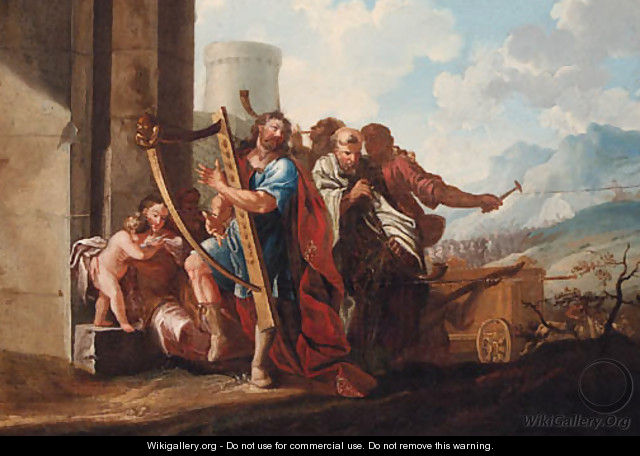
David, the author of the majority of the psalms in the Bible, along with several other psalmists, were men who followed hard after Elohim. No less than Elohim himself called David a man after his own heart (1 Sam 13:14–16). The spiritual cup of David’s heart as well as the hearts of other psalmists were full and overflowing with passion for Elohim, which expressed itself in quantifiable, extreme and radical ways by today’s Western standards. What can we learn from such individuals, and how can we come to this same place of passionate and enthusiastic (meaning “inspired or possessed by God”) devotion to YHVH Elohim?

David did not merely express his passion for Elohim intellectually in the psalms through music and poetry, for Scripture records that in one case he actually removed his kingly robes that hindered the movement of his arms and legs, and danced leaping and whirling, almost naked, with all of his might in the streets of Jerusalem praising and worshipping YHVH to the disdaining scorn of his less than passionate wife. Needless to say, after that incident, David refused to have intimate relations with his wife ever again to the day of her death (2 Sam 6:23). This was likely because her heart was in a very different place than that of her husband, and he could never get close to her again. This incident demonstrates the seriousness with which David took his passion for YHVH and how he viewed those close to him who were of a dissimilar or antithetical passionate disposition.
To be sure, David was not the only Hebrew given to outward displays of passion. The Hebrews, in general, like many inhabitants of the Near East to this day, were a dynamic and emotionally passionate people, whose lives were a river that customarily overflowed its banks with a emotionally enthusiasm for their Creator. David was a quintessential stereotype of this cultural norm. But many of the Hebrew prophets demonstrated a similar emotional exuberance when urging the Israelites to return to YHVH and to worship and obey him only. This passion worked itself out in many seeming bizarre stunts in their attempts to capture the attention of a people who had lost their passion for Elohim. For example, on one occasion, Isaiah prophesied virtually naked through the streets of his city for three years warning Israel of its impending doom (Isa 20:3). One prophet even adorned himself with iron horns and then prophesied to the kings of Israel and Judah (1 Kgs 22:11). Once Jeremiah prophesied with a wooden yoke wrapped around his neck (Jer 22:11). Another time, YHVH instructed Ezekiel to build a model city of Jerusalem and to construct siege walls and battering rams to symbolize the fall of Jerusalem at the hands of the Babylonians (Ezek 4:1–4). After that, YHVH commanded Ezekiel to lay on his left side for 390 days and then on his right side for another 40 days to symbolize YHVH’s judgment against Israel (Ezek 4:4–6). If that was not enough, during this time, YHVH instructed Ezekiel to eat only beans, lentils, millet and spelt baked on a fire fueled by human excrement (Ezek 4:9–12). These are just several example of the extreme passion with which the biblical people of Elohim were willing to serve and obey their Creator.
Admittedly, in our day, YHVH is seldom asking his people to engage in such extreme practices as the ancient biblical prophets did in service to him. But sadly, most people are not even passionate enough to do the minimum that YHVH expects. For example, how many people are willing to put aside their electronic devices to which they are addicted along with their other secular activities long enough to pray for an hour a day as Yeshua instructed (Matt 26:40–41)?
Make no mistake, we are capable of becoming passionate about many things that are of interest to us—things that we really want to do, and we definitely make time in our busy schedules for these things. We can spend hours glued to our television and computers screens watching movies, engaged in social media on our electronc devices, listening to podcasts, watching sports events, playing video games and the like. In fact, today how many people hoot and holler acting crazy cheering their favorite sports team, but when it comes to being fanatical for YHVH, well, “that’s emotionalism” and “I’m not that kind of person,” we tell ourselves. “What will people think of me?”
There is no lack of distractions out there whose octopus-like arms laden with suction cups will grab us and suck us in to its jaws, while drawing us away from seeking YHVH. Why is this? Its is because too many of us have let our hearts become hard and cold for Elohim and as a result of this we have fallen into a state of lukewarmness, lost our first love for Yeshua along with the joy of our salvation.
So what is the aim and goal of this brief written homily? It is to hold up in front of each of us a mirror in which to see ourselves, and then to compare what we see with what pleases YHVH Elohim as recorded in Scripture, and thus hopefully to challenge each us to repent of our lassitude and incite us to “break up your fallow ground: for it is time to seek YHVH, till he come and rain righteousness upon you,” (Hos 10:12). Our as Jeremiah chides us to do, “For thus saith YHVH…Break up your fallow ground, and sow not among thorns. Circumcise yourselves to YHVH, and take away the foreskins of your heart, ye men of Judah and inhabitants of Jerusalem: lest my fury come forth like fire, and burn that none can quench it, because of the evil of your doings,” (Jer 4:3–4). Or as Yeshua warns us, “Nevertheless I have somewhat against thee, because thou hast left thy first love. Remember therefore from whence thou art fallen, and repent, and do the first works; or else I will come unto thee quickly, and will remove thy candlestick out of his place, except thou repent,” (Rev 2:4–5). These are sober and challenging warning words from our Messiah!
Do you long to see and experience spiritual revival in these days of overwhelming darkness and evil? Well, revival starts in the heart of each individual as each of makes the conscious and determinate decision to seek YHVH and to allow him to revive us. Revival starts with YOU! Selah and amein.
How intense is YOUR worship of YHVH Elohim?
Shout joyfully to YHVH, all the earth; break forth in song, rejoice, and sing praises.…Shout joyfully before YHVH, the King. (Ps 98:4, 6)
Seven times a day I praise You, because of Your righteous judgments. (Ps 119:164)
Oh come, let us sing to YHVH! Let us shout joyfully to the Rock of our salvation.… Let us shout joyfully to Him with psalms.…Oh come, let us worship and bow down; let us kneel before YHVH our Maker. (Ps 95:1–2, 6)
And her saints shall shout aloud for joy. (Ps 132:16)
Lift up your hands in the sanctuary, and bless YHVH. (Ps 134:2)
I will praise You with my whole heart; before the gods [or mighty ones] I will sing praises to You. (Ps 138:1)
Let them praise His name with the dance. (Ps 149:3)
Let the high praises of Elohim be in their mouth, and a two-edged sword in their hand… (Ps 149:6)
Praise Him with the timbrel and dance… (Ps 150:4)
How intensely passionate are YOU in seeking YHVH Elohim?
Continue reading

Amidst geo-political turbulence, divine protection and a heavenly lifeline exists for the saints.
What is the overall message of this psalm? Even though the chapter subheading of my NKJV Bible, for example, describes this psalm as “God the refuge of his people and conqueror of the nations,” there is a deeper, more inspiring message to be discovered here that this title misses. Let’s dig into this precious morsel of the Word of Elohim to discover what this life-changing message is.
When it comes to discovering the hidden, golden nuggets in Scripture, one must be willing to become a spiritual hardrock miner, who is not averse to the difficult work of picking away at the seemingly unyielding and implacable rock and soil to uncover the mother lode of hidden treasure underground. Like digging for gold, the deeper one digs into Scripture and the more time and effort one invests in the process, the more likely one is to pull the unspeakably valuable treasures out of the spiritual bedrock of the Bible. I have been digging into this Rock of Ages daily for more than fifty years, and my heart and mind still tingle and pulsate with enthusiasm (please look up the meaning of the word enthusiasm for a cool nugget of truth that reveals why I purposely chose this word) when I discover new treasures buried therein.

To uncover these nuggets that lay below the surface words of Scripture, it is critical to understand an important fact: There are at least four layers of understanding to be found buried in the Word of Elohim. Let’s discover and briefly explore what these are.
Laying on the surface of Scripture, we find the peshat or literal meaning of what has been written. For example, a literal man named Noah built a literal ark of wood that floated on a literal flood of literal water, Moses led the children of Israel out of Egypt, and Yeshua was a carpenter’s son from Judea who lived in the first century. On a moral or philosophical level, the ten commandments, for example, are literal rules of righteous conduct that apply to our daily lives.
Digging deeper, we come to the next level as we drill down deeper into the Word of Elohim. This is the remez or suggested or hinted at meaning of a scriptural passage. For example, the Torah talks about “an eye for eye” when it comes to criminal justice. This may be taken literally to mean that if you injure someone’s eye, your eye is to be similarly injured as payment for your crime, thus evening the scales of justice. Moreover, an injured eye does not require the death penalty, and the crime of murder requires more than a slap on the wrist. So what this verse is really saying or hinting at beyond its literal or peshat level meaning is that the punishment must fit the crime.
Drilling down deeper into the bedrock of Scripture, we next come to the drash (the Hebrew word meaning “search”) level of Scripture. This often involves understanding a biblical passage from an allegorical or homiletical level. For example, even though Noah built an ark and survived divine judgment against men’s wickedness in it, there is an allegorical understanding to this story as well. Noah can be viewed as a Messianic figure who saves those who believe his message of repentance and righteous living, and are thus accorded an escape from divine judgment, even as Yeshua the Messiah does the same for those who believe him and place their trust in him.
At this point, it must be noted that although many scripture passages that have a peshat-level meaning can also be translated allegorically, some scriptures were written only with an allegorical meaning. For example, Elohim in several Scriptures is described as a having wings under which the saints can take refuge, or as a rock or fortress for his people. Similarly, Yeshua is likened to a door, and the saints are to be the salt of the earth. Obviously, these descriptions are not to be taken literally, but to be viewed as similes and symbolic metaphors.
The fourth or final level of scriptural understanding is the sod or hidden or mystical level. The book of Revelation, for example, contains many drash and sod level passages. The 666 mark of the beast passage of Revelation chapter thirteen is such an example. To this day, biblical scholars are still trying to unveil the meaning of this mysterious verse. Is it literal or symbolic? Is there a numerological meaning to 666? If so, how and what does it apply and to whom? Many theories have been proffered, but the exact meaning still remains a mystery.
This has been the briefest introductory overview to the four levels of biblical interpretation. Suffice it to say, when one reads the psalms (or any scripture passage for that matter), to better discover the deep treasure hidden therein, it is beneficial to keep these principles in mind.
To my mind, as in hardrock mining in search of a vein of gold, only after hours or even days of quiet, prayerful, meditative reflection, while at the same time keeping the principles of peshat, remez, drash and sod in mind will such a psalm as this one yield its priceless treasures of divine revelation—its manna from heaven, so to speak.
The writers of the psalms were deeply thoughtful and reflective; they didn’t just fling words indiscriminately like mud up against a wall hoping that something would stick. Although the different sections of Psalm 46 my seem disjointed and disconnected, the psalmist’s juxtapositioning of seemingly unrelated topics invites or even begs the reader, like all thoughtfully constructed poetic literature, to reflect on, ponder and dig deep to discover the author’s hidden often enigmatic or verbally encrypted message.
So now let’s see what heavenly treasures we can uncover from Psalm 46.

In the first section or block of thoughts in Psalm 46 (vv. 1–3), the psalmist-artist paints a picture in the reader’s mind. He presents us with the solidity of Elohim and the idea, as disconcerting as it may be, that earth may not be as immobile and permanent as it seems and we may wish it to be. Anyone who has lived through an earthquake, a volcanic eruption, a typhoon or hurricane, flood, mudslide, forest fire or such knows this to be true. Those of us who witnessed the eruption of Mount Saint Helens in 1980 know this fact well. As a teenager, I stood on the top of that pre-eruptive mountain that was subsequently blown to smithereens and scattered as fine dust across the face of the globe. Twelve hundred feet of the mountain’s summit is now missing, whole glaciers are gone, melted into water and mud, and there is now a gaping gouge in the mountain’s north and northeast sides. Nothing on earth seems as permanent and unmovable as it seems—even a giant mountain like Saint Helens, but now a good section of it blew away in an instant. Only Elohim and his Word are immovable rocks that neither the slow forces of erosion or sudden cataclysmic events like volcanic eruptions can dislodge and change.
In the opening verses of this psalm, the author contrasts the permanence of Elohim with the impermanence and transitory nature of the earth. Even though to the average person’s thinking the earth itself and the mountains that sit thereon seem immovable and permanent, they really are not. And this is the point the psalmist is making here. The remez or hint level of this idea is that if we view the mountains as permanent, then how are we to view the governments and nations of this earth? After all, elsewhere in Scripture, mountain are metaphors for the governmental systems and nations of men. Neither are as permanent or immovable as the Creator of the universe and the spiritual dimension at which he exists.
In the next block of thought in this psalm (vv. 4–6), the author suddenly switches gears and paints another word picture for the reader to consider. On the surface, this tableau seems totally unrelated to the first. But is it really?
Continue reading
For many decades, Psalm 37 has been one of the “go-to” psalms that I turn to in my time of personal need along with Psalms 91 and 103. My next favorite “go-to” psalms are Psalms 1, 34, 119, 73, 139 and 145. What are your favorites psalms that encourage and strengthen you when you feel beaten down and overwhelmed by this world? Let’s now explore the main themes of Psalm 37 that I find so uplifting to my soul and spirit when I am down. There are several.
As our all-knowing Creator, Elohim knows the end from the beginning, for he inhabits all time—past, present and future, therefore he knows what the outcome will be of everything in our lives. Furthermore, as an all-powerful Being, he then has the capability to direct our steps and the circumstances in our lives, so that the outcome will be a good one for those who love and wait on him. This psalm clearly lays this process out step-by-step, and, therefore, should bring great encouragement to the saints no matter the struggles they are encountering in their lives no matter when.
So what then, are the steps that lead to a blessed conclusion, no matter the circumstances in one’s life, for those who love YHVH Elohim? First, this psalm wisely counsels us to keep our eyes on Elohim and not to be overwhelmed by the storms of doubt and fear along with the seemingly answerable conundrums that plague, buffet and batter us along the path of life. The saint who will overcome the world, the flesh and the devil will be continually looking heavenward with his eyes fixed faithfully on Elohim rather than having his focus on a horizontal view with its waves and storms that continuously beat against the ships of our lives as we traverse the ocean of this physical existence (vv. 3–5, 7 cp. 1, 7, 32–34).
Waiting on YHVH—a subtheme of this psalm—literally involves wrapping oneself up with, around or binding oneself to YHVH Elohim, which is the meaning of the Hebrew word qavah translated in this three verses in this psalm as wait (see vv. 7, 9 and 34). Waiting involves faith in an unseen Elohim. It also involves exercising patience as opposed to acting impulsively or impetuously, which is not easily done when one is experiencing fear and concern and when the innate tendencies of fight or flight are pounding forcefully on the door of one’s mind and emotions. At that moment, we are faced with two options: will we take matters into our own hands and try to “work things out” ourselves, or will we wait patiently on YHVH and let him work out the perplexing difficulties we face in our lives?
Faith and waiting on YHVH do not imply inaction on our part, however. No. This psalm, as counter-intuitive as it may seem, admonishes us to demonstrate what most humans would consider to be bizarre and, perhaps, even a ridiculous behavior. That is to trust in an unseen Being and to do what is good in the face of the actions of evildoers against us (vv. 3, 7, 32–34). This is despite the compelling urge to take matters into one’s hands and going forth to confront one’s enemies and to solve one’s problems oneself. We have all been in this place, so you know what I am talking about.
Furthermore, as crazy as it may seem, not only are the children of Elohim to trust in our invisible Creator, but we are to delight in him and to be sustained by his faithfulness (v. 4), that is, to have faith in a Being that we cannot see or hear in the normal sense. So what is it to delight in YHVH? Most Christian Bibles translate the opening phrase of verse four as “Delight yourself in YHVH” (or something similar). But this fails to capture the meaning of the Hebrew words. By contrast, one orthodox Jewish Bible does a better job by translating the Hebrew as “rely on [YHVH] for your enjoyments” (ASET). Another has “Seek the favor of YHVH” (JPS). The idea here is to find joy in the delicate, soft, exquisite dainties or delights of YHVH (see The TWOT), while waiting on him, and while your heart is desiring a good outcome. To the natural mind, this may seem like a ridiculous reaction when one’s enemies are viciously pounding at the door of one’s life, but such a response is what is required to unlock the resources of heaven to come to one’s aid in the time of urgent need.
In the process of waiting for or relying on YHVH as well delighting on him to work things out, this psalm instructs us to commit or literally “roll over onto him” our cares and concerns and to trust totally in him (v. 5). This is in spite of the fretfulness that evil doers may cause us (v. 1), and the fact that wicked doers may even seek to harm or kill us (vv. 14, 32). Nowhere does this psalm give us the justification to trust in YHVH only when things are going well for us. No. For the child of Elohim, this is a mental-spiritual demeanor, lifestyle and a walk regardless of the circumstances.
Again, regardless of the outside circumstances of life, the saint is expected to walk counter-intuitively to his natural inclinations when facing crises. Resting and waiting patiently on YHVH to act on one’s behalf (v. 7) is the pathway to ultimate victory and blessing (vv. 9, 11, 22, 29). The word rest in verse seven literally means “to be dumb, to be still or silent or to stand still.” Frankly, this is the opposite response that most of us have when facing a crisis. The natural reaction is to fight or to flee—the old fight or flight syndrome. If not that, we tend, at least, to frantically work overtime mentally to figure out what we can do to defend ourselves from the attack. It is not natural for us to stand still, be silent and look heavenward. James the apostle adds his wisdom to such a situation when he tell us,
My brethren, count it all joy when you fall into various trials, knowing that the testing of your faith produces patience. But let patience have its perfect work, that you may be perfect and complete, lacking nothing. If any of you lacks wisdom, let him ask of Elohim, who gives to all liberally and without reproach, and it will be given to him. But let him ask in faith, with no doubting… (Jas 1:2–6)
This discussion begs an obvious question: Who are our enemies that are causing us the consternation that we are experiencing? The psalmist holds an expansive view as to who or what one’s enemies may be. Not all of our enemies have a human face attached to them. One’s “enemy” may be an evil time in which one is living such as a time of famine (vv. 19, 25). Famine is merely one example and an evil time. This could also include evil circumstances, health issues, demonic attacks, financial crisis as well as emotional and psychological struggles with which one has to deal. Evil can be anything that causes one to stumble along the path of live (v. 24) or to be forsaken or rejected by others (v. 25)
So in conclusion, what are the ultimate blessed benefits of waiting patiently on YHVH Elohim and resisting the temptation to react impulsively, impatiently and impetuously by taking matters into our own hands? Simply this:
The steps of a good man are ordered by YHVH, and He delights in his way. Though he fall, he shall not be utterly cast down; for YHVH upholds him with His hand. (vv. 23–24).
Moreover,
For those blessed by Him shall inherit the earth, but those cursed by Him shall be cut off. (v. 22)
I have been young, and now am old; yet I have not seen the righteous forsaken, nor his descendants begging bread. (v. 25
And finally,
Mark the blameless man, and observe the upright; for the future of that man is peace. But the transgressors shall be destroyed together; the future of the wicked shall be cut off. But the salvation of the righteous is from YHVH; He is their strength in the time of trouble. And YHVH shall help them and deliver them; He shall deliver them from the wicked, and save them, because they trust in Him. (vv. 37–40)
I don’t know about you, but this sounds like a pretty good deal to me! The fact is that you cannot lose when YHVH Elohim, the all-wise, all-knowing and all-powerful Creator of the universe, is on your side and when you follow his instructions. As for me and my household, we will put our eggs into that spiritual basket, invest in heaven’s bank, and lean our spiritually ladder up against this tree of life and keep climbing higher in our spiritual journey upward.

2 Timothy 1
2 Timothy 1:6, Stir up. What in us needs stirring up from time to time? Simply this: boldness to share the gospel with those around us as we discuss in the next verse.
2 Timothy 1:7, Spirit of fear [Gr. deilia]. Deilia denotes “timidity or cowardice.” The opposite of deilia is shame (v. 8), but shame of what? The context is clear here. It shame of the testimony or gospel of Yeshua and of standing up for those who are being persecuted for preaching the gospel (v. 8). For fear of what others will think, too many believers fail to share the gospel with those around them. Yeshua referred to this as putting one’s lamp under a bushel basket when, instead, he called his disciples to be like light on a hill (Matt 5:13–15) and commissioned them to take the gospel to the world (Matt 28:18–20; Mark 16:14–18). For too many saints, the great commission has become the great omission!

What have the saints to fear when Yeshua has given them the victory over sin and death (1 Cor 15:54–56)? Nay, through Yeshua the Messiah, the saint can do all things (Phil 4:13), and has become more than a conqueror (Rom 8:37), for greater is he that is in us than he that is in the world (1 John 4:4). After all, if Elohim is for us, who can be against us (Rom 8:31)? This means that YHVH will give us the boldness to share the gospel message with those around us, even as he gave the early disciples the boldness to do so when they asked him for it in the face of life threatening persecution (Acts 4:23–31).
Power [Gr. dunamis]…love [Gr. agapē]…sound mind [Gr. sōphronismos]. Dunamis refers to miraculous power or strength. Agape denotes “affection or benevolence” and, in Scripture, refers to the love of Elohim for his Son, for the human race, believers for Yeshua, the saints for one another, and is a fruit of the Spirit.
Sōphronismos denotes “a well-balanced, self-controlled or disciplined mind.” In other words, YHVH has equipped the saint with everything he needs to counteract the natural tendency toward fear in difficult situations. We have the miraculous power of the Spirit of Elohim working within us, the fruit of the Spirit of love, and a well-balanced and self disciplined mental state that will give in neither to irrational nor to naturally occurring human fear in the face of difficult situations.
What is Paul saying here in contrast to the spirit of fear or timidity and being ashamed of the testimony of Yeshua (v. 8)? He is declaring that Elohim has given his saints the means, power and ability to share the gospel with those around them and to stand up for the testimony of Yeshua in the face of persecution rather than succumbing to the natural tendency to pull away in timidity or cowardice.
Elsewhere, John declare that there is no fear in love, that perfect love casts out fear, and that the saint’s source of love is from the Father in heaven (1 John 4:18–19). If we are full of the love of Yeshua for others, then we will neither be afraid of what they think nor will we be ashamed to share the gospel with them, for our desire to see them saved will override all fear including that of criticism, mocking or rejection by others. The example of this can be illustrated by a house that is on fire and that contains sleeping occupants who are unaware of the fire that is about to kill them. Without thinking and in total boldness, a good Samaritan will break into the house, rush in yelling and screaming for the people to wake up and escape. He will do so boldly and without concern for what those in the house may think. In a sense, this should be our approach to those around us who are spiritually lost and in danger of being cast into the lake of fire.
2 Timothy 1:9, Before time began.YHVH Elohim established his plan of salvation for mankind through the redemptive life and death of Yeshua the Messiah before the world began (Rev 17:8; Acts 15:18; Rom 16:25; Tit 1:2; 1 Pet 1:20). Additionally, YHVH has chosen each saint through Yeshua before the foundation of the world (Eph 1:14; Rom 87:29–30; 11:2; Acts 18:38). That is, he knew each person by name who would accept his gift of salvation (Rev 13:8; 17:8) and, by implication, he also knew those who wouldn’t. Moreover, the kingdom of Elohim or heaven has been prepared for the saints from or before the foundation of the world (Matt 25:35).
2 Timothy 1:10, Life [Gr. zoe] and immortality [Gr. aphtharsia]. Zoe refers to life in it all of its aspects both in physical and spiritual dimensions. Aphtharsia denotes “incorruptibility or generally unending existence.” Through Yeshua, the saint has both physical and spiritual life that will extend past the final curtain of physical death and will continue unendingly into eternity. This is the message and power of the gospel in a person’s life through a relationship with Yeshua.

Deuteronomy 3
Deuteronomy 3:22, Must fear them. Know Elohim, No Fear; No Elohim, Know Fear.The Scriptures reveal an interesting, and counter-intuitive spiritual principle that humans have a hard time wrapping their heads and hearts around. It is this: When we fear Elohim, we will not fear our enemies, and we will be blessed by Elohim. When we do not fear Elohim, we will fear and be tormented by our enemies and we will not be blessed by Elohim (Ps 34:9; Acts 9:31).

What is it to fear Elohim? It is to walk in the wisdom of his commandments or his loving instructions in righteousness (Deut 10:12). Rebellious humans have a hard time doing this, since their sin nature is opposed to submitting to YHVH legal instructions (Jer 17:9; Rom 8:7).
Once, however, one gets their sin nature under control with the help of Yeshua, and one begins to love and fear Elohim by keeping his commandments, suddenly the physical things they once feared no longer have any hold on their hearts and minds.
Having defeated the greatest enemy of all—one’s sin nature—with Elohim’s help effectively empowers and emboldens the saint. He no longer fears what other people think about him because, in the long run, all that matters is what Elohim thinks. He no longer is concerned about his future physical needs and well-being because Elohim promises to take care of us when we trust and obey him. He no longer fears those who attack and persecute him, because he knows that with Elohim’s help, he can overcome any enemy.
Deuteronomy 3:23, Pleaded with YHVH. YHVH forbids Moses from fulfilling his life-long dream of entering the Promised Land. What was Moses’ repsonse? Did he cry, pout and pitch a fit, or did he accept YHVH’s will for his life? What can we learn from this? Do you have so much love for and faith in YHVH that you would be willing to let go of your greatest dream—even your life on the altar of faith and trust in YHVH and obey him no matter the outcome? Though YHVH were to slay you, will you like Job still love and trust him (Job 13:15)? If your entire life was devastated, you lost all your money, the land was desolate and your life become a desert, would you like Habukkuk still praise YHVH (Hab 3:17–19)? Selah.
Deuteronomy 4

Deuteronomy 4:2, You shall not add to the word that I command you, nor shall you subtract/diminish from it. YHVH warns his people against adding or subtracting from his written word elsewhere as well (Deut 12:32; Rev 22:18–19). Men seem inclined to ignore YHVH’s command in this regard. In fact, whole religions have been founded based on disregarding this prohibition. Some claim to be Bible-based (e.g. Mormonism with their Book of Mormon and rabbinic Judaism with its Talmud), and some have supplanted the entire Bible with their own book (Islam with its Quran). This doesn’t even include the numerous unbiblical traditions and man-made doctrines that many traditional churches and denominations have constructed out of whole cloth and patched into the teachings of the Bible. This cannot be pleasing to Elohim!
Who is the author of and real power behind adding to and subtracting from or twisting YHVH’s Word? It is Satan the serpent. (See Gen 3:1ff and Matt 4:3ff.) Make no mistake, adding or subtracting from the Word of Elohim is to fall for the lie that the devil told the first humans at the tree of knowledge that the Word of Elohim can be molded and formed to fit men’s ways of thinking instead of Elohim’s.
What did Yeshua warn the religionists of his day against in this regard? He said, “Thus have you made the commandment of Elohim of none effect by your tradition” (Matt 15:6) and, “Howbeit in vain they do worship me, teaching for doctrines the commandments of men” (Mark 7:7). What are some examples of traditions and theologies in the modern-day Christian and Jewish religions where YHVH’s word has been superseded by man’s traditions? What are some traditions and doctrines of men you have turned away from in order to bring yourself into greater alignment with YHVH’s Word? How is your life better for it? What has been the reaction of those around you in response to your aligning your life more closely with the truth of YHVH?
Finally, the Bible ends with a warning to those who would add to the word of Elohim.
For I testify to everyone who hears the words of the prophecy of this book: If anyone adds to these things, Elohim will add to him the plagues that are written in this book; and if anyone takes away from the words of the book of this prophecy, Elohim shall take away his part from the Book of Life, from the holy city, and from the things which are written in this book. (Rev 22:18–19)
When this passage says “this book,” which book is it talking about? The book of Revelation or the entire Bible? To err on the side of caution, it is prudent to assume that John is referring to the whole Bible, since Revelation is the last book of the Bible. Why do I assume this? Simply because I personally do not care to experiences any of Elohim’s curses; life is already difficult enough as it is!

Deuteronomy 4:2, Observe the commandments of YHVH. The word observe (RNA/shin-mem-resh)is a common Hebrew verb meaning “to keep, guard, give heed, watch, protect, have charge of.”In its noun-form, shamar means “a watchman.” According to The TWOT, the basic meaning of shamar is “to exercise great care over something.” One of the most frequent uses of this verb in Scripture is how it is used in this verse. YHVH commands his people to shamar his Torah-commandments some 30 times in the Torah alone. What does this mean to you? Are you learning to not only “hear,” but “to do” his commands (the Hebrew word shema)? How has your life changed and what are the resulting blessings? Though YHVH clearly commands his people “to keep” or “to guard,” what is commonly taught in most Christian churches in regard to “the law”?
Continue reading

2 Corinthians 10:4, The weapons of our warfare…spiritual.
A Redeemed Believers Authority Through Yeshua—The Biblical Concept of Spiritual Warfare
Is the concept of spiritual warfare a biblical one? Perhaps no scripture of the Bible states the fact that it is more clearly than 2 Corinthians 10:3–5. (Eph 6:10–18 would be a close second!)
For though we walk in the flesh, we do not war after the flesh:(for the weapons of our warfare are not carnal [but, by implication are spiritual], but mighty through Elohim to the pulling down of strong holds;) casting down imaginations, and every high thing that exalts itself against the knowledge of Elohim, and bringing into captivity every thought to the obedience of Messiah. (2 Cor 10:3–5, emphasis mine)
Obviously, Paul understood and taught that redeemed believers are in an ongoing spiritual battle against something or someone, but what and who? James reveals that there are three possible sources of conflict for the redeemed believer: the world, the flesh and the devil (Jas 3:15). The flesh (man’s sin nature) is the greatest enemy that the saint faces. Paul discusses his struggles we face with the carnal man in Romans 7. The world is also a formidable enemy of the redeemed righteous ones. In John 17, Yeshua tells his disciples that though they are in the world, they are not to be of the world (John 17:11,14). He then goes on to describe the conflicts they would have with the world because they are his disciples. Finally, in Ephesians six, Paul describes the spiritual combat the saints face with Satan and his cohorts (Eph 6:10–18). He is constantly seeking to destroy us (1 Pet 5:8), and to find opportunistic inroads into our lives to establish a spiritual beachhead (Eph 6:16; 1 Pet 5:8). It is this latter subject which we will discuss in the following study.
The foundation for waging effective spiritual warfare is to have a deep spiritual relationship with Yeshua — to be loving him by obeying is laws through him (Rom 7:25–26).
The Legal Basis for the Believer’s Spiritual Authority
(Taken from Destined for the Throne by Paul E. Billheimer, pp. 71–80 with additional comments by NL.)
Universal Jurisprudence. It is vitally important for every redeemed believer to know the fullness and extent of the victory over sin, death and the devil that Yeshua secured for us at the cross. To fully understand this, we must comprehend the legal basis for that victory. Elohim is an El (God) of total justice. He established the universe to be governed by a legal system. As Supreme Judge of the universe, he must follow the laws of justice he established that keep order in the universe.
Adam’s Commission. It all started in the Garden of Eden where man was created in YHVH’s image and was given authority and dominion over the entire earth and all thereon (Gen 1:26; Ps 8:6).
Adam’s Failure and Fall. YHVH gave man legal authority to rule the earth. But then Adam “fumbled the ball” and submitted to Satan’s authority by sinning, YHVH could not step in (though he had the authority to do so). To go over man’s head and to forcibly repossess the title to this earth from Satan would have been to do so without due process of law. At that moment, Satan became the god of this world. Even Yeshua, when confronting the devil in Matthew 4:5 did not question Satan’s authority.
The Search for a Legal Challenger. Adam chose to obey Satan and to sin against Elohim, and thus became the devil’s slave. Whatever we yield ourselves to we become the slave to (Rom 6:16). Once a slave to Satan, man lost all his legal rights to his person and to his domain (the earth). If Satan’s dominion was to be revoked, a way had to be found to redeem fallen man and recover his lost authority without violating universal principles of justice. YHVH had to abide by his own moral code of justice. He could not simply annul it and at the same time remain just and righteous. Only a member of Adam’s family could enter into this universal court and wrest Adam’s lost inheritance and dominion away from Satan, the usurper and slave master. The government of man was lost by man and had to be reclaimed by man. But where could such a man be found? All men had forfeited this right when they had sinned (Rom 3:23) and become a slave to Satan, as their forefather Adam had done at the Tree of Knowledge. A slave has no legal standing and cannot enter a court or lawfully participate in litigation. Thus a member of the human race had to be found upon whom Satan had no legal claim—one who had not endorsed Adam’s rebellion.
The Problem Solved: The Incarnation. With man it was an impossible situation, but with YHVH, all things are possible (Matt 19:26). “But when the fullness of the time was come, Elohim sent forth his Son, made of a woman, made under the law, to redeem them that were under the [penalty of] the law, that we might receive the adoption of sons [of Elohim, as Adam and Eve were]” (Gal 4:4–5). YHVH solved this dilemma through the incarnation. Yeshua was conceived by the Spirit of Elohim, and YHVH’s divine nature was present in him. Because he was sinless, Satan had no claim upon him, but because he was “made of a woman,” he was an authentic human being and could therefore qualify as a bona-fide member of the human race to enter the legal fight to reclaim Adam’s lost estate. This is why it was necessary for Yeshua to be born of a virgin.
Yeshua’s Sinless Life. Satan’s challenger not only had be a member of the human race, but he had to have lived a perfectly sinless life so that Satan could have no legal claim on him. If Yeshua were not the son of Elohim through Mary by virtue of supernatural conception, then he was merely the son of Adam. A mortal man, if he lived a sinless life, could redeem his own life only, but one man’s life is not of sufficient worth to redeem the entire human race. Only the Creator of man can do that. Only if Yeshua was fully man, and fully divine and fully the Creator of man would he have the power to redeem man, since the life of the Creator is of greater worth than all that he created. Though tempted by Satan at every place in is life, Yeshua remained sinless. That is why, when he died, the power of death had no legal claim on him and the could not legally stay in the grave. Because of Yeshua’s sinless life, his death resulted not only in defeating Satan’s purpose to obtain a legal claim on him, but it also canceled all of Satan’s legal claim on this earth and for those of the human race who put their trust in Yeshua for salvation and redemption (Heb 2:14; Col 2:14–15).
Though Yeshua has not yet enforced that legal claim over the physical earth and the kingdom’s thereof (this will occur at his second coming when he defeats Babylon the Great, the devil, and becomes King of kings), he is establishing his spiritual kingdom in the lives of his redeemed one’s — the saints or called out ones (the ecclesia). As such, they have the power of Yeshua in them to begin to reclaim the world for Yeshua away from Satan. It is called “kingdom authority.” Yeshua gave his disciples that authority when he sent them forth to regather the lost sheep of the house of Israel (Luke 9:1; 10:17; Mark 16:15–18).
Identification With Messiah’s Death and Resurrection. To access this victory of Yeshua over Satan and death, one has to identify spiritually with Yeshua from his death on the cross to his enthronement at the right hand of power in heaven. We are to be crucified with him, buried with him, raised with him, and exalted with him (Rom 6; Eph 2; 2 Cor 5:14,17; Gal 2:20; 2 Tim 2:11).
Continue reading