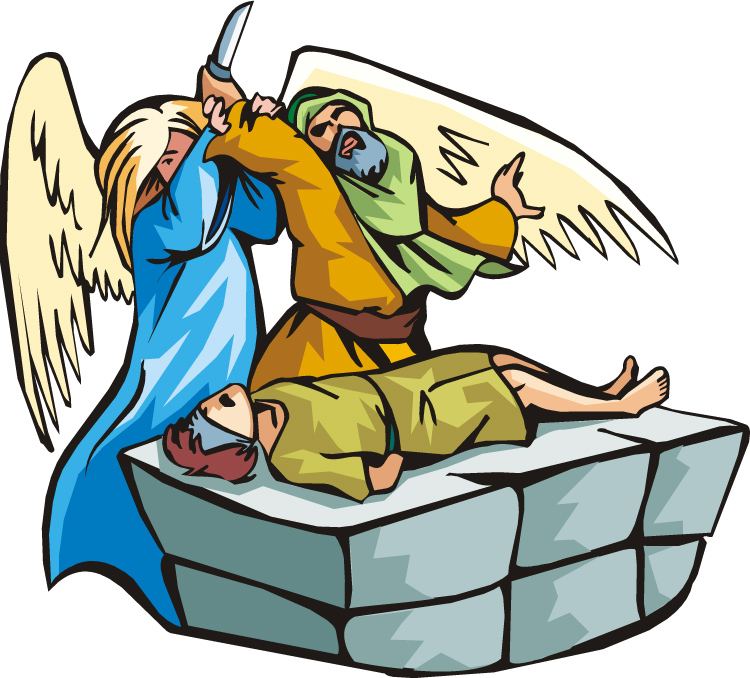
The “Sacrifice” of Isaac at Mount Moriah. 

Genesis 22:13, A ram caught in a thicket by his horns.

YHVH credited to Abraham’s spiritual account his willingness to sacrifice Isaac as if he had actually done so. In fact, there is an ancient rabbinical tradition that states Isaac actually died and was resurrected as the midrash comments on this passage: “As the knife reached his throat, Isaac’s soul flew away and left [e.g., he died]. But when a voice went forth from between the angels saying, ‘Do not stretch out your hand against the lad’ (Genesis 22:12), his soul returned to his body” (Pirkei DeRabbi Eliezer 31 as quoted in The ArtScroll Davis Edition Baal HaTurim Chumash Bamidbar, p. 1417) (bracketed comments are in the original).

The Jewish sages also note that Scripture states that both Abraham and Isaac ascended the mountain, but that it is recorded that only Abraham descended (22:19). Isaac’s absence from the Genesis narrative until many years latter (Gen 24:62) has given rise to much speculation on the part of the sages as to Isaac’s whereabouts in the interim (The ArtScroll Bereishis Vol. 1a, pp. 812–813).

Regardless of the rabbinic interpretations, does Scripture leave Isaac out of the narrative as if to highlight his absence, and to give the impression (albeit a prophetic allegorical one) that he was actually sacrificed? After all, what was the ram caught in the thorn bush thicket (wearing a crown of thorns) by its two horns all about? That ram was a substitute sacrifice picturing Yeshua the Messiah dying on the cross while wearing a crown of thorns. And who was it that commanded Abraham to lay down the knife and slaughter the ram instead? It was the Malak or Messenger of YHVH (verse 11–12) who was none other than a pre-incarnate appearance of YHVH-Yeshua some 1900 years before his appearance as the Messiah in human form on earth as the Lamb of Elohim slain from the foundation of the earth.

The Three Trumpets

The first and last trumpets relate to the two horns of the ram caught in the thicket on Mount Moriah. The ram represents Yeshua the Sacrificial Lamb. The thicket represents human sinfulness. Humanity is entangled in the thicket of sin from which it needs to be freed. Yeshua the Messiah is the Lamb (or ram) slain from the foundation of the world (Rev 13:8), who, while hanging on the cross, wore a crown of thorns. Is this not a picture of the “ram caught in the thicket” (Gen 22:13) of the man’s sins? After all, the Scriptures say that the sins of man were laid upon Yeshua (Isa 53:6). The crown of thorns is a picture of this. Furthermore, in Matthew 13, in Yeshua’s Parable of the Sower, we see that some of the seed was cast into the thorns, which Yeshua explained represents the cares of this world and the deceitfulness of riches that choke out the word of YHVH. These references to thorns and thicket are a picture of sin. The wages of sin is death.

In Genesis 22, Isaac was about to die, but the ram caught in the thicket that YHVH provided was a prophetic picture of Yeshua (a Hebrew word meaning “salvation”) that became a substitute sacrifice for Isaac. Isaac was set free and the ram was sacrificed instead. This ram was a prophetic picture of Yeshua’s death on the cross for man’s sins.

In Hebraic thought and prophetically-speaking, the left horn of the ram signifies mercy and grace. This is also a picture of the left (or weaker) hand of YHVH, which symbolizes grace, or the feminine side of Elohim. Furthermore, the left horn of the redemptive ram signifies the purpose of the first coming of Messiah Yeshua as the Suffering Savior, as one bringing mercy and grace, and who refused to quench a smoking flax or breaking a bruised reed as a meek and quiet lamb going to its slaughter (Matt 12:20; John 12:47; Isa 53:7).

The right horn of the ram caught in the thicket represents judgment picturing Elohim’s stronger right hand of power, might and judgment (Ps 89:10,13–14). Thus, this horn represents the second coming of Messiah, who is seated at the right hand of the Father (Acts 2:32–33), and who will come this time in power as King of kings to rule with a rod of iron and to judge the living and the dead, and to destroy all his enemies (Rev 17:14; 19:15).

That is why the first trumpet (representing the left horn of the ram) is sounded on Shavuot representing YHVH’s grace and mercy upon his people from Abraham until the Yeshua’s second coming—a time for his people to repent and return to him.

Genesis 22:4 says that Abraham saw the “place” (i.e. Mount Moriah) afar off “on the third day”. This is scriptural prophetic code for something significant. Mount Moriah was the place of Messiah’s crucifixion. Abraham saw—by faith—the place and work of Yeshua’s death afar off. “On the third day” signifies two things. First, a day in Scripture and in Jewish thought, in this instance, symbolizes 1000 years (2 Pet 3:8), and so it may represent the third one-thousand-year period from the time of Abraham (ca. 1872 B.C.). Messiah would come as the sacrificial Lamb in three days or in the third millennia from Abraham’s time. Yeshua was born and died in the first millennia A.D., or the third millennia from Abraham. Second, the phrase, “third day” can represent the time or millennia of Messiah’s second coming as well, as we shall see.

 The Messenger of YHVH at the Binding of Isaac

In Genesis 22:11, 15–17 we read the following,

11 And the Messenger/Malak of YHVH called unto him out of heaven, and said, Abraham, Abraham: and he said, Here am I … 15 And the Messenger/Malak of YHVH called unto Abraham out of heaven the second time, 16 And said, By myself have I sworn, saith YHVH, for because thou hast done this thing, and hast not withheld thy son, thine only son: 17 That in blessing I will bless thee, and in multiplying I will multiply thy seed as the stars of the heaven.

In this passage, there is no mention of the Messenger of YHVH appearing to Abraham in some bodily form, only his voice calling from heaven. What we want to emphasize in this passage is that the Messenger of YHVH is equating himself with YHVH (verse 16). The biblical passages where the Malak of YHVH equates himself with YHVH while appearing in human form have perennially defied reasonable explanation by the Jewish sages.

Notwithstanding, the ancient Targum Jerusalem (the pre-Christian Aramaic translation of the Hebrew Scriptures) equates the Malak of YHVH with “the Word of Elohim” in verse eight implying that YHVH and the Word of YHVH are in some way different from each other:

And Abraham said, The Word of Elohim will prepare for me a lamb; and if not, then thou art the offering, my son! And they went both of them together with a contrite heart.

Some Jewish sages asserts that “the angel speaks in God’s name, in first person” while others maintain that it was “God Himself who opened the heavens and addressed Abraham’ (The ArtScroll Bereishis/Genesis Commentary, p. 808). If the latter is true, than the Malak of Elohim/YHVH here is none other than Elohim himself. And logically, if he is Elohim here, then he must be Elohim/YHVH in the other passages where he is mentioned. And if Elohim can appear in human form, speak to men and eat with them (as in Genesis 18) then the question must be asked: why can’t YHVH appear in human form as the Messiah; namely, Yeshua the Messiah? After all, in Proverbs 30:4 (a passage we will discuss at length later) we read,

Who hath ascended up into heaven, or descended? who hath gathered the wind in his fists? who hath bound the waters in a garment? who hath established all the ends of the earth? what is his name, and what is his son’s name, if thou canst tell? (KJV) (emphasis added)

Additionally, in Isaiah 53, a passage recognized by both Jewish and Christian scholars as referring to Messiah verse one states,

Who hath believed our report? and to whom is the arm of YHVH revealed?

Here, the Messiah is called “the Arm of YHVH.” Is the Malak of YHVH/Elohim this “Arm of YHVH” who does the earthly bidding of the One in heaven and who acts as the intermediary between Elohim and man? We believe so.

Genesis 22:15, YHVH called to Abraham. When Abraham was willing to deny himself and to follow YHVH no matter the cost even to the point of sacrificing of his son, it was only then that heaven opened up, Elohim revealed himself to Abraham and blessed him. It is when we’re willing to lose our lives for YHVH, deny ourself and pick up our cross and follow Yeshua that the life of the Spirit is revealed to us and the blessings of heaven open up before us. Abraham a man who had died to himself, realized that nothing he possessed was his, for he was wholly surrendered and obedient to YHVH’s will. Abraham was materially rich and had everything, yet he possessed nothing. At this point, the riches of heaven were opened up to him. For him, the real treasures were inward and eternal.

 

“Remember Lot’s Wife!”

A Man Called Lot: What We Can Learn from His Life

In Luke 17 32, Yeshua warns end times believers to “Remember Lot’s wife.” What did he mean by this pointed warning? Is Lot not a picture of the typical Western saint whether Christian or Messianic? I believe so. In saying this, as a pastor and having been a watchman on the spiritual wall for many years, I see very little if any differentiation (broadly speaking) between Christians and most Messianics, for the spiritual condition of both groups is fundamentally the same.

Primarily what differentiates the two groups is the religious jargons and nomenclatures each group uses in addition to the outward religious trapping or externals each uses to identify itself. What about Torah, you may ask? Don’t Messianics obey the Torah and Christians do not? My response is that there is not a huge difference between the two—at least not from the Creator’s perspective. YHVH looks at hearts, and not merely the superficiality of outward appearances and the religious trappings by which people identify themselves.

In reality, both born-again Christians and born-again Messianics follow Torah principles to one degree or another. The only difference is that the former group does not claim to follow Torah, but teaches that it was “done away with.” In reality, to a certain degree, many serious Christians do follow the “moral” principles of the Torah along with tithing. On the other hand, a majority of Messianics profess loudly and proudly their Torah-obedience, but largely, in practice (except for an often half-hearted adherence to the observance of the Sabbath, the biblical feasts and the biblical dietary laws) they don’t. If so, they do so only in a way that is copacetic and convenient to the secular, post-Christian society and lifestyle Continue reading


Yeshua Straightens Out the Rich Young Ruler

Matthew 19:16, What good thing. Yeshua’s answer to the rich young ruler when he asks him what he must do to have eternal life might, in a cursory reading, appear that Yeshua is promoting a works based salvation. However this is not the case. Yeshua cleverly shows the young man that he is incapable of obtaining eternal life through good works, for man isn’t capable of perfectly following the Torah. In the case of the young man, he thought himself to be perfectly righteous, when in reality, Yeshua showed him that he was covetous, and therefore still an unrighteous sinner thus disqualifying himself from reward of eternal life. Yeshua, on the contrary, instead of promoting a works-based salvation model, instructs the young man to deal with his sin by selling his possessions and giving the proceeds to the poor, and then becoming a follower of him. The lesson here is that salvation and eternal life can come only as we turn from our sin and become a follower of Yeshua.

What Yeshua is really saying when he answers the young man’s question in verse 21 is this: “If you want to be perfect [Gr. teleios meaning “brought to its end, finished; wanting nothing necessary to completeness”],” turn from sin by obeying the Torah more completely, but also follow the Messiah by becoming his disciple. Remember, to hear and to obey (Heb. shema) the Messiah was a command of the Torah as well (Deut 18:15), and to not believe in him is sin (John 16:9 cp. 3:18). So according to the Bible, to be spiritually perfect or complete one must, as Yeshua said, love him by keeping his (Torah) commandments (John 14:15). It is the Torah that shows us how to love Elohim (and our fellow man as well).

Yeshua makes a similar point in his exchange with a scribe in Mark 12:28–34. While extolling the virtues of Torah-obedience, and commending the scribe for his understanding of the deeper heart issues of Torah-obedience, Yeshua makes an interesting concluding statement. He tells the scribe, “You are not far from the kingdom of Elohim (v. 34) as if to tell him, “You’re on the right spiritual track with regard to your Torah-obedience, and you’re heading for the kingdom, but that alone won’t get you into the kingdom. You must also become a disciple of Yeshua.


On the Origin of Demons

Matthew 17:21, This kind [of demon]. There are different kinds of demons that influence humans. The Testimony of Yeshua speaks of being “possessed with a demon” or “demons,”  “vexed with a demon,” or “severely possessed with a demon” (Matt 4:24; 8:16, 28, 33; 9:32; 12:22; 15:22; Mark 1:32; 5:15, 16, 18; Luke 8:36; John 10:21).

All these ideas are expressed by the Greek word daimonizomai meaning “to be under the power of or possessed by a demon, or demonized.”

There are levels of demonization. The Bible reveals that demons can influence humans (e.g. from fiery darts of Satan shot at the saints by which he attempts to influence them [Eph 6:16], by lying to humans [1 Kgs 22:22–23], through unclean spirits [e.g. Matt 12:43; Mark 1:23, 26; 3:30] and by literally living in or possessing a person. The latter is the most extreme form of demonization.

In this passage, a demon lived inside of a child (v. 18), and when Yeshua rebuked the demon, it came out of the child. When a person is possessed with a demon, prayer and fasting may be necessary on the part of the deliverer to cast out the demon. This is because the deliverer has, to one degree or another, himself been weakened spiritually by faithlessness and perverseness and therefore lacks the spiritual power and faith to cast out the demon (vv. 17, 22), or because he has been negatively influenced by those around him who are this way (v. 17), and thus has been weakened by his spiritual environment. This is why Yeshua, at times, had to put the spiritually weak and faithless people out of the room before healing a sick person (Mark 5:40).

Prayer and fasting energizes a person spiritually by afflicting the soul (the mind, will and emotions) and forcing it into conformity with the word, will and Spirit of Elohim through which one gains the spiritual power to accomplish supernatural feats such as  casting out demons.

When Yeshua speaks of “this kind” of demon (v. 18). What did he mean? What kind of demon? The Bible reveals that there are various levels and types of evil, satanic spirits (e.g. Eph 6:12). The Book of 1 Enoch teaches and second temple Jewish sages based on this that demons were the disembodied spirits of the nephilim (see Gen 6:2–4), who after their human bodies died continued to live (as ghost-like figures) roaming in search of a body (human or animal) or object to possess (1 Enoch 15:8–10). This may be what Yeshua is referring to here.

With regard to the origin of demons, the 1906 Jewish Encyclopedia under the articles entitles “Demonology” states,

The speculation regarding the nature and origin of these demons and their leaders led as early as the second pre-Christian century, in those fragments preserved under the name of the Book of Enoch, to the story of the fall of the angels (Enoch, vii.-viii.; lxix.). Like Beelzebub, or Lucifer (Isa. xiv. 12; compare Slavonic Enoch, xxix. 4), two hundred ‘Irin or “watchers” fell, attracted by the beauty of the daughters of men (Gen. vi. 4); only tradition obviously differed as to the leader of the rebellious host, whether it was Azazel or Shamazai. At any rate, they acknowledged the supremacy of Satan (liii. 3, liv. 6), though occasionally many satans are mentioned (xl. 7 et al.), and these fallen angels became “the evil spirits” (xv. 8, xix. 19) who taught mankind all the arts of deception, witchcraft, and sin (vii.-viii., lxix.). But their children, the offspring of this mixture of an earthly and a celestial race, became, when slain, the hybrid race of disembodiedspirits or demons doing the work of destruction until the Day of Judgment (xvi. 1).


The Gates of Hell—Victorious Over in Yeshua!

Matthew 16:13, 18, Caesarea Philippi…gates of hell. This Roman city (also known as Caesarea Paneas) was located at the southwest base of Mount Hermon. After the death of  Herod, and during the rule of the Roman procurators and up to the time of the Jewish revolt, Caesera became the capital and residence of the rulers (Golden Jerusalem, by Menashe Har-El, p. 52). It was here that the ancients built temples to various deities. The heathens typically built altars and temples on high places, which they considered to be gateways or portals to heaven, and Mount Hermon was the highest high place in the entire region with an elevation of 9,232 feet above sea level. At this place, the Greeks worshipped their god Pan. In the same area at the base of Hermon, the Canaanites worshipped Baalgad (Josh 13:5;  cp. Josh 11:17).

It is interesting to note that according to the modern Book of Enoch touting to be the one referred to in the Bible, purportedly 200 fallen angels descended upon Mount Hermon and there made a pact to seduce the beautiful daughters of men the result of which, allegedly, were the nephilim or giants (Enoch 7:1–11), thus corrupting the genetics of the human race. These hybrids were destroyed in the flood. These demons apparently taught their offspring sorcery and incantations (v. 10).

It is at Caesarea Philippi that Yeshua proclaimed his messiahship, as a prophetic declaration of war or a form of spiritual warfare against Satan and his demons at the very spot the heathen demon worshippers venerated as their highest high place.

Moreover, some biblical scholars believe that Yeshua’s transfiguration occurred on Mount Hermon, since the account of this event occurs immediately afterwards in Matt 17. At that event, the three disciples with Yeshua received a vision of his glorious appearance, which was another finger in the eye of the devil. HIs second coming is when Yeshua will destroy the devil’s kingdom and and capture him and confine him in chains to the abyss.

The tribe of Dan settled at the foot of Mount Hermon in the area of Tel Dan where they erected a pagan temple dedicated to golden calf worship. Jacob in his final prophecy to his sons connects Dan to a serpent (a biblical metaphor for Satan). Additionally, Moses prophesies that Dan would be a lions whelp or offspring who would inhabit Bashan, which is an area to Mount Hermon in the north (Deut 33:22; see notes on this verse). Some Bible researchers speculate that when these two prophecies are combined, it is revealed that Dan will be the serpents seed and from him will come the false, demon-inspired antichrist who claims to be the lion of Judah. Perhaps this is why the tribe of Dan isn’t mentioned in Rev 7, since this tribe has defected to Satan.

It is also interesting to note that at this spot Yeshua proclaimed that the gates of hell would not prevail against his saints (v. 18). If Caesarea Philippi was or is a portal to the demonic underworld, as some believe, then this could be a portal through which the end time demons will emerge from the bottomless pit in the last days to torment men as part of YHVH’s end time judgments as John writes about in Rev 9:1–11. Whatever the case may be, it is encouraging to have Yeshua’s assurance that the end times saints will have nothing to fear from the hellish demonic spirits that will be roaming the earth seeking to kill, steel and destroy just before his second coming. Moreover, YHVH promises in Rev 9:4 that his saints who have his seal on their foreheads will be protected from the unleased demonic hordes that will torment the earth in the end times.


Blog Scripture Reading for 10-29 Through 11-4-17

Aside

THIS WEEK’S SCRIPTURE READINGS FOR STUDY AND DISCUSSION:

Parashat Vayera — Genesis 18:1 – 22:24
Haftarah — 2 Kings 4:1-37
Prophets — Joshua 22:1 – 24:33; Judges 1:1 – 4:24
Writings — Psalms 26:1 – 33:22
Testimony — Matthew 16:1 – 21:22

Our new Scripture Reading Schedule for 2017-2018 is available to download and print.

Most of this week’s blog discussion points will be on these passages. If you have general comments or questions on the weekly Scripture readings not addressed in a blog post, here’s a place for you to post those. Just use the “leave a reply” link below.

The full “Read Through The Scriptures In A Year” schedule, broken down by each day, can be found on the right sidebar under “Helpful Links.” There are 4 sections of scripture to read each day: one each from the Torah, the Prophets, the Writings, and from the Testimony of Yeshua. Each week, the Torah and haftarah readings will follow the traditional one-year reading cycle.

Weekly Blog Scripture Readings for 10/29/17 through 11/4/17.


Abraham’s Vision of the Renewed Covenant

One of the mottos of this ministry is “Connecting the message of the gospel to its Torah roots.” The commentary below on Gen 15:17–18 below is a prime example of this, and is something I love to do.

Why does it bring  me such pleasure? For several reasons. It strengthens my faith in Messiah to see him prophesied about in the Bible thousands of years before his incarnation. It strengthens my faith in the Bible as the Word of Elohim. No one but the supreme sovereign omniscient superior mind of our Creator could have predicted such things long before they occurred. No other religion or religious book on earth contains such marvelous predictions as the Bible. In every way, it points to Elohim and its veracity is validated.

The other day, someone commented on my YouTube channel that it is pure human imagination to envision Yeshua prophesied about in the Tanach, that he isn’t in there. Then this sad soul went on to blather that Yeshua is not the Messiah, etc., etc. ad nauseam. The Bible says not to answer a fool according to his folly, for he will simply trample the pearls of truth like a swine shooting around in the muddy swill of his blind existence. There is none so blind as he refuses to see!

May the discussion below strengthen your faith in the Bible, in YHVH Elohim and in Yeshua the Messiah!  Natan

In Genesis 15:17–18a, we read,

And it came to pass, that, when the sun went down, and it was dark, behold a smoking furnace, and a burning lamp that passed between those pieces. In the same day YHVH made a covenant with Abram …

What is the meaning of this? This is nothing other than YHVH giving Abram a prophetic vision of Yeshua the Redeemer of Israel dying on the cross paying for the sins of Abram’s descendants who would break that very covenant that YHVH had made with Abram on that day. Both Jewish and Christian biblical commentators recognize aspects of this truth, but they don’t have fuller prophetic picture. This we will explain below.

Let’s first establish the fact that YHVH passed through the pieces of a sacrificed animal. Rashi, the medieval Jewish Torah scholar, recognizes that the Divine Presence was the one who passed through the pieces of animal while Abram slept (Rashi’s commentary on Gen 15:10). Furthermore, The ArtScroll Tanach Series Bereishis/Genesis Commentary, vol 1a, states, “The smoke [which rose up into the thick darkness (Radak)] was the ‘Cloud and thick darkness’ which appeared at the revelation of the Torah and the torch in its midst was ‘the fire’ which appeared at Sinai [see Exod 19:18; Deut 5:4]”…. [Elohim] caused His Presence, symbolized by the fire, to pass through and conclude the Covenant.… [T]he culmination of this vision was that the fire consumed the pieces, causing their smoke to ascend to heaven…” (pp. 534–535). Christian commentators Keil and Delitzsch in their commentary on this passage state, “In this symbol [i.e. the smoking pot and the fiery torch], Jehovah manifested Himself to Abram, just as He afterwards did to the people of Israel in the pillar of cloud and fire” (Hendrickson, p. 138). So both notable Jewish and Christian scholars relate the smoke and the fire Abram saw pass between the pieces of meat to YHVH’s Presence in the cloud and pillar of fire that led Israel in the wilderness. We read in Exodus 13:21,

And YHVH went before them by day in a pillar of a cloud, to lead them the way; and by night in a pillar of fire, to give them light; to go by day and night.

Then in Exodus 14:19 it is written:

And the angel of Elohim, which went before the camp of Israel, removed and went behind them; and the pillar of the cloud went from before their face, and stood behind them.

Who is this “Angel” of Elohim (in other places: he is called “the Angel” of YHVH)? Angel is an unfortunate translation. The Hebrew word for angel is malak (lTKN) and simply means “a heavenly or a human messenger.” Prophetically this word can refer to human messengers such as the one coming in the spirit of Elijah prior to Messiah’s coming, as well as to the Messiah himself (“Messenger/Malak of the covenant” in Malachi 3:1). In Genesis 32:22–30, Jacob wrestles with a man the Scriptures identify as the Malak of YHVH (Hosea 12:3-5) and whom Jacob called Elohim (Hos 12:3–4). This same Individual redeemed Jacob (Gen 48:18) and is identified with the Malak of Elohim … the Elohim of Bethel (Gen 31:11 and 13), and appeared to Moses at the burning bush (Exod 3:2). Now we see this same Entity leading Israel in the wilderness. Again who is he? Stephen in Acts 7:37–39 identifies the Messiah (i.e. “that Prophet” Moses mentioned in Deut 18:15) with the “Angel” or Heavenly Messenger which spoke to the children of Israel from Mount Sinai and who gave them the “living oracles,” who the Israelites later rejected for pagan gods. Paul elsewhere said of this same Personage that the Israelites did “all drink the same spiritual drink: for they drank of that spiritual Rock that followed them: and that Rock was Messiah” (1 Cor 10:4).

Of that pillar of fire that led them, we see that it gave them light, and we know that light is a biblical metaphor for YHVH’s Torah (e.g., Prov 6:23). Additionally, we know that Yeshua the Messiah is the Light of the World (John 1:6–9; 8:12; 9:5)—the Word of Elohim in living form (personified; John 1:1–14).

So, to connect the dots, we see that Abram saw a vision of the pre-incarnate Yeshua passing through the pieces of meat as he ratified the Abrahamic Covenant. He accepted the offering as it went up to heaven in a cloud of smoke even as fire came forth from the same cloud in the holy of holies in the Tabernacle Moses and the same pre-incarnate Yeshua accepted the first sacrifice on the altar of sacrifice (Lev 9:24, see also Judg 6:20–21; 13:19–20).

But there is more.

The Jewish sages recognize that the smoking furnace Abram saw in his vision is a picture of Gehinnom (the valley in Jerusalem where in ancient times the city’s garbage was burned making it a poetic and prophetic representation of Elohim’s fiery judgment upon the wicked) or four periods of future judgment that would come upon Israel as a result of her apostasy (see Rashi’s commentary on Gen 15:17). This is the rabbinic interpretation of the smoking furnace. Let us now present to you a possible Messianic interpretation of this same smoking furnace.

In ancient biblical times when two parties would negotiate an agreement, both parties would pass through the animal halves symbolizing the life and death consequences of violating the terms of the agreement. A death curse was literally placed upon the one who would break the covenant.

In the case of the Abrahamic Covenant, we see that Yeshua in his pre-incarnate state was the one who passed through the pieces of meat while Abram slept. This signifies that Yeshua took upon himself the curse of death if either he or Abraham (or his descendants) in any way violated the terms and conditions of the Abrahamic Covenant. We know that Abrahams descendants did not remain faithful to their covenants with YHVH. YHVH used the Babylonians, Persians, Greeks and the Romans to punish them, but this punishment did not redeem them from having violated their covenantal agreement. Yeshua, YHVH’s heavenly Messenger, took that full responsibility upon himself when he passed through the pieces of meat. He took upon himself the full and unconditional consequences of the sinful actions of Abraham’s descendants, which are the saints (Gal 3:29). The fiery wrath of Elohim’s judgment against sin (i.e. violation of Torah, see 1 John 3:4) came upon him and he was crucified by the Romans at Calvary. It is through the shed blood of Yeshua who paid for our sins that we enter into renewed covenant with the same Yeshua (as did Abraham) and become sons of Abraham, as well as adopted sons of Elohim resulting in eternal life. This is the message of Paul the apostle in Epistle to the Romans. We believe that this is how Genesis 15 foretells the future apostasy of Israel, the rise of Messiah Yeshua, the Savior and Redeemer of Israel, and his death at the cross to pay the legal price for their sins of rebellion and disobedience to YHVH and his commandments.