Why Study and Celebrate YHVH’s Feasts?

Here are seven biblical reasons to celebrate the feasts of YHVH Elohim:

  1. The biblical feasts are a prophetic shadow-picture of things to come (Col 2:16-17; Heb 10:1). When they were given to ancient Israel they pointed forward to future events that would occur to the nation of Israel. The spring feast days, for example, pointed to Messiah’s first coming while the fall feast days point to his second coming leading into the Messianic Age (Millennium) and into eternity beyond.
  2. All the biblical feasts point to Yeshua. The name Yeshua means “salvation” and these days all point to the various steps of the path of salvation that believers find themselves on.
  3. Many of the feasts point back to historical events that occurred in Israel’s history from which we can learn lessons and that are representative of our own spiritual journey (1 Cor 10:1–6, 11).
  4. The people of YHVH are commanded to keep what the Scriptures call the appointed times. They are times when he makes an appointment that he will meet with his people (Lev 23:1–2, 4). It is at these festivals or commanded assemblies that YHVH teaches his people about his wonderful plan of salvation or redemption of the world through Yeshua the ­Messiah.
  5. The feasts are in the Bible and the whole Bible is the inspired word of Elohim (2 Tim 3:16). Yeshua commands us to live by every word that comes out of the mouth of Elohim (Matt 4:4).
  6. The feasts set forth the pattern of heavenly things on earth (Heb 8:1–2, 5; 9:8–9, 23; Exod 25:8–9, 40; 26:30; Num 8:4; Ezek 43:1–6, 10–12).
  7. We as physical beings need physical means and methods to help us understand spiritual mysteries. YHVH gives us the natural to help us to understand the supernatural (spiritual) (1 Cor 2:9–13).
 

The Torah on Abortion/Infanticide

Leviticus 18:21, Pass through the fire. In the juxtapositioning of this passage directly after the Torah’s prohibition of illicit sex, it would appear that YHVH is broadcasting a clear message to his people. Extra-marital sex often results in unwanted babies. In our day, many choose to murder their undesired offspring through abortion. In ancient times, some of these unwanted children were likely sacrificed to the pagan Canaanite god Moloch by being burned alive. That is certainly the implication in this passage. Whatever the case, YHVH hates the murder of children for any reason!

This passage (along with Exod 21:22) is one of the strongest pro-life, anti-infanticide verses in the Scriptures. The penalty for those who sacrificed their children to Moloch was that the land would vomit the people out of it (vv. 25 and 28.) Could any clearer statement be made about how the Creator feels about the sanctity of life?

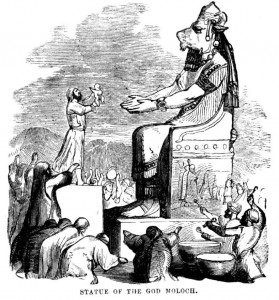
Statue of Moloch

The murder of the innocent children is perhaps the greatest sin that a nation can commit. Abortion is a form of child sacrifice, which is something many ancient cultures practiced (the Aztecs, Incas, Phoenicians, pre-Islamic Arabs, and the biblical Canaanites). In the Bible, YHVH condemns the practice of heathens and apostate Israelites who made their children pass through the fire in worship of the demon-god Moloch (See Lev 18:21; 20:2–5; Deut 12:30–31; 18:10.) What judgment did YHVH place on the Jewish nation for sacrificing its children to Moloch? (See Jer 7:30–34; 32:35–36.)

By the way, here are some statistics about abortion:

  • 42 million abortions occur worldwide each year (that’s 115,000 per day).
  • In 2008, 1.21 million abortions occurred in the U.S.
  • From 1973 to 2008, 50 million legal abortions occurred in the U.S.
  • 22 percent  of all U.S. pregnancies end in abortion.
  • In 2007, 84% of all abortions were performed on unmarried women.
  • At current rates, nearly one-third of American women will have an abortion.

(Sources of information: abortionno.org/Resources/fastfacts.html; guttmacher.org/pubs/fb_induced_abortion.html; abort73.com/abortion_facts/us_abortion_statistics/)


Blog Scripture Readings for 4/15–4/21/12 Midrash

Aside

For the second week of seven weeks of the 50-day count of the omer.

Leviticus 18–24; Jeremiah 1–14; and Psalms 17–23

Most of this week’s blog discussion points will be on these passages. The full year’s Bible Reading Schedule can be found on the right sidebar under “Helpful Links.”

If you have general comments or questions on the weekly Scripture readings not addressed in a blog post, here’s a place for you to post those. Just use the “leave a reply” link below.


Blog Scripture Readings for 4/9–4/15/12 Midrash

Aside

Leviticus 11–18; Isaiah 55–66; Jeremiah 1–2; and Psalms 11–17

Most of this week’s blog discussion points will be on these passages. The full year’s Bible Reading Schedule can be found on the right sidebar under “Helpful Links.”

If you have general comments or questions on the weekly Scripture readings not addressed in a blog post, here’s a place for you to post those. Just use the “leave a reply” link below.


Blog Scripture Readings for 4/1–4/7/12 Midrash

Aside

Leviticus 3–9; Isaiah 39–52; and Psalms 3–9

Most of this week’s blog discussion points will be on these passages. The full year’s Bible Reading Schedule can be found on the right sidebar under “Helpful Links.”

If you have general comments or questions on the weekly Scripture readings not addressed in a blog post, here’s a place for you to post those. Just use the “leave a reply” link below.


Blog Scripture Readings for 3/25–3/31/12 Midrash

Aside

Exodus 36–40; Lev 1–2; Isaiah 25–38; John 17–21 and Psalms 1–2

Most of this week’s blog discussion points will be on these passages. The full year’s Bible Reading Schedule can be found on the right sidebar under “Helpful Links.”

If you have general comments or questions on the weekly Scripture readings not addressed in a blog post, here’s a place for you to post those. Just use the “leave a reply” link below.


Blog Scripture Readings for 3/18–3/24/12 Midrash

Aside

Exodus 29–35; Isaiah 11–24 and John 10–16

Most of this week’s blog discussion points will be on these passages. The full year’s Bible Reading Schedule can be found on the right sidebar under “Helpful Links.”

If you have general comments or questions on the weekly Scripture readings not addressed in a blog post, here’s a place for you to post those. Just use the “leave a reply” link below.