The Serpent on a Pole, Yeshua and Us

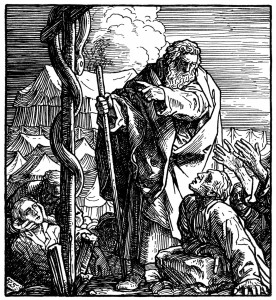
Numbers 21:4–9, Fiery serpent. The fiery serpents were a righteous judgment Elohim brought upon Israel for murmuring and unbelief. Israel had “sharpened their tongues like a serpent” (Ps 140:3) and “their throat [was] an open sepulcher; with their tongues have … used deceit; the poison of asps [was] under their lips” (Rom 3:13). All this was directed at Elohim and Moses. They reaped what they had sown. Elohim loosed fiery serpents upon the Israelites to bite and sting to death the unbelieving murmurers.
176144

The wilderness Elohim led them through was full of fiery serpents and scorpions (Deut 8:15), yet this is the only account in the Torah of these creatures ever attacking Israel. YHVH had protected them to this point and just this once he pulled back his hand of providential protection and grace allowing them to experience the due recompense of their sinful actions. How often has our merciful Father withheld the just desserts of our faithless, rebellious and abominable action against him and gracefully protected us from the full consequences of our sin? If we fail to hear his soft voice of correction he will deal more harshly with us until our attention is gained (Ps 32:8–9). All he has to do is withdraw his hand of protection that restrains the judgments we all deserve and the “fiery serpents” will likewise attack us. What happened to Ananias and Sapphira in the book of Acts is an example of this (Acts 5:1–11). Job experienced a similar situation as well.

Israel’s Murmuring. Israel complained for lack of food and water. In unbelief they concluded and confessed (literally prophesied upon themselves a curse) that they would die in the wilderness. Elohim gave them the fulfillment of their faithless delusions—serpents to sting them and leave them physiologically in a parched and burning condition. (The poison of these snakes actually leaves the victim burning with a fiery pain in his body and a desperately dry and thirsty condition [See Adam Clarke’s Commentary, vol. 1, p. 684]). Continue reading →


The Life of Yeshua in the Bread and Wine

1 Corinthians 11:23, This is my body. We are sanctified through the offering of the body of Yeshua (Heb 10:10). When we eat the bread of communion, we are “eating” Yeshua who is the incarnate Word of Elohim (John 1:14). We are announcing that Yeshua is the spiritual bread of life from heaven that leads to eternal life (John 6:48–51), and we are announcing our desire to live by the totality of his Word (Matt 4:4).

Communion 2

The bread symbolizing the body of Yeshua was unleavened, which is a picture of Yeshua’s sinless life. By eating this bread, we declare our faith in his sinless life by which he was able to pay for our sins. We also declare our identification with his sinlessness as an example for us to follow.

Yeshua took the unleavened bread and broke it signifying our deliverance from our sin nature by the breaking or death of his sinless body. The unleavened bread broken in the Lord’s supper speaks of our deliverance from the power of sin by the death of our old man. The rite of baptism is a picture of this (Rom 6:4–13). This paves the way for us to live a sanctified (sin-free) life.

We become unleavened or sinless (known as sanctification) because Yeshua our Passover Lamb was sacrificed for us (1 Cor 5:7). Continue reading →


Under the Law Vs. Under the Law Toward Messiah

1 Corinthians 9:20–22, Under the law. David Stern in his commentary asserts that this term means “under a legalistic perversion of the Torah”; i.e., that Torah here doesn’t mean Torah, but rather a skewed view of Torah as proffered by the Judaizers (i.e., those of the sect of the Pharisees or those who were under their influence who asserted that one needed to be circumcised and to keep the law of Moses in order to be saved, see Acts 15:1, 5).

Under a legalistic or skewed view of the Torah.

Under a legalistic or skewed view of the Torah.

In this passage, those who are “under the law” aren’t the Jews, since Paul already mentions them at the beginning of verse 20, but Gentiles who are living under a false notion that one can be saved by keeping the Torah.

Paul then goes on to describe the next group of Gentiles — “those who are without the Torah” (verse 21).

The third group of Gentiles to which Paul makes reference is “to the weak” (verse 22), who are those who are new to the faith and tend toward a more punctilious or legalistic obedience to the Torah.

In summary, Paul is saying that he’s sensitive to the spiritual paradigm of those to whom he is preaching the gospel, has learned to relate to all people from all backgrounds and, as such, has become all things to all men in an effort to save some.

Paul, at the same time, asserts that he is not “unTorahed” himself, but rather is “under or in subjection to the true Torah (as opposed to a legalistic perversion of the Torah) through his relationship with Yeshua (verse 21). This statement of Paul lines up perfectly with other statements he makes with regard to his pro-Torah beliefs and lifestyle (e.g., Rom 3:31; 7:12,14; Acts 21:24; 4:14; 25:8; 28:17; 1 Cor 7:19).


The Mysterious Ceremony Involving a Red Heifer Explained

Numbers 19:1–11. The red heifer. 

The Overview of the Ceremony and Its Greater Implications

The Jewish sages teach that the commandment (mitzvah) of the red cow is “beyond human understanding.” Like the afikoman (the middle broken matzah that is “buried” and “resurrected,” which is a picture of the death, burial and resurrection of Yeshua) in the Passover (Pesach) Seder, the meaning of which to this day remains unclear to the Jewish scholars, the red cow is a ritual that makes sense only when Yeshua the Messiah is added to the picture.

Red Cow 1-20010795-1

While the symbolism of the red heifer was, to Jewish Torah scholars, admittedly incomprehensible to human reason, by the second temple era they began to speculate about its spiritual significance in their aggadic literature. Some felt that it was an atonement for the sin of the golden calf (The Encyclopedia of Jewish Religion, Massada – P.E.C. Press, 1965, p. 327; The ArtScroll Chumash, p. 839). Others viewed it as somehow relating to the azazel or scapegoat and the bullock sin offering of Yom Kippur, since all were sacrificed outside the camp of Israel (Lev 16:27).

The sacrifice of the red heifer was for the purpose of purifying someone who had become ritually impure or polluted through contact with the dead, or for purifying metal war booty (Num 31:21ff). This sacrifice was to be made outside of the camp of Israel, and later occurred outside of the walls of the city of Jerusalem on the Mount of Olives, not far from the Temple. The concept of the camp signifies outside of or away from the divine presence or shekinah of YHVH meaning outside the tabernacle courtyard (The ArtScroll Chumash, p. 839).

The heifer was to be three to five years of age and totally red in color, blemish free and to have never born a burden and, according to Jewish tradition, to be without a single black or white hair on its body. Continue reading →


Blog Scripture Readings for 6/9 through 6/15/13

Aside

Parashat Korach — Numbers 19:1 – 22:1
Haftarah — Judges 11:1–33
Prophets — Ezekiel 8:1 – 14:23
Writings — Ecclesiastes 10:1 – 12:14; Esther 1:1 – 4:17
Testimony — 1 Corinthians 9:1 – 13:13

Most of this week’s blog discussion points will be on these passages. If you have general comments or questions on the weekly Scripture readings not addressed in a blog post, here’s a place for you to post those. Just use the “leave a reply” link below.

The full “Read Through The Scriptures In A Year” schedule, broken down by each day, can be found on the right sidebar under “Helpful Links.” There are 4 sections of scripture to read each day. One each from the Torah, the Prophets, the Writings, and from the Testimony of Yeshua. Each week, the Torah and haftarah readings will follow the traditional one-year reading cycle.

Weekly Blog Scripture Readings for 6/9 through 6/15/13.


Can of Worms: Is Tithing for Us Today?

Numbers 18:21, I have given the children of Levi all the tenth. The children of Israel were to pay a tithe (a tenth) of their income to support the Levites—those who ministered to the Israelites and taught them YHVH’s Torah. Since the Levitical priesthood system no longer exists, some people interpret this to mean that tithing and giving to support those who minister to the saints and feed them spiritually is no longer obligatory. Some have the notion that pastors and Bible teachers are to minister free of charge. What does the Apostle Paul say about this? In 1 Timothy 5:17–18 we read,

Can of worms 20089224

Let the elders that rule well be counted worthy of double honour, especially they who labour in the word and doctrine. For the Scripture says, You shall not muzzle the ox that treads out the corn. And, The labourer is worthy of his reward. 

Now let us look at the tithing question in more detail in light of the Torah’s command to support the Levites. How does this translate into supporting those who feed and care for us spiritually today?

Continue reading →


The Leaven of Bitterness

1 Corinthians 5:8, Leaven of malice and wickedness. Interestingly in the Torah, there are two Hebrew words used for leaven, which is a biblical metaphor for sin. The first word, chametz refers to the sin of malice (or ill-will, malignity, desire to injure, or bitterness), while se’or, the second word, refers to wickedness or sin in general, which the Scriptures refers to as the violation of YHVH’s Torah commands (1 John 3:4). It is likely that Paul had this concept in mind when he wrote this verse.

20480193

  • chametz/ץמח, is a noun (Strong’s H2557) meaning “leaven, that which is leavened, bitter.” Chametz is from the root H2556 chametz/ץמח (a verb) meaning “to be sour, to leaven.” According to The Theological Dictionary of the Old Testament, the root word of chametz designates the action and result of yeast, which ferments or sours bread dough. This idea of becoming sour is extended to a person’s negative attitude. For example, in Psalms 73:21 chametz is translated as cruel [and in Ps 73:21 as grieved]. The Torah strongly instructs that anyone eating chametz during Passover and the Feast of Unleavened Bread will be “cut off” from Israel (Exod 12:19–20). Exodus 12:39 notes that Passover bread was not leavened because the Hebrews went out quickly from Egypt and thus had no time for their bread dough to rise. Thus it had the symbolic value of teaching Israel that having been redeemed from Egypt they should leave their old life [and sinful, “sour” carnal nature] behind quickly and set out toward the Promised Land in a sin-free state. Leavened bread was also prohibited in connection with the sacrificial system (Exod 23:18; 34:25). Neither it nor honey could be burned with the meal (Lev 2:11), and it could not be baked with the fire offering (Lev 6:15). But leavened bread could be eaten with the thank offering (Lev 7:13) and with the first fruits offering on Shavuot (or Pentecost). In later Jewish thought, leavened bread become a symbol of corruption and impurity, as also in Yeshua’s teachings (Pss 71:4; 73:21; Hos 7:4; Matt 16:2; Mark 8:15) and in one remark by Paul (1 Cor 5:8; TWOT, vol. 1, page 289).
  • se’or/ראשׂ (Strong’s H7603) means “leaven.” This is the generic term for leavening or leavened bread and is found five times in Scripture (Exod 12:15, 19; 13:7; Lev 2:11; Deut 16:4). In the first four references, se’or is used in parallel construction with chametz. In all places but Leviticus 2:11, it is used in reference to the Feast of Unleavened Bread, while in the former se’or is used in reference to the meal offering.

Sin as the violation of the Torah (1 John 3:4) is often discussed, but the sin of ill-will, bitterness, or a sour attitude toward others tends to be overlooked. This is because this sin so deeply rooted in one’s personality that it’s often hard for the sinner to see it in himself, although it may be clearly visible to others—especially its victims.

This sin is rooted in a heart of unforgiveness and bitterness toward others due to past hurts or wrongs committed against the person who is now harboring the bitterness (cp. Acts 8:23; Rom 3:14; Eph 4:31; Heb 12:15). If not dealt with, bitterness becomes like a deep root that penetrates deeply into the person’s heart and mind (Heb 12:15). It can permeate (like leaven) one’s entire soul, negatively affecting those around them—especially toward those who remind them of the past hurt committed against them causing the ill will to be triggered.