The Burning Bush and the Messenger of YHVH

The “Angel” of YHVH In the Pillar of Fire

In Exodus 13:21 we read,
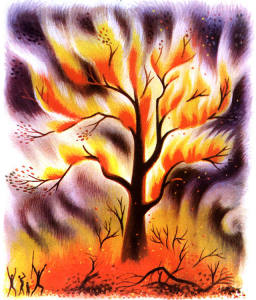
burning bush 4

And YHVH went before them by day in a pillar of a cloud, to lead them the way; and by night in a pillar of fire, to give them light; to go by day and night.

Then in Exodus 14:19 it is written,

And the angel of Elohim, which went before the camp of Israel, removed and went behind them; and the pillar of the cloud went from before their face, and stood behind them.

Who is this “Angel” of Elohim (elsewhere he is called “the Angel” of YHVH)? Angel is an unfortunate translation. The Hebrew word for angel is malak and simply means “a heavenly or a human messenger.” Prophetically this word can refer to human messengers such as the one coming in the spirit of Elijah prior to Messiah’s coming, as well as to the Messiah himself (as in “the Messenger/Malak of the covenant” in Malachi 3:1). In Genesis 32:22–30 Jacob wrestles with a man Scripture identifies as the Malak of YHVH (Hosea 12:3–5) and whom Jacob called Elohim (verse 30). This same Individual redeemed Jacob (Gen 48:18) and is identified with the Malak of Elohim … the Elohim of Bethel (Gen 31:11 and 13) and appeared to Moses at the burning bush (Exod 3:2). Now he is leading Israel in the wilderness. Again who is he? Stephen in Acts 7:37–39 identifies the Messiah (i.e. “that Prophet” Moses mentioned in Deut 18:15) with the “Angel” or Heavenly Messenger which Continue reading


Was Yeshua of Levitical Priestly Heritage?

Luke 1:36, Elizabeth your relative. While Mary was of the royal lineage of David, she also was a relative on her mother’s side of Elizabeth, the priest-wife of Zacharias, who was a daughter of Aaron (Luke 1:5).

Does this mean that Mary was of priestly as well as Davidic lineage. No. Here is why. The Torah only required the high priest to marry within his tribal family (Lev 21:14). The Torah didn’t prohibit rank and file priests were taking a wife from another tribe. For example, Mary’s father would have been a priest, but her mother could have been from another tribe. Mary’s mother could have been a sister to Elizabeth’s mother making Mary and Elizabeth cousins. This would have made Elizabeth of priestly lineage, but not Mary. According to her genealogy, Mary was of Davidic lineage via her father.

To be sure, Yeshua was a priest, but not one of Aaronic lineage, but after the order of Melchizedek, which was the priesthood of the firstborn son passed on generationally. Yeshua was the first born son of Elohim eternally, which is why he is presently at the right hand of Elohim acting as our Great High Priest (Heb 1:3 cp. 3:1; 4:4; 8:1).


The Many Called, the Chosen Few

Exodus 2:22, Gershom. Gershom’s sons eventually became idol worshipers inspire of their illustrious and righteous grandfather (Judg 18:30–31).

Human Resources concept

Many of the children of righteous men in the Bible didn’t follow in the footsteps of their fathers in remaining faithful to Elohim. Examples include Isaac (Esau), Aaron (Nadab and Abihu), Samuel (1 Sam 8:1–3), and David and many of the other righteous kings of Judah. What’s more, the Bible tells us nothing about the spiritual status of the sons of any of the prophets or apostles. Whether they remained faithful to YHVH or not, we don’t know. If they had been notable in their service to YHVH, it seems that Scripture would have some record of it.

One things seems certain. Most of the high visibility servants of YHVH were solitary figures. Little if anything is mentioned about their spouses, families or children who seemed to play no major role in the key figure’s ministry activities.

Interestingly, there are also several examples of righteous sons coming from unrighteous fathers and vice versa. This is the case with several of the kings of Judah.

All this is to say that just because a child was raised well in a godly family doesn’t guarantee they will continue to serve Elohim and walk in righteousness.

Likewise, just because a child was raised in an ungodly, even wicked family, doesn’t mean they will be wicked and ungodly.

Salvation is an individual matter. YHVH calls and chooses whom he will, and it’s up to the individual to respond to that calling. So will respond, most will not. As Yeshua said, many are called, but few are chosen (Matt 22:14).


Blog Scripture Readings for 12-27-15 Through 1-2-16

Aside

THIS WEEK’S SCRIPTURE READINGS FOR STUDY AND DISCUSSION:

Parashat Shemot — Exodus 1:1 – 6:1
Haftarah — Isaiah 27:6 – 28:13; 29:22-23
Prophets — 2 Samuel 8:1 – 14:33
Writings — Psalms 82:1 – 88:18
Testimony — Luke 1:1 – 2:51

Most of this week’s blog discussion points will be on these passages. If you have general comments or questions on the weekly Scripture readings not addressed in a blog post, here’s a place for you to post those. Just use the “leave a reply” link below.

The full “Read Through The Scriptures In A Year” schedule, broken down by each day, can be found on the right sidebar under “Helpful Links.” There are 4 sections of scripture to read each day. One each from the Torah, the Prophets, the Writings, and from the Testimony of Yeshua. Each week, the Torah and haftarah readings will follow the traditional one-year reading cycle.

Weekly Blog Scripture Readings for 12/27/15 through 1/2/16.


Psalm 81 and the New Moon/New Month

Please note: This brief study is an excerpt from a larger work I am about to publish on this blog entitled, “When Does the Biblical Month Begin? Refuting 14 Pro-Conjunction Arguments in Favor of the Visible Crescent.” Stay tuned. — Natan

A Study on Psalm 81 — Is the Word Keseh Proof That the Month Is Conjunction-Based? 

rosh_chodesh 2

A source of great controversy has been the meaning of the Hebrew word keseh as used in Psalm 81:3. The conjunctionists use this word as definitive proof that the new moon starts at the conjunctions. Complicating the issue is the fact that this word occurs only two times in the Tanakh, making its meaning all the more difficult to quantify. Let’s now look at the issues surrounding the meaning of this word.

New Moon Conjunctionist Assertion: In Psalm 81:3 (also Prov 76:10; Job 26:7–9), the phrase full moon is the Hebrew word keseh meaning “concealed, dark, hidden or covered.” This points to a full or dark new moon. The overwhelming use of keseh in the Tanakh (Old Testament) fits the definition above. Job 26:9 to backs up this claim, when you link it back to keseh in Psalm 81:3.

Refutation A: There are several problems with this argument. The word keseh/vxf in Job 26:9 is not the same keseh found in Psalm 81:3. These are two Hebrew words that sound similar and are transliterated the same. In Psalm 81:3, keseh/vxf (Strong’s H3677) ends in the Hebrew letter heh, while the Job 26:9 kiseh/txf (Strong’s H3678) ends with the letter aleph and has a completely different meaning.  This keseh means “seat (of honour), throne, seat, stool, throne; royal dignity, authority, power.” This different Hebrew word has nothing to do with concealing or covering. Some lexicons say that both words have the Hebrew word kasah as their root, but as we shall see below, scholars aren’t certain whether keseh derives from kasah or from a similarly sounding Aramaic loan word that doesn’t mean “concealed or covered” at all, but means “fullness or full moon” and hence the alternate reading in Psalm 81:3. Strong’s and TWOT both state that keseh/vxf in Psalm 81:3 can also be spelled keseh/txf, although it is vowel pointed differently and thus pronounced differently than the keseh/txf meaning “throne.” Both TWOT and Strongs list these words separately in their indexes, but the confusion comes when they list the alternate spelling of keseh (with the ending aleph/t under the heading of the keseh that Continue reading


Two Messiahs from Two Tribes, One Messiah From Two Tribes … or What?

Genesis 49:24, Shepherd…Stone of Israel. This seems to be an irrefutable prophetic reference to the Messiah of Israel whom Scripture refers to in various places as “the Stone the builders rejected,” “the Chief Cornerstone,” “Precious Cornerstone” and “the Rock of our Salvation” (Ps 118:22; Isa 28:16; Mark 12:10; Eph 2:20; 1 Pet 2:6–8). Yet this verse appears to be saying that this Messiah is coming from the tribe of Joseph. At the same time, Jacob’s prophecy to Judah contains another classic Messianic prophecy in the reference to the Shiloh to come (Gen 49:10). These two prophecies led some Jewish sages to believe that two Messianic figures would arise out of Israel: one from Judah and other from Ephraim.

What kind of blessing was this prediction that one day his descendants—the Ten Tribes—would be scattered among the nations? R. Munk explains: while it is true that the dispersion was caused by the unfaithfulness and sinfulness of Ephraim’s descendants (Hos 7:8ff), Jacob’s blessing was not in vain for “they will return to God” and will have their share in the world to come (Sanhedrin 110b). And R. Eliezer adds: “Even the darkness in which the Ten Tribes were lost will one day become as radiant as the day’ (according to the version of Avos d’Rabbi Nosson 36). And in the perspective of history, did not these exiled children of the Patriarchs enlighten the nations among whom they were scattered? They did so by teaching their conquerors the fundamental ideas of the knowledge and love of God, ideals they had never forsaken. Hence they too have a messianic vocation and their Messiah the. … Messiah son of Joseph (Succah 52a), also called Messiah son of Ephraim (Targum Yonasan on Exod 40:11), will play an essential role in humanity’s redemption, for he will be the precursor of the … Messiah Son of David …” (The ArtScroll Bereishis/Genesis Commentary, pp. 2121–2122).

How do we explain this seeming contradiction in view of the facts that there was only one Messiah, and his name was Yeshua, and he came from the tribe of Judah? These two Messiahs are explained in Yeshua’s two comings. In his first coming, he was like Joseph, a suffering servant who then become a king after enduring great hardships (read Isa 53). When he comes back the second time, he will be like David, the conquering, triumphant or warrior king where he will rule over the world and a united Israel (Rev 19:11–16). The Jewish sages had a concept of these two Messiahs, as well, but were unclear as to whether they would be the same person or not and how much time would separate their two comings. With perfect 20-20 hindsight, we can now ook back and see how Yeshua fulfilled this prophecy as the Messiah Son of Joseph (figuratively speaking) at this first coming, and how he is yet to come as the Messiah Son of David at his second coming where as the Conquering King he will defeat Babylon the Great and establish his earthly millennial kingdom where he will rule as King of kings (Rev 19–20).


Does Elohim help those who help themselves?

2 Samuel 7:9, I have …cut off all your enemies. YHVH informed David through Nathan the prophet that he had cut off all David’s enemies. However, this didn’t occur by David sitting on this thumbs and doing nothing while expecting YHVH to defeat his enemies. David had to actively and aggressively literally fight against his enemies. Only then did YHVH help David to defeat them.

There is a lesson here for us. If we need deliverance from our enemies (e.g., sin, addictions, sickness, poverty, demons, persecution, evil people or whatever), we have to do our part. Sometimes, YHVH will give us novel and unconventional ways to defeat our enemies as he did on many occasions with David and the Israelites. Nevertheless, for YHVH to intervene miraculously on behalf of his saints, they still needed to be doing their part: seeking him and trusting in and obeying him.

Although it appears nowhere in the Scriptures, it would seem that the old adage that Elohim helps those who help themselves has some merit.