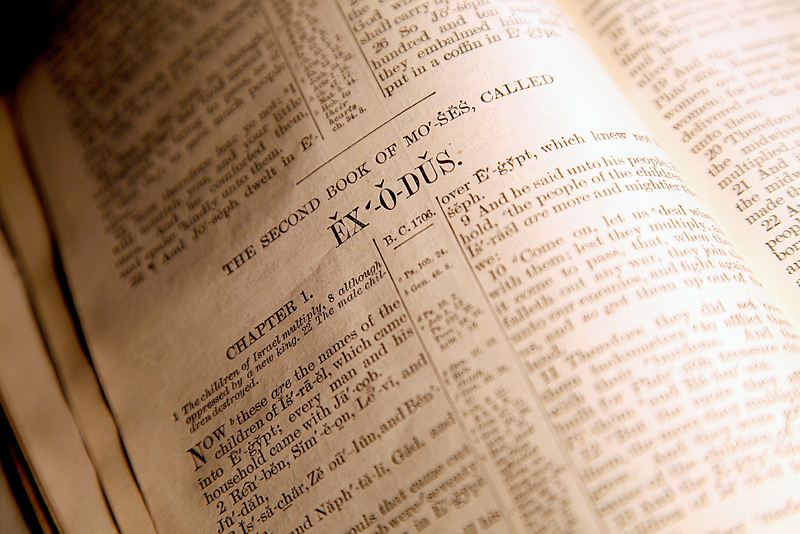
Exodus 1:7,Increased abundantly…multiplied. This was a partial fulfillment of Jacob’s prophecy in Gen 48:16 and 19.
Exodus 1:11,Taskmaster…afflict them.Taskmaster literally means “gangs of government officials who exacted or levied tribute or taxes from the Israelites by forcing them to work as serfs.” These government bureaucratic goons forced the Israelites, through affliction, into compulsory service involving government works projects. The Egyptians imposed a fascistic socialistic system upon the Israelites, which was a form of slavery.
Exodus 1:19–21,Midwives said. The righteous, Elohim-fearing midwives (v. 17), chose to obey Elohim rather than to follow government edicts that violated the laws of the Creator. This necessitated them lying to the Egyptians to preserve the lives of the innocent babies. This teaches us that it is not only acceptable to lie, but it is even commendable in YHVH’s eyes, to preserve life (see also Josh 1:17 where Rahab lied to protect the Israelite spies from certain death, and 1 Sam 20:6 where David had Jonathan lie for him to save his life from the murderous Saul). For their work of preserving innocent lives, YHVH blessed the midwives (vv. 20–21). In reality, the midwives were pro-life, anti-abortion activists who were given a place of honor in YHVH’s hall off fame for the righteous.
Exodus 2
Exodus 2:16; 3:1 (also 18:1),Priest of Midian. Heb. kohen meaning “priest, principal officer or chief ruler.” In the days prior to the Levitical priesthood, the Bible considers a father to be the priest of his family (see Exod 19:22, 24). Since Torah mentions three times that Jethro was the priest of Midian, evidently he was more than just a spiritual leader to his family; he was likely also a regional leader.
Luke 5:33–39, Fast often…eat and drink? The sayings of Yeshua are often enigmatic. This passage is one of them. Here is one possible interpretation of these difficult words of Yeshua. It was evident by the questions the Jews were asking Yeshua that he and his disciples weren’t following the accepted norms of the day in how they expressed themselves religiously.
Yeshua explains that our religious expression rather should fit the spiritual times and seasons (as determined by the Spirit of Elohim) in which we find ourselves, and that we shouldn’t just blindly follow men’s religious traditions. This will put us out of synch with the heart and will of Elohim.
Yeshua then goes on to illustrate his point by saying that some things don’t fit with other things because they’re mismatched such as a new patch on old clothes, or new wine in old wineskins.
The bottom line is this: If one tries to pound the proverbial round peg into the square hole, both the peg and hole will be ruined. Or put in spiritual terms, what is to be gained from trying to beat the round peg of YHVH’s will into the square hole of men’s traditions or expectations? Sometimes the old traditions are better, and sometimes the new ways are better. Wisdom and being in tune with the will and heart of Elohim will determine which way is preferable.
As we grow stronger in our spiritual maturity, hopefully we will learn to bend more with the wind of the Holy Spirit, and not so much with the winds of men’s doctrines, traditions and opinions.
Luke 5:17, The power [Gr. dumanis] of YHVH was present. Sometimes the power of YHVH is present to heal people, sometimes it is not. There are many factors that determine if and when a person is healed divinely. These include such things as the sovereign will of Elohim for that person’s life, the faith of the individuals performing or receiving the healing, repentance of sin or the lack thereof, divine judgment, trials Elohim may be allowing in one’s life for character refinement (think righteous Job and Paul’s thorn in the flesh), and whether one is a saint or not and many more factors about which we may or may not be aware due to our limited human understanding of the spiritual dimension where Elohim operates.
Let’s now explore the healing activities of Yeshua to see what we can learn about the spiritual mechanics of divine healing.The Greek word dunamis in the phrase, “the power [dumanis] of YHVH was present” means “strength, power, ability” or, as often used in the Testimony of Yeshua, it can mean “miraculous power.” This statement by Luke is interesting when it comes to understanding the dynamics of Yeshua’s healing activities. Did Yeshua heal all people all the time, or only when the power of Elohim was present for him to do so? This verse, at least in this case, would indicate the latter. Elsewhere, we read that Yeshua “healed many that were sick” (Mark 1:34), but not all that were sick. On other occasions, the Gospels record indicates that Yeshua did in fact heal all the sick who were brought to him (Matt 4:23–25; 9:35; Luke 6:19).
The Gospels also reveal some other interesting facts about Yeshua’s healing activities that we often pass over. On at least one occasions, Yeshua prayed to heal someone and they were only partially healed. Only after he prayed for them the second time, were they completely healed (Mark 8:22–25). Why was this? Couldn’t Yeshua have healed them the first time? Of course, but perhaps their faith wasn’t yet strong enough for them to be healed. Or maybe Yeshua was teaching us that sometimes we have to demonstrate persistent faith and keep seeking healing until the healing occurs. On other occasions, Yeshua healed people after he was “moved with compassion [love and pity]” for someone who was sick (Matt 14:14; Mark 1:41; Luke 7:13–15). The Greek word for compassion, literally means “to be moved in one’s bowels,” or in the deepest areas of one’s emotions. At other times, people simply touched Yeshua’s clothing as he was walking by, and the miraculous power (Gr. dunamis) of Elohim flowed from him and healed them (Matt 9:20; Mark 6:56; Luke 8:44 cp. Luke 6:19). They had the faith to be healed, and the received their miracle.
Elsewhere, it appears that Yeshua’s healing activities were hampered by the presence of those who ridiculed him and exhibited doubt and unbelief, which is why, on one occasion, he put the doubters out of the room and closed the door behind them, when he raised the little girl from the dead (Mark 5:40–42). Similarly, in his hometown of Nazareth, Yeshua “could do no mighty works there” except for healing a few sick people, “because of their [the townspeople’s] unbelief” (Mark 6:5–6; also Matt 13:58). Matthew’s account adds that the people of Nazareth were offended (literally, scandalized) by Yeshua, or that they stumbled over (or judged unfavorably, distrusted) Yeshua. Because of their low esteem for him, they lacked the faith to receive healing, which is why he healed so few people in that town.
When it comes to praying for divine healing, when in doubt, always look for an opportunity to pray for a sick person. Before praying, one must discern the situation. Does the person have faith to be healed? Is the anointing or Presence of YHVH there to heal the person? How is the Spirit of Elohim directing one to pray? Sometimes we sense the need to pray more authoritative prayers, other times, more pleading or intercessory prayers, and still other times prayers of agreement while asking heaven for the healing.
What’s more, prospective converts and new believers tend to have their prayers for healing answered more quickly, since this is a demonstration of the signs Yeshua promised that would follow the preaching of the gospel. Yeshua declared that divine healing as a result of the laying on of hands was to be a result of the preaching of the gospel to the unsaved (Mark 16:15–18).True, the saint can be healed, but often this will occur after having their faith stretched and refined. Therefore, the healing sometimes takes longer to receive.
This article was written by Brandon Smith and originally published at Birch Gold Group
Gold has seen an impressive price spike in the past 18 months, and if you are wondering what the cause is, you’ll find almost everyone has a different theory. That said, certain factors in historic gold rallies tend to be ignored. For example, the mainstream financial media often hyper focuses on stimulus measures by the Federal Reserve as the cause, but I would remind people that the most recent upward trend in gold started while the Fed was tightening liquidity and raising interest rates, not stimulating. Also, many analysts suggest that precious metals absorb investment cash flows when equities are sliding. Yet, for now, stocks have been rallying for the past year as gold prices also trend upward. So, what is the mainstream missing here?
First and foremost, it’s important to understand that gold is not necessarily just an inflation hedge; it is also a crisis hedge. As economic and geopolitical uncertainty grows, gold prices skyrocket. The past decade has seen uncertainty and instability that the world has not seen for almost a century. The problem is, the average American is oblivious to this state of affairs. They have no idea how bad the situation can get, as they assume there are checks and balances to counter any potential disaster in the financial structure. They assume that the government or the banks will step in.
However, there are signals that tell us that this will not be the case. In fact, it appears that central banks around the world are preparing for an event that they either cannot quantify yet or simply refuse to warn the public about. This is evident in the acceleration in gold stockpiling by banking institutions.
In 2016 during the election campaign of Donald Trump one of the primary factors of his popularity among conservatives was that he was one of the first candidates since Ron Paul to argue for bringing US troops home and ending American involvement in the various elitist fabricated wars in the Middle East. From Iraq, to Afghanistan, to Syria and Yemen and beyond, the Neo-Cons and Neo-Libs at the behest of their globalist masters had been waging war oversees unabated for over 15 years. The time was ripe for a change and people felt certain that if Hillary Clinton entered the White House, another 4-8 years of war were guaranteed.
There was nothing to be gained from these wars. They were only dragging the US down socially and economically, and even the idea of “getting the oil” had turned into a farce as the majority of Iraqi oil has been going to China, not the US. General estimates on the costs of the wars stand at $5 trillion US tax dollars and over 4500 American dead along with around 40,000 wounded. The only people that were benefiting from the situation were globalists and banking elites, who had been clamoring to destabilize the Middle East since the day they launched their “Project For A New American Century” (PNAC). Truly, all wars are banker wars.
The Obama Administration’s attempts to lure Americans into supporting open war with the Assad regime in Syria had failed. Consistent attempts by George W. Bush and Obama to increase tensions with Iran had fizzled. Americans were showing signs of fatigue, FINALLY fed up with the lies being constructed to trick them into being complicit in the banker wars. Trump was a breath of fresh air…but of course, like all other puppets of the globalists, his promises were empty.
Empires are built through the creation or acquisition of wealth. The Roman Empire came about through the productivity of its people and its subsequent acquisition of wealth from those that it invaded. The Spanish Empire began with productivity and expanded through the use of its large armada of ships, looting the New World of its gold. The British Empire began through localized productivity and grew through its creation of colonies worldwide—colonies that it exploited, bringing the wealth back to England to make it the wealthiest country in the world.
In the Victorian Age, we Brits were proud to say, “There will always be an England,” and “The sun never sets on the British Empire.” So, where did we go wrong? Why are we no longer the world’s foremost empire? Why have we lost not only the majority of our colonies, but also the majority of our wealth?
Well, first, let’s take a peek back at the other aforementioned empires and see how they fared. Rome was arguably the greatest empire the world has ever seen. Industrious Romans organized large armies that went to other parts of the world, subjugating them and seizing the wealth that they had built up over generations. And as long as there were further conquerable lands just over the next hill, this approach was very effective. However, once Rome faced diminishing returns on new lands to conquer, it became evident that those lands it had conquered had to be maintained and defended, even though there was little further wealth that could be confiscated.
Our new annual Scripture Reading Schedule for 2019-2020 with daily readings is available to download and print. If you are still working through 2018-2019’s Scripture Reading Schedule, the link will still be available on the right sidebar under “Helpful Links”. If you are using a mobile device or tablet, the link may be below, meaning you’ll need to scroll down instead.
Most of this week’s blog discussion points will be on these passages. If you have general comments or questions on the weekly Scripture readings not addressed in a blog post, here’s a place for you to post those. Just use the “leave a reply” link or the “share your thoughts” box below.
The full “Read Through The Scriptures In A Year” schedule, broken down by each day, can be found on the right sidebar under “Helpful Links.” There are 4 sections of scripture to read each day: one each from the Torah, the Prophets, the Writings, and from the Testimony of Yeshua. Each week, the Torah and haftarah readings will follow the traditional one-year reading cycle.
Weekly Blog Scripture Readings for 1/12 through 1/18/20.