The Baptism of the Holy Spirit: Who, What, When, and Why?

The Baptism of the Spirit Brings Power to Advance the Kingdom of Elohim

  • The gifts of the Spirit are the tools YHVH has given his saints to advance his kingdom.
  • They are for ministry purposes to bring glory to YHVH.
Baptism of Spirit 21398485

Born of the Spirit Vs. Baptized in the Spirit — What’s the Difference?

Is there a difference between being born of the Spirit and being baptized in the Spirit? Yes. Water baptism (or baptism for the remission of sins) occurs at one’s conversion and symbolizes being spiritually regenerated by dying to the old sin nature and being resurrected in the newness of life unto the righteousness of Yeshua. It marks the beginning of walking in victory over sin as a spiritual overcomer. The result is being able to live a life of righteousness through obedience to the commandments of Elohim. The outward evidence or fruit of this spiritual work in one’s life is the manifestation of the fruits of the Spirit the greatest of which is love. By contrast, the baptism of the Holy Spirit (as Yeshua describes it in Act 1:5–8 and Luke 24:49) is for ministry empowerment purposes. It enable the saints to yield more to the leading of the Spirit of Elohim as they confront the evil darkness in this world via the power of the Elohim. It is for the purpose of boldly and powerfully advancing the kingdom of Elohim through the preaching of the gospel message to those who are spiritually lost with miraculous signs and wonders following.

Yeshua describes the process of receiving the Holy Spirit of Elohim in John 3:5–8. Continue reading →


Blog Scripture Readings for 3/17 through 3/23/13

Aside

Parashat Tzav — Leviticus 6:1 (6:8 in Christian Bibles) – 8:36
Haftarah — Malachi 3:4–24
(4:6 in Christian Bibles)  **
Prophets — Isaiah 38:1 – 45:25
Writings — Proverbs 12:1 – 18:24
Testimony — Acts 2:39 – 7:37

Most of this week’s blog discussion points will be on these passages. If you have general comments or questions on the weekly Scripture readings not addressed in a blog post, here’s a place for you to post those. Just use the “leave a reply” link below.

The full “Read Through The Scriptures In A Year” schedule, broken down by each day, can be found on the right sidebar under “Helpful Links.” There are 4 sections of scripture to read each day. One each from the Torah, the Prophets, the Writings, and from the Testimony of Yeshua. Each week, the Torah and haftarah readings will follow the traditional one-year reading cycle.

Weekly Blog Scripture Readings for 3/17 through 3/23/13.

** A different Haftarah is read when it is a special sabbath in Jewish tradition. On 3/23 is the traditional “Shabbat HaGadol” (The Great Shabbat), which is the Sabbath that precedes Passover. Malachi 3:23 (or 4:5 in Christian Bibles) reads:

“Behold, I am going to send you Elijah the prophet before the coming of the great (haGadol) and terrible day [of YHVH].”


Got the Baptism of the Spirit?

It’s  All About Spiritual Activation

To enter into a relationship with YHVH Elohim, our Creator and Father in heaven, and to become his sons and daughters, we must be spiritually activated.

Holy Spirit fire 15205497

Man is comprised of body, soul and spirit (1 Thess 5:23). Before being spiritually regenerated or born again, our soul (our mind, will and emotions) controls what we think, say and do. The Scriptures talk say this about the spirit in man.

But there is a spirit in man: and the inspiration of the Almighty giveth them understanding. (Job 32:8)

Who knoweth the spirit of man that goeth upward, and the spirit of the beast that goeth downward to the earth? (Eccl 3:21)

The burden of the word of YHVH for Israel, saith YHVH, which stretcheth forth the heavens, and layeth the foundation of the earth, and formeth the spirit of man within him. (Zech 12:1)

For what man knoweth the things of a man, save the spirit of man which is in him? even so the things of Elohim knoweth no man, but the Spirit of Elohim. (1 Cor 2:11)

Man can’t enter into a relationship with a YHVH who is a spirit through his soul. Elohim is a Spirit, and we must relate to  him through the Spirit.

But the natural man does not receive the things of the Spirit of God, for they are foolishness to him; nor can he know them, because they are spiritually discerned. (1 Cor 2:14)

But the hour cometh, and now is, when the true worshippers shall worship the Father in spirit and in truth: for the Father seeketh such to worship him. Elohim is a Spirit: and they that worship him must worship him in spirit and in truth. (John 4:23–24)

For man to relate to Elohim, he must do so through his spirit. This means man’s spirit must be activated at the time of his new spiritual birth. When this occurs, Continue reading →


Why the Biblical Sacrificial System?

A Brief Study of the Sacrificial System—The Purpose of Sacrifice

Lamb sacrifice

  • The Levitical system foreshadowed and pointed to the Messiah’s ultimate sacrifice (Heb 9:11–12).
  • The tabernacle offerings were specifically designed to spiritually draw the offerer near to Elohim through the  sacrifice of a prescribed animal (Ps 51:16–17; 50:12–15 cp. 1 Pet 2:21).
  • Elohim commanded offerings to assist the offerer to better understand himself; his attitude, and his personal relationship with Elohim (e.g., Gen 3:21; 4:3–5; 8:20; 22:1–2 cp. 1 Cor 11:28).
  • Altars were erected by the patriarchs in order to honor Elohim through sacrifice after having had direct contact with him (Gen 12:6–8; 13:18; 26:24–25; 35:1; 35:2–4; Exod 17:13–16; cp. Exod 20:12).
  • Proper and regular sacrificial offerings kept the children of Israel in direct contact with the Elohim of the patriarchs (Exod 5:3; 10:25; cp. 1 Tim 2:5).
  • To make the offerer holy (set-apart) so that he would be allowed to approach and commune with the Set-Apart Elohim of Israel (Isa 43:15; 57:15; Lev 19:2 cp. 2 Cor 6:16–18).
  • Under certain circumstances, blood, as used in the Levitical system, could serve as a purification agent for both people and objects (Heb 9:18–23 cp. Luke 2:22–24).
  • The blood of the animal sacrifices served to cover the offerer’s sins, thereby allowing him to draw near to the Set-Apart Elohim of Israel. However, the offerer could only be forgiven for specific sins through full repentance and by returning to Elohim’s way of life as outlined in the Torah (Lev 1:4; 4:35; 23:27–28; Heb 10:3–4; cp. Rom 4:7–8).
  • The purpose of the animals offered by the Levitical priesthood served as a shadow of the blood of Messiah, which does not merely cover our sins, but removes all of the sins of the person who accepts Yeshua’s offering of himself for that sinner (Heb 9:11–12, 24–28; 1 Pet 1:18–19; Eph 5:25–27; Lev 25:47–49; Rom 5:11; John 1:29 cp. Heb 13:10–13).

YHVH instituted the biblical sacrificial system at the fall of man, and it pointed to the coming of Yeshua the Messiah, the Redeemer and Savior of mankind. Depending on how one understands the passages recording the vision of Ezekiel’s Temple (Ezek 40–48), there may or may not be a reinstitution of part of or the whole sacrificial system during the millennium. Some believe that Ezekiel’s Temple is only an allegorical picture of Yeshua on the cross and speaks to YHVH’s plan of salvation and therefore will never be built. Others feel that it is yet to be built. This author favors the former thesis.

After the fall of man, YHVH made Adam and Eve coats or garments of skins or leather (Gen 3:21). Though the Scriptures don’t tell us, we can guess these were made of leather from a kosher animal such as a cow, sheep or goat. In other words, YHVH probably sacrificed an animal to cover their physical and spiritual nakedness. This would have marked the beginning of the sacrificial system and thus pointed to Yeshua’s atoning death on the cross through his shed blood—the Lamb slain from the foundation of the world.

The next occurrence of a sacrifice was that of righteous Abel in Genesis chapter four. After that, animal sacrifices become a common occurrence with the male head of each family acting as the officiant or priest for his family. It was not until the golden calf incident (Exod 32) that the responsibility of the male head of the family to perform sacrifices passed to the Levites, thus, initiating the Levitical priesthood with its sacrificial system.

Sacrifices are no longer necessary, since Yeshua our Messiah offered his body as the penultimate sacrifice for our sins, once and for all, forever (Heb 10:10–21). HalleluYAH!!!


Blog Scripture Readings for 3/10 through 3/16/13

Aside

Parashat Vayikra — Leviticus 1:1 – 5:26 (6:7 in Christian Bibles)
Haftarah — Isaiah 43:21– 44:23
Prophets — Isaiah 30:1 – 37:38
Writings — Proverbs 5:1 – 11:31
Testimony — John 19:1 – 21:25; Acts 1:1 – 2:38

Most of this week’s blog discussion points will be on these passages. If you have general comments or questions on the weekly Scripture readings not addressed in a blog post, here’s a place for you to post those. Just use the “leave a reply” link below.

The full “Read Through The Scriptures In A Year” schedule, broken down by each day, can be found on the right sidebar under “Helpful Links.” There are 4 sections of scripture to read each day. One each from the Torah, the Prophets, the Writings, and from the Testimony of Yeshua. Each week, the Torah and haftarah readings will follow the traditional one-year reading cycle.

Weekly Blog Scripture Readings for 3/10 through 3/16/13.


The Cross and the Triangle in the Tabernacle

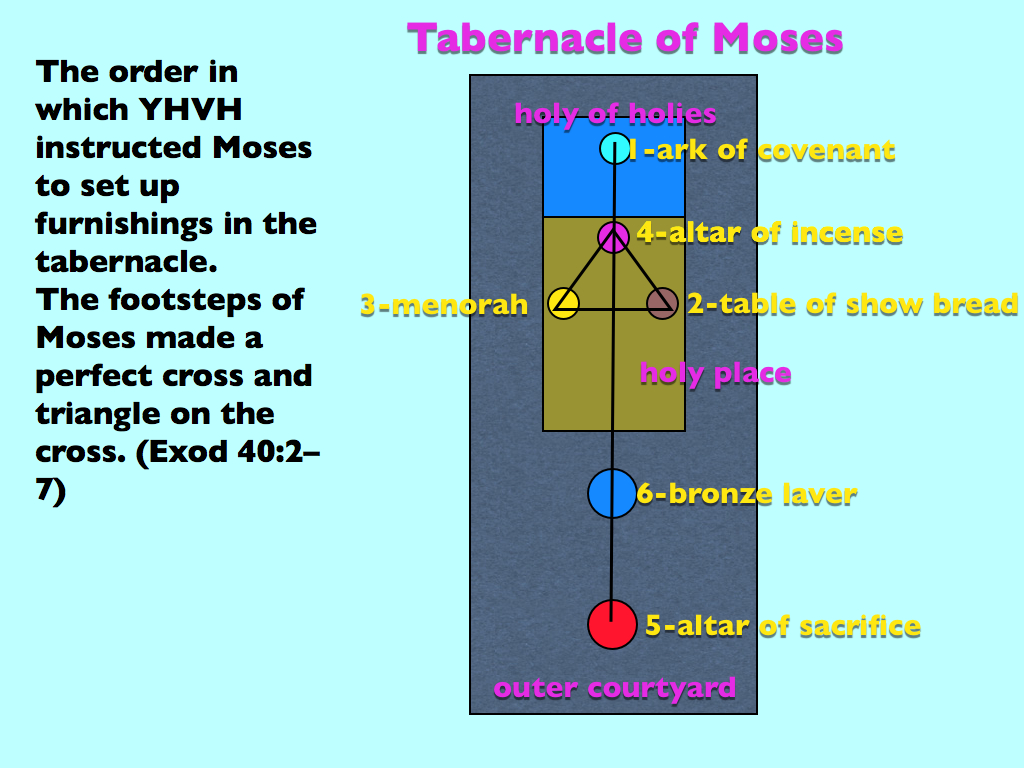
Exodus 40:2–7, Set up the tabernacle. YHVH’s instructions to Moses to set up the furnishings in the tabernacle followed a particular order. Moses first started in the holy of holies, then proceeded to the table of show bread, then moved across to the menorah, then over to the altar of incense, and then down to the altar of sacrifice within the tabernacle’s courtyard, and then up to the bronze laver. The outline of Moses’ movements make a triangle on a cross with the base of the triangle forming the cross arm of the cross. The base of cross corresponds to the altar of sacrifice, while apex of the triangle corresponds to the altar of incense and the top of the cross, which extends past the apex of the triangle is where the testimony in the holy of holies is.

Tabernacle Set-Up Order

Would anyone care to posit their opinion on the spiritual significance of this geometric pattern?


What Is Truth?

John 17:17, Truth. Yeshua, the One sent to this earth from Elohim in heaven, says here, “Thy [Elohim’s] Word is truth.” In Matthew 4:4, Yeshua said, “Man shall not live by bread alone, but by every word that proceeds out of the mouth of Elohim.”

32351753

So what is truth? The word in Hebrew for truth is emet (spelled aleph, mem, tav), which is comprised of the first, middle and last letters of the Hebrew alphabet. Truth embodies everything from the beginning to the very end of YHVH’s Word (literally, his Torah or the first five books of the Bible, and secondarily, the whole Bible from Genesis to Revelation).

Interestingly, the Scriptures call Yeshua “the beginning and the end of our faith” (Heb 12:2), and likens him metaphorically to alpha and omega (Rev 1:8, 11; 21:6; 22:13), which are the first and last letters of the Greek alphabet. These letters corresponds in symbolic meaning to the aleph and tav, which are the first and last letters of the Hebrew alphabet.

Continue reading →