Without Blemish—Why, What and Who

Leviticus 3:1, Without blemish. Heb. tamiym meaning “complete, whole, entire, sound, healthful, wholesome, unimpaired, innocent, having integrity.” Of this word, The TWOT states, [Tamiym r]efers to animals which are without blemish; also translates as such related adjectives as full, whole, upright, perfect. It represents the divine standard for man’s attainment.” Tamiyn occurs in the Tanakh 91 times, and the KJV translates it  in a variety of ways: without blemish, perfect, upright, without spot, uprightly, whole, sincerely, complete, full. Here are some examples of how tamiym is used in the Tanakh:

  • Noah was a just, perfect or upright (tamiym) man (Gen 6:9).
  • YHVH admonished Abraham to walk perfectly or blamelessly (tamiym) before him (Gen 17:1).
  • The Passover lamb was to be without blemish (tamiym, Exod 12:5) as were all the other animals offered to YHVH as sacrifices (e.g. Exod 29:1; Lev 1:3, 10; 3:1, 6, 9; 4:3, 23, 28, etc.).
  • YHVH instructed the Israelites to be blameless (tamiym) before him by not being like the wicked, abominable and idolatrous nations around them (Deut 18:13).
  • Elohim is perfect (tamiym, Deut 32:4).
  • The people of Elohim are to fear him and to serve him in sincerity (tamiym) and truth and to put away the gods of Egypt (this world) and to serve Elohim (Josh 24:14).
  • David was blameless or upright (tamiym) before Elohim (2 Sam 22:24). Even thought David committed adultery, murder and egregiously disobeyed in some other areas, Elohim viewed him as tamiym because of he had repented of and turned away from his sins.
  • When a person is upright or blameless (tamiym) before Elohim, Elohim will be blameless (tamam meaning “to be complete, be sound, be unimpaired, be upright or to deal in integrity, to act uprightly) in response to that person (2 Sam 24:26).
  • The ways of Elohim are perfect (tamiym, 2 Sam 22:31).
  • Elohim makes the ways of the saint perfect (tamiym, 2 Sam 22:33).
  • Those who walk uprightly (tamiym) will be allowed to dwell in the presence of Elohim (Ps 15:2).
  • The Torah-law of YHVH is perfect (tamiym, Ps 19:7).
  • YHVH blesses or withholds no good thing from the upright (tamiym, Ps 84:11 cp. Ps 119:1; Prov 2:21; 28:10, 18).
  • The righteous are to walk perfectly or blamelessly (tamiym) before Elohim (Ps 101:2, 6; 119:80; Prov 11:5).
  • YHVH delights in the blameless (tamiym) person (Prov 11:20).
  • The wicked abhor those who speak uprightly (tamiym, Amos 5:10).

Be ye therefore perfect, even as your Father which is in heaven is perfect. (Matt 5:48)


What is the covenant of salts?

Leviticus 2:13, (also Num 18:19) Salt of the covenant. Why did YHVH mandate that salt be added to this offering?

Like the other elements of all the offerings listed in this chapter, it is a physical substance YHVH uses as a prophetic metaphor to help humans to understand spiritual realities. As a top tier teacher, YHVH uses teaching tools to understand humans deep spiritual truths—to help us to bridge the gap in our understanding between the physical and earthly plane that the spiritual or heavenly plane. To wit, salt has two properties. It destroys (thereby purifying a substance) and preserves. It destroys plants and microorganism like fungus and bacteria and it therefore aids in the preservation of food by killing those things that cause food to decay. Therefore salt symbolizes the covenant of YHVH, which stipulates that if you follow the Torah you will be blessed (preserved and purified), but if you violate it you will be cursed (destroyed). As salt prevents spoilage of food, and acts as a cleansing agent, so the Torah-Word of Elohim, if obeyed, will keep one in the paths of righteousness and in right relationship with the Almighty. It will prevent one from spiritual degradation. 

Furthermore, salt as a preservative conserves and symbolizes permanence, even as the sacrificial meat it seasoned symbolized the immutability of YHVH’s covenant with his people.

Salt also makes food palatable, even as obedience to the commandments of Elohim make otherwise sinful men palatable to the “taste buds” of the Creator. Recall Yeshua’s statement about the saints being the salt of the earth (Matt 5:13). Our Master further states that every sacrifice was salted (Mark 9:49), and Paul declares that the saints are “living sacrifices, holy and acceptable [or well-pleasing] to Elohim.” As such, they are to be unlike the world, which to YHVH is tasteless and not well-pleasing (Rom 12:2–3)

So salt is a sign of YHVH covenant with his people for a variety of reasons that are spiritually significant. 

So important was salt in ancient times as a food preservative that it is called “a foundation of civilization.” Because it was difficult to obtain, it was a highly valued trade item, and roads were constructed to procure it (e.g. the Via Salaria in Italy during Roman times). Cities and empires were built around salt supplies. The English word salary derives from the Latin word salarium for salt, and either indicates that the wages of a Roman soldier were at times paid in salt, or that he was allotted money to purchase salt (http://en.wikipedia.org/wiki/History_of_salt).

These facts underscore the reality that without salt, human life cannot exist. As such, salt is an appropriate addition to the tabernacle sacrifices, for without the sin sacrifice of Yeshua (which the ancient Levitical sacrificial system prophetically portrayed), man has no hope of being preserved eternally.


The Sacrificial System, Yeshua and the Saint

There’s so much in the first few chapters of Leviticus, that I hardly know where to start. Here are a few of my notes on this wonderful section of Scripture. —Natan

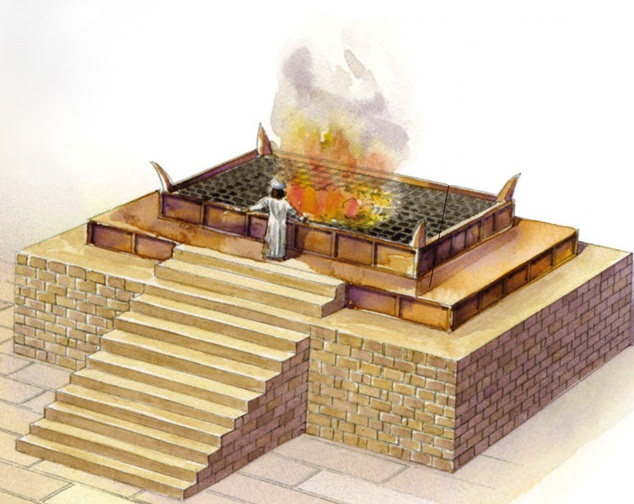
Leviticus 1:5, He shall kill. The sinner must kill the animal to be sacrificed as an atonement for his sin. The reinforces upon the individual’s heart and mind the gravity of his sin and the consequences there of upon an innocent animal, which symbolically pointed to the death of Yeshua, the Lamb of Elohim, upon the cross, who had to die for each person’s sins. If killing an innocent animal brings grief to a person’s heart, then how much more the death of Yeshua, the Son of Elohim?  

Sprinkle. Heb. word zaraq means “to scatter, sprinkle, toss, throw, scatter abundantly, strew.” The sprinkling of the blood of the sacrificed animal on and around the altar of sacrifice (and elsewhere in the tabernacle as well) is mentioned numerous times in the Torah (e.g. Exod 24:6; 29:16; Lev 1:11; 3:2, 8, 13; 4:6,17; 5:9; 7:2). The blood was even sprinkled on the people (Exod 24:8), and on Aaron and his sons (Exod 29:20–21). This is a prophetic picture of Yeshua bleeding, Continue reading


Holiness—The Dominant Theme of Leviticus and the Bible 

The focus of Leviticus is holiness and holy living. Holiness is the chief attribute of Elohim and the most defining aspect of his character. It has to do with the fact that Elohim is entirely good and without evil and moral defect and is sinless. This is why the spiritual beings around his heavenly throne are continually crying, “Holy, holy, holy” in his Presence (Isa 6:3; Rev 4:8). This is why one of his titles is The Kadosh One of Israel,which is used more than thirty times in the Tanakh (e.g. 2 Kgs 19:22; Ps 71:22; Isa 1:4; Jer 50:29). This is why the high priest who ministered in the Tabernacle of Moses and later in the temple wore a golden crown or headplate with the words inscribed on it, SET-APARTNESS TO YHVH. Not only was this pointing upward to YHVH’s set-apartness, but man himself is to become holy or set-apart even as YHVH Elohim is set-apart, for we read in the Epistle to the Hebrews that the attribute of holiness is a prerequisite for a man coming into the Presence of Elohim (Heb 12:14).

The Hebrew word for holy and holiness is kadosh, which is defined as “sacredness, consecrated, set-apartness or separateness.” That which is holy or kadosh relates to that Continue reading


Overview of the Book of Leviticus/Vayikra

Outline of Leviticus

Leviticus is divided into to several main parts. Chapters one to 16 deal with laws of sacrifice and purification. In the second section (chapters 17–25), Elohim sets forth his demands for holy living that his people might maintain a right relationship with him. Chapter 26 lays out the blessings and curses for obedience to YHVH’s commands. The Continue reading


Blog Scripture Readings for 3-10 Through 3-16-19

Aside

THIS WEEK’S SCRIPTURE READINGS FOR STUDY AND DISCUSSION:

Parashat Vayikra — Leviticus 1:1 – 5:26 (6:7)*
Haftarah — Isa 43:21 – 44:23 | 1 Sam 15:2-34; Deut 25:17-19**
Prophets — Isaiah 13:1 – 19:25
Writings — Psalms 145:1 – 150:5; Proverbs 1:1–33
Testimony — John 10:22 – 13:38

Most of this week’s blog discussion points will be on these passages. If you have general comments or questions on the weekly Scripture readings not addressed in a blog post, here’s a place for you to post those. Just use the “leave a reply” link below.

The full “Read Through The Scriptures In A Year” schedule, broken down by each day, can be found on the right sidebar under “Helpful Links.” There are 4 sections of scripture to read each day: one each from the Torah, the Prophets, the Writings, and from the Testimony of Yeshua. Each week, the Torah and haftarah readings will follow the traditional one-year reading cycle.

* Verse numbers in parenthesis refer to the verse number in Christian English Bibles when they differ from Hebrew Bibles or the Tanakh.

** A different Haftarah is read when it is a special sabbath in Jewish tradition. This week it is Shabbat Zachor on the traditional calendar with a special reading of 1 Samuel 15:2-34 as well as the maftir: Deuteronomy 25:17-19.

Weekly Blog Scripture Readings for 3/10/19 through 3/16/19.


Is it “happy biblical new year” now, or in one month?

Update from Natan: Here is an update on the article below that I wrote a few days ago. Since then, some interesting developments have occurred, which greatly confirm my conclusions below. It is this: What was purported to be abib/aviv barley was actually wheat. Yes. It was wheat, NOT barley.

What disturbs me greatly is that when the person who reported to have found abib barley in the land of Israel, he posted pictures of abib grain in his hand on the internet, and he represented it as being abib barley. Then when a couple of people pointed out the fact that what he was holding was not barley but was actually wheat, he admitted that it was wheat, but that it didn’t matter. He said it could have been corn or any other grain that had been abib and it didn’t matter if it was actually barley or not. What I’m asking myself???? Where is this in the Bible? Apparently, his reasoning is that since he found a small patch of some abib wheat, this is positive proof that the barley will come abib sometime in the next month in time for First Fruits Day, even though it’s not currently abib. Based on this false report, many people will be keeping the biblical feasts this year a whole month early!

After this, the same person then went on to publicly and viciously attack the other person who identified it as wheat and not barley. Yes! Instead of admitting that he had made a mistake in calling wheat barley, he attacked the other person calling them demonic, a deceiver, a tool of the devil, etc., etc. He then went on to give a bunch of unbiblical, man-made reasons why he was right…yet still no abib barley.

What’s the bottom line? Simply this. You can believe if you want that we’re in the first month of the new biblical year, but it’s based on a false report that the barley was abib when it was not. It seems that this individual is either an unrepentant deceiver, a false Bible teacher or a a very naive person who doesn’t know the difference between wheat and barley. He’s also not a very nice person in that he attacks people who respectfully disagree with him in a non-attacking manner. He’s not accountable to anyone and is a lone wolf, loose canon. As such, this person is not in a position to have people be looking to him to be determine when the new biblical year is to start based on the abib barley.

Alternate title: Was Abib/Aviv Barley Just Found in the Land of Israel?


We vote that the new biblical year will be in another month. A little further below, we’ll discus the reasons why.

But first, I want to bless all of my Christian and Jewish brothers and sisters who are actively participating in the process to help restore biblical truth. Both the prophet Malachi and Peter the apostle of Yeshua talked about this process. It’s helping to speed up the coming of the Messiah.

Remember the Torah-law of Moses, My servant, Which I commanded him in Horeb for all Israel, With the statutes and judgments. Behold, I will send you Elijah the prophet Before the coming of the great and dreadful day of YHVH. And he will turn The hearts of the fathers to the children, And the hearts of the children to their fathers, Lest I come and strike the earth with a curse. (Mal 4:4–6)

Repent therefore and be converted, that your sins may be blotted out, so that times of refreshing may come from the presence of the Lord, and that He may send Yeshua the Messiah, who was preached to you before, whom heaven must receive until the times of restoration of all things, which Elohim has spoken by the mouth of all His holy prophets since the world began. (Act 3:19–21)

Both of these passages are speaking about the same thing: a restoration of biblical truths, which have been forgotten or sublimated by the unbiblical traditions of men. Truth has suffered at the hands of religionists in both the Jewish and Christian camps. Many of YHVH’s people are beginning to awake from their spiritual slumber (Rev 3:3, realize that they’ve often been lied to (Jer 16:19), and now it’s time come out of spiritual Babylon (Rev 18:4).

But the restoration of truth is a process that takes time. Issues have to be worked through. Discoveries have to be made, truths uncovered and then tested to see if they really are truth. This process can messy and, at times, divisive.The restoration of truth is not for the faint of heart. Sadly, while this is occurring, charity in all things often gives way to the darker side of human nature: angry outbursts, offense, bitterness, attacks, gossip, slander and so on.

Most people will prefer to stay in the safe comfort zones of their religious traditions and denominations instead of stepping into the no-go zone between opposing camps—a veritable battlefield that is encircled with barbed wire, planted with land mines and rigged Continue reading