From the time of Abraham to Mount Sinai, to defeating Israel’s enemies, to the prophets’ warning call, to summoning Messiah’s bride to prepare for the marriage of the Lamb, to the pouring out of the end times wrath of Elohim upon Earth’s rebellious inhabitants, to announcing the return of Yeshua the Messiah, to the resurrection of the saints, the biblical ram’s horn shofar has played a key role in the life of Elohim’s people for thousands of years to this day. When sounded, the shofar sends terror and confusion into Satan’s camp, while causing the Divine Ear of heaven to listen. It is still a potent weapon and praise instrument in the hands of today’s saints when used with wisdom and understanding as this teaching reveals.
This and other videos by Nathan are available as podcasts on Spotify and Apple podcast under “Hoshana Rabbah.”
If you are interested in participating in Hoshana Rabbah’s weekly Shabbat online fellowship (Oasis Elim Online), send an email to hoshanarabbah@earthlink.net.
Are you and your family preparing spiritually for the Second Exodus?
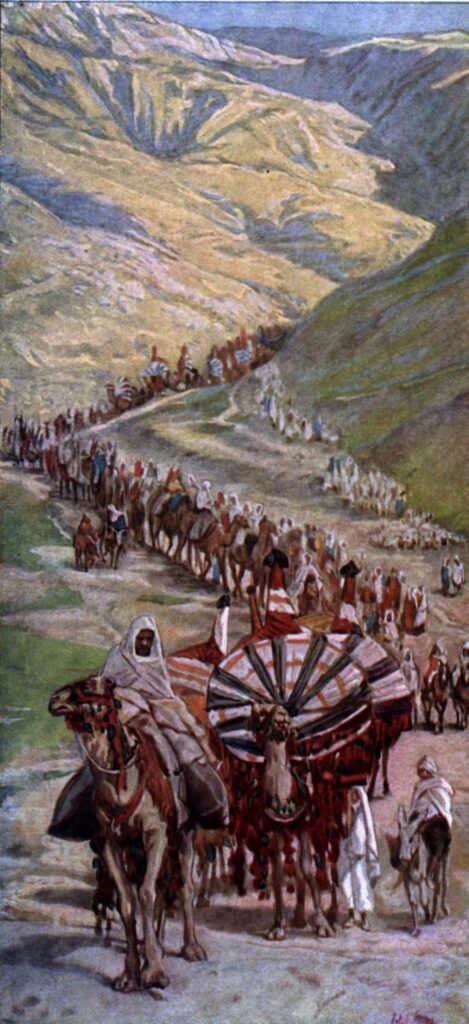
In the Book of Exodus, we read about the well known exodus of the children of Israel out of Egypt. In religious Jewish thought, this event is referred to as “the first redemption.” Interestingly and unbeknownst to most Christians, there is another exodus involving YHVH’s people that will occur at the end of the present age and the beginning of the next age. The ancient Jewish sages refer to this event as “the final redemption.” This is because numerous biblical prophecies speak of this final redemption, which we colloquially refer to here as “the second exodus.” When will this second exodus occur, who does it involve and what do these people leave and where to they go? That will be subject of the discussion below.
Israel’s first Exodus from Egypt
The concept of the Messianic Era in Hebraic thought involves an understanding of both the first and final redemptions, which are two separate events separated by thousands of years. The first redemption or first exodus occurred when the Israelites obeyed the Word of Elohim, and placed the blood of the lamb on the door posts of their homes resulting in YHVH delivering them out of Egypt. It is understood by biblically literate saints that Israel’s exodus from Egypt was prototypical of one’s placing their faith in Yeshua (the Lamb of Elohim) who redeems them from sin’s death grip through his shed blood at the cross, and then leads them out of their spiritual Egypt of sin and worldliness toward the promised land of a new spiritual life in Lord and Savior.
By contrast, the final redemption or second exodus is a series of events that will occur at the end of the age prior to the second coming of Messiah Yeshua at the beginning of the Messianic Era (or Millennium).
For those who have placed saving faith in Yeshua the Messiah, at the final redemption, these redeemed believers will receive their spiritual or glorified bodies at the resurrection of the dead, which occurs at the second coming of Yeshua. After that, they will rule and reign with Yeshua for a thousand years during the Messianic Era.
Now let’s explore several of the notable Bible prophecies that pertain to this long-awaited and glorious second exodus. This will yield us more clues as to the timing of the return of YHVH scattered, redeemed Israelites back to the land of Israel in fulfillment of numerous Bible prophecies.
Isaiah 11:10–12:6
Although consisting of only two chapters, this passage of the Scriptures is part of the same prophecy and speaks about the coming of Messiah, and the regathering of the outcasts of Israel from the nations to which they have been scattered. Below is a list of the salient points that pertain to the second exodus along with my commentary.
Isaiah 11:10, The root of Jesse (i.e., Yeshua the Messiah) will be an ensign or banner to the Gentiles of the nations. We know that Yeshua was that root or offspring of Jesse (King David’s father) who commanded his followers to preach the gospel to the Gentile world. The gospel has gone to the entire Gentile world only in the 20th century via the means of modern travel and mass communications.
Isaiah 11:11, The prophet, here, is referring to another group of people—a remnant of his people (the outcasts of Israel, verse 12) including both Jews (verse 12) and Ephraimites (verse 13, referring to the northern ten tribes of Israel) as opposed to the larger group of Gentile believers from among the nations (who have heard the gospel message) referred to in verse 10. YHVH will recover his people—the remnant of Israel—the second time (i.e., the second exodus) from all lands including the islands of the sea (North and South America, England, Australia, Japan, etc.).
Isaiah 11:12, YHVH will set up an ensign or banner for the nations and shall assemble the outcasts of Israel and the dispersed of Judah. Yeshua is that banner. Even though Yeshua is the ensign for the Gentiles of the nations and for the remnant outcast of Israel who are scattered among the nations, only the outcasts of Israel will be regathered along with the dispersed of Judah.
Isaiah 11:13, It is among this remnant group of scattered redeemed Israelites and dispersed redeemed Jews that peace between the two groups will occur. How may we ask are these two previously antagonistic groups brought together? This can only occur through a common adherence to Torah and a belief in Yeshua the Jewish Messiah through whom both Jews and Gentiles are merged spiritually to become “the one new man” (Eph 2:11–19). At the same time, the adversaries of Judah and Ephraim (the Edomite–Philistines or Moslems and their Islamo-fascist terrorist axis of evil comrades) will be cut off.
Isaiah 11:14–15, Together, Judah and Ephraim will defeat Edom, the Philistines of the West Bank and Gaza along with Moab. (Note that all these enemies of Israel are Moslem nations! Compare this with the prophecies of Obad 18 and Zech 9:13.) Perhaps there are two groups of Jews (from the tribe of Judah) and Ephraimites: the remnant and the greater group. It appears that greater or national (secular) Judah and national (secular) Ephraim will defeat Edom, as it seems less likely that a remnant of Yeshua-followers (the end times Torah-observant saints) will be the ones to do this.
Isaiah 11:16, The scene switches back to the remnant again where a highway will be formed for YHVH’s people to return to Israel from Assyria (the ancient, original nation of their captivity). This second exodus will be similar to Israel’s leaving Egypt the first time. As YHVH led ancient Israel through the wilderness en route to the Promised Land, he will do the same in the last days when Israel will return to the land of Israel from the nations worldwide to which these people eventually wandered in exile.
Isaiah 12:1–12, This chapter describe a millennial setting which occurs after the second coming of Yeshua the Messiah. For example, verse three is understood in Hebraic thought to be a reference to Hoshana Rabbah, the last great day of the fall biblical Feast of Tabernacles (or Chag haSukkot), which is a prophetic picture of the Millennium when the Spirit of YHVH will be poured out upon the earth.
Now let’s note Isaiah 11:10–12:6 in the broader context of the chapters following this passage. There is additional understanding to be found as to the timing of Ephraim’s return to the land (which the ancient Jewish sages call “the Final Redemption” and we refer to as “the Second Exodus” by examining the event foretold therein.
Isaiah13:6, 9, 13 speak of the day of YHVH’s wrath, which occurs at the end of the age when YHVH will judge the nations as described in the seven bowl judgments of Revelation 15 and 16. The wrath in Isaiah 13 is directed at Babylon, and in Revelation 15 and 16 YHVH’s wrath is toward the nations of the world that come under the economic-political-spiritual biblical label of “Babylon the Great,” which is a greater, world-ruling version of the original Babylon. Because of the proximity of Isaiah chapter 11 describing the second exodus to Isaiah chapter 13 prophesying the fall of Babylon, it would appear that these two events are related.
Isaiah 14, After this, chapter 14 goes on to talk about the fall of the king of Babylon in verses 13 through 20, and then curiously links this to Lucifer’s (Satan’s) rebellion against YHVH and his fall from glory and his eventually being cast into a pit (verse 15). The Book of Revelation speaks of similar events—Satan’s fall from heaven (Rev 12:7–9), Babylon the Great’s destruction (Rev 18), and Satan’s being cast into the bottomless pit (Rev 20:1–3). Are Isaiah and John’s prophecies speaking about the same events that are to occur at the end of the age, and to YHVH’s end times judgment of Babylon the Great with Satan the devil as its head (see Rev 13, 18, 19 and 20)? This could be the case. In time, as end time prophecies come to pass, we will know for sure.
Isaiah chapters 14 through 20 then goes on to prophecy another judgment against the king of Babylon, then a judgment against the Assyrians, Philistines (Isa 14), Moab (Isa 16) and Syria (Isa 17) and America—a land beyond and due west of Ethiopia that is accessible only by ocean ships (Isa 18), and, finally, judgment upon Egypt (Isa 19–20).
Isaiah 21 then revisits the fall of Babylon where in verse nine the phrase “Babylon is fallen, is fallen” is repeated as if to say that Babylon fell once, but that it will fall again in the end times. Most people are familiar with this phrase from John’s Book of Revelation (Rev 18:2), but are unaware that John is actually quoting Isaiah. It is as if John is calling our attention to Isaiah’s prophecy as a corollary antecedent statement that relates to his own prophecy.
Isaiah chapters 21, 23, 24 then go on to pronounce judgment against Edom and Arabia, against Phoenicia (Isa 23) and then against the whole earth (Isa 24). Could these prophecies of Isaiah be what John is seeing in Revelation when he describes YHVH’s bowl judgments against the whole earth just prior to the return of Yeshua (Rev 15 and 16), which John refers to as the wrath of Elohim (Rev 14:19; 15:1,7; 16:2,19)? In the chronology of the Book of Revelation, the fall of Babylon the Great occurs after the bowl judgments of the wrath of Elohim are poured out upon the whole earth. After this, Yeshua returns to this earth with his heavenly army to bring final judgment upon the armies that have gathered at Armageddon (Rev 19 and Jude 14–15). At this time, Satan and his Antichrist confederacy, who dared to exalt themselves against YHVH and his Anointed One, will be dashed to pieces and destroyed for good (Ps 2:1–12; Rev 19:11–21; 20:1–3)!
So we see from this series of passages additional clues as to the timing of the second exodus and the return of Ephraim to the land of Israel. As the first exodus of Israel from Egypt occurred in conjunction with Egypt’s judgment and demise, so it appears that similar events will surround the second exodus. YHVH will judge all the nations which are part of end times Babylon the Great as well as the devil, who is the instigator of man’s rebellion against YHVH-Yeshua, andthen the dispersed captives of Israel (both Jews and Ephraimite Christians will be set free to return to her promised inheritance.
Perhaps this whirlwind tour of all these prophecies is bit overwhelming, and this analysis may seem to be too broad and speculative. But before jumping to any conclusions one way or the other, let’s continue to examine other biblical prophecies on this subject to determine if a pattern of events will begin to take shape that will shed light on the timing of the return of the saints to the land of Israel as the Bible predicts. After you begin to see how the pieces of the puzzle fit together to form the whole picture, you will be in a better position to determine if there is enough evidence from the whole counsel of the Scriptures to support what I am proposing. As the Scriptures say, “Despise not prophesyings. Prove all things, hold fast that which is good” (1 Thess 5:20–21).
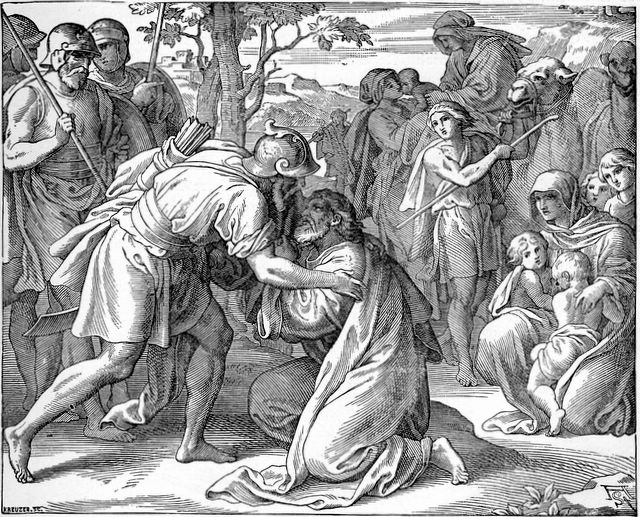
The conflict between the Jews (and Christians) and the Arabs has ancient roots. In Genesis 32, Esau (the father of many of the modern Palestinians) and his army stood in the way preventing Jacob (the father of Jews and Israelites) and his descendants from returning to their homeland—the land YHVH had promised to them. This historical event is prophetic of what will happen in the end times as the Jews and the rest of the Israelites endeavor to receive their promised inheritance and the kingdom of Elohim.
Not only that, YHVH used Esau to test Jacob, who had grown overly self-confident due to his business acumen, wealth and his ability to produce a large family clan. In the ancient world and in a tribal sense, he had reached the pinnacle of wealth and power. However, what mattered to YHVH more than these things was the character of a man. Would Jacob have faith in his Creator, or would he trust in his own abilities to outwit his adversaries and come out on top as he had done twice previously with his brother Esau and Uncle Laban? Jacob’s confrontation with his brother at the threshold of the land of Israel and his wrestling with the Messenger from heaven were the two tests that he had to pass. The Bible calls this Jacob’s Trouble and prophesies that something similar will occur in the end times to Jacob’s descendants(Jer 30:7).
As we read in Genesis 32, Jacob divided his wives and children into two camps (Gen 32:1, 7). This was prophetic of what would eventually occur to the nation of Israel after the death of King Solomon. The one nation of Israel became two houses or kingdoms—the Northern Kingdom of Israel (Judah) and the Southern Kingdom of Israel (or the northern ten tribes). The descendants of these two kingdoms are presently—loosely speaking—the Jews and the Christians (we have discussed and proven this point biblically elsewhere). But who are the descendants of Esau historically and, more importantly, today, and why is it important to know?
Many, if not most of the modern Moslems (especially the Arabs) trace their lineage back if not biologically then spiritually to Ishmael, the son of Abraham by Hagar. Islam in its religious book, the Koran, claims that it was Abraham and Ishmael who founded the religion of Islam and built the Kaaba, which is the small building containing a stone that supposedly fell from heaven. This shrine is located in the midst of great mosque in Mecca, Saudi Arabia. Of Ishmael and his descendants, the Bible prophesies in Genesis 16:11–12,
The angel of YHVH said to her further, “Behold, you are with child, and you shall bear a son; and you shall call his name Ishmael, because YHVH has given heed to your affliction. And he will be a wild donkey of a man, his hand will be against everyone, and everyone’s hand will be against him; and he will live to the east of all his brothers.”
The Koran has further twisted the biblical account to declare that the patriarchs (i.e., Abraham, Isaac and Jacob) were actually Muslims, and that Abraham gave the birthright blessing to Ishmael instead of Isaac. Both Israelites and Arabs, therefore, believe that they have a right to the Promised Land of Canaan, and, hence, this disagreement is at the roots of the modern Arab-Israeli conflict.
The Scriptures further record that Esau (or Edom), the disinherited son of Isaac, also had ought against his brother Jacob, who, in a sense, stole the birthright promise from him. Furthermore, Esau married the daughter of Ishmael (Gen 28:9). Thus, some of Ishmael’s and Esau’s descendants merged becoming a people-group, who continued the jealous feud with the sons of Jacob or Israel.
The Bible has more to say prophetically about the descendants of Esau, who scripturally are referred to as Edom (Esau’s nickname) than about those of Ishmael. Edom is portrayed as an aggressive and bloodthirsty people, who are opposed to Israel at every step. We will discover what the Scripture have to say about this below.
In the mean time, let’s take a closer look at Edom.
Esau and Edom (meaning “red”) are synonymous (see Gen 25:25, 30; 36:1, 8–9, 19, 43).
Esau intermarried with the descendants of Ishmael (Gen 28:9).
Seir is another name for the land of Edom (Gen 32:3; 33:16; 36:8).
Esau intermarried with the people of Canaan (Gen 36:2), the Hittites, the Hivites, as well as the Ishmaelites.
His descendants included the Amalekites (Gen 36:12, 16), who fought against the children of Israel upon leaving Egypt and as soon as they had entered the wilderness en route to the Promised Land (Exod 17:1).
Esau’s sons were dukes or chieftains (or leaders of clans) and became kings (Gen 36:15–16, 40–43).
Although Esau’s direct lineage was confined to the area of the traditional land of Edom, it is clear from the biblical record that he and his descendants intermarried with many of the neighboring nations, so that his descendants were scattered far and wide over the region that later became known as the Holy Land.
The entire one-chapter Book of Obadiahis a prophecy against Edom. Let’s note several key points in Obadiah’s prophecy that give us insights who the modern descendants of Edom are in light of end-time Bible prophecy. This will in turn help us to understand end-time world politics and give us a further clue to identifying America in prophecy. Let’s analyze some key verses in Obadiah in light of end-time events.
Verse 2, The descendants of Edom are greatly despised (scorned, held in contempt, disdained).
Verse 3, They dwell in the clefts (places of concealment, retreats) of the rocks. They are proud and view themselves as invincible.
Verse 4, YHVH promises to bring Edom down.
Verse 7, Edom has a confederacy (league, alliance) of nations, which include many of the modern Moslem and Arab nations.
Verse 11, Edom’s eyes are on Jerusalem. Edom along with his foreign allies will cast lots for Jerusalem (seek to divide it among the nations/religions of the world as an international city under the control of the United Nations?).
Verse 13, Edom has entered into the gates of the land of Israel in the day of her calamity or disaster.
Verse 14, Edom will kill Jewish refugees trying to escape the land of Israel in her time of distress.
Verse 15, The time frame of the fulfillment of these prophecies is “near” the day of YHVH, when he will judge Edom and the other heathen nations that have come against his people.
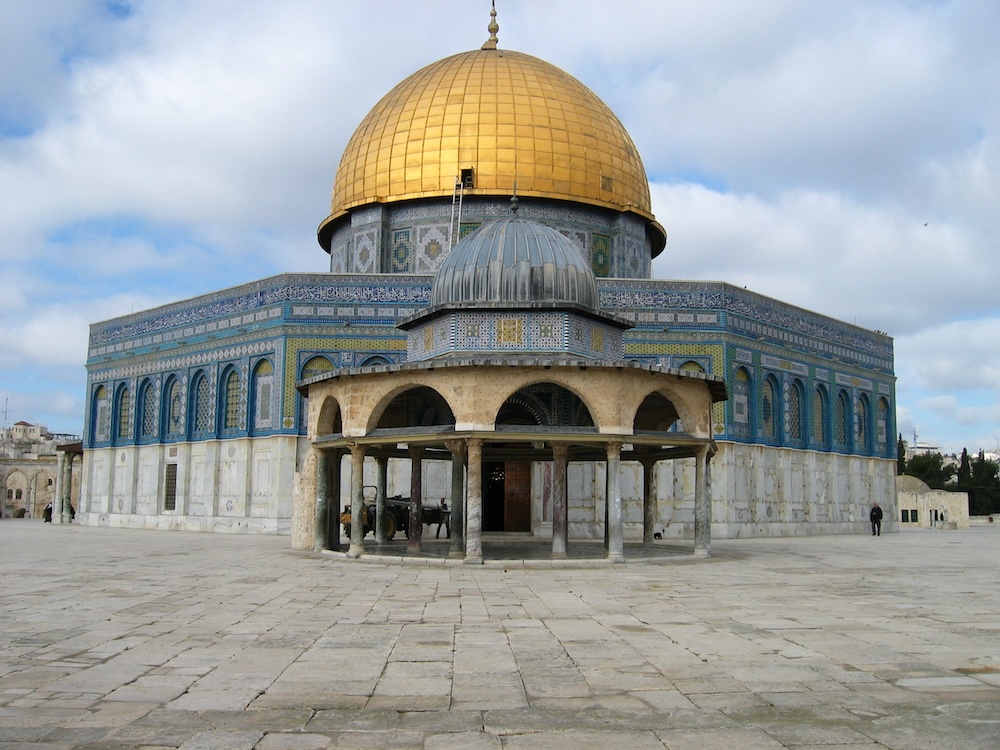
Verse 16, Edom will be drinking (celebrating?) on the Temple Mount or YHVH’s “holy mountain,” and, as a result, they shall drink the cup of YHVH’s wrath.
Verse 17, The house of Jacob will eventually retake possession of the Temple Mount.
How many descriptions of the modern Palestinian and other Islamic terrorists do we see in prophecies of Obadiah? What other people-group fits this description? Is Edom not a picture of many modern-day Palestinians and their Moslem backers who hate the Jews, the state or nation of Israel and America as well as Christians and Jews in general?
Elsewhere have discussed who Jacob represents in end-time Bible prophecy. Now we are discovering from the Scriptures who the arch-enemy of Jacob’s biological and spiritual descendants will be, and who will attempt to prevent them from returning to the land of Israel. This will happen in the end times before the coming of the Messiah. (I discuss this issue in more detail in my commentary on Genesis chapter 32 about “Jacob’s Trouble” as he encountered Esau when returning to the land of Canaan.)
Edom Has a Perpetual Hatred for Jacob (Judah and Ephraim)
As we have noted, Edom’s hatred for Israel has its roots in the antagonism between Ishmael and Isaac, and then afterwards between Esau and Jacob. The hatred that Esau had for Israel has been passed on down to successive generations of Edomites to modern times. The biblical prophets discusses this murderous antagonism on Edom’s part as being carried down generation to generation to the very end times. Let’s review some of these biblical prophecies.
Ezekiel 36 speaks about the conflict between end-times Edom and end-times Israel. In verse two, we see that the enemies of Israel have regarded the “ancient high [or declared, promised] places” of Israel as “ours in possession.” This is a clear reference to the holy places in Israel (e.g., the Temple Mount for the Jews and Bethlehem for the Christians—only in recent years have the Palestinians taken Bethlehem and forced—out of persecution and intimidation—the majority of the large Christian population of that city to leave). “High places” can also refer to the militarily strategic high places such as the Golan Heights, Mount Hermon and the ridges surrounding the eastern shores of the Sea of Galilee.
Next, let’s look at Ezekiel 35, which is another prophecy against Edom. In verses four through five, we see that end-times Edom will be devastated because of its perpetual hatred for the children of Israel. They have killed their enemies by the power of the sword. This is how Islam has traditionally spread—by the curved scimitar sword. Advancing Moslem armies force its captives to leave, covert or die. According to Ezekiel 35:5, this will be occurring during the time of the punishment (of the children of Israel?) at the time of the end (NAS) or the end of time (lit. Hebrew). This is another example of YHVH’s using Edom (Esau) to bring Ephraim and Judah to its knees in the time of the end.
The phrase “Jacob’s trouble” is a curious code term found buried deep in the prophetic writings of the ancient Jewish prophet Jeremiah who lived in the sixth century BC. Many Bible commentators have recognized that this phrase has end time prophetic implications and have attempted to decode this perplexing prophecy. Many have offered novel explanations as to its meaning. But most have fallen short. Why is this? Because unless one takes into consideration the greater contextual backdrop of this phrase, any explanation will wildly miss the target. Once the veil of mystery is lifted, this prophecy along with its Genesis 32 historical context, suddenly opens a huge panoramic window of understanding that explains the current conflict in the Middle East between the Jews and the Muslims, between the country of Israel and its surrounding neighbors as well as the tension between Islam and Christianity, plus explosive eruption of the current rise of anti-Semitism and anti-Israel sentiments worldwide.
Moreover, a failure to understand the meaning of “Jacob’s trouble” explains the current animus in some of the most unexpected places including among some so-called contemporary American Christian social media influencers and news commentators such as Tucker Carlson, Candace Owens and Nick Fuentes to name a few. If these misguided and uninformed media personalities were to understand the true biblical end time implications of Jacob’s trouble, they en masse would be stunned into silence, put a hand over their mouths, and immediately shut off their microphones for a long moment of reflection and repentance. They would quickly realize that they are on the wrong side of history, the truth and YHVH Elohim, the God of the Bible. In fact, they are taking the position of the spirit of antichrist! This may seem like a wild assertion on the part of this author, but once the facts are revealed, the pieces of the puzzle will suddenly and easily fall into a place and a huge picture of undeniable truth will form and the silly, childish babbling of the foolish Israel-haters will be once and for all silenced.
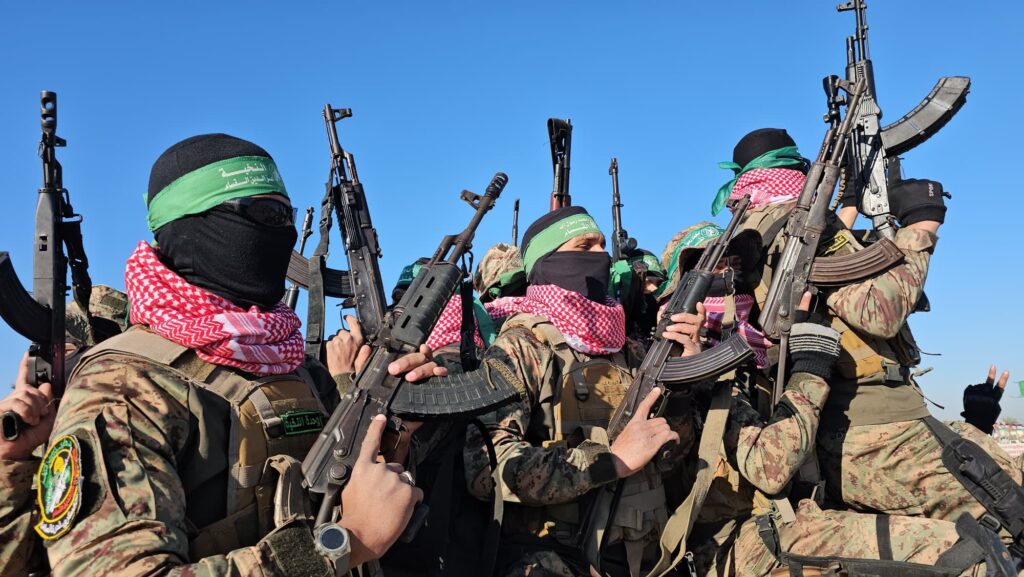
Woe be to anyone who finds themselves on the side of the enemies of the God of Israel. The Pharaoh of Egypt, the Babylonians, the Persians, the Greeks, the Romans, the Muslims, the Catholic Church, the Russian Tsar, the British Empire, Hitler, the Palestinian Authority, the Muslim Brotherhood, the United Nations, the International Criminal Court, Hamas, Hezbollah, Iran, Yemen and many more have attempted or are attempting in vain to squelch or even extinguish Jacob’s descendents from fulfilling their God-mandated Abrahamic Covenantal promises in one way or the other, and all have failed and are to this day still failing.
Now let’s learn what the phrase “Jacob’s trouble” means, and may the veil of ignorance be lifted and the scales fall off the eyes of the unbelievers and skeptics, and may the God of Abraham, Isaac and Jacob and their descendants along with the timeless truth of the Bible be vindicated(!)—sadly as if this should even be necessary.
“Jacob’s Trouble”—His Dark Night of the Soul in End Times Prophecy and YOU!
Jacob meeting Esau
You have probably heard the saying that the night is the darkest just before the dawn. Metaphorically speaking, when circumstances conspire against you and the outcome looks the bleakest, that is often when the rays of hope begin to shine through the darkest darkness and the outcome suddenly reveals itself. A way forward unexpectedly manifests itself out of the obscure gloom of apparent defeat and hopelessness. People of faith can more easily relate to such a scenario. This was exactly the place in which the patriarch Jacob found himself when returning to the land of Canaan—the future Promised Land. He had reached the pinnacles of success in his earthly endeavors, and now circumstances beyond his control in front of and behind him were conspiring to take everything away including his very life This is not only the story of his life, but each of us has likely found ourselves in similar spots as well. Deliverance and victory often emerge out of the darkest and bleakest periods of life. This is a test of our faith that, if we are to progress to the next level in our spiritual growth, we must pass.
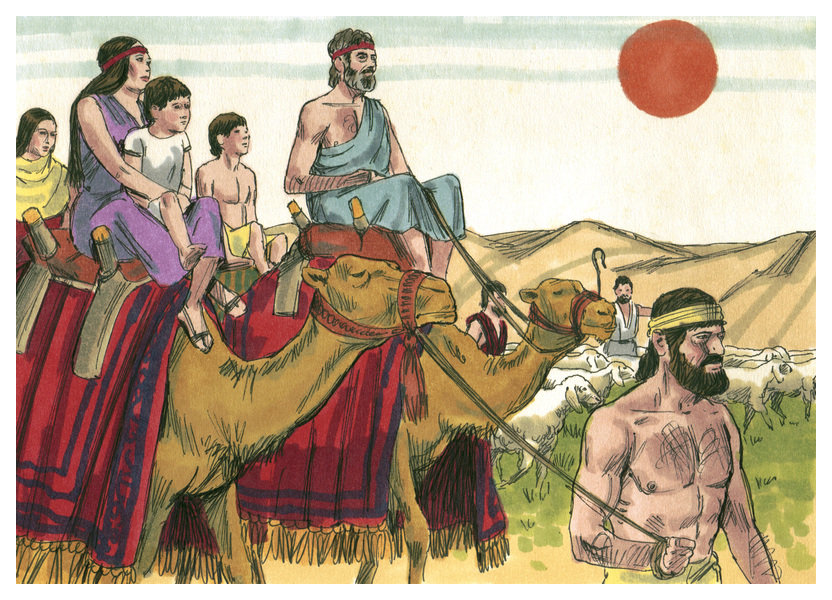
Genesis 32 is the story of Jacob’s return to Canaan after having been exiled from his homeland for 20 years. His exile occurred after he obtained his divinely promised birthright through shrewd and somewhat unscrupulous means from his brother Esau resulting in his having to flee Canaan for fear of his life due to his brothers desire lust for vengeance. Jacob took refuge in the region of Babylonia at his Uncle Laban’s home, where he married Laban’s two daughters, Leah and Rachel. After twenty years working for the greedy and treacherous Laban, Jacob had to flee Babylon with is father-in-law in angry pursuit. As if that were not enough, while Jacob and his family were returning to Canaan, they encountered Jacob’s angry brother Esau who was still angry two decades later of being cheated out of his inheritance. Esau along with a small army not only stood in Jacob’s way from entering the land of his promised inheritance, but also wanted to kill Jacob.
This account of Jacob’s personal, spiritual struggles also has prophetic, end times implications relating to the regathering out of exile of the twelve tribes of Israel (the Jews and the Christians) and their return to the Promised Land in Israel under Yeshua the Messiah at his second coming. The Scriptures refer to this time period as “Jacob’s Trouble.” This Bible verse is found in Jeremiah where we read,
Alas! For that day is great, so that none is like it; and it is the time of Jacob’s trouble, but he shall be saved out of it. (Jer 30:7)
The ancient Jewish sages believe that the encounter between Jacob and Esau (no doubt informed by Jeremiah’s prophecy) is prophetic in nature and will happen again in the end times, but this time on a much larger scale involving the numerous descendants of both Israel (or Jacob) and Esau (also called Edom). That is to say, the Israelites of the end times will be attempting to return to their ancestral homeland, while the modern descendants of Esau (the forces of Antichrist as represented by the antichrist religion of Islam and their Elohim-hating allies) will be blocking their way. As we proceed in this study, we will see whether this prophecy is beginning to come to pass in these last days.
Relating to Jacob’s descendants coming into the Promised Land, the ancient Jewish sages speak of two major redemptions in Israel’s long history. The first redemption occurred when YHVH delivered the oppressed and enslaved children of Israel out of Egypt at the exodus. History will then repeat itself in what the Jewish sages refer to as “the second or final redemption,” which will occur at the end of this present era when the Messiah will regather and then lead his exiled and scattered Israelite people back to the Promised Land in fulfillment of numerous biblical prophecies.
Rolling the time line backwards a little in the present story of Jacob, not only had Laban chased his son-in-law out of the area of Babylon, but Jacob was also being blocked from entering Canaan by his murderous brother Esau (or Edom). This is reminiscent of Pharaoh pursuing the Israelites as they were exodusing Egypt only to find their escape route blocked by the Red Sea. Pharaoh was the first Edom, if you will, or, stated otherwise, Edom is the second Pharaoh. In both instances, YHVH’s people were or will be forced to rely totally on him for deliverance from their enemies who were both in front of and behind them.
Initially, Jacob dealt with his crisis in a typically human way—by scheming and conniving “to save his own skin,” so to speak, instead of having faith in YHVH “to work things out.” He figured that by bribing his angry and bloodthirsty brother with wave after wave of gifts, he might appease and assuage Esau’s desire for murderous revenge (Gen 32:13–20).
Yet Jacob’s bifurcated response to this present danger by resorting to both appeasement and prayer was not acceptable to YHVH, who wanted Jacob to be a man of unmitigated faith, that is, to solely trust in him. Or as Job put it, though you slay me, yet will I trust you (Job 13:15).To bring Jacob to this point, a part of Jacob had to die: his prideful self-reliance and his inclination toward extricating himself from difficult situations through his own cunning ingenuity. This innate tendency of his, not unlike our own, was based on fear of death, and not on faith in YHVH. The Bible tells us that where there is fear, there is no love (1 John 4:18), and that YHVH has not given his people a spirit of fear, but of love, power and a sound mind (2 Tim 1:7). For Jacob to mature spiritually, YHVH wanted him to leave the fear and faithless aspect of his human nature on the east side of the Jordan where Babylon (a spiritual metaphor for the old carnal and sinful man and the ungodly ways of this world) was located. In its place, a faith-filled man who would totally trust YHVH in all things had to rise up. Jacob could no longer trust in his soul man (i.e., his mind, will and emotions) to determine his actions; rather, he had to rely on the Spirit of Elohim to lead him as it informed his inner man or personal spirit, which would, in turn, lead his soul forward in the walk of faith. Only a man of faith, who is mighty in the Spirit and obedient to YHVH, will be deemed worthy to enter the Promised Land (see Ezek 20:33–38, especially note vv. 37–38). The children of Israel learned this lesson the hard way too. The carcasses of older generation that lacked faith in and obedience to YHVH littered the wilderness en route to the Promised Land.
For indeed the gospel was preached to us as well as to them; but the word which they heard did not profit them, not being mixed with faith in those who heard it…Since therefore it remains that some must enter it, and those to whom it was first preached did not enter because of disobedience…(Heb 4:2, 6)
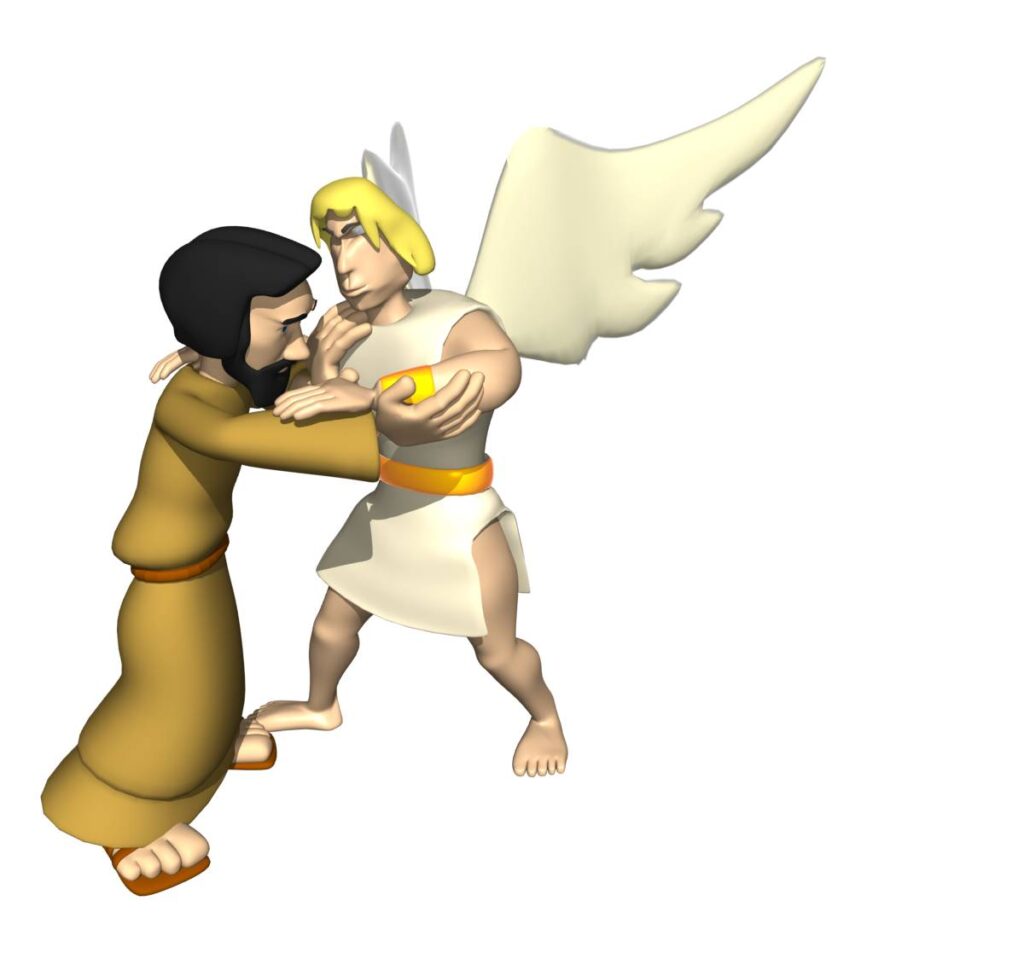
Like Jacob’s descendants later learned, he too had to discover that his old man, who lacked faith, had to die just before entering the Promised Land. But this was a difficult process. This is because Jacob had to come to grips with his own limitations and overcome the ugly side of his innate human nature that was directed by his mind, will and emotions and not by the Spirit of Elohim. This internal battle between the soul and the spirit occurred during a “dark-night-of-the-soul-encounter” when Jacob wrestled all night with the Messenger of Elohim (Gen 32:22–32).
The result was that in this struggle Jacob became permanently lame in his hip (Gen 32:32). He became physically injured, but more importantly, he became humbled in his heart. His soul man (i.e., his mind, will and emotions) became subservient to his spirit man (under the leading of the Spirit of Elohim). Out of his wrestling match, he gained a new identity, a new heart and a new name. Jacob the “heal catcher” became Israel “the prince of El [God]” or “the prevailer with El.” By wrestling with and overcoming his own soulish or carnal limitations, that is, his own pride, self-reliance on his mind to figure things out instead of trusting Elohim by walking in the faith and in the Spirit, he became a broken and changed man. By trusting in YHVH, he became a vessel that the Creator could use to further his plan of redemption as promised to Abraham, the father of our faith, for it was through Jacob that the birth of birth the nation of Israel was to occur.
Through events leading up to Jacob’s dark night of the soul, he learned a vital spiritual lesson: his carnal attempts at appeasing Esau gained him nothing except a slimmer net worth via the loss of material possessions. On the other hand, his wrestling with and surrendering to the Messenger of Elohim—who was, in reality, the preincarnate Yeshua—gained him and his descendants not only a nation and the Promised Land, but ultimately the whole world, through Yeshua the Messiah, and a place in YHVH’s eternal kingdom.
Interestingly and as part of a larger picture that would latter play out prophetically in the Bible’s pages, as a gambit to save his own skin from his vengeful brother, Jacob divided his family into two camps in the hopes that if Esau killed one group, the other would survive and vice versa. This was another one of his schemes that failed to work, but which has tremendous end-time prophetic implications. Genesis 32:2 records that Jacob called the name of the place where he split his family into two camps Mahanaim, which is a Hebrew word meaning “two camps” and is the plural of the root word machanah meaning “encampment, camp, camp of armed host, army camp, company or body of people.”This spot is near the River Jabok, which is a tributary to the Jordan River and is located on the east side of that river in the modern country of Jordan.During the time of the nation of ancient Israel, it was located in the Gilead region on either the border between Gad and Reuben or Gad and Ephraim. The Song of Solomon makes reference to mahanaim in chapter 6:13 where we read,
Return, return, O Shulamite; return, return, that we may look upon you. What will you see in the Shulamite? As it were the company [Heb. m’kolah] of two armies [Heb. mahanah].
The Hebrew word m’kolah means “dance.” I see a correlation between Song 6:13 and Genesis 32:2, since mahanaim in Genesis and machneh or “two armies” in the Song of Solomon are the same word; the former is the plural and the latter is the root word.
What is the prophetic connection between these two biblical passages? It appears that Genesis 32 is a prophetic shadow-picture of just how Jacob’s descendants will come back into the land of their inheritance prior to Yeshua’s return. This prophetic scenario is confirmed in the Jeremiah 30:7—the Jacob’s trouble prophecy. In Jeremiah’s prophecy, the context is Jacob’s end time descendants (i.e., the Christians and the Jews) returning from their captivity and exile in the nations of the world.
“For behold, the days are coming,” says YHVH, “that I will bring back from captivity My people Israel [the house of Israel who would become the Christians] and Judah [the Jews],” says YHVH. “And I will cause them to return to the land that I gave to their fathers, and they shall possess it…Alas! For that day is great, so that none is like it; and it is the time of Jacob’s trouble, but he shall be saved out of it. For it shall come to pass in that day,” says YHVH of hosts, “That I will break his yoke from your neck, and will burst your bonds; foreigners shall no more enslave them. But they shall serve YHVH their Elohim, and David their king, whom I will raise up for them. (Jer 30:3, 7–10)
Obviously, this prophecy along with a resurrected King David to rule over a regathered and reunited Israel (i.e., Christians and Jews) hasn’t occurred yet. This will happen at Yeshua the Messiah’s second coming. The corollary to this prophetic passage is Ezekiel’s Two Sticks Prophecy where, again in the end times, the two camps or houses of Israel are regathered and reunited with King David ruling over them in the sight of the Messiah (Ezek 37:13–27).
Why has Islam been in a perpetual, murderous war against Jews and Christians since its founding in the sixth century AD? Actually, this conflict is a spiritual one going back to the biblical patriarchs, and, on the larger scale, goes back to the snake in the tree in the Garden of Eden as this video reveals. The key to understanding the present conflict between these religious and ethnic groups involves understanding the past cycles of history and why Islam is intent on conquering the Christian West and the present Jewish state or nation of Israel.
This and other videos by Nathan are available as podcasts on Spotify and Apple podcast under “Hoshana Rabbah.”
If this message has been a blessing to you, please consider showing your appreciation by making a donation to Hoshana Rabbah at http://hoshanarabbah.org/blog/. Thank you!
How does the Bible define the spirit of Antichrist? What religion on earth today fits the strictest definition of the spirit of Antichrist? Who are the fellow travelers who have aligned themselves with this demonic spirit? Why are Christians, Jews, the Bible and the land of Israel the targets of this evil spirit? Why do you need to know about this and what can you do about it? All of these questions and much more are discussed and answered in this video from a biblical perspective.
This and other videos by Nathan are available as podcasts on Spotify and Apple podcast under “Hoshana Rabbah.”
If this message has been a blessing to you, please consider showing your appreciation by making a donation to Hoshana Rabbah at http://hoshanarabbah.org/blog/. Thank you!
The more we study the Bible, the more amazing it becomes! You have the written words on the physical page, but beyond that there are numerous levels of multidimensional understanding beneath those words that one discovers as one digs deeper. One example of this are Yeshua’s words and actions between Matthew chapters 16 to 25 which the Gospel writer at the prophetic allegorical level, whether he knew it at the time or not, lays out in a perfect chronological timeline of end time events that lead up to and proceed the long anticipated second coming of Yeshua the Messiah. In this video Nathan reveals and discusses these events. These are things that have been wonderfully hidden in plain sight all along to be discovered by those who know the times and season in which they are living and have eyes to see and ears to hear. Come along with us on this adventure and may your faith be strengthened!
This and other videos by Nathan are available as podcasts on Spotify and Apple podcast under “Hoshana Rabbah.”
If this message has been a blessing to you, please consider showing your appreciation by making a donation to Hoshana Rabbah at http://hoshanarabbah.org/blog/. Thank you!