Category Archives: Feasts
New Video: YHVH’s Plan of Salvation in the Seven Biblical Feasts
In this video, learn how the seven biblical feasts as outlined in Leviticus 23 are YHVH’s seven-step plan of salvation (or redemption) for mankind. They are the chronological template of the seven steps each one must take to go from being a slave to the world, flesh and the devil in the spiritual Egypt of this world to becoming a child of Elohim (God) forever in the New Jerusalem. The feasts show man how to be reconciled to our Father in heaven through Yeshua the Messiah.
Watch this video now at
YHVH’s Plan of Salvation in the Biblical Feasts
The seven biblical feasts are a chronological step-by-step template of YHVH’s plan of redemption or salvation for mankind. This process begins with Passover—a picture of a believer’s initial salvation, and concludes with the Eighth Day—a picture of eternal life for each bonafide and glorified member of the spiritual family of Elohim. The first step in this spiritual journey starts with one’s turning their back on spiritual Egypt,which is the realm of the world, the flesh and the devil, and embarking on a life-long spiritual journey that leads one progressively to higher planes with the ultimate goal being the paradise of the New Jerusalem—literally a heaven on earth.
Sadly, the church system has failed to reveal these essential truths to believers. It has robbed the saints of their biblical, Hebraic and Torah-based heritage including an understanding of the biblical feasts and has replaced it with many lies. This has left believers without a full
understanding both their spiritual heritage and destiny. For most believers caught up in the Babylonian church system, it’s merely a matter of getting saved, doing some good works along the way and going to church. Beyond that, one bides their time standing on the street corner waiting for death or the rapture bus—whichever come first—to take them to heaven. But is this all there is to the believer’s life? What is supposed to happen from the point of one’s initial salvation until they “get to heaven”? Hmm?! Now there’s a good head-scratcher for most!
Thankfully, YHVH hasn’t abandoned his spiritual children to wander aimlessly through the wilderness of life. He has a plan for each of us. Continue reading
The Feasts, Tabernacle, Man in 3D
Exodus 23:14–19, Three times you shall keep a feast. Conventional Jewish wisdom teaches us that during the three pilgrimage festivals all the individuals of the nation are to appear out of all isolations personally in the presence of the one God of Israel in the festival circle (or chag) around the common sanctuary (where YHVH has chosen to place his name, Deut 16:2,11,15), thereby becoming conscious that each one is connected to all the other members of the nation, with YHVH Elohim, and with the Torah (The Pentateuch—Deuteronomy, p. 310, by S. R. Hirsch).
But there is much more than this if we add Yeshua the Messiah of Israel into the picture. Each of the three feasts point directly to him. Passover and the Feast of Unleavened Bread, the Feast of Weeks or Pentecost, and the Feast of Tabernacles all point to Yeshua, since the first three spring feasts point to Yeshua’s first coming, while the last fall feast points to his second coming. Each of these feasts represent milestones in the spiritual walk of the redeemed believer.
But it gets better. There were three sections in the Tabernacle of Moses: the outer courtyard, the holy place and the holy of holies. These correspond with the three parts of man: body, soul and spirit (1 Thess 5:23).
The feasts of Passover and Unleavened Bread are the first two feasts we celebrate in the spring and represent the first steps in a new believer’s spiritual walk. This corresponds with the outer courtyard and relates more to the spiritual cleansing of the outer parts or body of man. It is here that one begins their spiritual walk and relationship with Yeshua, who is the Word of Elohim.
The Feast of Weeks or Pentecost is the next step one takes in their spiritual walk. The holy place speaks of bring the soul (the mind, will and emotions) into submission to the will of YHVH as one advances in their spiritual walk and learns about the fruits and gifts of the Spirit of Elohim, who they are as redeemed Israelites, and about worship and praise.
Finally, the holy of holies corresponds to the Feast of Tabernacles and the Eighth Day and the spirit part of man. This part of the tabernacle speaks more of man’s ultimate spiritual relationship with Elohim. It is here that man relates to Elohim, who is a Spirit, on a spirit to Spirit level (John 4:24; 1 Cor 2:10–13). This points to man’s ultimate destiny as glorified beings in the New Jerusalem as adopted members into the family of Elohim (John 1:12; Rom 8:14–15, 23; 9:4; 2 Cor 6:18; Gal 4:5–6; Eph 1:5; 1 John 3:1; Rev 21:7).
This is just the tip of the iceberg. I’m sure there’s much more to learn on this subject.
Why Study and Celebrate the Biblical Feasts?
If you had to sum up the entire message of the Bible in one word what would it be? Probably words such as love, hope, salvation, eternal life or heaven are coming to your mind. But I challenge you to find a better word than the following: r-e-c-o-n-c-i-l-i-a-t-i-o-n. The dictionary defines reconciliation as “to restore to friendship or harmony, to settle or resolve a quarrel, to make consistent or congruous.”
When the first humans chose to listen to the lies of the serpent and to rebel against YHVH and to give in to sin at the tree of the knowledge of good and evil at the very beginning, our first parents chose the path of separation from their Heavenly Father. Sin causes man to be separated from our totally holy, righteous, sinless and loving Creator.
Since that time YHVH has been endeavoring to reconcile man to himself. He has laid out the criteria for this to occur—for man to once again have a loving and intimate relationship with his Heavenly Father as did Adam and Eve before they sinned.
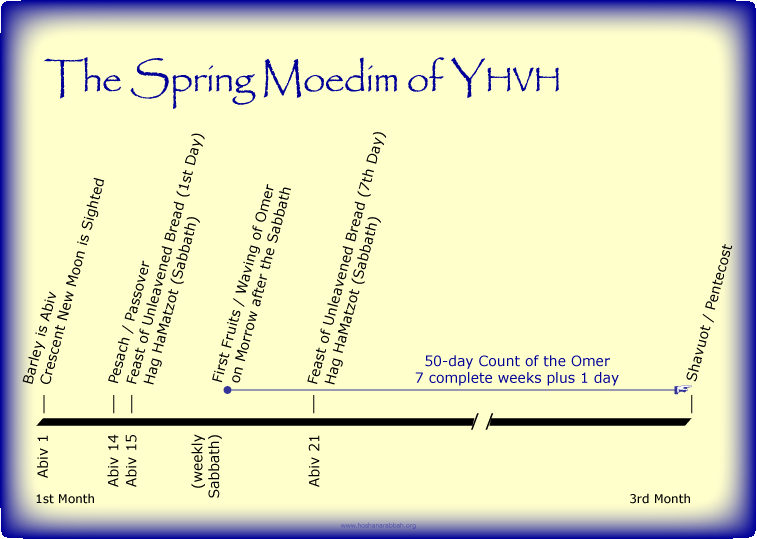
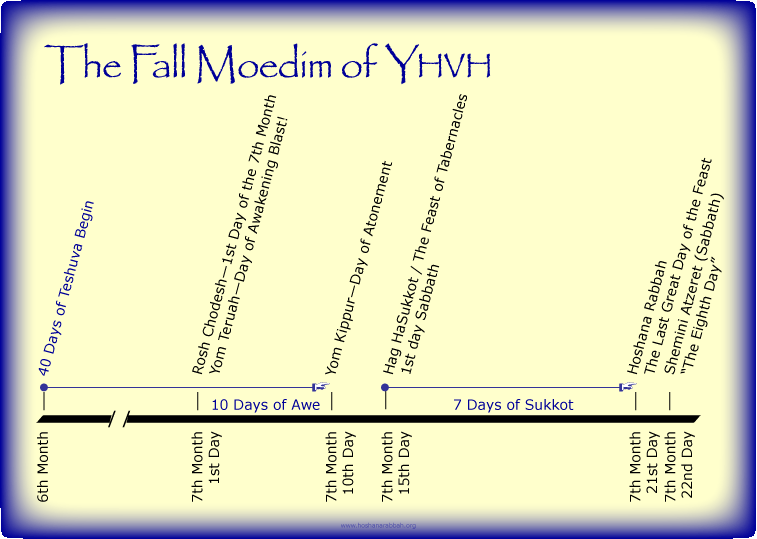
The seven biblical feasts of YHVH prophetically represent the steps man must take to be reconciled to his Heavenly Father. They are the complete plan of salvation or redemption rolled up into an easy-to-understand seven step plan. Though a child can understand these steps, the truths contained therein
When Does the Biblical New Year Start?
Exodus 12:2, Month. It is the Hebrew word chodesh (Strong’s H2320/TWOT 613b) meaning “the new moon, month, monthly, the first day of the month, the lunar month.” It is found in the Tanakh (Hebrew Scriptures or Old Testament) 276 times and is translated in the King James Version as “month” 254 times, “new moon” (20 times), and “monthly” (1 time). We see that from these definitions that the terms “month” and “new moon” are synonymous. It has been understood for millennia that ancient Israelites began their month with the new moon.
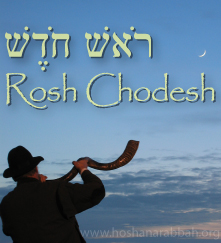
Why was it important for the Israelites to know when the new moon occurred and when the month began? The dates of the annual biblical festivals that YHVH gave to Israel and instructed them to observe were determined based on when the new moon occurred (Lev 23:5, 6, 24, 27, 34).
The next question to answer is this: when does the biblical month begin?
For modern astronomers the term “new moon” means something different than it did to the ancients, including those who YHVH inspired to write the Bible. Ancient calendars were determined by the moon, while modern ones are not. Some biblical expositors teach that the new moon begins when the moon is in conjunction or in line with the earth and the sun and is in its dark phase. Others believe that the month begins just after the moon has moved out of its dark phase and begins to show a sliver of light, which is called the visible or crescent new moon. Who is right?
Some Bible teachers claim that there is no place in the Scriptures that specifically states that the new moon begins at the first visible sliver after being dark for several days. Therefore, they reason, it is an assumption to say that it does, and therefore, the new moon should be determined from its conjunction with the earth and sun while it is in its dark phase. While on the surface, this may seem like a valid argument, one important verse in the Scriptures, however, and some simple logic quickly disproves this notion. It is Genesis 1:14.
And Elohim said, “Let there be lights in the firmament of the heaven to divide the day from the night; and let them be for signs, and for seasons [moedim/biblical festivals], and for days, and years.”
In this verse we see that the sun and the moon are “signs” for seasons, days and years. The word “sign” is the Hebrew word owt/ אות (Strong’s H226; TWOT 41a) meaning “sign, signal, mark, token, emblem, signboard, standard.” In the Tanakh, owt describes such visible (not invisible) signs as Noah’s rainbow (Gen 9:12–13, 17), Cain’s mark (Gen 4:15), circumcision (Gen 17:11), and the Sabbath (Exod 31:13, 17; Ezek 20:12). In addition, owt is used some 80 times in the Tanakh to refer to miraculous signs. These include the plagues of Egypt (Exod 7:3; Deut 4:34, etc.), the sign of the virgin birth of the Messiah (Isa 7:11, 14); YHVH miraculous signs to Gideon (Judg 6:17) and King Hezekiah (2 Kgs 20:9; Isa 38:7). In addition, Aaron’s rod that budded was a sign or token (Num 17:25). Many more examples could be given.
What do all these examples of how the Bible uses the Hebrew word owt have in common? They were all a visible sign that one could see. This is the definition of the word owt and how it is used in the Hebrew Scriptures. Simply stated, the visible sliver of the new moon fits the definition of owt as used in Genesis 1:14, while the astronomical conjunction (when the moon is in its dark phase and is invisible to the eye because the earth is between the moon and the sun) does not. Psalm 104:19 is definitive biblical proof that the moon’s purpose is to determine the biblical feasts when it says YHVH “appointed the moon for seasons [Heb. moedim, which means ‘appointed times’ or ‘biblical holidays’].” The moon cannot be a visible sign to determine seasons or biblical festivals if it is hidden or dark.
The fact that ancient Israelites determined the new moon based on the sighting with the naked eye of the moon’s sliver has been substantiated repeatedly by historians and religious scholars over the past 2000 years.

A Vision for Sukkot in 2012
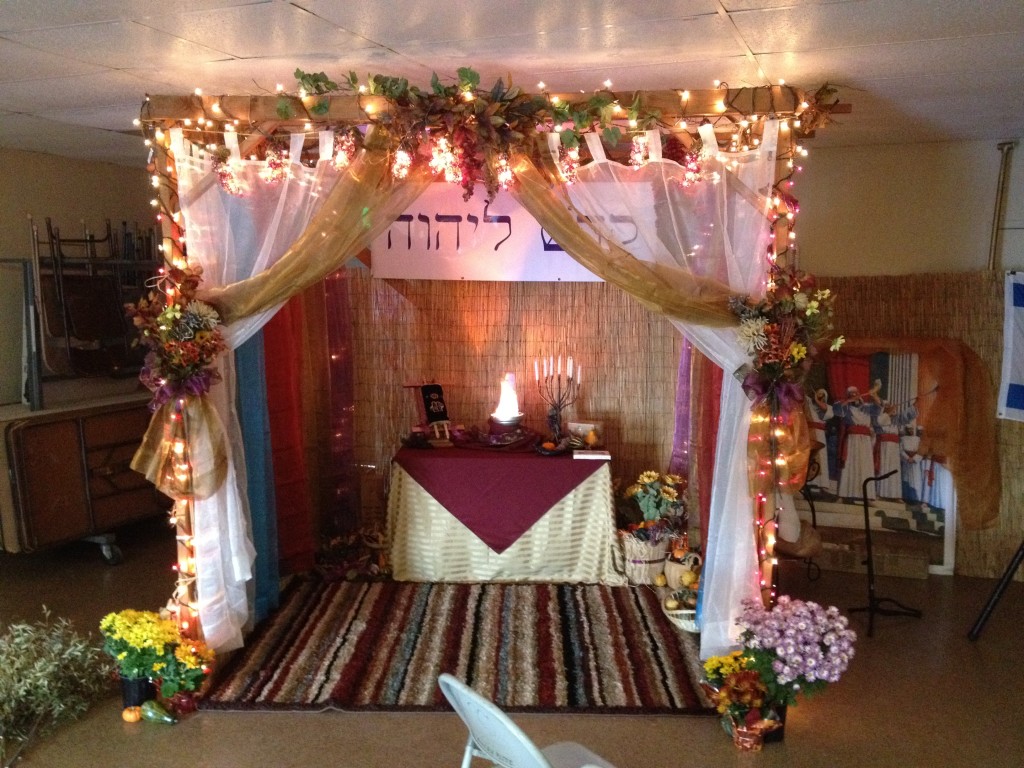
The following is Hoshana Rabbah Biblical Discipleship Resource’s vision for its Sukkot celebration it sponsors each year in Oregon. This year is our tenth anniversary. Read and be inspired…
A Prophetic Vision
Imagine it. Babylon the Great is fallen, forsaken and abandoned. Good at long last has triumphed over evil. The saints celebrate their victory over their captive demonic oppressors. Eden of the distant past is recalled while the heaven on earth of the New Jerusalem is just over the next horizon. The Creator of the universe—the King of kings—makes his abode in Jerusalem. The Bridegroom Prince of Peace kisses his princess. They live happily ever after. This is the storybook ending to 6000 years of hell on earth!
These flash images—downloaded from heaven and archived in the prophecies Ancient Holy Scriptures—are about to begin leaping off the pages of your Bible. This is the Feast of Tabernacles (or Sukkot)—a week-long biblical festival and a foretaste of the age to come (to learn more about this biblical feast, go to http://www.hoshanarabbah.org/pdfs/sukkot.pdf).
At Sukkot Northwest 2012 in LaPine, Oregon, we will not only fulfill the biblical (Torah) commands to gather together and to joyfully celebrate Sukkot, but, at the same time, come prepared to experience a foretaste of the Millennium where the saints of the Most High shows their love for their Heavenly Bridegroom and for each other by gathering at the place where YHVH has chosen to place his name (Deut 16:13–15; 12:5–7,17–21; 14:23). Yes, in his Word, YHVH commands his people to celebrate Sukkot each year—forever (Lev 23:1–2, 34-41; Deut 16:13–17). Though Sukkot is a commanded assembly (Lev 23:34–36; Deut 16:13–15), it’s more like a doting father ordering his children to indulge themselves in the best and most exciting, other-worldly vacation of their lives! How can anyone refuse such an invitation?
Knowing our Heritage Prepares Us to Receive Our Inheritance
At Sukkot Northwest 2012, we, as redeemed Israelites, will rejoice in our biblical heritage as we memorialize the wanderings of our ancestors in the wilderness en route to the Promised Land. Continue reading