How the First Fruits Day Points to Yeshua

The Day of the Wave Sheaf Offering or First Fruits Day

In Hebrew roots circles, a day has gained prominence for celebrating the resurrection of Yeshua. It is called by many, the Feast of First Fruits or simply First Fruits. In several books published by Messianic or Hebrew roots teachers, this day has been elevated to the status as one of the “feasts” of YHVH on a par with Passover, Unleavened Bread, Pentecost, Trumpets, Atonement and Tabernacles. In creating a special designation for this day—one, as we shall see later, that Scripture does not give it—most of these teachers curiously omit the last of YHVH’s seven “feasts” or miqra-ee kodesh (commanded assemblies); namely, The Eighth Day or Shemini Atzeret. This festival is a Sabbath and immediately falls after the Feast of Tabernacles. It has important spiritual significance and represents the formation of the New Heaven and New Earth and the descent of the New Jerusalem after the end of the 1000-year long Millennium on earth. It literally represents heaven-on-earth for eternity. It is, therefore, a shame to omit this most important festival of YHVH!

A field of barley grain in the land of Israel.

A field of barley grain in the land of Israel.

The Nature of the Omer Offering/Service

Does the omer offering on “Wave Sheaf Sunday” prophetically point to and foretell the death and/or resurrection of Yeshua, and if so, how? First, let us look at the scriptural passages that speak of this day.

Leviticus 23:10–17, Speak unto the children of Israel, and say unto them, When you be come into the land which I give unto you, and shall reap the harvest thereof, then you shall bring a sheaf of the first fruits [reshiyth] of your harvest unto the priest: And he shall wave the sheaf before YHVH, to be accepted for you: on the morrow after the Sabbath the priest shall wave it. And you shall offer that day when you wave the sheaf an he lamb without blemish of the first year for a burnt offering unto YHVH. And the grain offering thereof shall be two tenth deals of fine flour mingled with oil, an offering made by fire unto YHVH for a sweet savor: and the drink offering thereof shall be of wine, the fourth part of an hin. And you shall eat neither bread, nor parched corn, nor green ears, until the selfsame day that you have brought an offering unto your Elohim: it shall be a statute for ever throughout your generations in all your dwellings. And you shall count unto you from the morrow after the Sabbath, from the day that you brought the sheaf [omer] of the wave offering; seven sabbaths shall be complete: Even unto the morrow after the seventh Sabbath shall you number fifty days; and you shall offer a new meat offering unto YHVH. You shall bring out of your habitations two wave loaves of two tenth deals: they shall be of fine flour; they shall be baked with leaven; they are the first fruits [bikkurim] unto YHVH.

Leviticus 23:10b–14a, … you are to bring the premier sheaf of your harvest to the priest. He is to elevate the sheaf before the presence of YHVH, for acceptance for you; on the morrrow after the Sabbath the priest is to elevate it. You are to perform a sacrifice on the day of your elevating the sheaf: a sheep, wholly-sound, in its (first) year, as an offering-up to YHVH, and its grain-gift: two tenth-measures of flour mixed with oil, a fire-offering to YHVH, a soothing savour; and its poured-offering of wine: a fourth of a hin. Now bread, parched-grain or groats, you are not to eat, until that same day, until you have brought the near-offering of our Elohim… (The Shocken Bible)

Leviticus 2:12–16, As for the offering of the first fruits, you shall offer them to YHVH, but they shall not be burned on the altar for a sweet aroma. And every offering of your grain offering you shall season with salt; you shall not allow the salt of the covenant of your God to be lacking from your grain offering. With all your offerings you shall offer salt. And if you offer a meal offering of thy first fruits [bikkurim] unto YHVH, you shall offer for the meal offering of thy first fruits [bikkurim] green ears [abib, H24, or green in the ears barley] of corn [qalah; H7033, roasted dried, burned, parched grain] dried by the fire, even corn beaten [geres; H1643, crushed grain or groats] out of full ears. And you shall put oil upon it, and lay frankincense thereon: it is a meat offering. And the priest shall burn the memorial of it, part of the beaten corn thereof, and part of the oil thereof, with all the frankincense thereof: it is an offering made by fire unto YHVH.

The Order of Events Associated With the Waving of the Omer

Now that we have the scriptural passages before us pertaining to the First Fruits Day, let’s list in chronological order the events and ceremonies that occurred on this day involving both the Israelite farmer and the priest.


Continue reading


Easter Replaces Passover—120 years after the death of Yeshua!

When Did the Early Christians First Celebrate a Day Commemorating the Resurrection of Yeshua?

Although the resurrection of Yeshua the Messiah is a biblical and historical fact, it’s celebration (known as Easter), is neither commanded in the Scriptures, nor was it celebrated by the original disciples of Yeshua. It is purely an invention of the church, and that eventually replaced Passover! Here are the facts:

Easter 33365762

In A History of Christianity (vol. 1), Kenneth Scott Latourette states that notice of Easter as a festival occurs in the middle of the second century, but that festivals commemorating the resurrection of Messiah were presumably observed by at least some Christians from much earlier times (p. 137). Philip Schaff also attributes the beginning of the Easter festival to the middle of the second century (History of the Christian Church, vol. 2, p. 207). He states that the Christian Passover naturally grew out of the Jewish Passover, as the Lord’s Day (Sunday) grew out of the Sabbath. “It is based on the view that Christ crucified and risen is the centre of faith. The Jewish Christians would very naturally from the beginning continue to celebrate the legal Passover, but in the light of its fulfillment by the sacrifice of Christ, and would dwell chiefly on the aspect of the crucifixion. The Gentile Christians, for whom the Jewish Passover had no meaning except through reflection on the cross, would chiefly celebrate the Lord’s resurrection as they did on every Sunday of the week.” He notes that the early Christians commemorated the entire period between the death and resurrection of Yeshua with vigils, fasting, special devotions, meetings culminating in a resurrection feast celebrating the whole work of redemption. The feast of the resurrection gradually became the most prominent aspect of the Christian Passover (Easter celebration), but the crucifixion continued to be celebrated on Good Friday” (Ibid., pp. 207–208). Continue reading


New Video: Let Us Celebrate the Feast of Unleavened Bread—1 Cor 5:8

In 1 Corinthians 5:8, the Apostle Paul tells us to keep (or celebrate) the Feast of Unleavened Bread, which occurs right after the Passover. Though many in the church feel that Paul liberated Christians from the law of Moses (the Torah) including the Sabbath and the biblical feasts, here Paul is telling us to celebrate it.

In this video, learn what the the significance and relevance of this biblical holiday is to you. It is the story of your life—past, present and future! A complimentary study guide is available at http://www.hoshanarabbah.org/pdfs/unlbread.pdf.

chag_hamatzot_720


The Passover and the Seder Demystified

This is a long teaching (a little over 6 standard pages), but it will help you to understand the Passover holiday, how it relates to you as a redeemed believer in Yeshua, and the importance, relevance and blessing of celebrating it. 

Personally, I’ve been celebrating the Passover for almost 50 years. It is my privilege to share with you a few things I’ve learned along the way about the biblical festival.

I hope you enjoy the following teaching. It covers a lot of ground in a short space, so buckle your seat belts and hold on!

Passover

Isn’t your life already busy enough? Who has time for a six-hour Passover Seder commemorating something that happened thousands of years ago? What could this possibly have to do with my life here and now, you may ask? How can a 3500-year-old Biblical ritual in any way relate to those living in the age of the laser, satellites, the worldwide web and computers? Well, let’s see!

The Preacher said in Ecclesiastes 3:15, “That which is has been already and that which will be has already been.…” Life is full of paradoxes. Do advancements in technology, science, economics, medicine, religion, and world government really promise to give men the rest for their weary souls for which they long?

How about a different approach to the questions and problems facing modern man? Is it possible to go forward by going backwards? This is a thesis that the ancient prophet Yermeyahu (Jeremiah) proffered to those who had ears to hear. He said, “Thus says YHVH, ‘Stand by the ways and see and ask for the ancient paths, where the good way is, and walk in it; and you will find rest for your souls. But they said, we will not walk in it’” (Jer 6:16). What were those ancient paths to which this white-haired Jewish prophet referred? This question is answered three verses later: “Because they have not listened to My words, and as for My Torah, they have rejected it also” (verse 19). YHVH through his prophets has been showing men the way of rest for their souls for thousands of years, yet men consistently refuse to listen. They always have a better way, so it seems!
The festival of Passover is one of the most ancient paths to be found in all of the Scriptures. In it are contained clues that will help the partakers of it to understand the past, present and the future. Continue reading


How the First Passover Perfectly Pictured Yeshua the Messiah

For I am not ashamed of the gospel of Messiah, for it is the power of Elohim to salvation for everyone who believes, for the Jew first and also for the Greek. (Rom 1:16)

For the preaching of the cross is to them that perish foolishness; but unto us which are saved it is the power of God. (1 Cor 1:18)

Neither is there salvation in any other: for there is none other name under heaven given among men, whereby we must be saved [except the name of Yeshua the Messiah]. (Acts 4:12)

According to the laws of statistical probability, what are the chances of an event happening and then fifteen hundred years later another event occurring bearing an uncanny resemblance to the first one? Now suppose that not only did fifteen hundred years separate the two events, but that they occurred in two different countries several hundred miles apart, which in the ancient world considering the difficulties of travel and communications may as well have been halfway around the globe. Now suppose that the second event involved the death of a person, and that the events leading up to their death including the manner and timing of that death was beyond the control of the individual dying so that in no way could the person dying stage his death to mirror the first event. In fact, those killing the individual possessed no foreknowledge of the event that had occurred fifteen hundred years earlier. What are the chances of this occurring? Well beyond the laws of possibility!

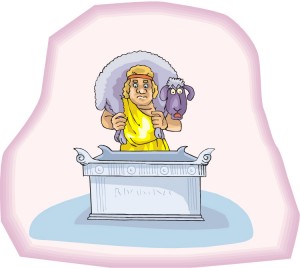
Lamb sacrifice

This is not a fictional story! Truth is sometimes stranger than fiction. The details of these two events are chronicled in the pages of the Bible. The first event occurred in ancient Egypt and is recorded in the Book of Exodus chapters eleven and twelve. There we find recorded the details of the children of Israel’s first Passover while they were yet slaves in the land of Egypt. A whole series of events led up to this first Passover, which culminated with each family’s ritual killing of a lamb, smearing its blood on the frame of their doors, roasting the lamb, and then eating it. Doing this insured that YHVH would pass over their homes leaving those inside alive. The firstborn of those whose homes did not have the blood on them were killed.

The second event involved a descendant of those ancient people who was born in a different land fifteen hundred years later. His name was Yeshua of Nazareth, a Jew, and viewed by many of his day as the long-awaited Messiah of Israel. One of the proofs of his Messiahship would be whether he would fulfill the many prophecies that had been foretold Continue reading