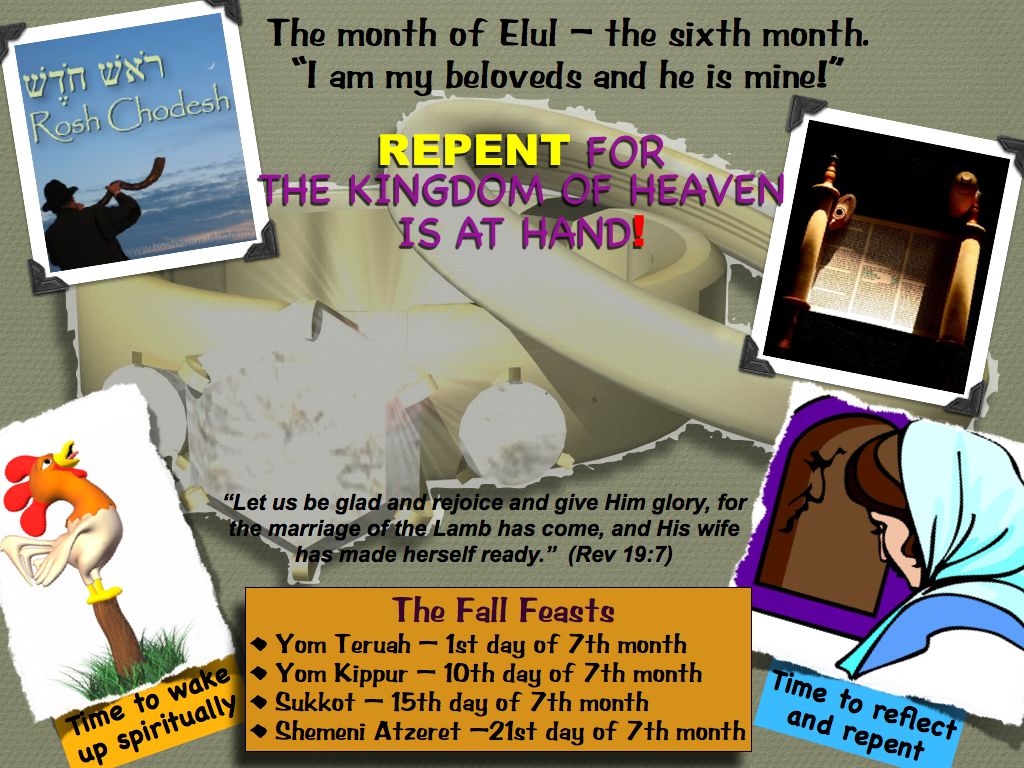
Happy First Day of the Sixth Month of Elul

Today, the new moon was spotted in the land of Israel meaning this is the first day of the biblical month of Elul—the sixth month of the biblical calendar.

In one month, YHVH’s people will begin celebrating the fall biblical festivals, which prophetically point to events surrounding the second coming of our Lord and Savior, Yeshua the Messiah, and the establishment of his millennial kingdom on earth.

It’s time to awaken from the summer spiritual doldrums and to prepare yourself spiritually…! The King of kings is coming. Are you ready?

For more information on this important month, see my previous post, “Teshuvah: A Word YOU Need to Add to YOUR Lexicon” at http://hoshanarabbah.org/blog/2013/08/03/teshuvah/.

Elul


The Second Passover—A Second Chance for Salvation

Numbers 9:6–11, Defiled by a human corpse. This passage can also be understood allegorically.
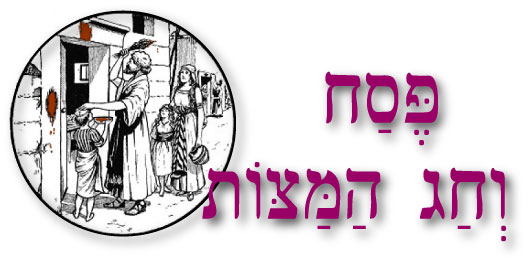
pesach_art


The second Passover is a prophetic picture pertaining to the lost and scattered sheep of the house of Israel who, like those individuals in this passage, had been journeying in exile (just like the prodigal son in Yeshua’s parable) among the Gentiles in a foreign land and away from the land and Elohim of Israel.

In the process of their spiritual wandering, they have become defiled by sin and death (likened here to touching a human corpse), since the wages of sin is death (Rom 6:23), and all men have sinned and fallen short of the YHVH’s glory (Rom 3:23).

While in exile (again like the prodigal son in the parable), they awake to their spiritual apostasy and want to come back home to observe the Passover (a picture of redemption or salvation). Passover is the only biblical festival for which YHVH’s allows a make up.

At the first Passover in Egypt, those who weren’t in their houses under the lamb’s blood-painted doors fell under the death penalty for sin and were killed. This teaches us that Passover is a picture of man’s obtaining salvation through the blood of Yeshua, the Messiah who is the Lamb of Elohim.

YHVH desires that all men be saved and come to know Yeshua the Savior, and Passover is a picture of this. This is why he gives men a second chance to keep the Passover—he wants all to be saved (John 3:16; 2 Pet 3:9), including his lost, scattered, exiled and prodigal children from the house of Israel.

 

New Video: The Feast of Pentecost and the Bride of Yeshua

In this brief video, Natan Lawrence shows the relationship between the feast of Pentecost (or Shavuot), the marriage of YHVH to the children of Israel at Mt. Sinai, the wedding chuppah (canopy), the holy of holies, and the upper room experience on the day of Pentecost, and the marriage of Yeshua the Bridegroom to redeemed believers in the Song of Solomon.


The Giving of the Torah at Mount Sinai on Pentecost

On Pentecost (Heb. Shavuot), YHVH gave his chosen people the Torah. Also on Shavuot, YHVH “married” Israel (Ezek 16:1–13) when he formulated a covenantal agreement with her to which she agreed when she said “I do” three times (Exod 19:8; 24:1–8). The Torah was the basis of that covenant, or the marriage vows, if you will, to which Israel swore allegiance.

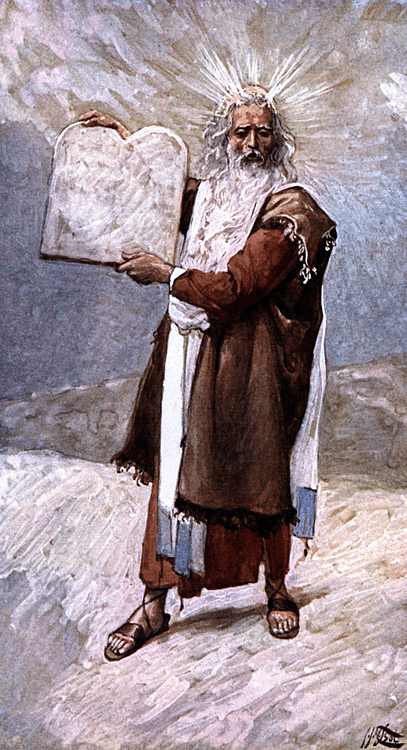
Moses' shining face

YHVH gave his people the words of life to live by, but because of the hardness of their hearts they were not able to be faithful to his Torah. Like a wife who says “I do” in response to her wedding vows, but cannot remain faithful to her marriage covenant, so Scripture likens Israel to such a woman who became a spiritual harlot (Ezek 16:14–34).

In spite of Israel’s apostasy and spiritual whoredoms, YHVH had made promises to Abraham and to his descendants that were unconditional in nature. Whether Abraham’s descendants remained faithful to YHVH or not, YHVH’s promises to Abraham were inviolate. Though the Israelites had violated the vows they made to YHVH at Mount Sinai, he revealed to the ancient Hebrew prophets that he would eventually formulate a second renewed covenant with Israel, and this time he would pour out upon them his Spirit and write his Torah-laws in their hearts (Jer 31:31–33; 24:7; Ezek 11:19; 36:25–27).

On Passover at the last supper, YHVH-Yeshua betrothed himself to Israel all over again (Matt 26:28; 1 Cor 11:25). As a seal or pledge of this betrothal, he promised to send to his Continue reading


Understanding Pentecost (Pt 2)

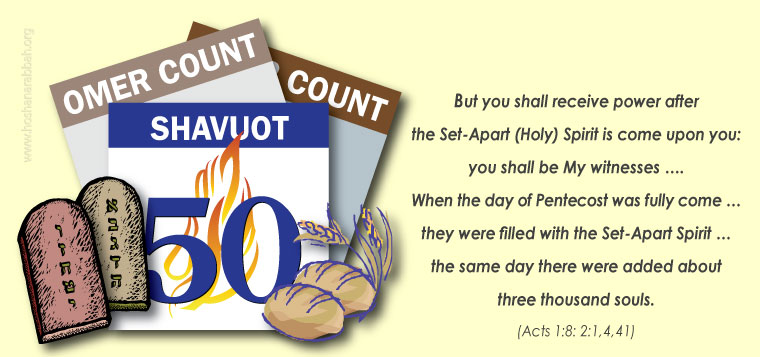
Shavuot is the third festival in YHVH’s cyclical parade of annual sacred appointed times. It is also known as the Feast of the Harvest of the First Fruits (Exod 23:16), Day of First Fruits (Num 28:26) and the Feast of Weeks or Shavuot (which is Hebrew for weeks, Exod 34:22; Deut 16:10, 16; 2 Chr 8:13). Shavuot falls fifty days “from the day after the [weekly] Sabbath” (NKJV) that falls during the Days of Unleavened Bread, and hence the derivation of the name Pentecost (meaning “to count fifty”) as recorded in the Testimony of Yeshua (or New Testament/NT, Acts 2:16).

Shavuot_banner

YHVH through his Torah (the law of Moses) instructed his people that Shavuot was…

  • a day of rest where laborious or servile work was prohibited (Lev 23:21)
  • a commanded assembly (Lev 23:21)
  • a time when the priests offered up offerings and sacrifices (Lev 23:18–20)
  • a time when all males were to bring the tithes of the increase of their income (Exod 23:14–17; Deut 16:16)
  • a time when the priests were to offer up as a wave offering to YHVH two loaves of leavened bread made of the freshly harvested wheat (Lev. 23:17)
  • to occur where YHVH would place his name and all were to go there to celebrate it (Deut 16:11)
  • a time of rejoicing (Deut 16:11)
  • to be forever (Lev 23:21)

An Agricultural Festival With Prophetic Implications
Ancient Israel was an agricultural society that had a spring harvest of grain and a fall harvest of fruit. The spring harvest consisted of the smaller barley harvest, which began during the Days of Unleavened Bread, and the much larger wheat harvest occurring fifty days later at Shavuot. Both the barley and wheat harvests were prophetic pictures symbolizing new life and new creation, and both were presented to YHVH by the priests for his acceptance—a sheaf of barley on First Fruits Day on the Sunday during Hag HaMatzot (the Feast of Unleavened Bread, Lev 23:10–11), and two loaves of leavened wheat bread on Shavuot (Lev 23:17).

On First Fruits Day, the priests of Israel would raise the newly harvested barley and wave it Continue reading