When Is the Feast of Weeks, Shavuot or Pentecost?

When is the Feast of Weeks (Heb. Chag Shavuot) or Pentecost? This has been a subject of debate among the Jews going back for two thousand years to the first century, and still is today among well meaning people who love Elohim and desire to follow his word. This is the question I will address in this study.

Since Shavuot is the only biblical holiday that involves counting days and weeks (hence its name, the Feast of Weeks), there are different opinions about when to start the count leading up to Shavuot. The Torah tells us to count from the Sabbath associated with the Feast of Unleavened Bread.

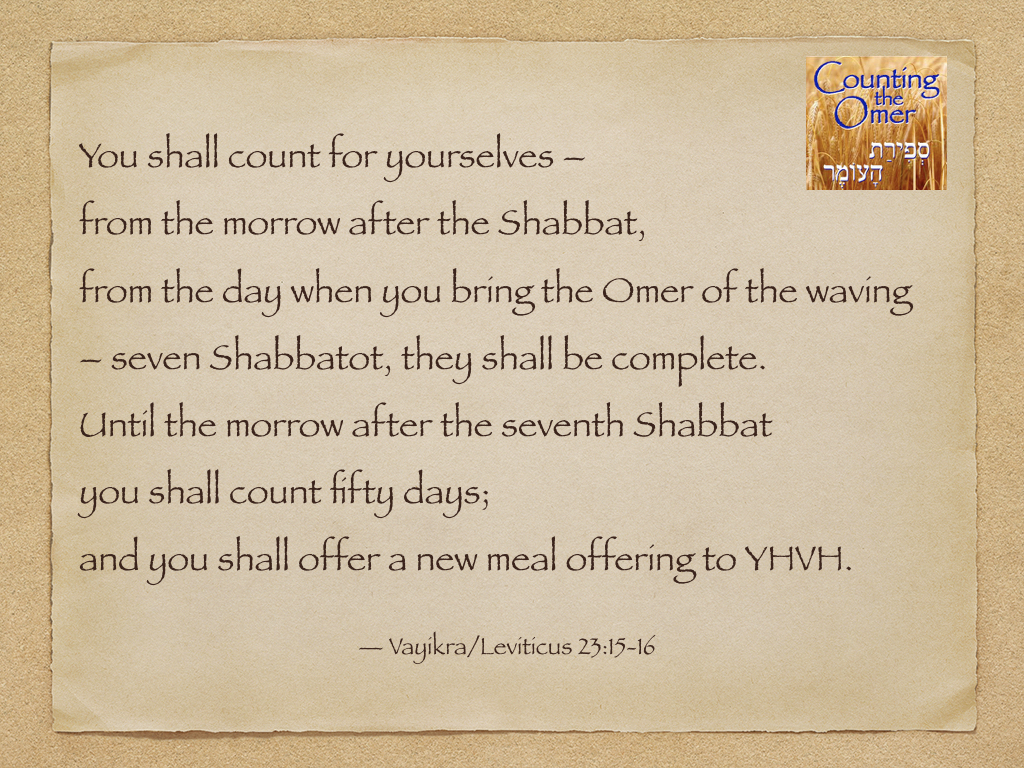
And you shall count for yourselves from the day after the Sabbath, from the day that you brought the sheaf of the wave offering: seven Sabbaths shall be completed. Count fifty days to the day after the seventh Sabbath; then you shall offer a new grain offering to the LORD. (Lev 23:15–16, NKJV)

This sounds simple enough. Or is it?

The question and the subject of the debate is which Sabbath do you start counting from? The day after the weekly Sabbath occurring during the Feast of Unleavened Bread or the day after the high holy day Sabbath of the first day of the Feast of Unleavened Bread, which occurs on the fifteenth day of the first month of the biblical year?

In the first century in the time of Yeshua and the apostles, there were two main opinions among the leading Jews on when to start counting the weeks (called “the counting of the omer”) leading up to Shavuot. The religious sect of the Pharisees whose spiritual descendants are the modern rabbinic Jews started the counting of the omer from the day after first high holy day of the Feast of Unleavened Bread, which is a high holy day Sabbath (John 19:31). On the other hand, the Sadducees, the other main Jewish sects of the first century (along with the Boethusians, which was likely a sub-sect of the Sadducees; see A History of the Jewish People in the Time of Jesus Christ, second division, vol 2, p. 37, by Emil Schurer; Commentary on the NT from the Talmud and Hebraica, vol. 4, p. 23 [commentary on Acts 2:1], by John Lightfoot) counted the omer from the day after the weekly Sabbath that falls within the week of the Feast of Unleavened Bread. Some modern Messianics follow the rabbinic method, while others follow the Sadducean method.

It is generally understood by historical scholars that the Jewish sect of the Continue reading →


Getting Ready for Shavuot, the Feast of Weeks or Pentecost

Next Sunday (May 27, 2018) is Shavuot or the biblical Feast of Weeks (also known as Pentecost). This is according to the visible new moon, aviv barley calendar, which I prove and explain in my three calendar articles on the subject (https://www.hoshanarabbah.org/teaching.html#feast) was the calendar in use at the time of Yeshua and the apostles. Those who follow the rabbinic calendar (invented in the middle of the fourth century A.D. and approved by the Roman emperor, Constantine) celebrated Pentecost a week earlier. Those who follow the any of the other non-biblical calendars (e.g. the astronomical new moon conjunction calendar, the vernal equinox calendar, the Enoch calendar, etc., etc.) would have celebrated or will be celebrating Shavuot on some other day.

The following are links to resources that I produced (with the help of my wife) to help you to understand the importance of this day and why we need to celebrate it with full understanding of its significance in YHVH’s plan of redemption for sinful humans.


The Biblical Feasts: The Seven Steps in YHVH’s Plan of Salvation

YHVH’s seven biblical feasts are the seven steps in the Creator’s plan of salvation to redeem sinful and fallen man to him and by which man can be adopted into the family of Elohim and receive eternal life.

Overview of the Biblical Feasts

If you had to sum up the entire message of the Bible in one word what would it be? Probably words such as love, hope, salvation, eternal life or heaven are coming to your mind. But I challenge you to find a better word than the following: r-e-c-o-n-c-i-l-i-a-t-i-o-n. The dictionary defines reconciliation as “to restore to friendship or harmony, to settle or resolve a quarrel, to make consistent or congruous.” When man chose to rebel against YHVH and to give in to sin at the Tree of the Knowledge of Good and Evil at the very beginning he chose the path of separation from his Heavenly Father. Sin causes man to be separated from a totally holy, righteous and sinless Creator. Since that time YHVH has been endeavoring to reconcile man to himself. He has laid out criteria for man to follow for this to occur—for man to once again have a friendly, loving and intimate relationship with his Heavenly Father as did Adam before he sinned.

The set-apart appointed times (moedim) or divine rehearsals/gatherings (miqra kodesh) of YHVH are prophetic shadow-pictures or symbols of the steps man must take to be reconciled to his Heavenly Father. They are the complete plan of salvation or redemption rolled up into seven easy-to-understand steps. Though a child can understand these steps, the truths contained therein can at the same time be expanded and unfolded until one literally has rolled out before oneself the entire message of the Bible from Genesis to Revelation—a message that to the human comprehension is staggering, deep and rich beyond understanding. These feast days are literally the skeletal structure upon which the truths of the entire Bible hang. The message of redemption, sanctification, salvation, the atonement, glorification, eschatology, the history of Israel, the entire Gospel message, the covenants, the marriage of the Lamb, the bride of Messiah and Yeshua the Messiah are all prefigured within the glorious spiritual container of YHVH’s set apart feasts contained in seven steps—seven being the biblical number of divine perfection and completion.

Quite assuredly, without a deep, walking-it-out comprehension of the feast days of YHVH, no matter how learned one is in biblical understanding, or how academically astute and mentally acute in biblical erudition one may be, one will not have a deep understanding of those scriptural subjects listed above. How can one understand end-time events such as the second coming, the great tribulation and the rapture unless one understands the feast days from a deep Hebraic perspective? One simply cannot have just a knowledge of Greek, the Gospels, the Apostolic Scriptures along with a surface understanding (i.e. traditional Christian perspective) of the prophecies of the “Old Testament” and expect to understand eschatology (the study of end-time events) unless one immerses themselves in understanding and keeping the feast days of YHVH. One cannot throw out the foundation or the skeletal structure and expect to have a body of understanding that amounts to anything at all. Simple logic and common sense and the very truth and character of YHVH Elohim demands and dictates this so.

At Mount Sinai, YHVH gave to his people Israel what is commonly called the “Ten Commandments.” These words from the mouth of YHVH himself were and are literally the foundation and cornerstone to the rest of the 613 commandments from YHVH given to Continue reading →


Counting the Omer—Week One

Today is the seventh day of the first week of seven weeks.

Today is the seventh day of the counting of 50 days from the day of the waving of the omer on the morrow after the Sabbath.

Today is Shabbat, the first Shabbat of seven Shabbatot.

Today completes the first week of seven weeks.


Counting the Omer—50 Days to The Feast of Weeks/Shavuot/Pentecost

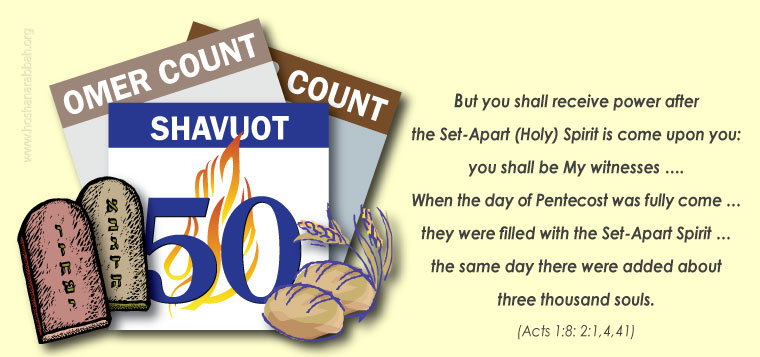
Today is the first day of the counting of the omer. After 50 days from today, it will be Pentecost, which in Greek means “count fifty.” 

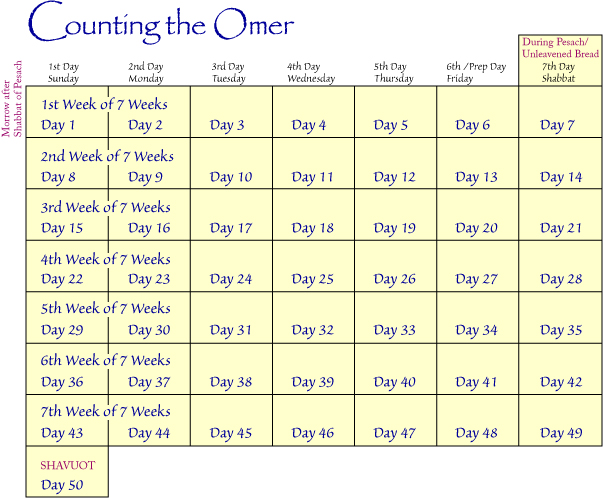
The Torah commands us to count the omer (Lev 23:15–16). The graphic below will help you to do that. Keep track of the days and change the statement below accordingly to fit the omer count for the particular day.

May YHVH bless you as you participate in the countdown to Shavuot, the Feast of Weeks or Pentecost.

Counting the Omer—What Is Its Spiritual Prophetic Significance?

There are 49 days between First Fruits Day, which occurs during the Feast of Unleavened Bread, and the Feast of Weeks (or Pentecost). Why does YHVH in the Torah command us to count the seven weeks or 49 days between these two events, with Pentecost occurring on the fiftieth day? The short answer is that Yeshua doesn’t want to marry a spiritual baby. For the long answer, keep reading…

From the Depths of Slavery to a Kingdom of Priests

Every detail in Scripture is for our learning and edification. All the examples of the past are for our learning upon whom the ends of the world are come (1 Cor 10:11; Rom 15:4). Everyday, YHVH is uncovering the prophetic mysteries hidden in the Scriptures that are being revealed to those who diligently seek him by diligently studying to show themselves approved as a workman rightly dividing YHVH’s Word (2 Tim 2:15).

YHVH’s command for us to count the omer as a countdown to the Feast of Weeks (Heb. Shavuot; Gr. Pentecoste, Lev 23:15–16) memorializes the Israelites’ journey from spiritual babyhood to adulthood. During this 49-day count, Israel ascended from out of the depths of slavery and suffering in Egypt, was baptized in the Red Sea, and then arrived at Mount Sinai—a place of a spiritual standing before YHVH as a kingdom of priests (Exod 19:6). It Continue reading →


Videos: Unleavened Bread, First Fruits and the Omer Count


Dealing With the “Leavening” in Our Lives—Overcoming Sin!


Throughout Scripture, leavening is a spiritual metaphor for sin, pride, hypocrisy, malice, bitterness and false religious doctrine (Pss 71:4; 73:21; Hos 7:4; Matt 16:6; Mark 8:15; Luke 12:1; 1 Cor 5:8–6; Gal 5:9). Even as a small amount of leavening agents in bread (e.g., yeast and various chemical agents) will quickly permeate bread dough causing it to rise, so a little sin can rapidly infect our lives (or like a quick spread cancer disease) and take us away from Elohim’s path of righteous-living.

The Scripture teaches us to be overcomers (Rom 12:21; 1 John 2:13–14; 5:4) eradicating the leavening of sin from our lives. We must overcome the world, the flesh and the devil (Jas 3:15). Yeshua admonished each of the seven Messianic assemblies to be overcomers (Rev 2:7,11,17,26; 3:5,12,21; see also Matt 24:13). For those who overcome, there will be great rewards—a spiritual inheritance; they will be sons of Elohim (Rev 21:7).

The Greek word for overcome is nikao (Strong’s G3528) meaning “to conquer, to get the victory, prevail” and is where the word nike comes from.

What Is Sin?

Sin is the anything that violates the Torah-instructions/laws of Elohim (1 John 3:4).

Sin is unrighteousness (1 John 5:17; YHVH’s Torah commands define what righteousness is, Ps 119:172).

Sin is not believing in Yeshua, who is the Torah-Word of Elohim incarnate (John 3:18; 16:9).

Sin is failing to do (or not to do) that we which we should be do (or not do) — i.e., the sin of omission (Jas 4:17).

Sin is putting me-first (my desires, impulses), not YHVH first (his will) in our lives.

It is humanism, which is self-rule and self-worship. It is following the lie of the devil: man can have it his way regardless of what YHVH’s Word says, and not suffer any consequences for it. This is the big lie from the serpent in the Garden.

Sin is a direct challenge to YHVH’s authority in our lives. It is arrogance and self exaltation against YHVH’s will. It involves lack of belief in his Word. It is putting my will above his Word.

Defining the Types of Sin Spoken of in Isaiah 53

Asham (Strong’s H817/TWOT 180b): means “guilt, offense, guiltiness, sin, trespass, fault, trespass or sin offering.”

“[T]he root asham includes acts of sin, responsibility for them, punishment and its aftermath or, as an alternative, atonement. The word denotes any breach of God’s covenant with Israel and any divine act of dealing with it, whether punishment or atonement” (TWOT, p. 79).

Avown (Strong’s H5771/TWOT 1577a) means “perversity, depravity, iniquity, guilt or punishment for iniquity; the root of this word means to bend, twist, distort, to deviate from Continue reading →