The 7 and 8 Steps in the Tabernacle as They Relate to Biblical Marriage and the Feasts

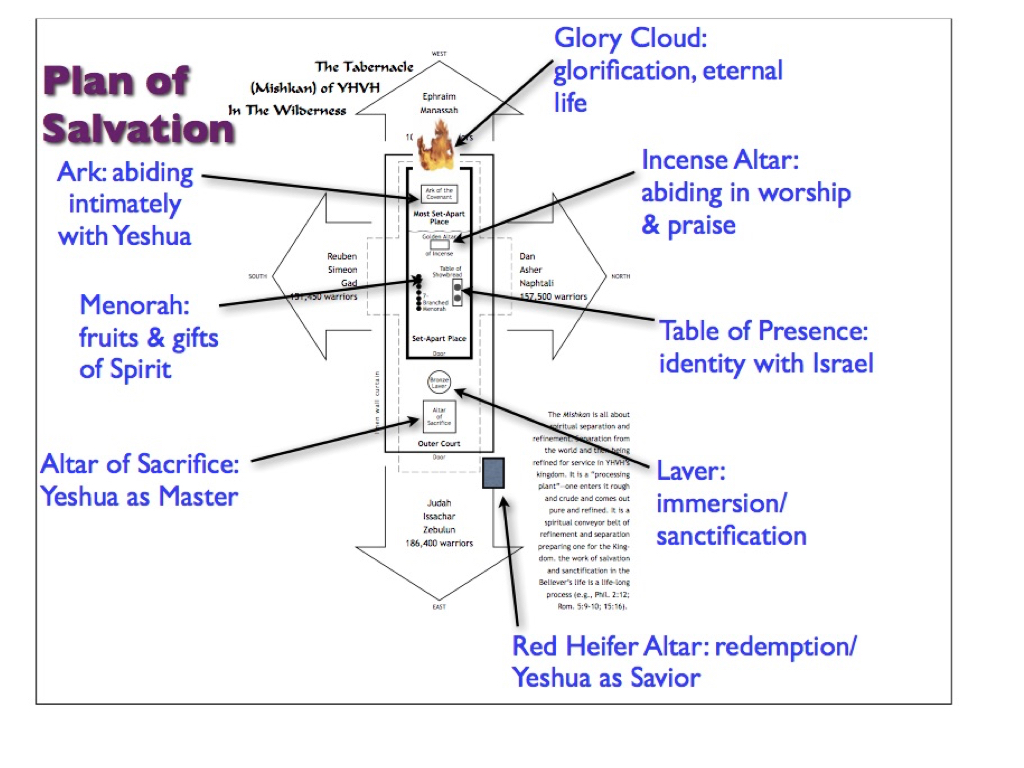
The Tabernacle of Moses is a giant gospel tract that explains the entire Bible—YHVH’s plan of salvation from Genesis to Revelation—in a simple child-like way, so that our human pea brains will be able to understand that which is, in reality, way beyond our comprehension.

This post contains A LOT of info, so grab a cup of coffee (or two or three) and get the coffee “anointing” and sit down and learn some things about the Tabernacle of Moses that you’ve probably never heard anywhere else. I promise that you will be blessed (and I don’t make promises that I can’t keep). This is because YHVH gave me these revelations many years ago, so I give him all the glory and credit.

First, the Tabernacle is YHVH’s plan of salvation or redemption for humans. Here’s a quick outline of this. We won’t cover this part in great detail here, since we’ve gone over these things previously on this blog over the past few weeks. (Please review each of the furnishings in the tabernacle to see how they relate to the seven and eight steps in YHVH’s plan of salvation.)

The Bible Is the Story of Reconciliation Between Two Lovers—The Tabernacle Contains the Outline of that Love Story

Love and romance has captured the imagination of man since time immemorial. Today we see this fascination evidenced in music, movies, literature and numerous other ways including modern man’s obsession with sexuality and even, sadly, in rise of pornography and the societal acceptance of sexually perverse lifestyles.

The Creator of the universe, the Set Apart One of Israel, the Author of the Scriptures, is captivated by the concept of love and romance as well. He is the Creator of marriage and sex. In fact, his first command to man was to be fruitful and to multiply and to fill the earth with humans (Gen 1:28). To accomplish this involves sexual relations in marriage. The writer of Hebrews declares that marriage is honorable and the marriage bed is not to be defiled (Heb 13:4). Much of the Bible is devoted to the subject of love and marriage. Love and marriage at a human level is merely a shadow of something much deeper: love and marriage at a spiritual level. John 3:16, the most popular verse in the Bible, talks about Elohim’s quintessential love for mankind and alludes to this higher spiritual level.

Most people understand that poetry and poetic prose is the language of love, yet few realize that much of the Scripture is poetry (or poetic prose) in Hebraic style. Much of this poetic style is lost in the translation from Hebrew into other languages like English. For example, all the books of Psalms, Proverbs, Job, Song of Solomon, Ecclesiastes and most of the writings of the Hebrew prophets are written in a poetic style. Many of Continue reading


Passover—When to Celebrate It and a Quick Overview of the Seder

The exact timing of the Passover has sparked much controversy over the years among believers. In the early Christian church it was known as the “Quartadeciman Controversy.” Concerning this debate, which continued into the fourth century a.d. and was finally settled at the famous Council of Nicea in a.d. 325, church historian Philip Schaff in noted multi-volumed History of the Christian Church states, “Respecting the time of the Christian Passover … there was a difference of observance which created violent controversies in the ancient church [resulting in questioning] the genuineness of John’s Gospel” (vol. 2, p. 210). The Quartadeciman Controversy, although slightly different in nature to the subject of this present work, only serves to underscore the volatility of issues of dogma. With this in mind, let us not forget what Yeshua referred to as the “weightier matters of the law”: judgment, mercy and faith (Matt. 23:23). Now let’s begin our study of the timing of Passover.

First, there are some absolutes that Scripture gives regarding Passover:

  • Scripture states that Pesach/Passover is on the fourteenth day of the first month (Lev. 23:5), and is called the month of Abib (Exod. 12:2,5–14; 13:4) of Elohim’s biblical calendar (Hag HaMatzot/Feast of Unleavened Bread starts on the fifteenth).
  • For Messiah Yeshua to be the literal fulfillment of the Passover Lamb he had to die at the same moment in time that the Passover lamb was slain.

When Is Passover and When Was the Passover Lamb Sacrificed in the Temple?

Exodus 12:6 says, 

And you shall keep it [the lamb] until the fourteenth day of the same month, then the whole assembly of the congregation of Israel is to kill it at twilight [Heb. erev, marginal notes in KJV: between the two evenings].

According to ancient rabbinical sources, at the time of Yeshua, the term between the evenings or twilight had taken on a broader meaning than just twilight as in accordance with the literal meaning of the Hebrew word erev. For the Pharisees, it referred not just to the approximately 45-minute time period just before darkness that we in the west call twilight, to the time period from noon onward when the sun begins to decline from its Continue reading


How Did Yeshua Perfectly Fulfil the Passover?

Exodus 12:1–51, The Passover. 

How did Yeshua the Messiah perfectly fulfil all the types and shadows of the first Passover in Egypt?

According to the laws of statistical probability, what are the chances of an event happening and then fifteen hundred years later another event occurring bearing an uncanny resemblance to the first one? Now suppose that not only did fifteen hundred years separate the two events, but that they occurred in two different countries several hundred miles apart, which in the ancient world may as well have been halfway around the globe. Now suppose that the second event involved the death of a person, and that the events leading up to their death including the manner and timing of that death was beyond the control of the individual dying so that in no way could the person dying stage his death to mirror the first event. In fact, those killing the individual possessed no foreknowledge of the event that had occurred fifteen hundred years earlier. What are the chances of this occurring?

This is not a fictional story! Truth is stranger than fiction. The details of these two events are chronicled in the pages of the Bible. The first event occurred in ancient Egypt and is recorded in the Book of Exodus chapters eleven and twelve. There we find recorded the details of the Continue reading


13 Ways Hanukkah Is Different from Christmas

Hanukkah (a Hebrew word meaning “the Feast of Dedication” and also known as the Festival of Lights) is a minor holiday in Judaism and is only mentioned once in the Scriptures (John 10:22). It is the memorial of the cleansing of the temple in Jerusalem after the pagan Greeks had defiled it with idols. There is no scriptural command to celebrate it. There is no indication that Yeshua or the early disciples celebrated it, although John in his Gospel mentions that Yeshua happened be at the temple during this holiday. Nevertheless, Hanukkah as great positive spiritual ramifications.

Hanukkah 33399027

Although Hanukkah and Christmas occur in the same month, they are totally different from each other. Hanukkah is not a replacement for Christmas for those who have discovered the pagan origins and unbiblical nature of Christmas. Here are several ways how these two holidays differ: Continue reading


Chanukah or Christmas, Neither or Both?

Happy Chanukah/Hanukkah! Tonight begins the first night of the Festival of Lights. Want to know more? Please read on…

John 10:22, The Feast of Dedication [or consecration]. This is a reference to the annual Chanukah (also spelled Hanukkah, and also known as the Festival of Lights) celebration lasting for eight days beginning in the 25th day of Jewish month Chislev (in the middle of our December). This minor Jewish feast was instituted by Judas Maccabaeus (164 BC) in memory of the cleansing of the Jerusalem temple from its desecration by Antiochus Epiphanes, the pagan Greco-Syrian king.

The word Chanukah derives from the Hebrew word KH-N-K meaning “to dedicate.”

While Chanukah isn’t a biblically commanded observance, it is interesting to note that Yeshua happened to be at the temple in Jerusalem at this time as John mentions in his Gospel (John 10:22). Are there any spiritual significances to this? Perhaps.

Chanukah falls in the same time frame as the modern Christian festival of Christmas, which has its roots in the pagan Roman festival of Saturnalia, which culminated on December 25. Saturnalia was a pre-Christian festival held from December 17 to 25 in honor of the sun god characterized by drunken revelries, sexual debauchery, hedonistic indulgences of all sort, and human sacrifices. Saturnalia was a festival of lights in an effort to defeat the forces of darkness at the darkest time of the year and to woo the sun as earth’s life-giver back again thus insuring that the earth wouldn’t become an uninhabitable dark and frozen wasteland.

In the fourth century, Christian leaders “redeemed” Saturnalia by attaching the birth of Jesus Continue reading


More Photos from Sukkot 2018 in Central Oregon

As promised, here are some more photos from our local Sukkot gathering this year.

The campground and our campsite.

Natan talking to Rog while Dale (both from Nebraska) is making ice cream.

Natan giving a teaching.

Natan preaching next to the river.

The congregation listening to Natan teaching by the river.

A local resident drops in to hear the Word of Elohim expounded.

As in Yeshua’s day, some folks only come to get fed physically, not spiritually.

Some of the congregation.

And now for some spectacular  outdoor scenes from the local area…

Fall Creek en route to the Green Lakes at the base of South Sister and Broken Top mountains.

Another view of Fall Creek.

The headwaters of Fall Creek.

At the 6,600 foot level at the Green Lakes at the base of South Sister.

Natan swimming in the 47 degree temperature waters of Fall River near the campground during a mountain bike trail ride with Sandi.

The fall colors of Fall River.