Communion or the Lord’s Supper Explained in Its Hebraic Context

The Importance of Memorials and Symbols

Obedient and truth-seeking disciples of Yeshua will want to love him by keeping his commandments (John 14:12), and by teaching and doing everything he commanded (Matt 28:20). They will be following Paul’s example to imitate Yeshua (1 Cor 11:1) as well heeding John’s admonition “to walk just as [Yeshua] walked” (1 John 2:6). 

With regard to obeying YHVH’s commands, symbols and memorials figure prominently in YHVH Elohim’s spiritual economy. Why is this? They are teaching aids. Physical humans need physical things to help them to comprehend spiritual truths and ideals. Using symbols, commemorations and memorials is a method of teaching and relates to pedagogy, which is “the method and practice of teaching, especially as an academic subject or theoretical concept.” A effective teacher endeavors to build bridges of understanding between what the student knows and what the teacher wants to teach the student— between the known and the unknown, between what the student understands now and what the teacher wants his students to learn. A successful teacher learns the skill of building bridges of understanding with his students to bring them to a higher level of understanding. The same is true of YHVH Elohim as we works with humans to teach them about spiritual things.

On a spiritual level, YHVH Elohim, our Heavenly Teacher, employes similar pedagogic or teaching techniques as he endeavors to bring men to a higher level of understanding heaven’s spiritual truths and realities. The use of symbols and memorials as teaching tools is essential to this process of teaching and learning.

The Bible is full of symbols and memorials that represent or point to something else and act as teaching aids to assist humans in learning about Elohim and what he requires of us. For example, Continue reading


How the First Passover Perfectly Pictured Yeshua the Messiah

For I am not ashamed of the gospel of Messiah, for it is the power of Elohim to salvation for everyone who believes, for the Jew first and also for the Greek. (Rom 1:16)

For the preaching of the cross is to them that perish foolishness; but unto us which are saved it is the power of God. (1 Cor 1:18)

Neither is there salvation in any other: for there is none other name under heaven given among men, whereby we must be saved [except the name of Yeshua the Messiah]. (Acts 4:12)

According to the laws of statistical probability, what are the chances of an event happening and then fifteen hundred years later another event occurring bearing an uncanny resemblance to the first one? Now suppose that not only did fifteen hundred years separate the two events, but that they occurred in two different countries several hundred miles apart, which in the ancient world considering the difficulties of travel and communications may as well have been halfway around the globe. Now suppose that the second event involved the death of a person, and that the events leading up to their death including the manner and timing of that death was beyond the control of the individual dying so that in no way could the person dying stage his death to mirror the first event. In fact, those killing the individual possessed no foreknowledge of the event that had occurred fifteen hundred years earlier. What are the chances of this occurring? Well beyond the laws of possibility!

This is not a fictional story! Truth is sometimes stranger than fiction. The details of these two events are chronicled in the pages of the Bible. The first event occurred in ancient Egypt and is recorded in the Book of Exodus chapters eleven and twelve. There we find recorded the details of the children of Israel’s first Passover while they were yet slaves in the land of Egypt. A whole series of events led up to this first Passover, which culminated with each family’s ritual killing of a lamb, smearing its blood on the frame of their doors, roasting the lamb, and then eating it. Doing this insured that YHVH would pass over their homes leaving those inside alive. The firstborn of those whose homes did not have the blood on them were killed.

The second event involved a descendant of those ancient people who was born in a different land fifteen hundred years later. His name was Yeshua of Nazareth, a Jew, and viewed by many of his day as the long-awaited Messiah of Israel. One of the proofs of his Messiahship would be whether Continue reading


Why Celebrate the Passover?

Isn’t your life already busy enough? Who has time for a six-hour Passover Seder commemorating something that happened thousands of years ago? What could this possibly have to do with my life here and now, you may ask? How can a 3500-year-old Biblical ritual in any way relate to those living in the age of the laser, satellites, the worldwide web and computers? Well, let’s see!

The Preacher said in Ecclesiastes 3:15, “That which is has been already and that which will be has already been.…” Life is full of paradoxes. Do advancements in technology, science, economics, medicine, religion, and world government really promise to give men the rest for their weary souls for which they long?

How about a different approach to the questions and problems facing modern man? Is it possible to go forward by going backwards? This is a thesis that the ancient prophet Yermeyahu (Jeremiah) proffered to those who had ears to hear. He said, “Thus says YHVH, ‘Stand by the ways and see and ask for the ancient paths, where the good way is, and walk in it; and you will find rest for your souls. But they said, we will not walk in it’” (Jer 6:16). What were those ancient paths to which this white-haired Jewish prophet referred? This question is answered three verses later: “Because they have not listened to My words, and as for My Torah, they have rejected it also” (verse 19). YHVH through his prophets has been showing men the way of rest for their souls for thousands of years, yet men consistently refuse to listen. They always have a better way, so it seems!

The festival of Passover is one of the most ancient paths to be found in all of the Scriptures. In it are contained clues that will help the partakers of it to understand the past, present and the future. 

A God-hater, Karl Marx, the father of modern communism, said that religion is the opiate of the masses. Yes, this can be said of dead, truthless and spiritless religion. But how about that religion which gives definition, purpose, meaning, hope and destiny to a man’s life? How could anything that comes directly from the Loving Father who created you and me in his own image be detrimental to us?

It has been said that the religion of the Bible tells a man where he has come from, where he is at and where he is going. Could it not be said that a man who knows the answers to these questions possesses true wisdom and wealth, and has indeed found rest for his troubled soul?

One of the most important scriptures in the Jewish faith is the famous shema passage of Deuteronomy 6:4–9. This passage, which is like a “pledge of allegiance” for the Jews, starts out by saying, “Hear [shema], O Israel …” The word shema literally means “to hear and to do.” Later, in verse five, the shema continues, “And you shall love YHVH your Elohim with all your heart, and with all your soul and with all your might.” Loving our Heavenly Creator is not just a mind-thing, but also an action and a doing thing. It is something we act out and participate in. This is the Hebrew way … the ancient paths! As a path is for the purpose of walking down, even so, Passover is meant to be celebrated. This is how YHVH’s people showed their love and devotion to him. Yeshua, the Jewish Messiah, reiterated this when he said, “If you love me, keep my commandments [or Torah mitzvot]” (John 14:15). 

This is what the Passover Seder is all about. We, as humans, learn by doing. We learn obedience by obeying. We learn to love by loving. We learn about heavenly and spiritual mysteries by walking out the types and shadows found in Scripture (of which Passover is but one) that point to the heavenly and spiritual domain or dimension of YHVH himself. The French have a saying: L’appétit vient en mangeant. Translated this means: Appetite comes while eating. Or we could say that the more one eats (delicious food) the more one wants. David said in Continue reading


Why Study About and Celebrate YHVH’s Biblical Feasts?

It’s Time to Take Off the Blindfold!

The biblical truths presented below you have NOT heard in your Sunday churches. If you had, you would have been observing or celebrating YHVH Elohim’s biblical feasts in those churches! Yet these truths have been in your Bible all along. The problem is that most people have been blinded to them, and until YHVH opens their eyes and they express willingness to hear and obey YHVH’s truth, they will remain spiritually blind!

An Introduction to the Biblical Feasts

If you had to sum up the entire message of the Bible in one word what would it be? Probably words such as love, hope, salvation, eternal life or heaven are coming to your mind. But I challenge you to find a better word than the following: r-e-c-o-n-c-i-l-i-a-t-i-o-n. The dictionary defines reconciliation as “to restore to friendship or harmony, to settle or resolve a quarrel, to make consistent or congruous.”

When the first humans chose to listen to the lies of the serpent and to rebel against YHVH by giving in to sin at the tree of the knowledge of good and evil at the very beginning, our first parents chose the path of separation from their Heavenly Father. Sin causes man to be separated from our totally holy, righteous, sinless and loving Creator.

Since that time YHVH has been endeavoring to reconcile man to himself. He has laid out the criteria for this to occur—for man to once again have a loving and intimate relationship with his Heavenly Father as did Adam and Eve before they sinned.

The seven biblical feasts of YHVH (please note, the Bible calls them YHVH’s feasts, not men’s feasts, Lev 23:2, 4; Exod 31:13) prophetically represent the steps man must take to be reconciled to his Heavenly Father. They are the complete plan of salvation or redemption rolled up into an easy-to-understand ­seven-step plan. Though a child can understand these steps, the truths contained therein can, at the same time, be expanded and unfolded until one literally has rolled out before oneself the entire message of the Bible from Genesis to Revelation—a message that to the human comprehension is staggering, deep and rich beyond understanding. The biblical feasts are literally the skeletal structure upon which the truths of the entire Bible Continue reading


When do we celebrate the Passover?

Passover occurs on the fourteenth day of the first month at twilight (Lev 23:5; Num 9:3, 5, 11). Twilight is the Hebrew word erev meaning “evening, night, sunset” according to all the main Hebrew lexicons. The root word for erev is arab meaning “to become evening, grow dark or to spend the evening, do at evening.”

The phrase “at twilight” can also mean “between the evenings” (see the marginal notes for Exod 12:6 in the KJV). The addition of the word at (Heb. beyn) adds an additional meaning to the word erev as we shall discuss further below. 

Which twilight time did the Israelites keep Passover? The twilight of the thirteenth day going into the fourteenth day, or the twilight of the fourteenth day going into the fifteenth day? Let’s examine the Scriptures for the answer.

YHVH commanded the Israelites to kill the Passover lamb at twilight (Exod 12:6) and then to put its blood on their doorposts (Exod 12:7). After that, they were to roast and eat the lamb in that same evening (Exod 12:8). The word evening in Hebrew is layil meaning “night as opposed to day.” They were to eat the lamb that evening “with a belt on your waist, your sandals on your feet, and your staff in your hand…in haste” (Exod 12:11). This was the same night that Elohim struck all the firstborn of Egypt, but passed over all the houses of the Israelites that had blood on the doorposts (Exod 12:12–14).

One thing is certain. Passover occurs on the fourteenth day of the first month of the biblical Continue reading


How to Prepare Yourself for Passover and YHVH’s Spring Feasts

It’s time to get spiritually clean!

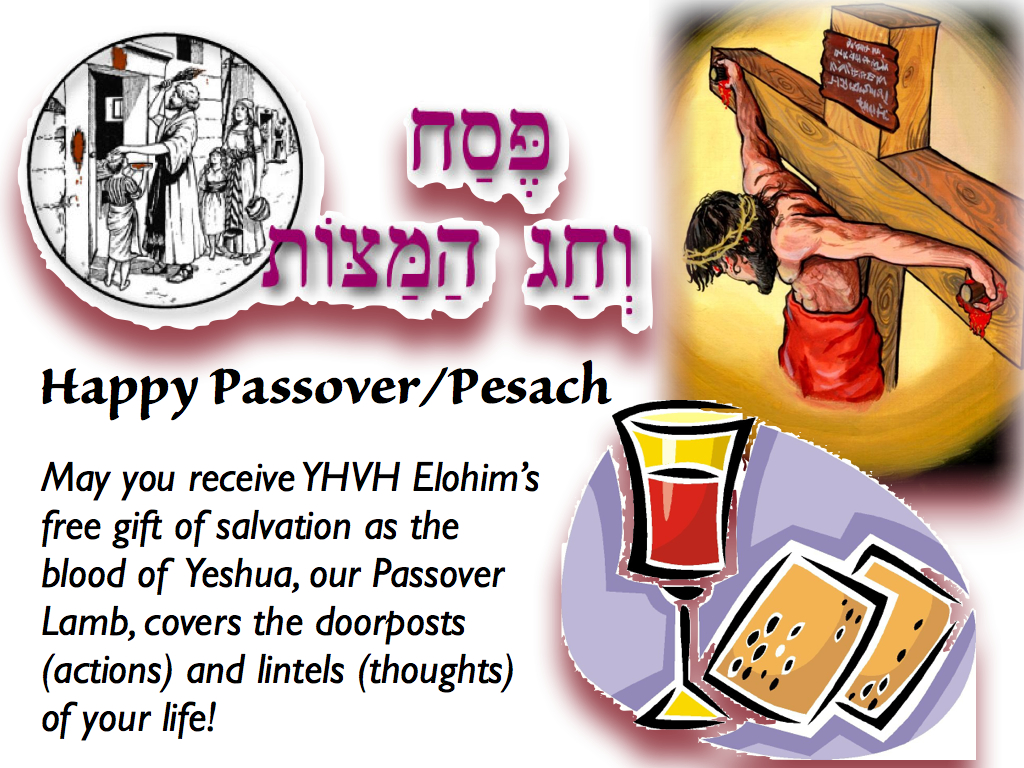
Repent of Sin and Get Under the Lamb’s Blood. As the children of Israel applied the lamb’s blood to the door posts and lintels of their house, so we must apply the sin-cleansing and Satan-defeating blood of Yeshua afresh to our lives (i.e. to our thoughts as represented by the door lintel and and to our hands or actions as represented by the door posts). This occurs as we repent of our sins, and pray for and receive YHVH’s forgiveness. He will then cover our sins over or wash away our sins by Yeshua’s blood (1 John 1:9; Rev 1:5).

In Egypt at Passover time, YHVH judged all those who had failed to put the lamb’s blood on the door posts of their houses. In other words, they weren’t under the blood of the lamb, but were still under the penalty of sin, which is death (Ezek 18:4; Rom 6:23). Any unrepented of sin in our lives brings the curse of death on us. To the degree that one has sin in their life is the degree to which the spirit of death has a legal claim on us. Now is the time to repent of sin by confessing it and seeking Elohim’s forgiveness under the blood of Yeshua and then forsaking that sin through YHVH’s grace (1 John 1:9). 

Here are some things of which to repent. 

  • Pride. Do you always think that you’re right? Your opinion is what matters the most? Do you have a hard time with those who don’t see it your way, when you don’t get your way? Do you have a fit when people disagree with you? Do you criticize others and put others down (especially those who are closest to you)? Do you belittle, mock, scorn and ridicule others? Do you focus on other people’s faults? Do you have a hard time identifying any sins that you have committed? Are you proud of your humility? Are you proud of how Torah-observant you are (compared to others)? Are you overly defensive when someone corrects you or challenges your opinion? Do you blame others when things don’t go right instead of taking personal responsibility for your actions? Are you proud of (instead of grateful to YHVH for) your achievements in life? Do you constantly have to be talking about yourself? Is much of what you do, say and think focused on yourself? These are all signs of pride. Pride is self-idolization. Elohim hates pride and calls it an abomination (Prov 6:16–17).
  • Ungratefulness and selfishness. Are you ungrateful? Are you discontent about your place in life? Do you always want more? Are your material possessions and personal belongings really important to you? Do you have a hard time giving things away? This is a form of self-idolatry, pride and idolization of things.
  • The love of this world over love of YHVH and the things that matter to him. This is a form of idolatry. In this case, we’re concerned with what others think more than what Elohim thinks about things. Therefore, our thoughts and actions are geared at trying to please ourself and others instead of pleasing Elohim (Jas 4:4; 1 John 2:15).
  • Sins of the mouth include mean, selfish, unkind, angry, impatient, egotistical words and gossip. This is idolization of self. What matters most is what I have to say, how I feel, my opinions and I have the right to say what I want when I want. This is also pride.
  • The lack of the fear of Elohim. Are you more concerned with what others think than what YHVH Elohim thinks about something? Anything in our lives that we put ahead of Elohim is idolatry.

Ask yourself this: In everything that I do and say, am I advancing the kingdom of Elohim and bringing glory to Yeshua or am I doing the opposite? Am I being a river of life to all those around me, or am I dragging them downward by being a purveyor of negativity and darkness? Are my Continue reading


Happy Biblical New Year 2019!

Today is the first day of the biblical new year. Happy biblical new year or lashana tovah (in Hebrew) 2019!

Get ready!! YHVH Elohim’s spring biblical feasts are coming quickly… Passover/Pesach will be in 14 days and the first day of the Feast of Unleavened Bread/ChagMatzot will be in 15 days. 

For the exact dates and a free calendar go HERE
or simply print this: