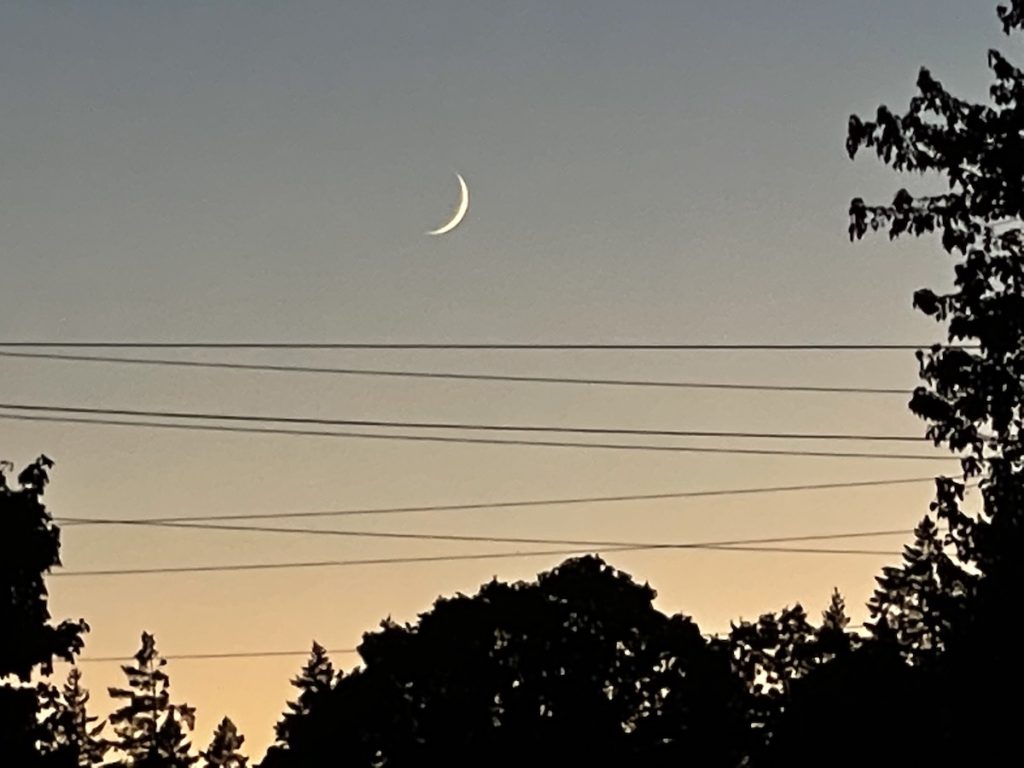
The new moon as sighted from my backyard on the evening of September 8, 2021
The moon does not lie! Men’s calendars do, however, when it comes to the times and seasons of Elohim. They obscure divinely revealed Truth as they come and go from the scene.
Over the millennia, calendars get changed and reconfigured based the whims of human vicissitudes, but the heavenly bodies, which are in reality a giant timepiece that YHVH Elohim created, never change. They are as reliable now as they were in the time of the Yeshua and before and going all the way back to the beginning of time for determining the set-apart, kadosh (holy) times and seasons of YHVH.
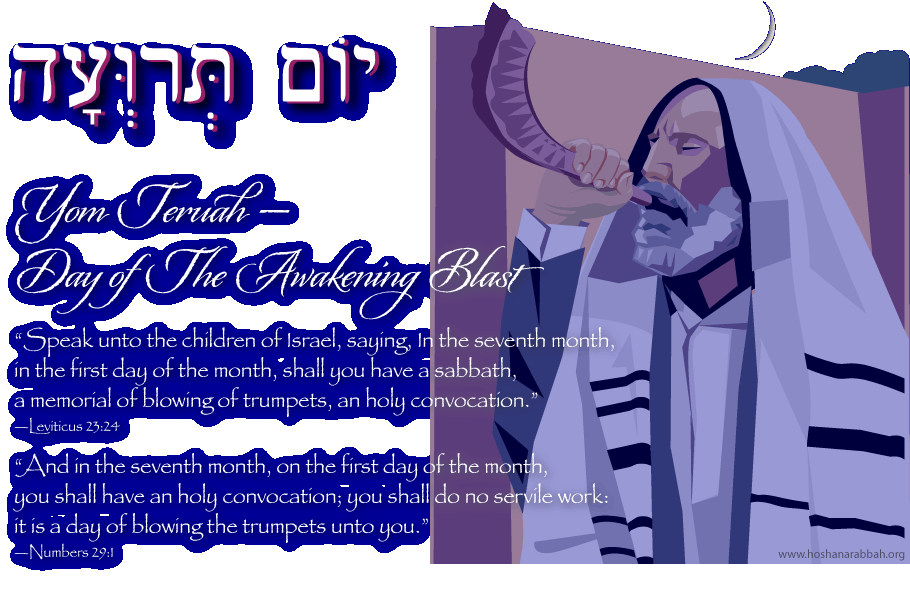
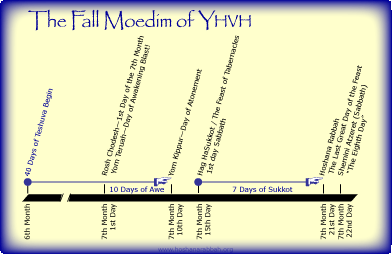
For these reason, I get excited when I see the new moon of the seventh month on YHVH’s biblical calendar. It tells me that I’m meeting the Almighty on the exact day that he set in stone long ago to celebrate Yom Teruah, the Day of Shofar Blowing or Shouting.
But what’s the big to do all about? Why all the shouting and shofar horn blowing?
It will be on this day in the not too distant future that Yeshua the Messiah will be returning in power and glory, and when he will gather his righteous saints—both the living and the dead— together to meet him in the air. NOW THAT IS SOMETHING TO SHOUT ABOUT!
To learn more about Yom Teruah and how to celebrate it, go to
To fully understand Scripture and to extract its applicable meaning to us, we must insert ourselves into the scriptural narrative and ask, what can I learn from this and how does it apply to me? With such an inquiring mind and an open heart, the still small voice of the Spirit of Elohim will begin to whisper insights into our spirit and mind.
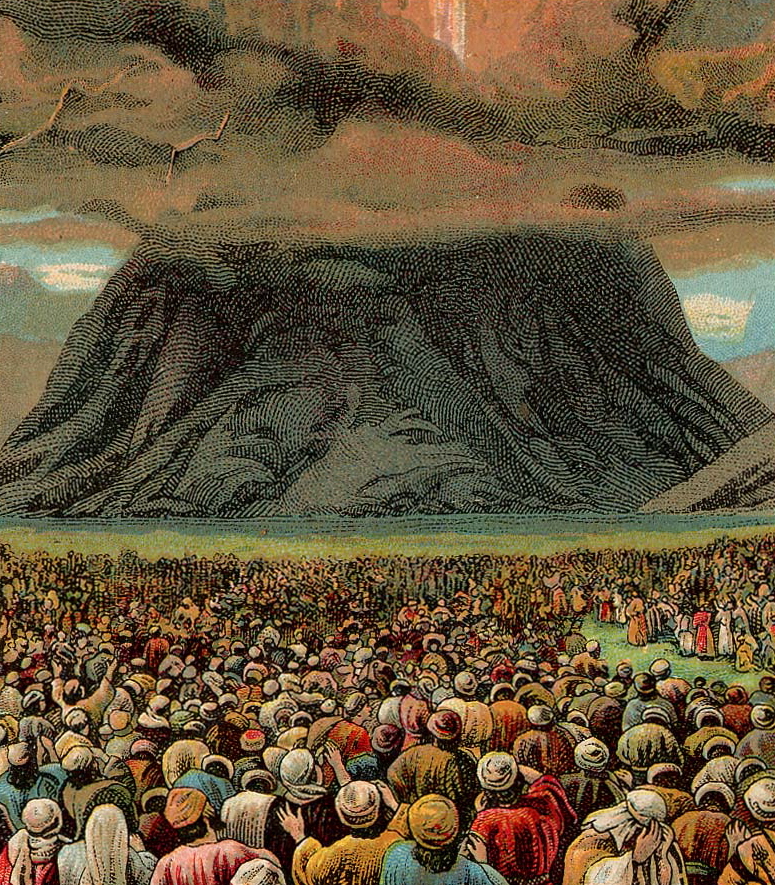
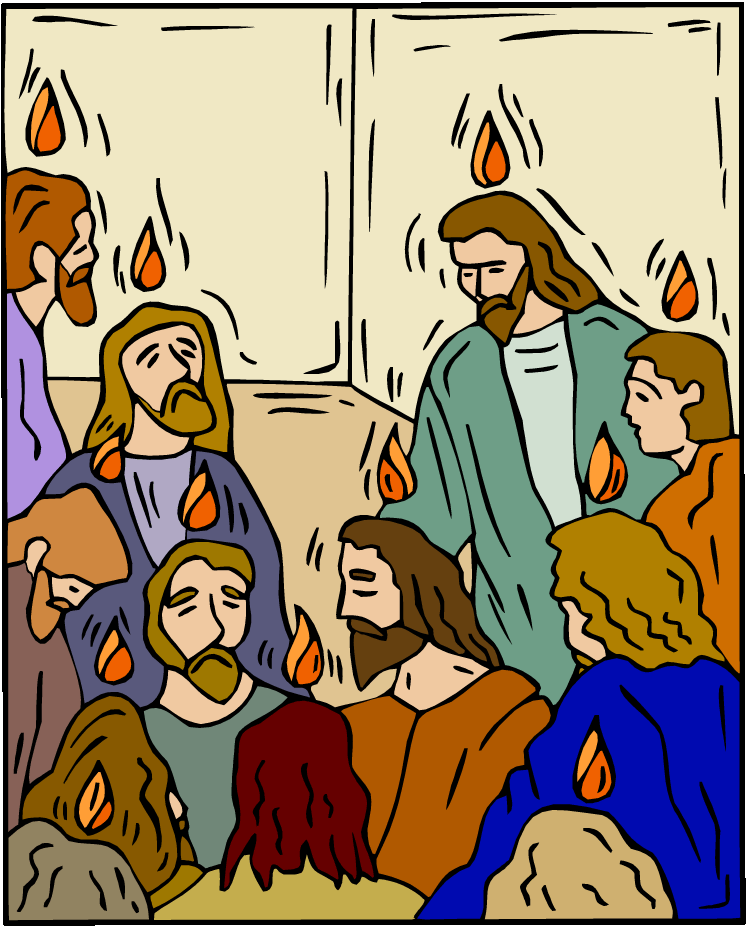
This is how the Word of Elohim comes alive to us and how we find spiritual direction—light in the darkness—to guide us in the path of life. With this in mind, let us now discover what we can learn from Exodus chapter 19 as the children of Israel prepared to meet YHVH Elohim on the day of Pentecost (or Shavuot—its Hebrew name).
Insights from Exodus 19
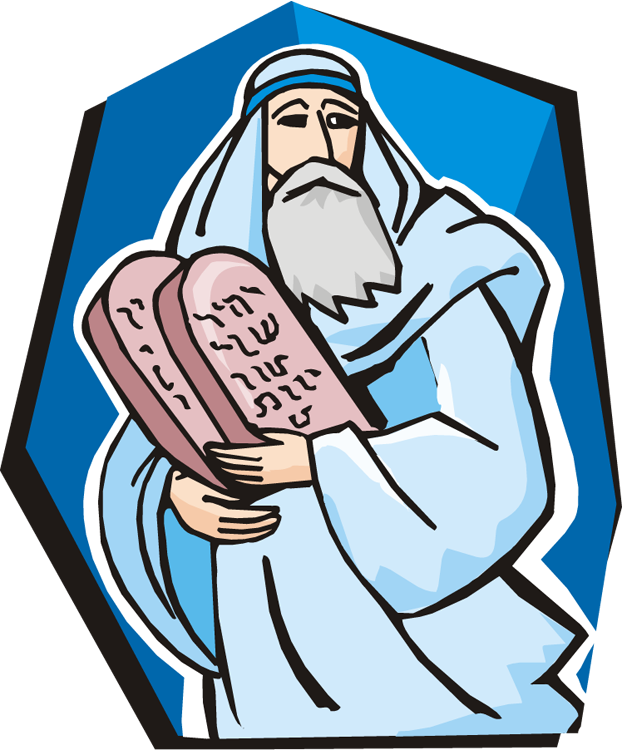
Exodus 19:3, Moses. The name Moses/Moshesh literally means “drawing out or rescued.” What was Moses drawn out of or rescued from? From the waters of the Nile River in Egypt. Water can be a biblical metaphor for humanity, and Egypt a metaphor for Satan’s world. That is to say that Moses was drawn out of or rescued from the seas of humanity. YHVH then used Moses to rescue, draw forth or fish the children of Israel out of the same sea of Satan’s world.
Exodus 19:3, Moses went up. Even before Elohim called Moses, he was willing to go up. Elsewhere in the Psalms, we learn that if we incline our hearts toward YHVH, he will incline himself toward us. Yeshua promised that all those who ask, seek and knock will be rewarded accordingly.
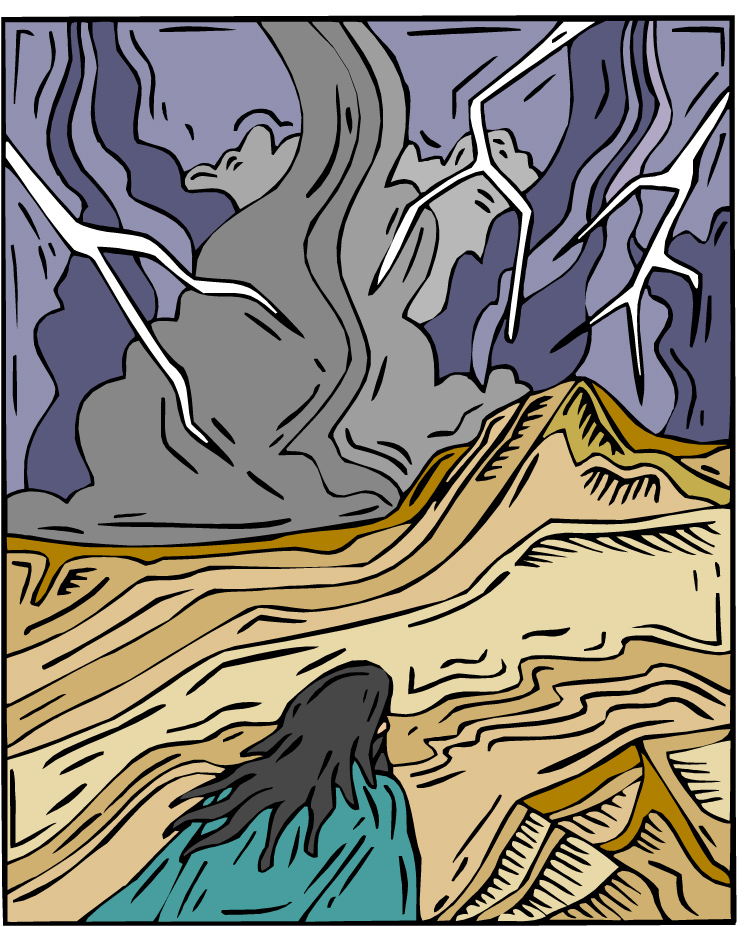
Exodus 19:3, From the mountain. YHVH not only exists, but he exists above the earth on a proverbial mountain far above the human plane. Isaiah declared that YHVH is “high and lifted up.” He is calling us to come up to him. Will we go up to him, or do we love this world too much to answer his call to come up? Twice David the psalmist asks and then answers the question, who will ascend the hill or mountain of YHVH?
YHVH, who may abide in Your tabernacle? Who may dwell in Your holy hill? He who walks uprightly, and works righteousness, and speaks the truth in his heart; he who does not backbite with his tongue, nor does evil to his neighbor, nor does he take up a reproach against his friend; in whose eyes a vile person is despised, but he honors those who fear YHVH; he who swears to his own hurt and does not change; he who does not put out his money at usury, nor does he take a bribe against the innocent. He who does these things shall never be moved. (Ps 15:1–5)
Who may ascend into the hill of YHVH? Or who may stand in His holy place? He who has clean hands and a pure heart, who has not lifted up his soul to an idol, nor sworn deceitfully. He shall receive blessing from YHVH, and righteousness from the Elohim of his salvation. (Ps 24:3–5)
Are you a spiritual mountain climber, or one who is content to be a spiritual low-lander preferring to inhabit the basement of life?
Exodus 19:3, From the mountain. YHVH not only exists, but he exists above the earth on a proverbial mountain far above the human plane. Isaiah declared that YHVH is “high and lifted up.” He is calling us to come up to him. Will we go up to him, or do we love this world too much to answer his call to come up?
Exodus 19:4, Brought you [Israel] to myself. YHVH’s purpose for calling Israel out of Egypt was to bring them to himself. One cannot be of the world and the same time be in Elohim. Yeshua said that his servants cannot serve two masters—Elohim and this world (or mammon). He also declared that though we are in this world, we are not to be of this world. Though we live in this world physically, we are not to be a part of, loyal to or identify with this world spiritually.
Exodus 19:5, If…then. The agreement between Elohim and Israel known as the Mosaic or Siniatic Covenant was conditional. His blessings upon Israel and his elevating them to favored nation status was conditional upon their obeying his voice and walking in covenant with him. It was based on relationship. Is not everything in life that we do based on conditional agreements and relationships with other people and the world around us? There are things we have to do if we want certain outcomes. If we fail to do them, then we pay the price. This includes marriage agreements, employer-employee relationships, friendships, buying a car or house, staying behind a guardrail on the edge of a cliff, following the driving rules of the road, obeying the laws of the land, taking care of our bodies, eating and not eating certain foods, and the list goes on and on. Why should we think that our relationship with our Creator is any different? If we follow his rules, we will be blessed, and if we do not, we will suffer the consequences.
Exodus 19:5, Obey my voice…keep my covenant. Too many times we are inclined to think of the Bible in terms of dos and don’ts—laws and rules. If we stop mid-sentence in verse five, this is what we come up with, and this is off-putting to most people who are naturally averse to rule-keeping. However, obedience to YHVH and his commandments is simply a means to an end as the second half of this verse shows us. It is about relationship with our Creator—about blessings, life and eventually immortality.
Exodus 19:5, Special treasure to me. Why does YHVH want to bring you and me to himself? He wants us to be his own treasured possession. What is your treasured possession? If your house was burning down or you had to flee immediately and could take only one possession, what would it be? That is how YHVH views those who seek and follow him, but much, much more.
Exodus 19:5, Above all people. YHVH exists in heaven, on a proverbial mountain. He invites his people—those who answer his call—to come up to him. He has shown us the way—his way, the way of Torah (i.e. obeying his voice and keeping covenant with him), which is the way up to him. When we come up to him, it will put us above the people around us. That is why the Bible always speaks of “going up to Jerusalem” or “going down to Egypt.” Heaven is above this earth; the earth is below heaven.” Those who are citizens of the kingdom of Elohim are at a higher spiritual plane than those who are of this earth or world. It does not mean that Elohim’s saints are better than anyone else. It just means that they are walking at a higher level spiritually, and that they have been saved by his grace—his unmerited pardon, and that he has divinely enabled them to obey him. Let no man glory in his, wisdom, might or riches but only in the fact that he understands and knows Elohim (Jer 9:24).
Exodus 19:5, For all the earth is mine. Why does YHVH add this phrase after the previous one? What is his point? As the Creator of all things, everything belongs to him; therefore, he determines the rules and on what basis he will elevate people to a special status before him. He delivered Israel out of Egypt and chose Israel to be his own treasured people conditional upon their obeying his voice and walking in covenant with him (v. 5). All of the other religions, man-made philosophies and spiritual paths notwithstanding, there is only one way to Elohim; it is his way.
Exodus 19:6, Kingdom of priests…a holy nation. YHVH had a purpose for elevating his people to that of favored nation status. It was not so that they could just revel in his blessings eating, drinking and making merry until they passed from this mortal scene. No. YHVH had a end game plan for his people then, and he still has the same plan for his people now. It is to taste and see that YHVH is good, that obeying him brings blessings and then to share that good news with those around us. If you are a follower of Yeshua, are you fulfilling your role as his a part of his royal priesthood, holy nation and his own special people to proclaim the praises of him to those who are still dwelling in the darkness of this world and to help bring them into the marvelous light of his Truth as Peter proclaims (1 Pet 2:9)? Or are we just reaping the benefits of YHVH’s grace upon our lives, and living our lives for our own self-centered benefit without fulfilling our end of the deal to be spiritual salt and light to those around us? Is our relationship with YHVH a one-way street where we expect all the benefits without giving anything in return? If so, ask yourself this: How does such a relationship work in a marriage or friendship where one party does everything and the other party does nothing in return? How long can this last before the one doing all the giving says, “Forget it, I’m out of here! This one-sided relationship is no longer worth my time or effort.” Eventually, YHVH will say the same thing to those who are only takers and not givers. They will hear the words, “Depart from me you workers of iniquity, I never knew you.”
Over the past 20 years, I, along with the help of my wife, have put together an abundant array of resources to help you to understand and then to celebrate YHVH’s biblical feasts. Here is a list of these FREE resources and the links to find them. Happy studying and then doing for the glory of YHVH, the advancement of his heavenly kingdom and for YOUR spiritual growth and development into the fullness and stature of Yeshua the Messiah!
Happy studying and may you be filled with joy as you learn more about the ways of YHVH and how to step deeper into the river of life in serving and obeying him!
Leviticus 23:2,My feasts [Heb. moedim]. YHVH calls these feasts his feasts. They’re not men’s feasts or the Jewish feasts! They came from YHVH and belong to him. When men pervert YHVH’s feasts by mixing in pagan traditions, they’re no longer YHVH’s feasts, but men’s feasts (e.g. Isa 1:13–15; Amos 5:21; Hos 2:11). When men pollute his feasts and appointed times, YHVH says that he hates them because they’re no longer his feasts (Isa 1:14–15).
In Ezekiel 20, we see that YHVH’s feasts (or sabbaths) are a covenantal sign between YHVH and his people (Ezek 20:12) that they were to live by (Ezek 20:11), yet which Israel, in rebellion, refused to do while in the wilderness. Instead they defiled his sabbaths by, presumably, not doing them and doing other things on those holy days (Ezek 20:13). Israel’s rebellion against YHVH with regard to their refusal to keep his sabbaths brought upon them YHVH’s judgments (Ezek 20:13).
In other words, it was YHVH’s will for the Israelites to keep his sabbaths in the wilderness, but because of their idolatrous rebellion, they refused to do so. In fact, YHVH calls refusing to observe his sabbaths idolatry and for this sin (along with other sins), the Israelites had to wander in the wilderness for forty years (Ezek 20:15–16). In profaning his sabbaths, YHVH accuses the Israelites of despising his Torah (Ezek 20:16). YHVH then goes on to urge his people to not follow the example of their rebellious forefathers, but rather to walk in all of his Torah commands (including his sabbaths, Ezek 20:18–20). Because of their profaning his sabbaths, he punished them by scattering them in exile among the heathens. Those modern saints who refuse to keep YHVH’s Sabbath and feasts are walking in the same sin as the ancient Israelites. Often people who refuse to keep YHVH’s feast days holy do so because the feasts conflict with their secular activities (such as their jobs). YHVH calls this idolatry and being like the heathen (Ezek 20:30, 32). In the end times, YHVH is going to separate his people out from the heathen and bring them back into covenantal agreement with him including obedience to his sabbaths (Ezek 20:33–38). He will purge from his people those rebels who refuse to obey him including keeping his sabbaths (Ezek 20:38), which are a sign of his covenantal relationship with them.
In Genesis chapter one when Elohim created the sun and moon, he called the former “the greater light” and the latter “the lesser light” (Gen 1:16). The former rules the day and the lesser rules the night (ibib.). This is prophetic of the role of Yeshua and the saints in the world.
Yeshua the Messiah is the Light of the world (John 1:6–9; 8:12; 9:5) or the Sun of Righteousness (Mal 4:2) or the Greater Light to show man the path of spiritual light in the darkness of this world. The saints are like the moon or the lesser light that reflects the light of the sun or the greater light into the darkness of this world. Yeshua shines his spiritual light onto his disciples who then take that light and evangelize those lost in spiritual darkness with the message of the gospel. This is the great commission!
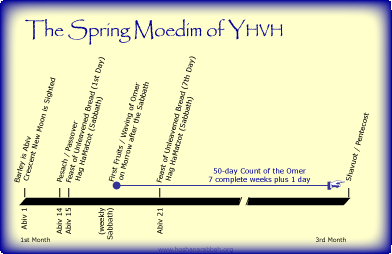
The biblical feasts are calculated based on the lunations of the moon. The seven biblical holidays speak of YHVH’s plan of salvation to show man the way to Yeshua who is the Greater Spiritual Light as represented by the sun. The feasts are like a tract or sermon by which the saints preach the gospel message of salvation to the world. The saints as the lesser light reflecting the message of salvation through Yeshua the Greater Light into the darkness of this world through their adherence to the biblical feasts. This is one reason why the moon—the lesser light—is so pivotal to YHVH’s calendar and feasts.
The traditional calendar currently used by the non-believing, rabbinic Jews is off; it’s not in accordance with the moon though the Jews erroneously purport it to be. At the same time, they’re not bringing the gospel message of Yeshua to the world—only the doctrines of men and men’s traditions. Their whole message is askew and fails to reflect the Greater Light of Yeshua.
Similarly, the mainstream church tries to preach the gospel, but without understanding the moon, feasts and biblical calendar their message of the gospel is only a partial one and is also off spiritually.
A time may come in the future when the calendar and feasts will go strictly off the sun and not the moon. This may occur when there is a new heaven and a new earth when Yeshua is ruling on this earth and he will be the only Light of the world. That time isn’t yet, though, for it’s still the saints’ job as the lesser light to be like the moon to reflect the truth of Yeshua, the Greater Light, to this world through a lunar-based calendar upon which the biblical feasts are based.
Leviticus 16:1–34, Passover and the Day of Atonement compared. A cursory reading of the Scriptures seems to indicate that there exists overlapping similarities between some of the blood atonement ceremonies of Passover or Pesach and the Day of Atonement or Yom Kippur. What are the differences between the sin atonement offerings of Pesach and Yom Kippur?
Perhaps realizing the fact that the Passover occurs during the spring feast day season and the Day of Atonement occurs during the fall feast day season may help to answer this question. This is because prophetically the spring feast days picture Messiah Yeshua’s first coming, while the fall feast days prophetically point to his second coming. How does this understanding shed light on the answer to this question?
Both Pesach and Yom Kippur picture redemption through the shed blood of Yeshua, that is, the saint being delivered from bondage to sin and the rudiments of this world. Passover symbolizes the first steps a new believer takes when coming out of spiritual Egypt and accepting Yeshua, the Lamb of YHVH, as one’s Savior and Master. Yom Kippur, on the other hand, pictures the blood of the Lamb covering over the saint’ sins after his initial salvation experience and the corporate sins of the nation of Israel.
If our understanding of the order of end time events is correct, Yom Kippur also prophetically points to the time when Yeshua will return to the earth to initiate the final regathering of the lost and scattered tribes of Israel, and to prepare to marry his bride, redeemed Israel or the Israel of Elohim (Gal 6:16), that is, the saints. Perhaps this latter understanding will help to answer why another Passover-like feast is needed. Yom Kippur does not focus so much on leaving Egypt, but rather on YHVH’s people preparing to enter the millennial kingdom under the Messiah. Those saints who will be the betrothed bride of Yeshua need to make themselves ready for Yeshua’s return by putting on spiritual robes of righteousness that are spotless and pure. Although the bride of Messiah saints are not sinners by definition, for the Bible calls them “the righteous” (1 Pet 4:18), they still sin (hopefully only occasionally; 1 John 1:8–9; Rom 7:13–25), and still need to have their sins washed away by the blood of Yeshua, even just before they meet Yeshua at his return. Yom Kippur pictures this final redemptive cleansing or preparation time of Yeshua’s bride.
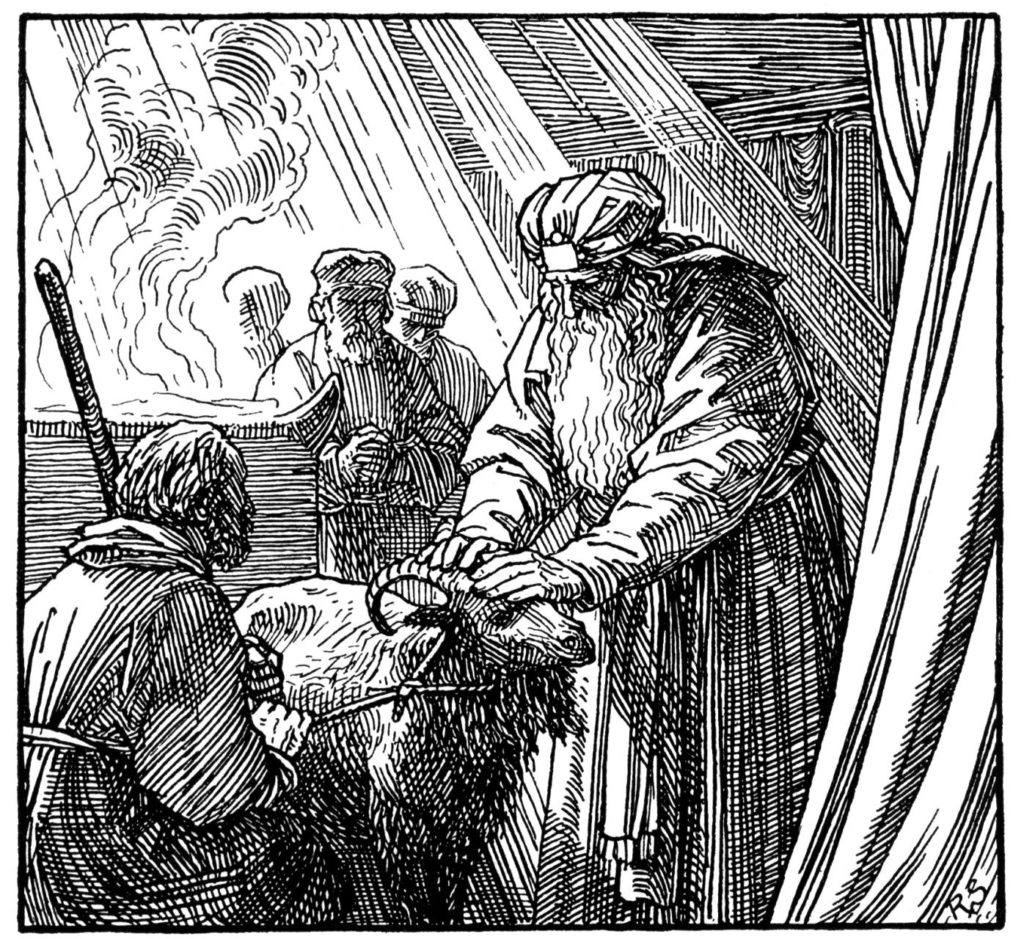
Understanding the Yom Kippur Goat Rituals
Understanding and interpreting the rituals of Leviticus 16 can be perplexing and complicated task. This is because often encrypted in certain scriptural passages the deep and open-minded Bible student will find multiple levels of meaning and prophetic fulfillments. The serious biblical researcher understands this and is not put off by any seeming discrepancies between a surface or literal fulfillment of a scripture vis-à-vis its prophetic fulfillment. An example of this would be the virgin and child prophecy of Isaiah 7. There was both a historical or immediate fulfillment of this prophecy and a future one relating to the coming Messiah.
Moreover, we must keep something else in mind when dealing with biblical passages that are difficult to understand because they contain figurative language of a prophetic nature that often employ typologies (types and shadows). By definition, a type is a person or thing that represents someone or something else. When dealing with prophetic types in Scripture, the type never perfectly mirrors that to which it is prophetically pointing. The type is merely a shadow of what is to come (Col 2:17; Heb 10:1; 8:5), and therefore it is neither a perfect representation of the reality nor its there a perfect one-to-one correlation between the two. However, there are enough similarities to deduce a correlation between the two, even as a shadow is the shape and outline of the image it represents, but it doesn’t contain all the details of it.