The Grander Picture of the Tabernacle of Moses and Man’s Ultimate Destiny
Exodus chapter 25 and onward contains YHVH’s instructions to Israel to build a tabernacle or sanctuary so, in his own words, “I may dwell among them” (Exod 25:8). Is the construction of an elaborate tent in the desert merely a quaint, archaic and irrelevant historical event that occurred millennia ago, or is there a larger prophetic picture here that points to something much grander that relates to you and me? The answer to the latter question is a most definite and emphatic, “Yes!”
As a historical, contextual backdrop, let us first step back to the beginning of man’s creation. At that time, YHVH Elohim formed man in his image for the purpose of raising up a family of glorified sons and daughters to become like him, and to live with him forever in a glorified and elevated state of existence. To that end, he placed the first humans in an idyllic garden where he could walk and commune with them in the cool of the day—symbolic of a state of restful or comfortable and relaxed communion. Sadly, this one-on-one relationship did not last long, and man was thrust out of the garden (symbolic of YHVH’s dwelling place on earth) because of sin and the lack of man’s holiness without which no man can enter into much less remain in the presence of the holy (set-apart), perfect and sinless YHVH Elohim.
Moving forward in time, some 3,500 years later in the time of Moses, we arrive at the time where YHVH instructed the children of Israel to build another dwelling place for him that he might abide with his people once more. Instead of a garden, this was a movable tent called the Tabernacle of Moses, which contained a special room called the holy of holies. It was in this one spot where YHVH desired to dwell on earth again with his human children.
But there is one caveat. One cannot merely go blithely, casually or cavalierly waltzing into the holy presence of YHVH in a state of sinful impurity or unholiness. After all, would a person in their right mind deign to march into the presence of the pope, king of England or the Oval Office of the White House unwashed wearing filthy jeans and a holey T-shirt? This would be unthinkable. How much more then the Creator of the universe? No. There is a process of spiritual cleansing that must first occur and the tabernacle (along with the seven biblical feasts) reveals a seven step process, which is YHVH’s plan of redemption or salvation for man, for man to join in holy communion with a holy Elohim.
The tabernacle that YHVH commissioned the Israelites to construct was literally a giant, demonstrative and interactive gospel tract showing man the way to his Father in heaven. It was (and still is) a symbolic and metaphorical picture of the transformational cleansing process required to go from a state of spiritual uncleanliness to purity with the ever-present help of Yeshua the Messiah who came to show man the way to his Father in heaven (John 14:6). Amazingly, the tabernacle is also a picture of each of us, who, if we are willing, can follow Yeshua step-by-step into the presence of our holy (pure and sinless) Father in heaven.
To be sure, YHVH desires a personal relationship not only with corporate Israel, but also with each of us individually. Elohim’s chosen people, the nation of Israel, is comprised of individual entities each with their own unque relationship with the Creator. Coming into the inner sanctum of the holy of holies in the tabernacle (representative of YHVH’s heavenly throne room) should be the ultimate goal of each person, and it is YHVH’s highest desires and plan to lead each of us into his presence by way of Yeshua his Son, who is the way, the truth and the life and the only way to the Father (John 14:6).
The transformational of process of spiritual cleansing begins occurring when one comes to faith in Yeshua, repents of one’s sin, and then allows the Holy Spirit to commence a miraculous spiritual work on the inside of each of us. The Tabernacle of Moses is the three-dimensional gospel tract that outlines the progressive steps in this cleansing process that ultimately transforms a person into the higher and ultimate dimensions of a spiritual reality that is beyond that of this physical existence. Moreover, the tabernacle outlines the steps required for the indwelling presence of YHVH’s Spirit which activates our personal spirit that resides deep inside of us thus drawing us upward to our Father in heaven. As such, we literally become a living Tabernacle of Moses or, as Paul characterizes it, a temple of the Holy Spirit. This is a mystery that few humans, including Christians, understand, but that has been hidden in plain sight in our Bibles for thousands of years!
To the degree that we allow YHVH to work in us, to cleanse and refine us, is to the degree that we advance along the progressive steps upward toward our Father in heaven as outlined in the Tabernacle of Moses.
If we will be honest with ourselves, most of us are not as far along in this process as we think. There for YHVH’s grace go each of us! But at least we have the road map of the tabernacle to show us the way onward and upward. There are no shortcuts to Elohim, and this journey will take a lifetime, and even then, each of us will still need the grace of Elohim as well as the imputed righteousness of Yeshua to compensate for our lack of righteousness. Despite our best efforts, each of us will fall short of “the mark for the prize of the high calling of Elohim in Messiah Yeshua” (Phil 3:14). This is because the righteous are scarcely saved (1 Pet 4:18), and all of our righteousness is as filthy rags (Isa 64:6). When we finally come to this realization and humble ourselves before YHVH Almighty, and we allow him to begin cleaning us spiritually (a process called “sanctification”) from the inside out, it is then that he can begin his spiritually transformational work deep inside each of us and lift as he raises us up (Jas 4:10) to seat us in heavenly places with Yeshua (Eph 2:6). It is then that we will be fully born again as new, glorified and immortalized children of Elohim and adopted into his eternal family (Rom 8:12, 23; 9:4; Gal 4:5; Eph 1:5).
This is the ultimate message of the entire Bible of which the Tabernacle of Moses is an illustrative, symbolic and prophetic depiction, so that even a child can visualize it. Sadly, this is also a truth and message that the mainstream Christian church has largely overlooked, even though, and curiously so, many churches, cathedrals and basilicas the world over are patterned to one degree or another after the Tabernacle of Moses.
Exodus 25:8–9,A sanctuary…tabernacle.
How the Tabernacle of Moses Relates to YOU
Before launching into a study of the Tabernacle of Moses, let’s first ask ourselves a question. When teaching our little children and the things of life, do we hand them the multi-volumed set of Encyclopedia Britannicas? Of course not. They wouldn’t get past page one. We give simple story books with giant print and a plethora of pictures that help them to understand basic concepts like the alphabet, colors, the names of animals and so on. YHVH Elohim, our Father in heaven, did the same thing when teaching his children of Israel—and us too—about his amazing and life transforming plan of salvation. Instead of a storybook, he had the Israelites construct the Tabernacle of Moses, which reads like simple gospel tract. But curiously, the more one dives into and explores its depths, complex and expansive of truth and divine revelation into the mind and heart of YHVH Elohim and the Person of Yeshua the Messiah will progressively reveal themselves layer by layer leading to the heart and soul of our Father in heaven with the end result of abiding forever in his glorious presence.
Yet there is another way to look at the Infinite (Elohim) trying to communicate with the finite (humans). If you were the Creator of the universe, what means would you use to communicate with those that you had created through love in your likeness and image? In a remote and somewhat dissimilar way that nevertheless transmits a certain idea, it is like a human standing over an anthill trying to communicate with the ants. How do you do it? Similarly, how does an all powerful, Spirit Being, loving Father in heaven relate to his mortal children who are but mere specks of dust without vaporizing them into oblivion with his raw power by his presence? The difficulty is compounded when fearful and estranged humans do not want to hear the voice of Elohim, which is what happened when YHVH Elohim’s voice thundered from Mount Sinai. The children of Israel begged him not to talk face-to-face with them lest they die. They asked the Almighty One to speak to them instead through Moses (Exod 20:19).
When man committed his first sin at the tree of the knowledge of good and evil in the garden, he was cut off from a spiritual relationship with their holy and sinless Creator. The Garden of Eden pictured this halcyon state between YHVH and man. Because of sin and rebellion on man’s part, this relationship was ruined, and YHVH expelled the first humans from the idyllic Eden, and direct communications between man and his Maker were hampered if not largely cut off. However, Elohim had a plan to restore the loving relationship he had with his earthly children before their rebellion and fall. But if men refuse to hear you when you speak, what are you do?
For certain, the Almighty does not lack for ways to communicate with his human children. Man is without excuse when it comes to hearing Elohim, for even the heavens declare the glory of the Creator and the plans he has for mankind (Ps 19:1ff). The visible things of this creation shout loudly about the spiritual mysteries heaven desires to reveal to its earthly subjects (Rom 1:18–20); therefore, only blind fools refuse to acknowledge YHVH’s existence (Pss 14:1–3; 53:1–3). Furthermore, from time to time over the millennia, Elohim has chosen to speak directly to some of his select servants through dreams, visions, signs, wonders, angels, and once he even spoke through a donkey! But how does he speak to a whole nation, if that nation is plugging its ears and refusing to hear its Master’s voice?
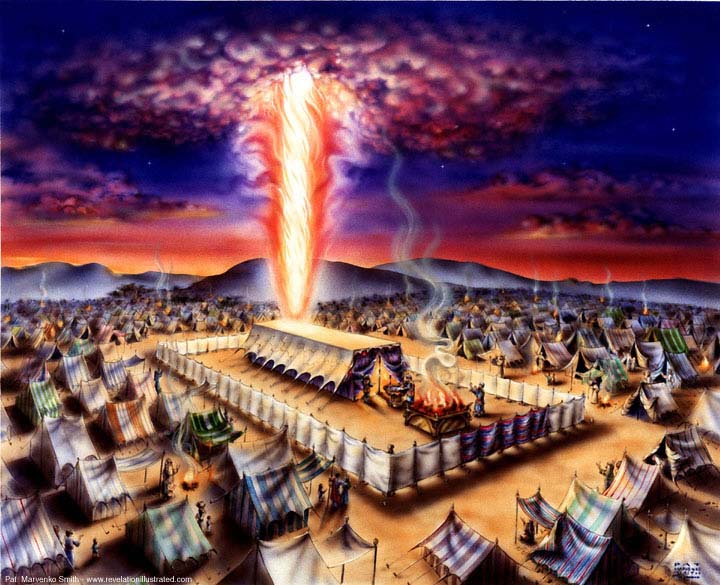
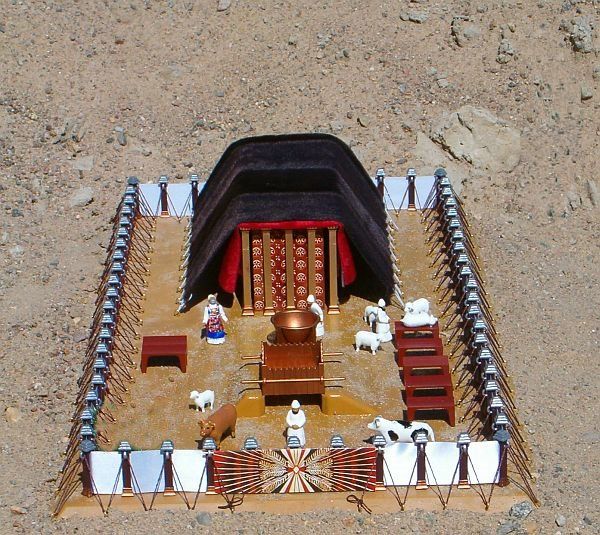
Enter into the picture the Tabernacle of Moses or mishkan, which YHVH commissioned the children of Israel toconstruct in circa 1450 b.c. at the foot of Mount Sinai. It took the Israelites about a year to build. It was the first job assignment that YHVH gave to the children of Israel after their Exodus from Egypt. The tabernacle was literally a three-dimensional gospel message tract. It was the visual demonstration of the whole salvation message of the Bible in a building—the blueprint of the plan of the redemption of wayward, sinful man. It was a functioning masterpiece of artwork demonstrating the Father’s love for his people, and of his desire to commune and to communicate with Israel—his treasured possession, those he had hand picked and called out from the 70 nations of the world. Not only did the tabernacle involve the sense of sight, but the other four senses as well: sound, smell, touch, and taste. It also engaged and even challenged the heart, emotions, mind and the spirit of man to focus on one’s need to be spiritually reconciled to his Creator. The Tabernacle of Moses was a vehicle for the Creator of the universe to communicate with man using a panoramic, multidimensional, panoply of communication devices all of which pointed to the coming Messiah, the Redeemer of mankind, who would die for the sins of the world in order to restore man into a loving relationship with his ever-loving, gracious and longsuffering Father in heaven.
This is the story of the tabernacle in which theatrical plays are present through the props of pageantry with containing costumed actors each performing his carefully choreographed role on cue. Even a child can comprehend the message of this play, yet it contains mysteries and truths so deep that only in eternity itself will they be revealed to their fullest extent to those who have been initiated into higher spiritual levels of divine revelation through the tabernacle’s symbolic and metaphorical rites and ceremonies, which were illustrative prophetic shadows of future momentous events relating to the redemption of mankind. To understand it, is to understand the message of the whole Bible from Genesis to Revelation.
Let’s now enter into the world of the Tabernacle of Moses. Welcome aboard!
The Steps of Redemption Within the Tabernacle
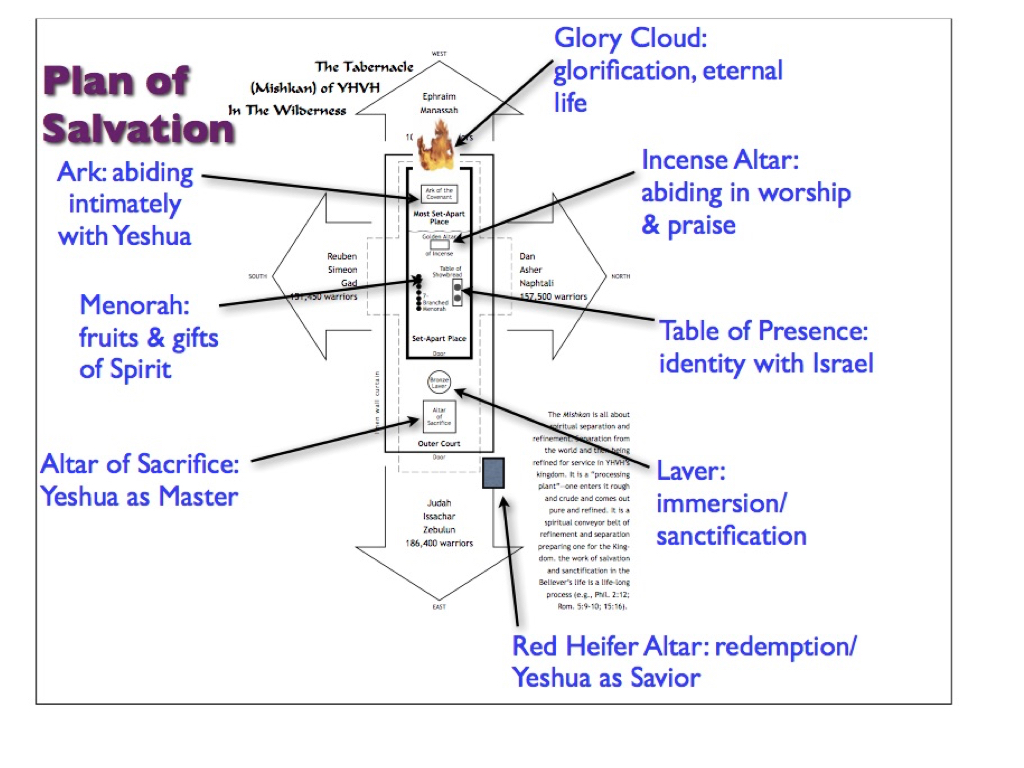
Contained in Tabernacle of Moses are seven (the biblical number signifying perfection of completion) and eight (the biblical number signifying new beginnings) progressive steps that reveal the Creator’s plan of redemption or salvation for mankind from the first step of initial salvation to becoming a glorified resurrected, immortal and forever child of Elohim.
First Step of Eight. Each of us is born in a state of separation from his Creator because all humans were cut off from Elohim due to man’s original sin. Before being reconciled to YHVH, each of us is lost and wandering about in our own personal wilderness of sin. Along the way, we suddenly come upon a beautiful site. We see the good news or gospel message, the light of YHVH’s divinely reveled Truth, the message of the cross, which is symbolized by the multi-colored door and the luminescent walls of the Tabernacle of Moses in the bleak, desolate and monochromatic desert wilderness. As one takes his first steps to become separated or set-apart from the confusion, darkness, chaos, emptiness, lostness and death of the surrounding wilderness of this world, one first encounters the altar of the red heifer located outside the tabernacle (in later years located on the Mount of Olives opposite the temple, Mishnah Parah 1:1ff). There the red heifer was slaughtered and burned and its ashes were used as a sin offering to bring about purification for uncleanness (Num 19:1ff). Yeshua was likewise crucified outside of the camp of Israel and the gates of Jerusalem (Heb 13:10–13). This altar represents the work of Yeshua at the cross. One cannot enter the tabernacle until one has been redeemed and purified by the blood of Yeshua. Even the Israelites killed the Passover lamb outside their homes on the afternoon of the fourteenth of the month of the Abib. The blood was then smeared on the doors of their homes. Once they entered the blood-smeared doors and were inside their homes, they were safe from the destroyer of YHVH, who simply passed over them. Likewise, when we enter through the gates of the tabernacle (which are crimson in color, as well as blue, white and purple—colors which point to the four Gospels and the four aspects of Yeshua’s mission as Redeemer), we do so saved and purified. This first step in YHVH’s plan of redemption is symbolized by the Passover (Pesach), which is the first of YHVH’s seven annual appointed times (or moedim).
Second Step of Eight/First Step of Seven. Upon entering the tabernacle one immediately comes to the altar of sacrifice. After the lamb was sacrificed on the afternoon of the Passover, that evening (the beginning of the fifteenth day of the first month, which was also the first day or a high Sabbath of the Feast of Unleavened Bread/Chag HaMatzot), the Israelites ate the Passover lamb. Similarly, at the altar of sacrifice the Levites would eat those animals sacrificed there. This pictures the fact that the saved believer must continue to “eat the flesh” and “drink the blood” of Yeshua to stay in communion with him (John 6:35–58), and that when one sins after one is saved they must continue in a state of repentance and overcoming through the blood of Yeshua the Lamb of Elohim (1 John 1:7–9). On that evening, one not only ate lamb, but unleavened bread after having put all leavened food out of one’s home. This pictures the believer walking forward spiritually as they are putting sin out of their life. To the degree that one eliminates sin from one’s life is the degree to which one has communion with our Father in heaven. Therefore, the altar of sacrifice in the tabernacle is a metaphorical picture of both the Passover meal and the first high Sabbath of the Feast of Unleavened Bread.
Third Step of Eight/Second Step of Seven. At the bronze laver one ritually washed in preparation for entering into service in the tabernacle sanctuary itself. This represents being baptized for the remission of sins, being washed in the water of the Word of Elohim and receiving the Set-Apart or Holy Spirit of Elohim. This corresponds with the children of Israel crossing the Red Sea and being baptized unto Moses, who was a prophetic type of Yeshua (1 Cor 10:2). This occurred during the Feast of Unleavened Bread, and most likely on the last high Sabbath of that week-long festival.
Fourth Step of Eight/Third Step of Seven. One now enters the tabernacle itself and next finds oneself at the menorah, where the light of the Spirit of Elohim shines in the hearts and minds of men. Here as one is growing in spiritual maturity, one begins becoming fruitful as they learn to walk in the fruit of the Spirit, and become empowered with the gifts of the Spirit to reach a lost world. Once separated, redeemed, washed and transformed by the Word and Spirit of Elohim, one becomes a spiritual light that is shining into this dark, lost world. Humans are the lesser light (like the moon) reflecting the greater light of the Yeshua, who is the Sun of Righteousness (Mal 4:2). This occurred for the first-century believers on the Feast of Pentecost (or Chag haShavuot).
Fifth Step of Eight/Fourth Step of Seven. Now we come to the table of show bread containing twelve loaves of unleavened bread neatly arranged in two stacks of six each. This step portends a future time when Yeshua’s people prepare themselves to meet him at his second coming. It is at this time that the awakening and reunion or regathering of the twelve tribes of Israel occur untied around Yeshua, the Bread of Life occurs. This is all pictured prophetically by the Day of Trumpets (or the Shouting or the Shofar Blast).
Sixth Step of Eight/Fifth Step of Seven. The next step of progression in the tabernacle is the altar of incense in front of the curtain that leads to another room called the holy of holies. At this step the focus is on intimacy and intercession, purity of heart, oneness and relationship with the Father through prayer, praise and worship. This speaks of thefinal redemption (jubilee) where YHVH’s people will be regathered to worship him in total freedom without the distractions of the world, flesh and the devil (who have been judged). The altar of incense and Day of Atonement (Yom Kippur) are pictures of this.
Seventh Step of Eight/Sixth Step of Seven. We have now entered the inner sanctum of the tabernacle called the holy of holies which represents the heavenly throne room of YHVH Elohim. This step speaks of total peace (shalom) and Sabbath rest during the Millennium between YHVH and his beloved saints, the bride of Yeshua. It is a time of feasting and rejoicing; a time of Torah-teaching and learning, of spiritual bread and fruitfulness. The ark of the covenant and the Feast of Tabernacles (Chag haSukkot) picture this step.
Eighth Step of Eight (Eternity Begins)/Seventh Step of Seven (perfection or completion has occurred in YHVH’s plan of salvation for man). This step pictures being totally set-apart to YHVH for eternity. This is the ultimate goal, or summum bonum of YHVH for his redeemed children. At this point the saints experience the ultimate deliverance from spiritual darkness as they are bathed in the divine and eternal light of New Jerusalem, which is the Sun of Righteousness who is the Lamb of YHVH in whom there is total light and no shadows. The shekinah glory of YHVH Elohim above the ark of the covenant signifies this glorious time of which the seventh feast, The Eighth Day (Shemini Atzeret) is a prophetic picture.
Thus, there are seven appointed times or feasts and seven steps in the mishkan, but eight steps in all picturing perfection and completion and new beginning in the New Heaven, New Earth and New Jerusalem.
Exodus 25:8, That I may dwell with them. It is the heart of Elohim—to dwell with his people that he has created in his own image. Imagine that! He wanted to dwell with Adam and Eve in the garden until their sin and rebellion cut them off from fellowship with him. In the process of time, YHVH instructed his special people to construct the Tabernacle of Moses, which contains the ways and means by which sinful humans could have their sins atoned for and come back into a right relationship with their holy Creator, so that he might again dwell with them forever. Everything in the tabernacle pointed forward to Yeshua the Messiah through whose atoning death repentant and believing humans reverse the curse of a broken relationship that Adam and Eve left in the wake of their sin. The tabernacle showed man the way back to the Father through a relationship with Yeshua, so that relationship with Elohim might once again be restored and heaven and earth might dwell together in love, harmony and peace. Those people who have made this spiritual transaction and made peace with their Creator are now the spiritual temple or dwelling place of Elohim, who lives in them by means of his Holy Spirit as both Paul and Yeshua inform us (1 Cor 3:16; 2 Cor 6:16; John 14:16–18, 26; 15:26; 16:13–14).
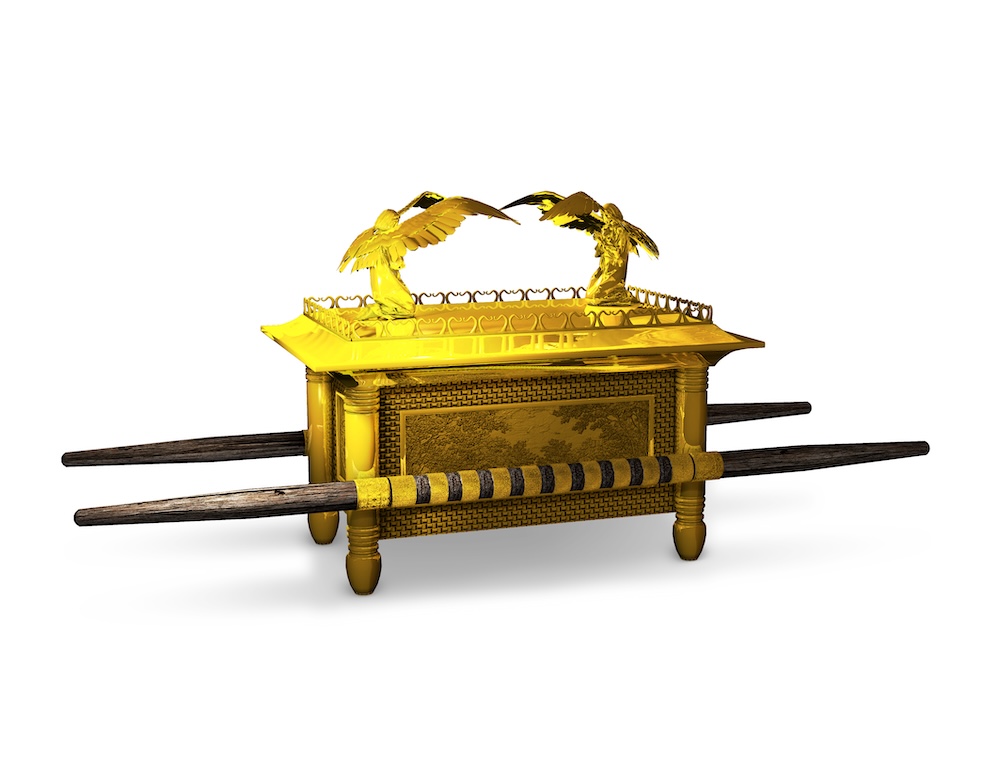
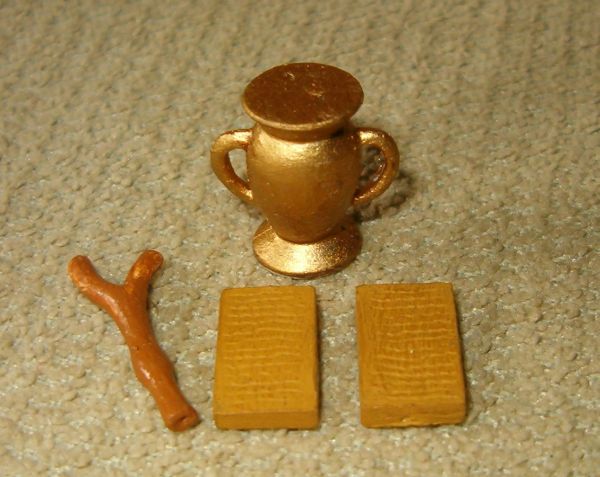
Exodus 25:10–22, Ark. The ark of the covenant was a small box of acacia wood overlaid in gold, which contained the golden pot of manna, Aaron’s rod that budded and the two tablets of stone containing the ten statements (or the Ten Commandments) of Elohim. Against the ark was leaned a scroll with the complete Torah written on it (Deut 31:26).
Covering the ark was a golden cap called the mercy seat or kapporet, which is related to the word kippur as in Yom Kippur, the Day of Atonement. Both words share a common Hebrew linguistic root, which is the word kapar, and which according to TheTheological Wordbook of the Old Testament (The TWOT)means “to make an atonement, make reconciliation or purge.” Thus the mercy seat or the golden “lid” covering the ark of the covenant located in the holy of holies or d’veer (i.e., the inner shrine of the Tabernacle of Moses) in Hebrew is the word kapporet. This was “the place of atonement or the place where atonement was made.” TheTWOT defines what happened at the kapporet as follows:
“It was from the…mercy seat that [YHVH] promised to meet with the men [of Israel] (Num 7:89). The word, however, is not related to mercy and of course was not a seat. The word is derived from the root ‘to atone.’ The Greek equivalent in the LXX is usually hilasterion, “place or object of propitiation,” a word which is applied to [Messiah] in Rom 3:25. The translation ‘mercy seat’ does not sufficiently express the fact that the lid of the ark was the place where the blood was sprinkled on the day of atonement. ‘Place of atonement’ would perhaps be more expressive.”
The mercy seat covering the ark that contained the Torah is a vivid symbolic picture of YHVH’s mercy triumphing over his judgment against man’s sin (Jas 2:13). Each of us deserves death for violating YHVH’s commandments, for the wages of sin is death (Rom 6:23), and sin is the violation of YHVH’s Torah commands (1 John 3:4). Yet when we repent of our sins and place our faith in Yeshua’s atoning death on the cross as payment for those sins, YHVH forgives us and grants us his merciful grace.
Everything in, on and around the ark pointed to Yeshua, who is man’s Savior and Redeemer. Inside the ark was the golden pot of manna, which points to Yeshua who the bread of life—the Word of Elohim made flesh. Aaron’s rod that budded speaks of Yeshua’s role as man’s ultimate heavenly High Priest thanks to his atoning and life-giving work at the cross. The two stone tablets and the Torah scroll prophetically point to Yeshua, who was the Word of Elohim from the foundation of the world (John 1:1, 14), and whose words or instructions in righteousness the saints are instructed to follow (John 14:15; 1 John 2:3–6; Rev 12:17; 14:12).
Overshadowing the mercy seat were two golden cherubim with outstretched wings. This is a prophetic picture of YHVH’s throne in heaven, which is surrounded by cherubim and other living creatures that sing his praises and minister to him non-stop (Rev 4).
The ark of the covenant is the gold-covered acacia wood box with the pure gold crown or mercy seat upon which are the two gold cherubim that represented the very throne and glorious presence of YHVH himself. Inside the box were the tables of the Torah, Aaron’s rod that budded (Num 16) and the golden pot of manna (Exod 16:32–34). Against the ark was leaned a scroll of the complete Torah (Deut 31:26).
Once a year, on the Day of Atonement, the high priest entered this innermost room of the tabernacle to make atonement for his sins and those of the nation of Israel (Lev 16:14–19). The most set-apart place was also called the oracle (Heb. dveer), for it was here that YHVH often met with and talked to Moses giving him instructions on how to govern the Israelites (e.g., Exod 25:21–22).
The gold-covered wooden ark of the covenant box prophetically symbolizes resurrected and glorified humanity raised to that place of holy perfection and purity by the work of Yeshua and the mercy of YHVH. Two spiritual realities characterize the resurrected and glorified saints of Yeshua. They are spirit and truth (John 4:23); namely, the truth of Torah of the Written Torah (the box contained the two stone tablets) and that of Yeshua the Living Torah who is the Manna or Bread of Life. In addition, Aaron’s rod that budded (also in the ark of the covenant box) pictures the authority and fruitfulness of the royal priesthood of believers (2 Pet 2:5-9) through the work of Yeshua on the cross (see also Rev 11:17; 12:14). Additionally, the Torah scroll leaning up against the ark illustrates to us that without total dependence on Yeshua (i.e., his work at the cross and partaking of the spiritual manna of Yeshua’s broken body) we cannot properly obey YHVH’s Torah.Only with Yeshua living in the heart of a regenerated believer by the power of his Spirit can one keep YHVH’s Torah-word. Without the Torah leaning on Yeshua, the Torah becomes the dead letter of the law(2 Cor 3:6)!
Furthermore, as the high priest sprinkled the mercy seat with blood seven times on Yom Kippur even so Yeshua when redeeming man bled seven times: once at Gethsemane, once from the scourging, then from the crown of thorns, from the nail in the left hand, the nail in the right hand, the nail in the feet and finally from the spear in his side.
Exodus 25:21, The testimony. This is the Torah in written or codified form or what became known biblically as “the Book of the Law of Moses” (Josh 8:31) or simply “the Law of Moses” (Josh 8:31; 1 Kgs 2:3; Ezra 3:2; Neh 8:1; Dan 9:11; Mal 4:4; Luke 2:22; John 7:23; Acts 13:39; 1 Cor 9:9). In the eyes of Yeshua and Luke, the author of the Books of Acts, the terms “the Law of Moses” is synonymous with the first with the first five books of Moses (Luke 24:44; Acts 28:23) which is synonymous with the Torah. Thus terms the Torah, the Book of the Law of Moses and the Law of Moses are different ways of saying the same thing.
Exodus 21–23, YHVH lays out for his people the basic principles of morality and righteousness.
YHVH’s Method of Teaching His Children His Divinely Revealed Truth
After having given the ten statements (or ten commandments), which forms the basic cornerstone of the YHVH’s whole Torah-law and out of which all of his other commandments emanate, YHVH now expanded on these basic principles in chapters 21 to 23. These scriptures contains the fundamental principles of how to love YHVH Elohim wholly and one’s neighbor as oneself (otherwise known as “the golden rule”).
Exodus chapters 20 to 23 contain the basic laws and principles for a society to function smoothly at a high level spiritually. They form the foundation of societal governance, which the new nation of Israel needed in order to survive without falling into anarchy while remaining in right relationship with their Elohim as a holy or set-apart nation surrounded by heathen nations.
It is also interesting to note that YHVH did not give Israel all 613 Torah laws at once, but introduced them to his people little-by-little on an as-need basis so as not to overwhelm them too quickly. He led and taught the children of Israel as loving and patient parents teach their children them little-by-little in small doses so as not to overwhelm them. This is the same method that the Spirit of Elohim use to this day to teach new disciples of Yeshua about the Truth of the Bible little-by-little and step-by-step. In this same manner, wise and godly Bible teachers will teach their disciples the principles of godly living.
YHVH started with the ten statements of Exodus 20, then expanded these ten into the basic laws in chapters 21 through 23, and he then goes from there instructing the Israelites in ways of righteous living. This teaches us another truth about how YHVH operates with his human children: he reveals himself to those who seek him slowly and methodically over time. He and his ways are too transcendently great and expansive for the mind of man to encompass all at once.
For my thoughts are not your thoughts, neither are your ways my ways, saith YHVH. For as the heavens are higher than the earth, so are my ways higher than your ways, and my thoughts than your thoughts. (Isa 58:8–9)
This measured and progressive method of divine truth revelation is exactly how the apostles chose to reveal YHVH’s truth to the new Gentile converts in Acts 15—little by little. First they heard the gospel message and came to Messiah, then they were given basic rules to follow in order to enter into the fellowship of the saints, then they would learn the laws of Moses over time each Sabbath in the instructional setting of the local synagogue.
Learning the divinely revealed truths of Elohim and his ways of righteousness as found in the Bible is a step-by-step process that will last a lifetime as each of us grows up from spiritual childhood into mature, adult sons and daughters of YHVH Elohim.
Exodus 21:1, These are the judgments [mishpatim]. Mishpat (pl. mishpatim) means “judgment, justice, ordinance, sentence, legal decision or seat of judgment.” Most of these laws (as listed in chapters 21 through 23) are civil in nature and govern our relationship with our fellow man as summarized by the phrase in the shema, “you shall love your neighbor as yourself” (Lev 19:18), or by “golden rule” of Yeshua: “Therefore, whatever you want men to do to you, do also to them, for this is the Law and the Prophets” (Matt 7:12). Thus, most of these laws would correspond to the second half (the fifth through tenth) of the ten statements of Exodus 20. Some, however, relate to the first four commandments, which show man how to love Elohim including prohibitions against worshiping idols and pronouncing the names of pagan deities as well as instructions regarding the seventh day Sabbath, tithing, obeying the Messenger of Elohim, and celebrating YHVH’s feasts).
In reality, chapters 21 to 23 are simply an expansion or extension of the fundamental principles laid down in YHVH’s ten statements of chapter 20. This then makes the ten statements a remez or “a hint” suggesting that there are additional laws that form the larger body of YHVH’s Torah. The ten statements of Exodus 20 are simply springboards that point man toward the larger body of YHVH’s legal structure that is laid out in his full Torah. The ten statements are like the cornerstone of the building of Torah. Each of these judgments can be traced back to a fundamental principle laid out in the ten statements. For example, the laws pertaining to servitude are to prevent men from stealing from his neighbor via debt and the consequences of one’s inability to pay one’s debts. The laws pertaining to physical violence against one’s neighbor are an extension of the law against murder, fornication. The law against bestiality is an extension of the law against adultery. The law prohibiting sorcery is an extension of the law against idolatry, while not afflicting the widows or fatherless is from the law against theft. The prohibition against slander comes is an extension of that against lying, and the biblical feasts or annual sabbaths spring out of the weekly Sabbath. Being obedient to the Messenger of YHVH comes out of the first and second statements about YHVH being the Elohim of Israel and following no other gods. Moreover, the death a person by someone’s animal is an expansion of the “thou shalt not murder” command. The charging of usury on loaned money is an expansion of the commands not to covet or steal. The land sabbath and annual sabbaths (i.e., YHVH’s appointed times or moedim) are an expansion of the weekly Sabbath.
It should be obvious to see how all of YHVH’s Torah commands can easily be expanded out of the original ten, which form the foundation for the rest of the Torah. Additionally, the approximately 1056 imperative commands found in the Testimony of Yeshua all spring from the original 613 commandments found in the Torah. YHVH’s Word would be in opposition to itself if any of the 1056 were to contradict or nullify any of the Torah’s 613. If they did, that would make YHVH into a liar and his word inconsistent with itself. This cannot be (Mal 3:6; Heb 13:8; John 10:35)!
Exodus 21:6,Bore his ear. The servant who of his own freewill and out of love for his master chose to remain in his maser’s household forever (i.e., the rest of his life) was permanently marked in this manner to signify that he was willing to hear and obey all his master’s commands punctually. This is a spiritual picture of the disciples of Yeshua who chose to become his bond servants (e.g., Rom 1:1; Gal 1:10; Col 4:12; Tit 1:1; Jas 1:1; Jude 1; Rev 1:1; 15:3). Not only do the true disciples of Yeshua accept him as their Savior, but they submit to him as their Lord or Master. They accept the fact he has purchased them with his blood, and that they now owe their lives to him. They have willingly chosen to dwell in his spiritual house forever, to serve him and to hear and to do all that he commands of them. Yeshua is, after all, not only the saint’s Savior but also his Lord or Master. Why? Because the saint was”bought with a price” (1 Cor 6:20; 7:23); that is, “you were not redeemed with corruptible things, like silver or gold, from your aimless conduct received by tradition from your fathers but with the precious blood of Christ, as of a lamb without blemish and without spot” (1 Pet 1:18–19).
Forever. The Hebrew word olam translated as “forever” throughout the Scriptures means “as long as the conditions exist” and not necessarily “for eternity” as the meaning of the English word “forever” often implies. In this verse, forever obviously means “as long as the servant shall live” and not “for eternity.” When the Hebrew word v’ad translated as “and ever” is added to olam (forever), the concept of eternity is connoted (e.g., YHVH’s reign as king is for eternity, Exod 15:18; Ps 10:16; the resurrected righteous will live for eternity, Pss 21:4; 45:6; Dan 12:3; during the millennium, righteous redeemed Israelites will walk with YHVH for eternity, Mic 4:5; the righteous will keep YHVH’s Torah for eternity, Ps 119:44; the righteous will praise YHVH for eternity, Ps 145:1, 2, 21).
Exodus 21:10,Takes another wife. Polygamy (also colloquially referred to as plural marriage or patriarchal marriage) is neither prescribed nor proscribed in the Bible. In biblical times, its practice was infrequently occasioned out of necessity usually because of the barrenness of a man’s first wife. A man occasionally needed to take a second wife to bear him a son to carry on the family tribal or kingly lineage or for the purpose of political alliances. However, in every instance where polygamy is recorded in Scripture, it is accompanied by marital and familial jealousy, rivalry, strife and division (e.g., Abraham, Jacob, Samuel’s parents, David and Solomon). Thus, one cannot look to polygamy as a biblically embraced ideal marriage situation. Rather, YHVH gave Adam one wife (not two or more), and commanded him to procreate with her. One wife for life is the biblical ideal. However due to less than ideal circumstances, human weakness or outright carnal reasons, YHVH allowed for a man to take another wife, and if done, he was commanded to not favor his second wife over his first as this verse states.
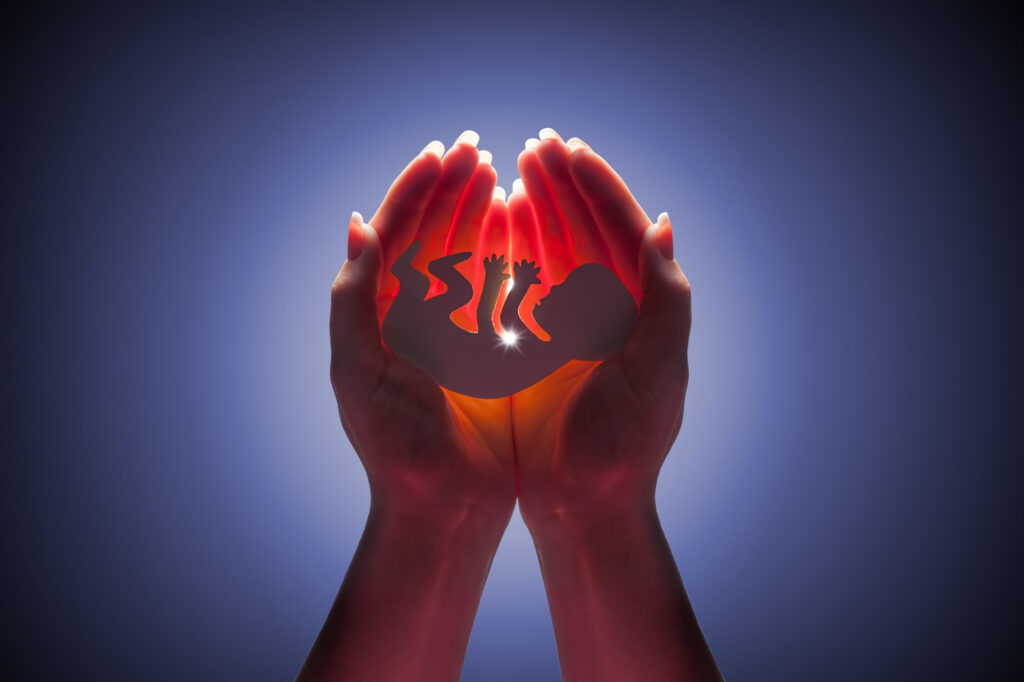
Exodus 21:22,Hurt a woman with child.The Bible on the Sanctity of Life and AbortionThis passage is one of the strongest pro-life, anti-abortion verses in the Scriptures. Clearly, this passage teaches us that life begins in the womb. The penalty for a man who is responsible for the death of an unborn child is death (v. 23.) Could any clearer statement be made about how the Creator feels about the sanctity of life? Here are some statistics about abortion:
42 million abortions occur worldwide each year (that’s 115,000 per day).
In 2008, 1.21 million abortions occurred in the U.S.
From 1973 to 2008, 50 million legal abortions occurred in the U.S.
22 percent of all U.S. pregnancies end in abortion.
In 2007, 84% of all abortions were performed on unmarried women.
At current rates, nearly one-third of American women will have an abortion.
(Sources of information: abortionno.org/Resources/fastfacts.html; guttmacher.org/pubs/fb_induced_abortion.html; abort73.com/abortion_facts/us_abortion_statistics/ — this is now a dead link).
Thankfully, as of this writing, the abortion rate in the US is slowly, but steadily dropping. In 2000 according to the National Right to Life (NRL), 1.36 million babies were aborted. The Center for Disease Control (CDC) puts the number at 857,475. In 2014 according to the NRL the number of abortions in the US dropped to 926,240. According to the NRL the total number of abortions performed in the US from 1973 to 2013 was nearly 58.6 million, while the CDC puts the number at nearly 51.9 million.
The murder of the innocent children is perhaps the greatest sin that a nation can commit. Abortion is a form of child sacrifice, which is something many ancient cultures practiced (e.g., the Aztecs, Incas, Phoenicians, pre-Islamic Arabs, and the biblical Canaanites). In the Bible, YHVH condemns the practice of the heathens and apostate Israelites who made their children pass through the fire in the worship of the demon-god Moloch (see Lev 18:21; 20:2–5; Deut 12:30–31; 18:10). YHVH placed on the nation of Israel a severe judgment for sacrificing its children to Moloch (or Chemosh). He promised that their cities would be destroyed, that their nation would be conquered by foreigners, and that the Jews would be taken captive (see Jer 7:30–34; 32:35–36).
Exodus 21:22 clearly delineates the Creator’s position that human life begins at conception (see also Ps 139:13–16; Jer 1:5; Luke 1:15, 41, 44), not at birth as he so-called Pro-Choice deceivers aver.
Exodus 21:26–27,Eye…Tooth. This is the well known “eye for an eye and tooth for a tooth passage.” This is a remez meaning that these verses lay out a principle that is broadly applicable to many situations. That is to say, what this verse is teaching us is that justice is properly served when the crime fits the punishment or when the criminal is himself deprived of that which he deprived his victim. To be sure, such a punishment is a strong deterrence to criminality! In the case of one causing another person an injury for which one cannot recompense the victim (in the case of a loss of an eye or tooth), the criminal must suffer the same fate as his victim. In the case where a criminal causes harm to another (such as theft), which can be repaid, it is the criminal’s responsibility to make restitution.
From the time of Abraham to Mount Sinai, to defeating Israel’s enemies, to the prophets’ warning call, to summoning Messiah’s bride to prepare for the marriage of the Lamb, to the pouring out of the end times wrath of Elohim upon Earth’s rebellious inhabitants, to announcing the return of Yeshua the Messiah, to the resurrection of the saints, the biblical ram’s horn shofar has played a key role in the life of Elohim’s people for thousands of years to this day. When sounded, the shofar sends terror and confusion into Satan’s camp, while causing the Divine Ear of heaven to listen. It is still a potent weapon and praise instrument in the hands of today’s saints when used with wisdom and understanding as this teaching reveals.
This and other videos by Nathan are available as podcasts on Spotify and Apple podcast under “Hoshana Rabbah.”
If you are interested in participating in Hoshana Rabbah’s weekly Shabbat online fellowship (Oasis Elim Online), send an email to hoshanarabbah@earthlink.net.