Prophetic Implications of the Five Loaves and Two Fishes

Get ready for some surprising prophetic understandings from one of the most well-known stories about Yeshua—the feeding of the 5000 with five loaves and two fishes.

The corollary passage to Mark 8:1–10 is Matthew 14:13–21, which we will explore below.  

First you might want to review Matthew 14:13–21.

This account appears to be an allegory pertaining to end-time events—specifically, the regathering of the Israelite exiles, and is another allusion to the final redemption.

John the Immerser (Baptist), who came in the spirit of Elijah to prepare the way for Messiah, had just been killed by the politico-religious system of his day. (Similarly, it is interesting to note that the two end time witnesses or prophets who will come in the spirit of Elijah will be martyred in Jerusalem just prior to the return of Yeshua [Rev 11:1–13].) In response to John’s murder at the hands of Herod, Yeshua and his disciples left the area to escape any possible backlash of the wrath of Herod (who allegorically represents the devil). This seems to be a picture of what is prophesied to occur to the bride (the saints) of Messiah during the great tribulation just prior to the return of Yeshua (Rev 12:12–17). The boat seems to metaphorically represent the eagle’s wings of Revelation 12:14 that carried the woman into the wilderness, which is a place of protection and safety during the great tribulation.

Once in the wilderness, “when the day was far spent … and now the time is far passed” (a prophetic reference to the end of the age Continue reading


“Go Ye Therefore” and Teach What???

Matthew 28:19–20, Go you therefore. What were Yeshua’s final instructions to his disciples before his return to heaven? This portion of Scripture is commonly called, the Great Commission and is found in Matthew 28:19-20. Do we find here any clues to Yeshua’s view toward the Torah as to what his expectations were of his disciples? Here Yeshua instructs his disciples (that includes you and me) to:

Go you therefore, and teach all nations, baptizing them in the name of the Father, and of the Son, and of the Set-Apart Spirit: teaching them to observe [keep, preserve, hold fast] all things whatsoever I have commanded you: and, lo, I am with you always, even unto the end of the world. Amein.
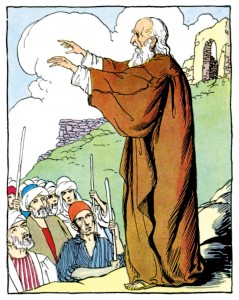
It is clear from this text that Yeshua, a Jewish rabbi (Matt 26:25, 49; Mark. 9:5; 10:51; 11:21; 14:45; John 1:38, 49; 3:2, 26, 4:31; 6:25; 9:2; 11:8), expected his disciples to follow, teach accurately and spread his teachings (the good news of the kingdom of Elohim) to the world. In the religious culture of first century, Judaism disciples (talmudim) were expected to teach exactly what their rabbi or Torah teachers had taught them. This is no different in our day when students enroll in a denominational Bible college or seminary, receive ordination and are then sent out into the mission field in the name of that denomination. The students are expected to carry forth the unique teachings and doctrines of that denomination. If they do not, they will either be reprimanded and expected to realign their teachings with the denomination’s official position. If they refuse to do so, that denomination will discharge them from their duties and defrock them.

Likewise, Yeshua expected his disciples to teach the nations to “observe all things whatsoever I have com- manded you.” In fact, in Acts 1:8 Yeshua said to his disciples that, “You shall be witnesses unto me” to the whole world. This was their mission and assignment.

Yeshua, as did all Jews of his era, spoke Hebrew, and maybe even Aramaic. The word for “commanded” (Matt 28:20) as in “whatsoever I have commanded you …” in either the Hebrew or Aramaic is the word mitzvah, which would have been the same word used in Matthew 5:19 where Yeshua says, “whosoever breaks one of these least commandments, and shall teach men so, he shall be called least in the kingdom of heaven …” (emphasis added). The word mitzvah in Hebraic religious thought is a clear reference to the Torah commandments of YHVH in the books of the Law of Moses.David uses the term mitzvah (in its plural form mitzvot) numerous times in Psalm 119 equating it with the Torah-law of Elohim as given to Moses and the children of Israel.

It was these same commandments (mitzvot) that Yeshua stated in the Sermon on the Mount that he told his disciples to “think not” that he had come to destroy, that he taught would never pass away as long as heaven and earth stood, that he said whoever would break one of the least of them and teach men so would be called least in the kingdom of heaven, and whoever would keep them and teach men so would be called the greatest in the kingdom. It was these same commandments that Yeshua commissioned his disciples to teach and observe, to keep, hold fast and preserve.

Even in his final word to his disciples before his death, Yeshua commanded his disciples to adhere to the Torah and to convey to those who would follow them the same message.

Can there be any doubt as to what Yeshua’s view of the Torah was, and what his expectations were for his disciples in this regard? How is it that the church has diverged so greatly from the fundamental teachings of Yeshua and his disciples when so many teach that he and his disciples came to “do away with the law?” It has been admitted, by even some in the church, that Christianity is not the religion of Jesus/Yeshua, but rather the religion about the Person of Jesus/Yeshua. For it to be fully the religion of Yeshua and his early disciples, it would have to uphold that obedience to the Torah’s standards of righteous living is a requirement of Christians today.


 

Torah’s Higher Highway

The Jewish Leaders Had Forsaken the Higher Torah

Yeshua blasted the religious leaders of his day not only for not following Torah, but also for omitting the weightier matters of Torah, which are mercy, justice and faith.

Woe unto you, scribes and Pharisees, hypocrites! for ye pay tithe of mint and anise and cumin, and have omitted the weightier matters of the law, judgment, mercy, and faith: these ought ye to have done, and not to leave the other undone. Ye blind guides, which strain at a gnat, and swallow a camel. (Matt 23:23)

The Pharisees had a letter-of-the-law righteousness. But Yeshua said that the righteousness of his disciples had to exceed that of the religious Jews of that day (Matt 5:20). Yeshua wasn’t talking about the fine points of a letter-of-the-law Torah-obedience here, for it is doubtful that anyone could have surpassed the punctilious Pharisees in that arena. He must have therefore been talking about something else—something higher and beyond the mere keeping the letter of the law along with all their added legal traditions.

At the same time, sadly, the Jews had inadvertently nullified some of the Torah through their religious traditions (Mark 7:13). The Torah should be viewed as more than just a set of dos and don’ts; we should see it as pointing the way to our Father’s heart. His heart is the higher Torah. To get to YHVH’s heart we must lay aside any religious traditions that nullify the Torah-Word of  YHVH, and then follow the Torah at its purest and highest level. But merely following the letter of the Torah legalistically is not sufficient. There is something beyond that.

The Letter Kills, But the Spirit Makes Alive

The letter of the law kills, but the Spirit of the law brings life. The letter by itself brings bondage and legalism. It can even become burdensome and grievous.

Who also hath made us able ministers of the new testament; not of the letter, but of the spirit: for the letter killeth, but the spirit giveth life. (2 Cor 3:6)

For this is the love of Elohim, that we keep his commandments: and his commandments are not grievous/heavy or burdensome. (1 John 5:3)

Love, Not Law-Keeping, Is What Attracts

Yeshua told his disciples that men would know they were his not because they kept the Torah scrupulously to the letter, but because they walked in love for one another.

By this shall all men know that ye are my disciples, if ye have love one to another. (John 13:35)

Paul also taught that love was the greater thing in 1 Corinthians 13. Love is above all knowledge (including Torah), and all prophecy (inspired teaching of Torah).

The Higher Torah Is About Relationship

The higher Torah is this: Continue reading


The Well of Well-Being

Genesis 26:1ff, At the well of Lachai-roi, Isaac was fruitful. There he met his wife while in communion with YHVH (24:62–64). Isaac also dwelt there for 20 years where he entreated YHVH because of Rebekah’s barrenness (25:21), and YHVH answered Isaac’s prayer and Rebekah gave birth to twins (25:22ff). But because of famine in the land, Isaac felt compelled to leave Canaan to seek relief in Egypt following the earlier footsteps of his father, Abraham.

Is it wise to rely on “Egypt” (a metaphor for the world) for our sustenance instead of trusting YHVH and believing that where he has planted us and blessed us is where we should stay?

While en route to Egypt YHVH, gracefully redirected Isaac away from Egypt instructing him rather to sojourn in Gerar (temporarily) where he would continue to bless him and his posterity (26:2–4). Isaac obeyed YHVH—more or less. Isaac ended up in Gerar located on the border between Canaan and Egypt and dwelt there a long time (not temporarily as YHVH had instructed him, 26:6,8).

Was he fully obeying YHVH or hedging his bet between faith and fear, between Canaan, the land of promise, and Egypt, the land of comfort for the flesh man? How often do we halt between two opinions and compromise between YHVH’s will and our own in matters where he has given us clear direction?

What happened in Gerar? (26:7) He sinned (lied) repeating the sin of his father (Gen 20:1–2).

Compromised obedience puts us in compromising situations where in order to “save our skin” we often have to compromise our values.

Though Isaac was out of YHVH’s will, YHVH was still faithful to keep the promises to Isaac he had made earlier (26:3–4). Isaac was blessed one hundred fold in his wealth (26:12–14).

Despite YHVH’s blessings, Isaac’s labors were not without difficulty and opposition from an enemy who was intent upon stealing his water wells, which were rightfully his (Gen 26:12–15). In the arid regions of the Holy Land, wells are essential for survival and prosperity.

Wells are a spiritual metaphor for salvation, life, abundance and truth—things the enemy is intent on killing for, stealing and destroying (in this light, consider Isa 12:3; 55:1–3; Ps 36:9; John 4:7–14; 7:37–39; 10:10).

Do you know Yeshua the Messiah (Jesus Christ) who is the well of salvation leading to eternal life—immortality?  Who will bring the waters of salvation to your thirsty soul? Who will heal the dry ground of your life and who will cause your spiritual desert to bloom like a rose? Who will turn your life into a river of life to all those around you? If you don’t know Yeshua, call out to him now!


What to Do With an Unpayable Debt

Matthew 18:24, 28, Ten thousand talents…a hundred denarii. A talent was a unit of measure for gold and silver and was equivalent to about 75 lbs. One talent of silver at today’s rate of $30 per ounce would be worth $36,000. Ten thousand talents of silver would be worth about $36 million. A denarius was equivalent to a fair day’s wages (Matt 20:2). If one earns $40,000 in a year and works 260 days per year, then 100 denarii would be equivalent to about $15,384.

The lesson of Yeshua’s parable about the unforgiving servant is obvious. If one’s master forgives him of a debt that’s impossible to repay ($36 million), then one should forgive one’s neighbor the small debt of $15,384. Likewise, if Yeshua through his death on the cross forgives a repentant sinner of the wages of sin, which is death (an impossible debt for a sinner to pay), then shouldn’t the same forgiven sinner likewise forgive those who have offended him (Matt 18:6–8) or sinned against him (verse 15–19)?


Do You Have a Sunny Disposition? If not, get ready…

Matthew 13:43, Shine forth as the sun. The reward of the resurrected righteous will cause them to shine forth like the sun or stars (Dan 12:3), and like Yeshua (1 John 3:2), whose face shines like the sun (Rev 1:16), for he is the Sun of Righteousness (Mal 4:2), who will be the light of the New Jerusalem shining in place of the physical sun (Rev 21:23; 22:5; Isa 60:20).

Paul speaks of the resurrection of the saints or their glorification that will occur at that time, and he also likens the saints’ appearance to the stars. As stars have different levels of brightness, so too will the saints (1 Cor 15:41–43) in accordance with their levels of rewards based on their level of obedience to the Torah (Matt 5:19; 16:27; Rom 2:6–11; 2 Cor 5:10; Eph 6:8; 1 Pet 1:17; Rev 19:8; 22:12–15).

Hebrews 2:10 says,

For it became him, for whom are all things, and by whom are all things, in bringing many sons unto glory, to make the captain of their salvation perfect through sufferings.

The word glory in this verse means “majesty, excellence, dignity” as well as “the splendor or brightness of the stars.” Perhaps Paul’s statement in 1 Corinthians 2:9 makes more sense in this light.

But as it is written, Eye hath not seen, nor ear heard, neither have entered into the heart of man, the things which God hath prepared for them that love him.

Hopefully this word of encouragement from the Word of Elohim will help to brighten your day.


Messiah Yeshua—the Servant of Elohim

Matthew 12:18–21, Behold! My Servant. The nation of Israel was to be YHVH’s servant to be a spiritual light to the Gentiles (Isa 49:6 cp. Deut 4:5–6), yet Israel failed in their YHVH-ordained mission to evangelize the world. Therefore, YHVH raised up Yeshua out of Israel to be that Servant instead. This is why Matthew applies this prophecy to Yeshua in this passage.

Furthermore, Matthew in applying Isaiah’s prophecy to Yeshua’s first coming sees him not as fulfilling his kingly role (in Jewish thought, Messiah Son of David, the Conquering King [e.g. Rev 19–20]—of which the life of David was viewed as a prophetic prototype), but his servant role (in Jewish thought, Messiah Son of Joseph, the Suffering Servant [e.g. Isa 53]—of which the life of Joseph was viewed as a prophetic prototype). At Yeshua’s second coming, he will come as the Conquering King of kings and Lord of lords to defeat his enemies and to establish his kingdom on the earth.

Matthew 12:23, Son of David. The popular expectation of the Jews in Yeshua’s day was that the Messiah would come to fulfill the role as the Conquering King Messiah to liberate them from the tyranny of the Romans and to re-establish a sovereign Israelite nation. Even the followers of Yeshua thought this (e.g. Matt 20:21; Acts 1:6). Therefore, the Messianic expression Son of David was a euphemistic title reflecting this expectation.