Exodus 12:2, Month. It is the Hebrew word chodesh (Strong’s H2320/TWOT 613b) meaning “the new moon, month, monthly, the first day of the month, the lunar month.” It is found in the Tanakh (Hebrew Scriptures or Old Testament) 276 times and is translated in the King James Version as “month” 254 times, “new moon” (20 times), and “monthly” (1 time). We see that from these definitions that the terms “month” and “new moon” are synonymous. It has been understood for millennia that ancient Israelites began their month with the new moon.
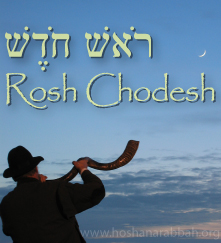
Why was it important for the Israelites to know when the new moon occurred and when the month began? The dates of the annual biblical festivals that YHVH gave to Israel and instructed them to observe were determined based on when the new moon occurred (Lev 23:5, 6, 24, 27, 34).
The next question to answer is this: when does the biblical month begin?
For modern astronomers the term “new moon” means something different than it did to the ancients, including those who YHVH inspired to write the Bible. Ancient calendars were determined by the moon, while modern ones are not. Some biblical expositors teach that the new moon begins when the moon is in conjunction or in line with the earth and the sun and is in its dark phase. Others believe that the month begins just after the moon has moved out of its dark phase and begins to show a sliver of light, which is called the visible or crescent new moon. Who is right?
Some Bible teachers claim that there is no place in the Scriptures that specifically states that the new moon begins at the first visible sliver after being dark for several days. Therefore, they reason, it is an assumption to say that it does, and therefore, the new moon should be determined from its conjunction with the earth and sun while it is in its dark phase. While on the surface, this may seem like a valid argument, one important verse in the Scriptures, however, and some simple logic quickly disproves this notion. It is Genesis 1:14.
And Elohim said, “Let there be lights in the firmament of the heaven to divide the day from the night; and let them be for signs, and for seasons [moedim/biblical festivals], and for days, and years.”
In this verse we see that the sun and the moon are “signs” for seasons, days and years. The word “sign” is the Hebrew word owt/ אות (Strong’s H226; TWOT 41a) meaning “sign, signal, mark, token, emblem, signboard, standard.” In the Tanakh, owt describes such visible (not invisible) signs as Noah’s rainbow (Gen 9:12–13, 17), Cain’s mark (Gen 4:15), circumcision (Gen 17:11), and the Sabbath (Exod 31:13, 17; Ezek 20:12). In addition, owt is used some 80 times in the Tanakh to refer to miraculous signs. These include the plagues of Egypt (Exod 7:3; Deut 4:34, etc.), the sign of the virgin birth of the Messiah (Isa 7:11, 14); YHVH miraculous signs to Gideon (Judg 6:17) and King Hezekiah (2 Kgs 20:9; Isa 38:7). In addition, Aaron’s rod that budded was a sign or token (Num 17:25). Many more examples could be given.
What do all these examples of how the Bible uses the Hebrew word owt have in common? They were all a visible sign that one could see. This is the definition of the word owt and how it is used in the Hebrew Scriptures. Simply stated, the visible sliver of the new moon fits the definition of owt as used in Genesis 1:14, while the astronomical conjunction (when the moon is in its dark phase and is invisible to the eye because the earth is between the moon and the sun) does not. Psalm 104:19 is definitive biblical proof that the moon’s purpose is to determine the biblical feasts when it says YHVH “appointed the moon for seasons [Heb. moedim, which means ‘appointed times’ or ‘biblical holidays’].” The moon cannot be a visible sign to determine seasons or biblical festivals if it is hidden or dark.
The fact that ancient Israelites determined the new moon based on the sighting with the naked eye of the moon’s sliver has been substantiated repeatedly by historians and religious scholars over the past 2000 years.