Questions and Answers About Who the Descendants of Joseph and Judah Became

Genesis 44:18, And Judah came near. What is the spiritual prophetic significance of Judah initiating the approaching of Joseph? Remember who the descendants of Judah became? The Jews became the Southern Kingdom of Israel, and Joseph’s sons Ephraim and Manasseh became the Northern Kingdom or house of Israel and eventually the “lost sheep of the house of Israel.”

Prophetically-speaking, who is the most notable descendant of the tribe of Judah? (See Rev 5:5.). Did Yeshua, the Lion of the Tribe of Judah, seek you or did you seek him when you were lost? (See Rom 5:8; Luke 19:10; Matt 18:11.)

Why is Judah coming near to Joseph (who he does not yet recognize as Joseph)? What were Judah’s heart motives in coming near? (See Gen 44:18–34). Was Yeshua motivated to come near to us out of love for his Father as well? (See John 8:28; chapter 17.)

Did Judah offer to lay down his life as a ransom for his youngest brother? (See Gen 44:33.) Who does this point to prophetically? Who else freely gave his life as a substitute for his brothers? (See Mark 10:45; Matt 20:28; 1 Tim 2:5; John 10:11, 15, 17–18; 1 John 3:16.)

  • Please note that Judah is an antetype (prophetic forerunner) of Yeshua the Messiah.
  • Both sought to please their fathers.
  • Both acted out of unconditional love for their younger brother.
  • Both stood to gain nothing personally, but rather stood to lose much, if their plan did not work. Judah, a prince, would become a slave in Egypt; Yeshua would become a slave to death and hell, if he sinned.

It is interesting to note that classic Christian commentator Matthew Henry draws a similar analogy between Judah’s actions here and Messiah Yeshua, as well (A Commentary On the Whole Bible, vol. 1, p. 243, by Matthew Henry).

Judah’s love for his father and Benjamin and his willingness to lay down his life as a ransom to become a slave in Egypt to Joseph is analogous to Messiah Yeshua’s love for the lost sheep of the house of Israel to whom he came to reach out and to ransom in order to bring them back into the fold of Israel (John 10:15–16; Matt 10:6; 15:24).

What was the burden on the Apostle Paul’s heart in this regard? (Read Romans 9:1–5.) Who does Paul later go on to talk about and extend his heart burden to in Romans 9:23–24? Remember that the term Gentile simply means “ethnic or people groups, or the people of the nations.” Who is Paul specifically referring to here? Paul had the same intense love for his Jewish brethren as he did for those “people groups of the nations” whom he equates with the lost, adulterous and apostate house of Israel (the Northern Kingdom of the ten tribes of Israel). Compare Romans 9:25 with Hosea 2:23 (the former being a direct quote from the latter) in context with the whole book of Hosea, which is addressed particularly to the apostate house of Israel and who had become “lost” among the nations, of which Joseph in Egypt is a prophetic antetype.

 

More Prophetic Pictures in the Story of Judah, Joseph and Benjamin

Genesis 44:32–34, Became surety for the lad. Christian commentator Matthew Henry on this passage states, “Judah’s faithful cleaving to Benjamin, now, in his distress, was recompensed long afterwards by the tribe of Benjamin keeping with the tribe of Judah, when the other tribes deserted it” (Matthew Henry Concise Commentary on the Whole Bible, p. 56).

It is amazing that some 800 years later this fraternal love between the two tribes of Judah and Benjamin continued to work in the collective psyches of these tribes such that the heart of the younger was still knit in loyalty with that of older brother. What does this say about generational blessings (and curses) or attitudes that are passed on down to one’s descendants? If curses can be passed on down to the third or fourth generation (Exod 20:5), how about blessings? The Book of Proverbs states that, “Death and life are in the power of the tongue, and those who love it will eat its fruit,” (Prov 18:21) and that, “ A wholesome tongue is a tree of life, but perverseness in it breaks the spirit,” (Prov 15:4).  ­

Generations of our descendants can be affected positively or negatively by the inclination of our hearts and the words of our mouth. It had been Judah’s idea to sell Joseph to slave traders. In the meantime, Judah’s heart had changed so that he was willing to lay down his life for his brother, Benjamin, Joseph’s only full brother. This change of heart on Judah’s part and the resulting outpouring of love for his youngest brother had lasting positive results. What are the prophetic implications of this relationship between Joseph (Ephraim and Manasseh) and Judah?

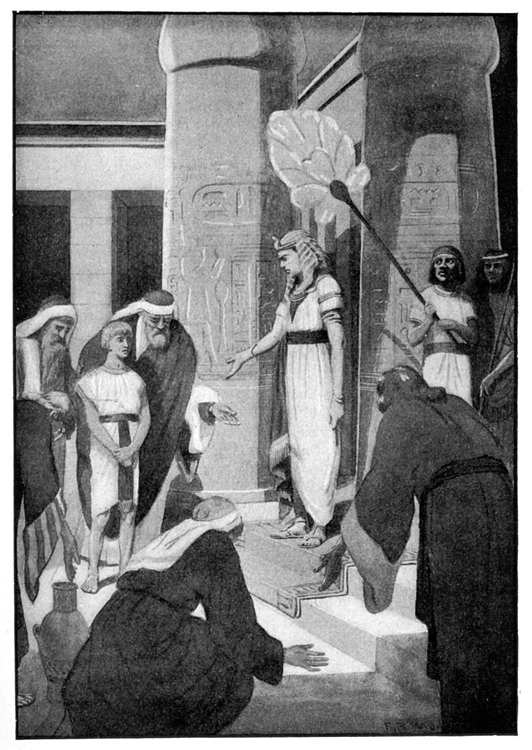
Did Judah recognize Joseph, or did Joseph have to reveal himself? (Read Gen 45:1–4.) Was Judah “blinded” to whom Joseph was? Why? What is this a prophetic picture of? (See Rom 11:25.) As we have seen in the previous studies, Joseph was a type of the Messiah as well as the father of Ephraim and Manasseh, the dominate tribes of the Northern Kingdom of Israel, who went apostate and become “lost sheep” among the nations of the world (Hos 7:8; 8:8; Ezek 34:16 and numerous other Scriptures). Therefore, who does Joseph prophetically represent? This is a prophetic picture of the “lost sheep of the house of Israel” and the Messiah who would come to seek out those lost sheep (Matt 15:24; 10:6). And whom does Judah represent? Is Judah a prophetic shadow of the Lion of the Tribe of Judah who would later come as the Messiah to redeem his “brother” who would be lost in spiritual Egypt? Or does he represent the Southern Kingdom of the house of Judah who is “blind” to his Messiah? Perhaps he is a prophetic picture of both. These are potentially difficult questions to answer. One could easily force these scriptures in Genesis to fit into a false prophetic scenario.

This has been a head scratcher for the Jewish sages as well. They have seen in the story of Joseph, the Suffering Servant, a Messiah Son of Joseph figure who they felt would be a descendant of Ephraim and who would come to redeem the lost sheep or exiles of the house of Israel in preparation for a second Messiah to come whom they refer to as the Conquering King or Messiah the Son of David, (Mesorah Publications ArtScroll Bereishis, vol. 1(b), pp. 2121–2122). They see these Messiahs as two separate individuals. Yet in our story of Joseph and Judah can we see the antetypes of these two Messiahs acting out their roles at the same time? Could Judah and Joseph point to both comings of Messiah Yeshua? At his first coming, did not Yeshua, the Suffering Servant, come to redeem a remnant of lost Judah in addition to a much larger portion of “the lost sheep of the house of Israel”? Yet at his second coming, will this same Messiah Son of Joseph come back as the Lion of Judah to be revealed to his Jewish brothers who had previously rejected him?


The Story of Joseph Is a Prophetic Antitype of End Time Events

Joseph and Judah (the Two Houses of Israel)

In what follows, we will see types and shadows that point to the end-time reunification of the two houses of Israel (Joseph/Ephraim and Judah/the Jews), and to Yeshua the Messiah whose role it would be to regather and reunite the two houses of Israel by laying his life down as a ransom or substitute for his brothers. In this study, we will discuss the following themes:

  • reuniting lost family members
  • reconciliation and healing of wounds and offenses between families
  • forgiveness of past wrongs, offenses and misunderstandings
  • prophetic shadows of Yeshua the Messiah

Let’s now analyze the events in the life of Joseph (and to a lesser degree, Judah) as they occurred chronologically to see how they pointed forward to events that would occur in the future including the end times.

Joseph Taken as Captive to a Gentile Nation (Gen 37)

Joseph was sold into slavery and taken as a captive to Egypt. Similarly and prophetically, Joseph’s descendants (Ephraim and Manasseh), along with their fellow tribesmen of the northern kingdom of Israel (or house of Israel), were taken as captives into Assyria (ca. 723 B.C.). From there they were scattered around the world (into spiritual “Egypt,” ) where the biblical prophets predicted they would remain until the final regathering at the end of the age (just prior to and at the coming of Messiah). We will understand this more as we proceed.

Joseph: From Slave to Ruler (Gen 37, 41)

At first, Joseph was a slave and a prisoner in Egypt, but then he prospered and was elevated to a position of leadership there. Likewise, in the future, Joseph’s descendants (Ephraim, Manasseh, and the rest of the house of Israel) would start out as slaves and captives in Assyria (in the eighth century b.c.), but would later become leaders and rulers Continue reading


Genesis 42–46 Two Brothers and the Two Houses of Israel in End-Time Prophecy

Biblical Types and Antetypes

A major key to understanding biblical prophecy is to recognize the relationship between antetypes and types in the Scriptures. This means that an event or a series of events occurred once, was recorded in the Scriptures, and then at a later time a similitude of the event repeats itself, but with different characters and scene.

An antetype is a type or pattern of something that occurs before the actual event occurs (sometimes incorrectly referred to as an antitype, which means opposite rather than before). In other words, the first event predicts or points prophetically to the future event. This is a way for the Creator to give clues and hints about future events that will come to pass. Those who are ardent students of his Word and those “who have (spiritual) ears to hear” will pick up on these clues and be able to have a sense of what the Creator is going to do at some future date. In this way, those who diligently seek him are rewarded with understanding or “inside information” about what he is planning to do in the future. At the same time, his divine plans and purposes will be obscured from those who don’t have a diligent heart to seek him and his truth, and who could possibly misuse the truth, if they were to discover it, for selfish purposes if they were to learn it.

Similarly, the Gospels record that Yeshua explained deep spiritual truths via parables not to make the meaning clear to the general public, but rather to obscure it. His teachings were Continue reading


Gen 41–44:17 Parashat Miketz pt 1

This is a gospel-oriented Torah study. Our goal is to connect the good news of Yeshua the Messiah (the gospel message) to its Hebraic, pro-Torah roots or foundations. The information given here is more than head knowledge. Understanding and wisdom (the right application of knowledge that is based on truth) is taught thus making biblical truth practical, relevant and applicable to your daily life. The truths of the Bible not only have the power to transform your life here and now for the better, but eventually to take you past the veil of death and into eternity.

This Torah study is subdivided in sections by topic in a magazine format thus making it easy to watch at several sittings.

May you be blessed as you watch this video.

For a free, printable adult and youth Torah study guide on this Torah portion (parashah), please go to http://www.hoshanarabbah.org/parshiot.html


Yeshua the Messiah Foretold in the Life of Joseph

Genesis 37–41 The Life of Joseph—A Foreshadow of Messiah Ben (Son of) Yosef

The spirit of Antimessiah (Antichrist) is on a dramatic rise in our day. It is even rampant among those who are returning to the Hebraic, Torah-centric roots of the Christian faith where some people are losing their faith in Yeshua the Messiah. A few are even converting to Rabbinic Judaism, which denies the messiahship and deity of Yeshua and the divine inspiration of the Testimony of Yeshua. Some of the blame for this can be laid at the feet of a few of the modern-day descendants of the non-believing Pharisees (i.e. the Rabbinic Jews), who use clever arguments to beguile unstable and unlearned souls into humanistic reasoning devoid of a living faith in Yeshua their Savior and the Redeemer of man. Because of a spiritual blindness that Scripture prophesied would come upon the Jews producing a hardness of heart toward Yeshua the Messiah, unbelieving Jews ignore the numerous prophetic shadow-pictures pointing to Yeshua the Messiah contained in their own Tanakh.

May the following study strengthen your faith in Yeshua the Messiah, in his divine origination in the very heart, mind and essence of Elohim, and in the fact that he was foreordained to come to this earth to reconcile sinful man to his Heavenly Father through his self-sacrifice on the cross. All this was prophesied long ago in the Tanakh. The ancient Jewish sages speak of a messianic figure coming called Messiah son of Joseph (Mashiach ben Yosef), the Suffering Servant, whose life and ministry would parallel that of Joseph, yet these same Jewish sages fail to see the connection between Joseph’s life and that of Yeshua. Let’s now chronicle the striking and uncanny parallels between Joseph and Continue reading


New Video: Gen 37–40:23 Parashat Vayeshev

This is a gospel-oriented Torah study guide. Our goal is to connect the good news of Yeshua the Messiah (the gospel message) to its Hebraic, pro-Torah roots or foundations. The information given here is more than head knowledge. Understanding and wisdom (the right application of knowledge that is based on truth) is taught thus making biblical truth practical, relevant and applicable to your daily life. The truths of the Bible not only have the power to transform your life here and now for the better, but eventually to take you past the veil of death and into eternity.

This Torah study is subdivided in sections by topic in a magazine format thus making it easy to watch at several sittings.

May you be blessed as you watch this video.

For a free, printable adult and youth Torah study guide on this Torah portion (parashah), please go to http://www.hoshanarabbah.org/parshiot.html