Blog Scripture Readings for 10/21 through 10/27/12

Aside

Parashat Lekh L’kha — Genesis 12:1 – 17:27
Haftarah — Isaiah 40:27 – 41:16
Prophets — Joshua 17:1 – 24:33
Writings — Psalms 15:1 – 21:13
Testimony — Matthew 10:25 – 14:21

Most of this week’s blog discussion points will be on these passages.

There are 4 sections of scripture to read each day. One each from the Torah, the Prophets, the Writings, and from the Testimony of Yeshua. Each week, the Torah reading will follow the traditional one-year reading cycle as well as the haftarah. By reading all the scriptures on this schedule each day, you will have read all scriptures from Genesis to Revelation by the end of next Sukkot (2013)!

The full Scripture Reading Schedule broken down by each day can be found on the right sidebar under “Helpful Links.”

If you have general comments or questions on the weekly Scripture readings not addressed in a blog post, here’s a place for you to post those. Just use the “leave a reply” link below.

Weekly Blog Scripture Readings for 10/21 through 10/27/2012


Meaning of Disciples’ Names

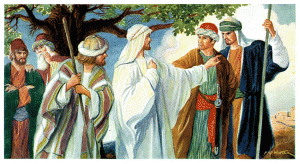
Matthew 10:2–4, The names of the twelve. The disciples’ names reflect the multilingualism that had influence over Jews of the first century in the land of Israel. Likely, Yeshua and his disciples were multilingual. They spoke Hebrew and Aramaic and likely had some knowledge of Greek as well.

  • Simon Peter  Heb. shimon (from shama) meaning “heard.” Gk. petros meaning “a rock or stone.”
  • Andereas Gr. (from aner) meaning “manly.”
  • James. Heb. jacob meaning “heal catcher, supplanter.”
  • John Heb. jochanan (Yah and chanan) meaning “YHVH has graced, shown mercy.”
  • Philip Gk. philoppos (philos meaning “friend” and hippos meaning “horse”) meaning “a friend or lover of horses.”
  • Bartholomaios Aram. meaning “son of Tolmai.”
  • Thomas Aram. meaning “coupled or joined together, twin.”
  • Matthew Heb. Matthaios or Mattiyahu meaning “gift of YHVH.”
  • Thaddaeus Of uncertain origin. Could be Greek or Hebrew.
  • Judas Heb. Yehudah meaning “praise.”
 

Introduction to the Psalms

Name of the Book

The Hebrew name for Psalms is Sepher Tehillim meaning “Book of Praises.” The word psalm is the Hebrew word mizmor meaning “melody” and derives from a word to mean “to sing, sing praise, make music.” The English word psalm derives from the Greek word psalmos meaning “a song sung to harp music.”

The Nature of the Book

The Book of Psalms is a collection of devotional materials including prayers, poems, and hymns, some of which were set to music. Worship and praise of Elohim through music is a unifying aspect of this book. The psalms include songs of thanksgiving, hymns of praise, psalms of repentance and confession, psalms that invoke curses upon one’s enemies, psalms sung by pilgrims en route to Jerusalem, and messianic psalms.

Authors of the Psalms

This book contains psalms by at least six authors. David wrote 73 psalms (according to the titles of the psalms) and two others are ascribed to him in the Testimony of Yeshua (Ps 2, see Acts 4:25 and Ps 95, see Heb 4:7). Asaph either wrote or was responsible for preserving 12 psalms (Pss 50 and 73 through 83). The sons of Korah wrote 11 psalms (Pss 42, 44 through 49). Solomon composed two psalms (Pss 72 and 127), while Etham wrote Psalms 89, Moses authored Psalm 90 (and possibly Ps 91), and Heman (Ps 88). Several Psalms have no designated author.

Categories of Psalms

The psalms can be group into four categories:

  • Didactic Psalms that give instruction (e.g., Ps 119).
  • The Messianic Psalms containing prophecies relating to the Messiah (e.g., Ps 22).
  • The Imprecatory Psalms where the servant of Elohim pleads his case before the Almighty pleading for justice for the righteous and punishment upon the wicked (e.g., Ps 109).
  • Penitential Psalms expressing the feelings of the repentant heart but also the desire for spiritual cleansing (Pss 32; 38; 51;102; 130; 143).

Other classifications of Psalms include:

  • Psalms of degrees or ascent (i.e., Pss 120–134). These are psalms that were sung on special occasions as the priests were ascending the steps of the temple, or that were sung as the Israelites were going up to Jerusalem to celebrate the yearly biblical pilgrimage feasts (i.e. Passover and the Feast of Unleavened Bread, the Feast of Weeks, the Feast of Tabernacles).
  • The miktam (or michtam) psalms (Pss 16; 56–60). Though the meaning of the term michtam is unclear, it seems to refer to a psalm that is considered as precious as stamped gold.

The Five Books Within the Psalms

According to Jewish tradition, the Book of Psalms can be divided into five smaller books or sections. They are,

  • Book One: Pss 1–41
  • Book Two: Pss 42–72
  • Book Three: Pss 73–89
  • Book Four: Pss 90–106
  • Book Five: Pss 107–150

Scholars aren’t sure why Psalms is so sub-divided. One theory is that the five sections correspond to the five books of the Torah (or Pentateuch). Or they may simply be individual collections of psalms that were eventually combined to form the larger book we now have.


What Is a “Worker of Iniquity”?

Matthew 7:21–23, What is the meaning of the word “iniquity” or “lawlessness” (in verse 23)? It is the Greek word anomia (Strong’s G458) meaning “unrighteousness” or “lawlessness.” Righteousness by biblical definition is “adherence to the Torah-commandments of YHVH” (Ps 119:172).

When the Jewish writers of the Testimony of Yeshua (NT) use the word “law” is almost always a reference to the Torah. In Hebrew thought then (and now), there was no other law except the Law of Moses. This “law” or Torah came from Elohim through the “Angel” or  more properly the Messenger from heaven who gave the Torah to Moses, and who was none other than the pre-incarnate Yeshua (Acts 7:37–38). So the word “iniquity” or “lawlessness,” as used in our verse could quite simply be understood to mean “Torahlessness.” In fact, Torahlessness would be an apt translation of the Greek word anomia, which is behind the word iniquity or lawlessness (depending on the English translation).

Quite clearly, In Matthew 7:21-23, Yeshua is speaking to those who claim or profess to be his followers, who claim or profess his name, claim his miraculous power, claim to speak by his authority and even claim, no doubt, to love him, but in reality they fail to love him (according to the biblical definition of love) by obeying his word or Torah-commandments (John 14:15). In other words, they are sinners, walking in sinfulness, for John defines sin in his epistle as “the transgression of the Torah-law of Elohim” (1 John 3:4).

Of these same people, in the day of judgment, Yeshua will say, “Depart from me, you that work [do] Torahlessness, I never knew you.” Yeshua will not accept these people on the basis of their verbal professions or claims, nor will he accept them on the basis of their prophetic or miracle-working abilities. Yeshua, the Living Torah of Elohim made flesh, will accept them only on the basis of their obedience to and orientation toward the Torah-law of Elohim.

Is Yeshua here abrogating or nullifying the Torah-law given to Moses or is he reaffirming it to his followers? The language of this scripture is very clear to those who have ears to hear and to those who are truth-seekers. He is loudly and clearly validating the Torah and its relevance upon the lives of his disciples or followers!

If you are a true follower of Yeshua, the Messiah, THEN you will be making every effort to love him by obeying his Torah as best you can by his grace and the power of his Set-Apart Spirit. So help us Elohim!!!


Blog Scripture Readings for 10/14 through 10/20/12

Aside

Parashat Noach — Genesis 6:9 – 11:32
10/14/12 Genesis 6:9–22 Joshua 9 Psalms 8 Matthew 6:16-34
10/15/12 Genesis 7:1–16 Joshua 10 Psalms 9 Matthew 7
10/16/12 Genesis 7:17–8:14 Joshua 11 Psalms 10 Matthew 8:1-17
10/17/12 Genesis 8:15–9:7 Joshua 12 Psalms 11 Matthew 8:18-34
10/18/12 Genesis 9:8–17 Joshua 13 Psalms 12 Matthew 9:1-17
10/19/12 Genesis 9:18–10:32 Joshua 14, 15 Psalms 13 Matthew 9:18-38
10/20/12 Genesis 11:1–32 Joshua 16 Psalms 14 Matthew 10:1-24
Haftarah — Isaiah 54:1 – 55:5

Most of this week’s blog discussion points will be on these passages.

There are 4 sections of scripture to read each day. One each from the Torah, the Prophets, the Writings, and from the Testimony of Yeshua. Each week, the Torah reading will follow the traditional one-year reading cycle as well as the haftarah. By reading all the scriptures on this schedule each day, you will have read all scriptures from Genesis to Revelation by the end of next Sukkot (2013)!

The new Scripture Reading Schedule can be found on the right sidebar under “Helpful Links.”

If you have general comments or questions on the weekly Scripture readings not addressed in a blog post, here’s a place for you to post those. Just use the “leave a reply” link below.

Weekly Blog Scripture Readings for 10/14 through 10/20/2012


Some Nuggets from Matthew

Matthew 1:21, Call his name Yeshua. (Also see notes at Mark 5:41; Luke 19:9.) This verse is proof that Matthew was not originally written in Greek, since the word Jesus (Gr. Iesous a transliteration from the Hebrew word Yeshua, in English Joshua or, in Hebrew, Yehoshuah meaning “YHVH is salvation”) is an unintelligible word in Greek. Only if it were originally written in Hebrew would the name Yeshua, and the corresponding angelic declaration “for he shall save his people from their sins” make any logical sense.

Matthew 3:7, Brood/offspring of vipers. John is calling the religious leaders of his day offspring or children of the n’chashim [Heb. serpents], which was another name for the devil (Gen 3:1 cp. Rev 12:9; 20:2). Yeshua labeled the same thusly in Matthew 23:33 where he accused them of devouring widows houses (verses 14). The serpent was cursed to eat dust (Gen 3:14). As the serpent eats dust (loose earth or admah), the devil’s religious pawns “eat”man (adam) who is made of dust. False religious systems prey on man/dust—especially the widows and the poor (who, like the dust of the earth, are at the lowest strata economically), and who have no one to protect them from these false systems. The nachash was a liar and used smooth words to entice man into sin and rebellion against Elohim to satisfy his own arrogance and avarice, not unlike the silver and split tongued preachers of today who are cunning in their abilities to separate people from their money.

Matthew 4:17, Repent…at hand. Yeshua continued preaching the repentance message of John, and this became the essence of the gospel message (see verse 23). When Yeshua sent out his disciples two-by-two, he instructed them to preach the same message (Matt 10:7; Luke 9:6), the same message of repentance became part of the great commission (Luke 24:47). On the day of Pentecost, Peter preached the same message of repentance (Acts 2:38).

“Repent for the kingdom of heaven is at hand” is a message that is seldom heard in the Christian churches today, nor has it been consistently preached for a long time. In the late nineteenth century, Charles Haddon Spurgeon, the great English preacher, complained in his day that “Repentance is an old-fashioned word not much used by modern revivalists” (The Soul Winner, p. 27 published in 1895!). If this was true in Spurgeon’s day, how much more so today?! Yet, this seldom used word in the lips of today’s Christian preachers was the first word out of John and Yeshua’s mouths when they began their preaching careers. Even so, if we are to be imitators of Yeshua, repent must be the first word out of our mouths when sharing the gospel to a sinful world!

Why should “repentance from sin” to be the first words out of the gospel preacher’s mouth? Quite simply, Adam and Eve fell out of fellowship with Elohim because of sin, and the only way for man to restore relationship with his Creator is to go back to the place where our first parents got off of YHVH’s spiritual path, to repent of that sin and to — from that point on — walk in obedience to his Word. Yeshua, as the Second Adam, leads man in that restoration process to undo the evil that the first Adam did. Repentance is the first step.


Some Nuggets from B’reisheet

Genesis 1:1, In. In Hebrew, the preposition in is written as the letter bet (corresponding to our letter b). This is the first word in the Torah. Interesting, the last word in the Torah is Israel (Deut 34:12). In the Hebrew language, the letter bet is a picture of a house (or a tent) with the front door open. From this, some commentators have correctly reasoned that the Torah was written to the house of Israel whose spiritual doors are wide open for all nations to enter therein in order to enter into a spiritual relationship with the Elohim of Israel.
Genesis 2:2, The seventh day. Sabbath. Though this is not a direct command to keep the Sabbath (Heb. Shabbat), YHVH was leading his people by example when he sanctified the Sabbath and then rested from his work on this day. In Hebraic thought, one leads by example, without necessarily stating the command to do so. YHVH blessed the family first, then Sabbath next. Sabbath keeps the family together that keeps the Sabbath. The imperative command to keep the Sabbath is first found in Exodus 16–30 and then repeated in Exodus 20:8–11.

Genesis 2:3, All his work which he had made. Setting man an example of how to rest on the Sabbath, Elohim ceased all his work, workmanship, occupation, or business (Heb. melawkaw) and that which he did, produced, prepared or made (Heb. asah).

Genesis 3:23, To till/work [Heb. abad] the ground [Heb. adamah] from which he was taken. Adam means “man, mankind, ground, land, and is a cognate to adom meaning “red,” and relates to the ruddiness of man’s complexion. According to the TWOT, this word has to do with the man as being created in Elohim’s image, the crown of his creation. In this verse, Elohim commissioned Adam to work or to serve the earth/adamah. In a homiletic sense, this command of YHVH could be construed to mean that Adam/man who is spiritually rough and ruddy, yet who is created in the image of Elohim, has been commissioned to work on himself to work on and to conquer his [base] sin nature and to bring himself into conformity with the image of YHVH. Another facet of this idea could be that through the experiences and struggles of hard work, man will learn to overcome his fallen sin nature and rise to the higher calling of becoming like Elohim in nature. In a sense, hard work is part of man’s redemption process.

Genesis 4:10, Cries unto me from the ground. The earth not only witnesses against man because of his sins, but reacts adversely in judgment against man (Gen 4:12 and 3:17–19; Lev 26:19; Deut 28:23). If a man obeys YHVH, then the earth will bless man (Lev 26:4; Deut 11:14; 28:12; Isa 30:23; Joel 2:22–24). If man fails to praise YHVH, then even the stones will cry out (Luke 19:40). See also 1 John 5:8 where the earth along with the water and the Spirit bears witness to YHVH’s plan of redemption for men.

The earth has also acted as a witness against Israel when they have sworn a covenant with Elohim (Deut 4:26; 30:19; 31:28; 32:1).

Because the earth has been a witness to so much sin and bloodshed, and to Israel’s unfaithfulness to YHVH, this is why the earth has to be first cleansed (by the blood of wicked men to atone for their sins, Rev 14:20) and then by fire (2 Pet 3:7,12), and a new heaven and earth will arrive that has not been a witness to man’s sin and rebellion.