What Is Biblical Repentance?

Though a subject the modern church rarely teaches on, repentance from sin forms the bedrock of the gospel message and is one of two words that characterized the message that Yeshua himself preached. Without true repentance, there is no salvation, according to the Bible. Learn all about repentance from this video.


Blog Scripture Readings for 8/25 through 8/31/13

Aside

Parashat Nitzavim-Vayelekh — Deuteronomy 29:9 (10)* – 31:30
Haftarah — Isaiah 61:10 – 63:9
Prophets — Micah 6:1 – 7:20; Nahum 1:1 – 3:19; Habakkuk 1:1 – 2:20
Writings — 2 Chronicles 3:1 – 13:22
Testimony — Hebrews 10:1 – 13:25; Revelation 1:1 – 1:20

Most of this week’s blog discussion points will be on these passages. If you have general comments or questions on the weekly Scripture readings not addressed in a blog post, here’s a place for you to post those. Just use the “leave a reply” link below.

The full “Read Through The Scriptures In A Year” schedule, broken down by each day, can be found on the right sidebar under “Helpful Links.” There are 4 sections of scripture to read each day. One each from the Torah, the Prophets, the Writings, and from the Testimony of Yeshua. Each week, the Torah and haftarah readings will follow the traditional one-year reading cycle.

Weekly Blog Scripture Readings for 8/25 through 8/31/13.

* Verse numbers in parenthesis refer to the verse number in Christian Bibles.


YHVH’s Covenants: Who Is at Fault and What Is Vanishing Away?

Hebrews 8:13, Ready to vanish away. Many who read this verse assume that the writer is saying that the Torah-law was ready to vanish away ergo the law has been done away. This belief is orthodox Christianity! But is this what the author is saying here? Read it again? Is he saying that the law is vanishing away or the covenant is vanishing away? The latter! What is the difference between the two?

Contract form–21599635

The covenant was nothing more than a contract between YHVH and the people of Israel that he made with them at Mount Sinai (Exod 19–24). Think of a modern contract (e.g., buying a car, a house or agreeing to pay for services rendered). A contract is nothing more than an agreement between two or more parties. Then you have the terms of the contract. If one party fails to keep up his end of the agreement, does that mean that the terms of the contract are evil? Not at all. It means that one party failed to keep his word and the contract was then voided.

The same was true with the contract of the “Old Covenant” that YHVH made with the Israelites. The terms were that if they would worship him and obeyed his Torah-laws, he would bless them, and if not, he would punish them. They agreed to these terms three times (Exod 19:8; 24:3,7), yet they ended up not keeping their word and worshipping false gods and breaking his laws again and again. After hundreds of years of unfaithfulness, they finally totally abandoned YHVH. The covenant was broken for good. But did their unfaithfulness to his Torah-laws mean that his instructions in righteousness were evil, or that their hearts were evil? Logic dictates the answer to be the latter.

To say that the Torah was evil and needed to be obliterated (or done away with) is like saying when you get a speeding ticket, the speed laws should be eliminated. Of course, this is absurd, and so it is to say that the laws of YHVH need to be eliminated because the people violated the covenant thus rendering it null and void.

Here are some more observation on the subject of the Old Covenant vanishing away and giving way to the New Covenant: Continue reading →


Back from Backpacking — Feast Your Eyes!

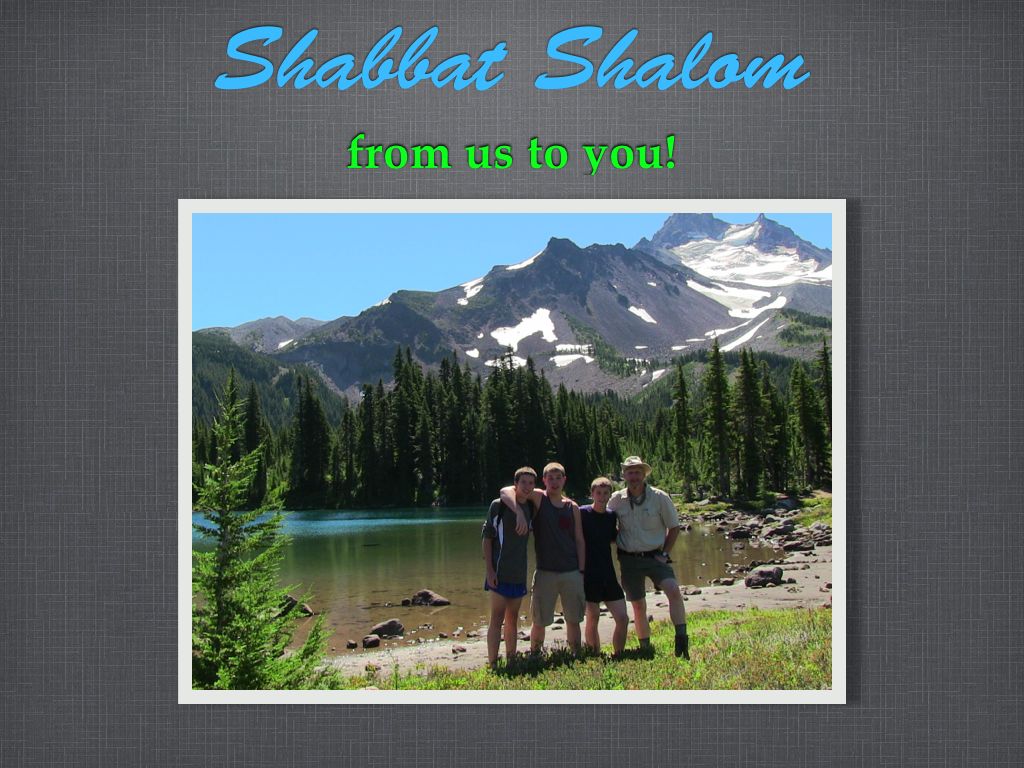
During the past few days, I have been backpacking with several of my kids in the high alpine country of the Cascade Mountains in Oregon. These are some photos we took from Jefferson Park, which lies at the base of 10,499 foot tall Mount Jefferson. Please join me in giving YHVH the praise and glory for creating such spectacular beauty for us all freely to enjoy!

Mount Jefferson from Bays Lake where we camped.

Mount Jefferson from Bays Lake where we camped.


Alpine glow on Mount Jefferson as the sun sets.

Alpine glow on Mount Jefferson as the sun sets.


My son Jared drinking from a stream that flows directly off of Mount Jefferson's glaciers.

My son Jared drinking from a stream that flows directly off of Mount Jefferson’s glaciers.

Mountain meadows in Jefferson Park at 6000 foot elevation.

Mountain meadows in Jefferson Park at 6000 foot elevation.


Meadow wildflowers in Jefferson Park, Oregon at the 6000 foot elevation.

Meadow wildflowers in Jefferson Park, Oregon at the 6000 foot elevation.


Natan on the side of Mount Jefferson at the base of a glacier near the 7500 foot level.

Natan on the side of Mount Jefferson at the base of a glacier near the 7500 foot level.


Hebrews 7:12: So What Really “Changed”?

Hebrews 7:12, Priesthood being changed…a change also of the law [Torah]. The Greek words for being changed and a change are respectively metatithemi (a verb) and metathesis (a noun). The root of the noun is the verb, which means “to transpose, to transfer, to go or pass over, to fall away or desert from one person or thing to another.” Many people interpret this verse to mean that YHVH’s Torah-law was changed (i.e., invalidated or annulled) by the new covenant, but is this what the author is saying here?

Before going further in our discussion, let’s lay out some basic truths of the Scriptures.

YHVH doesn’t change (Mal 3:6; Heb 13:8; Jas 1:17). The word torah [in English, translated as law] means “instructions, principles, teachings” and came directly from YHVH to his people. The Torah teaches men how to love YHVH and love one’s fellow man. It is YHVH’s instructions in righteousness and reflects his very character and nature. Who he is can’t change.

It is a sin (a violation of the Torah) to change the Torah (Deut 4:2; 12:32).

So in this light, what is this verse really saying? Continue reading →


The Stones Cry Out the Praises of Yeshua!

Deuteronomy 27:2, 4, 8, Set up great stones. On Mount Ebal on whole, un-cut stones, the Israelites were to write the Torah-law and then coat these stones with lime plaster. Elohim also told them to build an altar there where they were to make burnt and peace offerings. Why was Torah written on stones on Mount Ebal—the mountain of the curses? Why not on Mount Gerizim, the mountain of blessing?

Certainly this cannot mean that the Torah is a curse, for Paul calls it kadosh (holy), just and good in Romans 7:12. What could the stones represent?

Who is the Chief Cornerstone, the Stone the builders rejected (Ps 118:22; Matt 21:42; Acts 4:11; Eph 2:20), and the stone cut without hands (Dan 2:34)? What was the purpose of these offerings and to whom do the burnt and peace offerings point? Could lime plaster represent robes of righteousness? Who is clothed in robes of righteousness once sins have been atoned for? (Read Rev 19:7–8 cp. 3:5,18; Isa 61:10.) Who was wounded for our ­transgressions and bruised for our iniquities, had laid on him the iniquities of us all, and was made an offering for sin (Isa 53:5, 6, 10)? Who was the Living Torah, the Word of Elohim made flesh (John 1:1,14)? Who redeemed us from the curses of the law (Gal 3:13), which came upon us as a result of our sinning (sin is the violation of YHVH’s law, 1 John 3:4), and thus bringing a death penalty upon us (the wages of sin is death, Rom 6:23)?

Does it now make sense why the Torah and the altar were placed on Mount Ebal? This is another one of the many prophetic shadow pictures in the Torah pointing to the redemptive work of Yeshua at the cross. Does this strengthen your faith that Yeshua is indeed the Messiah, the Lamb of Elohim slain from the foundation of the earth? Who else could have fulfilled these prophecies?