Yeshua Heals the Gadarene Demoniac

Matthew 8:28–34 (also Mark 4:35–5:20 and Luke 8:26–39),

c2

“And when [Yeshua] had come to the other side [of the Sea of Galilee] into the country of the Gergesenes, there met him two possessed with demons [or, a man with an unclean spirit, Mark 5:2], coming out of the tombs, exceeding fierce, so that no man might pass by that way [or, no man could tame him, Mark 5:4]. And, behold, they cried out, saying, ‘What have we to do with you, Yeshua, Son of Elohim? Have you come here to torment us before the time?’ And there was a good way off from them an herd of many swine feeding. So the demons besought him, saying, ‘If you cast us out, allow us to go away into the herd of swine.’ And he said unto them, ‘Go [or, come out of the man, unclean spirit, Mark 5:8].’ And when they were come out, they went into the herd of swine, and, behold, the whole herd of swine [and, they were about two thousand, Mark 5:13] ran violently down a steep place into the sea, and perished in the waters. And they that kept them fled, and went their ways into the city, and told every thing, and what was befallen to the possessed of the demons. And, behold, the whole city came out to meet Yeshua, and when they saw him, they besought him that he would depart out of their coasts.” Mark’s account adds the following (Mark 5:15–20): “And they come to Yeshua and stared at him that had been possessed by the legion of demons, sitting, and clothed, and in his right mind and they were afraid. And they that saw it told them how it befell to him that was possessed with the demons, and also concerning the swine. And they began to beg him to depart out of their coasts. And when he was come into the ship, he that had been possessed with the devil begged him that he might be with him. Howbeit Yeshua would not allow it, but said unto him, ‘Go home to your friends, and tell them how great things the Master has done for you, and has had compassion on you.’ And he departed, and began to preach [proclaim] in Decapolis the great things Yeshua had done for him and all men did marvel.”

Prophetic Points to Analyze:

  • Mark 4:37, a great storm
  • Mark 4:38, asleep on a pillow
  • Matthew 28, the other side
  • Matthew 28, two possessed with demons
  • Matthew 28, coming out of the tombs
  • Matthew 28, no man could tame him
  • Matthew 30, swine
  • Mark 5:13, two thousand
  • Matthew 32, perished in the waters
  • Matthew 34, coasts
  • Mark 5:20, Decapolis

In this passage, we find more symbolic and prophetic language pertaining to the exile and future redemption of lost, scattered and spiritually apostate Israel. Here Yeshua had crossed to the other side of the Sea of Galilee into the region of the Gergesenes—a name which is a variant of Gadarenes and is plural for the word Gadara. This city was located on the east side of the Jordan River six miles southeast of the Sea of Galilee, and was one of the cities of the Roman province of Decapolis (i.e., “ten cities”). This was in the ancient territory of the tribe of Gad (one of the ten tribes of the Northern Kingdom or house of Israel).

The sea over which Yeshua crossed is a scriptural prophetic metaphor for the sea of humanity in general (e.g., see Dan 7:3). In Mark’s account, we learn that the sea was stormy at the time of Yeshua’s crossing (Mark 4:35–41). This is a prophetic picture of political turmoil and upheaval among the governments and peoples of the earth. Through this storm, Yeshua had been asleep with his disciples in the safety of the boat riding atop of the sea. This is a picture of YHVH’s preserving his saints through the horrendous times the Scriptures call the day of YHVH’s wrath (or the wrath of Elohim, i.e., the seven last plagues or bowl judgments of the Book of Revelation) during which time YHVH will pour out his wrath and judgment upon the unregenerate inhabitants of the earth.

A similar scenario occurred in Noah’s day. Noah and his family rode safely over the top of the waves, which were filled with drowned humanity. Noah was spared from the wrath of Elohim against a wicked and unrepentant generation. Similarly, the end-time saints of YHVH will not have to endure his final wrath as long as they are in the same spiritual boat Continue reading →


Blog Scripture Readings for 1-11 through 1-17-15

Aside

THIS WEEK’S SCRIPTURE READINGS FOR STUDY AND DISCUSSION:

Parashat Va’eira — Exodus 6:2 – 9:35
Haftarah — Ezekiel 28:25 – 29:21
Prophets — 2 Samuel 17:1 – 23:39
Writings — Psalms 96:1 – 103:22
Testimony — Luke 8:26 – 11:13

Most of this week’s blog discussion points will be on these passages. If you have general comments or questions on the weekly Scripture readings not addressed in a blog post, here’s a place for you to post those. Just use the “leave a reply” link below.

The full “Read Through The Scriptures In A Year” schedule, broken down by each day, can be found on the right sidebar under “Helpful Links.” There are 4 sections of scripture to read each day. One each from the Torah, the Prophets, the Writings, and from the Testimony of Yeshua. Each week, the Torah and haftarah readings will follow the traditional one-year reading cycle.

Weekly Blog Scripture Readings for 1/11 through 1/17/15.


Who is the “Angel of the Lord”?

Exodus 3:2; 13:21; 14:20
The Burning Bush and the Messenger of YHVH

The “Angel” of YHVH In the Pillar of Fire

In Exodus 13:21 we read,

And YHVH went before them by day in a pillar of a cloud, to lead them the way; and by night in a pillar of fire, to give them light; to go by day and night.

Then in Exodus 14:19 it is written,

And the angel of Elohim, which went before the camp of Israel, removed and went behind them; and the pillar of the cloud went from before their face, and stood behind them.

Who is this “Angel” of Elohim (elsewhere he is called “the Angel” of YHVH)? Angel is an unfortunate translation. The Hebrew word for angel is malak and simply means “a heavenly or a human messenger.” Prophetically this word can refer to human messengers such as the one coming in the spirit of Elijah prior to Messiah’s coming, as well as to the Messiah himself (as in “the Messenger/Malak of the covenant” in Malachi 3:1). In Genesis 32:22–30 Jacob wrestles with a man Scripture identifies as the Malak of YHVH (Hosea 12:3–5) and whom Jacob called Elohim (verse 30). This same Individual redeemed Jacob (Gen 48:18) and is identified with the Malak of Elohim … the Elohim of Bethel (31:11 and 13) and appeared to Moses at the burning bush (Exod 3:2). Now he is leading Israel in the wilderness. Again who is he? Continue reading →


Overview of the Books of the Torah (Main Themes)

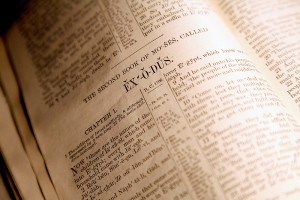
Exodus (Shemot) is the book whose principle theme is redemption—Israel’s deliverance from Egypt (Mitzraim). Here we learn how YHVH saves his people and we are shown that his people are redeemed in order to worship him.

The Theme of Redemption

Say, therefore, to the sons of Israel, “I am YHVH, and I will bring you out from under the burdens of the Egyptians, and I will deliver you from their bondage. I will also redeem you with an outstretched arm and with great judgments. Then I will take you for My people, and I will be your Elohim; and you shall know that I am YHVH your Elohim, who brought you out from under the burdens of the Egyptians. I will bring you to the land which I swore to give to Abraham, Isaac, and Jacob, and I will give it to you for a possession; I am YHVH.” (Exod 6:6-8, emphasis added)

Worship

And he said, “Certainly I will be with you, and this shall be a token unto you, that I have sent you, when you have brought forth the people out of Egypt, you shall serve Elohim upon this mountain.” (Exod 3:12, emphasis added)

And I say unto you, “Let my son go, that he may serve [Hebr. awvawd, Strong’s H5647] me, and if you refuse to let him go, behold, I will slay your son, even your firstborn.” (Exod 4:23, emphasis added)

And you shall say unto him, “YHVH Elohim of the Hebrews has sent me to you, saying, ‘Let my people go, that they may serve [Hebr. awvawd, Strong’s H5647] me in the wilderness, and, behold, until now you would not hear.’” (Exod 7:16, emphasis added)

The Basic Outline of Exodus

Chapters 1–6 show us the need for redemption.

Chapters 7–11 show us the power or might of the Redeemer as the ten plagues are poured out upon Egypt.

Chapters 12–18 show us the character of redemption; purchased by blood and emancipated by power.

Chapters 19–24 we are taught the duty of the redeemed.

Chapters 25–40 we see the restoration of the redeemed—provisions are made for the failures of the redeemed.

The Metaphors in Exodus

Egypt is a metaphor for the world, the place of sin and bondage where one is held captive before being delivered or redeemed by the power of YHVH and the blood of Yeshua, the Lamb of Elohim. It is interesting to note that ­although Egypt was the land of science and art, it was similarly the land of death. Their religion was fixated with death.

Pharaoh is a metaphor for Satan, a merciless taskmaster who opposes the people of YHVH every step of the way.

Pharaoh’s magicians is a metaphor for demonic spirits, doing Pharaoh’s bidding in opposing Israel.

Moses is a prophetic metaphor for Yeshua (his first coming), the Deliverer of his people from the bondage and power of sin, death and hell, which is the power of the enemy, Satan.

The blood of the lamb on the door posts is a metaphor for Yeshua, the Redeemer, whose death on the cross atoned for man’s sins causing YHVH’s judgment against sin to passover us.

The crossing of the Red Sea is a metaphor for our union with Messiah Yeshua in his death and resurrection via the ritual of tevilah (immersion or baptism) at a mikvah (a gathering of waters).

The journey through the wilderness is a metaphor for the trials and testing that occur during the redeemed believer’s spiritual walk through this life with YHVH’s provision to meet every need and his protection from every attack of the adversary.

Exodus 1-65289158

The giving of the Torah is a metaphor for the obedience and submission that we owe to YHVH, our new Master.

The Tabernacle of Moses with its furnishings is a metaphor for YHVH’s plan of redemption (salvation) for mankind and the steps in man’s spiritual maturation into intimacy with the Father through Yeshua the Messiah.


New Video: Is the Two-House Message Biblical or Not?

Based off of Genesis 48.

Is the commonly called “two house” or “two-stick” message” of the Bible something we should study? Are there any spiritual and prophetic benefits to understanding who the two houses of Israel are? The answer is yes. I would prefer to call it the “One House Message,” since this biblical truth involves the regathering and reunification of the Jews (the house of Judah) and the Christians (the house of Israel or Ephraim) into one nation through Yeshua the Messiah. This is the one new man message Paul proclaimed in Ephesians chapter two. This is the great and largely overlooked truth behind the message of the gospel of Yeshua the Messiah. In this video, you will discover the twelve benefits of understanding who the two houses of Israel are and how it relates to you.


Blog Scripture Readings for 1-4 Through 1-10-15

Aside

THIS WEEK’S SCRIPTURE READINGS FOR STUDY AND DISCUSSION:

Parashat Shemot — Exodus 1:1 – 6:1
Haftarah — Isaiah 27:6 – 28:13; 29:22-23
Prophets — 2 Samuel 10:1 – 16:23
Writings — Psalms 89:30 – 95:11
Testimony — Luke 5:1 – 8:25

Most of this week’s blog discussion points will be on these passages. If you have general comments or questions on the weekly Scripture readings not addressed in a blog post, here’s a place for you to post those. Just use the “leave a reply” link below.

The full “Read Through The Scriptures In A Year” schedule, broken down by each day, can be found on the right sidebar under “Helpful Links.” There are 4 sections of scripture to read each day. One each from the Torah, the Prophets, the Writings, and from the Testimony of Yeshua. Each week, the Torah and haftarah readings will follow the traditional one-year reading cycle.

Weekly Blog Scripture Readings for 1/4 through 1/10/15.


Two Messiahs? One from Joseph and Judah?

Genesis 49:24, Shepherd…Stone of Israel. This seems to be an irrefutable prophetic reference to the Messiah of Israel whom Scripture refers to in various places as “the Stone the builders rejected,” “the Chief Cornerstone,” “Precious Cornerstone” and “the Rock of our Salvation” (Ps 118:22; Isa 28:16; Mark 12:10; Eph 2:20; 1 Pet 2:6–8). Yet this verse appears to be saying that this Messiah is coming from the tribe of Joseph. At the same time, Jacob’s prophecy to Judah contains another classic Messianic prophecy in the reference to the Shiloh to come (Gen 49:10). These two prophecies led some Jewish sages to believe that two Messianic figures would arise out of Israel: one from Judah and other from Ephraim.

What kind of blessing was this prediction that one day his descendants—the Ten Tribes—would be scattered among the nations? R. Munk explains: while it is true that the dispersion was caused by the unfaithfulness and sinfulness of Ephraim’s descendants (Hos 7:8ff), Jacob’s blessing was not in vain for “they will return to God” and will have their share in the world to come (Sanhedrin 110b). And R. Eliezer adds: “Even the darkness in which the Ten Tribes were lost will one day become as radiant as the day’ (according to the version of Avos d’Rabbi Nosson 36). And in the perspective of history, did not these exiled children of the Patriarchs enlighten the nations among whom they were scattered? They did so by teaching their conquerors the fundamental ideas of the knowledge and love of God, ideals they had never forsaken. Hence they too have a messianic vocation and their Messiah the. … Messiah son of Joseph (Succah 52a), also called Messiah son of Ephraim (Targum Yonasan on Exod 40:11), will play an essential role in humanity’s redemption, for he will be the precursor of the … Messiah Son of David …” (The ArtScroll Bereishis/Genesis Commentary, pp. 2121–2122).

How do we explain this seeming contradiction in view of the facts that there was only one Messiah, and his name was Yeshua, and he came from the tribe of Judah? These two Messiahs are explained in Yeshua’s two comings. In his first coming, he was like Joseph, a suffering servant who then become a king after enduring great hardships (read Isa 53). When he comes back the second time, he will be like David, the conquering, triumphant or warrior king where he will rule over the world and a united Israel (Rev 19:11–16). The Jewish sages had a concept of these two Messiahs, as well, but were unclear as to whether they would be the same person or not and how much time would separate their two comings. With perfect 20-20 hindsight, we can now look back and see how Yeshua fulfilled this prophecy as the Messiah Son of Joseph (figuratively speaking) at this first coming, and how he is yet to come as the Messiah Son of David at his second coming where as the Conquering King he will defeat Babylon the Great and establish his earthly millennial kingdom where he will rule as King of kings (Rev 19–20).