Are You a Shepherdless Sheep?

Lone Sheep

Deuteronomy 31:23, He gave Joshua the son of Nun a charge. YHVH is the author of godly leadership. He prepares and trains leaders and then raises them up to lead his people in the paths of righteousness leading to the spiritual Promised Land. Beware of leaders who raise themselves up and promote themselves.

What is the purpose of righteous leadership? (See Eph 4:11–12.) What are the qualifications for leadership ? (See 1 Tim 3:1–13.) What is the premise of true, Spirit-ordained leadership? (See Matt 23:11.)

Many believers have been hurt by kingdom-building, money-grubbing and self-seeking leaders in the church world and now trust no one. They pride themselves on being “independent.” Is this good?

Did Yeshua ever speak of his sheep as being “lone rangers” or did he refer to them as “a flock?” Does he ever speak of his flock as being shepherdless? Of course, Yeshua is the Chief Shepherd, but does he speaks of undershepherds as well? (Read John 10:1–18.) Is a flock that is under the guidance of a servant shepherd a place of safety or harm? Is being outside the flock a place of safety or harm? (See Matt 18:12.)

Yeshua says that those who are outside are “lost” and have “gone astray” and are in danger of perishing (Matt 18:11–14).

Are you part of a literal flock of believers, or have you spiritualized this passage away to justify your independent (rebellious?) spirit against YHVH-ordained authority?


What about “I change not!” do we not understand?

Deuteronomy 31:10–13, You shall read this Torah before all Israel. Verses like this tend to expose the theological confusion that occurs in the minds of many Christian Bible teachers. For example, Christian commentator Matthew Henry on this verse writes about the need to read the Word of Elohim and that doing so will “help us to keep his commandments.” Yet elsewhere he says in the same commentary about the same laws that the commandments or laws of YHVH “are done away with.” Statements like these are representative of a split and incongruous, double-speak thinking on the part of many Christian Bible teachers and people when it comes to the commandments or laws of Elohim. Some laws, they say, we are to keep (e.g., thou shalt not murder, lie, commit adultery, etc.), but other laws we can disobey (e.g., the Sabbath, dietary laws, and biblical feasts). Is it possible to have it both ways: to believe that we need to keep his commandments, yet teach they are done away with? If so, then what is the meaning of such biblical phrases pertaining to YHVH’s Torah or Word as “forever,” “for a thousand generations,” “the same yesterday today and forever,” “till heaven and earth pass away,” “I change not,” and “think not that I came to destroy the Torah-law?” Is ­YHVH’s Word inconsistent and contradictory, or is this, instead, the case with the thinking of men? Is YHVH’s immutable character flawed with regard to keeping his Word, promises and standards or is man the one at fault?

Do we have a high enough view of YHVH Elohim and fear him and tremble at his Word (Isa  66:2), or have we, in reality, to demoted the veracity of his Word by contorting YHVH and his Word to fit the mindset of changeable and inconsistent man (which the Scriptures define as idolatry)? Have we bought into the lie that the serpent proffered at the tree of knowledge in the Garden of Eden when he told the man and the woman that YHVH really did not mean what he said and that humans can take the “have it your own way” and “pick and choose” approach when it comes to obeying the Word of YHVH (a philosophy that forms the basis for the religious movement called secular humanism, which is at the heart of all the religions of the world—including much of Christianity—except the true religion of the Bible)?

How many aspects of Christian theology are no more than a thinly veiled version of the religion of humanism in disguise? These are tough questions that we as redeemed Israelites need to ponder seriously. Let’s not forget the words of Yeshua in John 14:15, “If you love me, keep my [Torah] commandments” and the words of the apostle in 1 John 2:5–5, “He that says, ‘I know him,’ and does not keep his [Torah] commandments is a liar and the truth is not in him. But whosoever keeps his Word in him truly is the love of Elohim perfected: hereby know we that we are in him.”

The bottom line of why man has a hard time submitting to all of YHVH’s commandments is nowhere stated more concisely in the Bible than in Romans 8:7,

[T]he carnal mind is enmity against Elohim: for it is not subject to the law of Elohim, neither indeed can be.


 

Don’t get spit out of Yeshua’s mouth!

Lion crachant de l'eau  Rome

Revelation 3:14, The church at Laodicea.

Will you pass the test and make it into YHVH kingdom? 

Life is a series of tests. We either pass or fail them. YHVH is the school teacher who determines whether we will pass or fail, not us. His Word is our text book that tells us how to pass. If we learn the lessons and put to practice the things we have learned, we will pass. If not, we will fail.

The problem is that we’re not just in a regular school classroom where if we fail, it’s really not a big deal in the bigger scope of life. Our classroom is this life. Whether we pass or fail will determine not only whether we will obtain eternal life or eternal damnation, but if we pass, the grade we get will determine our level of rewards in YHVH’s eternal kingdom. There are a couple of things going on here.

When YHVH calls us with his holy calling and we respond, we have a choice. The choice we make will determine Continue reading →


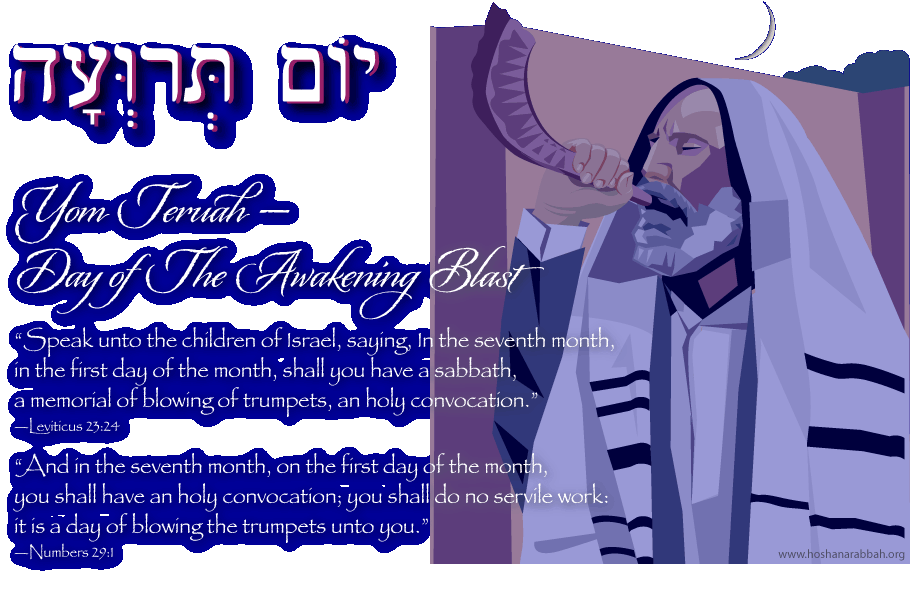
Yom Teruah is here! Time to gird up your loins.

yom-teruah_heb_920Main Yom Teruah Verses

Lev 23:23–25

Num 29:1

The Breath of Life and Yom Teruah

Without the life-giving breath of YHVH we are dead both physically and spiritually. As YHVH breathed the breath of life into Adam who then became a living being (nephesh), so when Yeshua breathed on His disciples (John 20:22) they came alive spiritually. YHVH breathed on the first century redeemed believers through the wind of the Ruach HaKodesh (the Set-apart Spirit) on the Day of Pentecost in Acts 2:2, and the congregation of renewed covenant believers was birthed. Similarly, on the day of Messiah’s second return (Yom Teruah), the shofar (called the last trumpet in Jewish thought, which comes just prior to the final or the great trumpet/shofar hagadol of Yom Kippur) will sound and the dead in Messiah will be resurrected. Again the breath of YHVH will revive the dead, which is similar to the breath of YHVH blowing over the Valley of Dry Bones in Ezekiel 37.

What can we learn from this? When YHVH breathes or blows on man, the supernatural pierces the natural dimension and the supernatural breaks the status quo of the natural and supernaturally empowers one to do that which he could not do in his own power naturally. We need YHVH’s divine breath to blow on us to empower us with his power and his ability to be and act supernatural in a natural world for his glory and the advancement of his kingdom!

When the shofar sounded in ancient Israel, it signaled that heaven and earth were about to meet, that divine power, the supernatural forces of heaven was about to break Continue reading →


Blog Scripture Readings for 10-2 Through 10-8-16

Aside

THIS WEEK’S SCRIPTURE READINGS FOR STUDY AND DISCUSSION:

Parashat Vayelekh — Deuteronomy 31:1 – 31:30
Haftarah — Hosea 14:2-10; Micah 7:18-20; Joel 2:15-27**
Prophets — Zephaniah 3:1-20; Haggai 1:1 – 2:23; Zechariah 1:1 – 4:14
Writings — 2 Chronicles 16:1 – 22:12
Testimony — Revelation 4:1 – 10:11

Most of this week’s blog discussion points will be on these passages. If you have general comments or questions on the weekly Scripture readings not addressed in a blog post, here’s a place for you to post those. Just use the “leave a reply” link below.

The full “Read Through The Scriptures In A Year” schedule, broken down by each day, can be found on the right sidebar under “Helpful Links.” There are 4 sections of scripture to read each day. One each from the Torah, the Prophets, the Writings, and from the Testimony of Yeshua. Each week, the Torah and haftarah readings will follow the traditional one-year reading cycle.

** A different Haftarah is read when it is a special sabbath in Jewish tradition. This week it is Shabbat Shuvah on the traditional calendar. Otherwise, Isaiah 55:6 – 56:8 would be read.

Weekly Blog Scripture Readings for 10/2 through 10/8/16.


Yom Teruah is this coming Monday. Are you ready?

Here are links to some resources on the upcoming biblical appointed time called Yom Teruah (the Day of Trumpts/Shofars/Shouting):

http://www.hoshanarabbah.org/pdfs/yom_teruah.pdf

me>


The Lost Tribes of Israel Were Scattered and Will Return

I want you

YOU are part of Bible prophecy being fulfilled as your return to the Hebrew roots of the Christian faith. Here’s what the Scriptures have to say about this:

Deuteronomy 30:3, From all the nations to which YHVH … has scattered you. The Scriptures over and over again record that the house of Israel (Ephraim) would be scattered over the face of the whole earth (Ezek 34:6, 12; 36:19; 37:21; John 11:52), and that YHVH will regather them in the end times and return them to the land of Israel (Deut 30:3–5). Deuteronomy 32:26 says, “I said, I would scatter them into the corners …” The ArtScroll Stone Edition Chumash comments, “This refers to the exile of the Ten Tribes, who were scattered to an unknown place where they have never been heard from again.

On the phrase of the same verse, “I would make the remembrance of them to cease from among men. …” the same Chumash states, “This is a reference to the exile of Judah and Benjamin, the Davidic kingdom from which today’s known Jews are descended.” It goes on to say that though nations would seek to destroy Israel entirely, YHVH would never allow Israel to become extinct or disappear. Israel’s perpetual existence is a constant reminder of YHVH’s plan and eventually Israel will thrive and fulfill YHVH’s intention for it” (pp. 1105–1106).

Nineteenth orthodox Jewish scholar S. R. Hirsch in his commentary on the same verse translates the phrase, “I would scatter them into the corners …” as, “I would relegate them into a corner …,” and then says that the Hebrew here refers to the “extreme end of a surface, the side or corner ….” He, too, relates this fate to the Ten Tribes who would be scattered “to some distant corner of the world, where, left entirely to themselves, they could mature towards serious reflection and ultimate return to Me …” (p. 650).

Some in the Christians deny that these Scriptures passages pertain to the ten tribes of the Northern Kingdom of Israel and instead insist that they are speaking about Judah (the Jews) only. They insist that the return of the Jews to the land of Israel starting in 1948 is the fulfillment of these prophecies and the ten tribes of Israel are lost forever. How can this a correct understanding in light of the Scriptures and the Jewish sages interpretations of those scriptures that states again and again that the ten tribes will return at the end of the age to be reunited with the Jews under the reign of Messiah Son of David (Ezek 37:15–28)?