New Video: Drawing Closer to YHVH Before the Fall Feasts & the Second Coming
Reply

Parashat Ki Tavo — Deuteronomy 26:1 – 29:8 (9)*
Haftarah — Isaiah 60:1-22
Prophets — Amos 6:1 – 9:15; Obadiah; Jonah 1:1 – 2:10
Writings — 2 Chronicles 1:1 – 8:18
Testimony — Hebrews 1:1 – 7:28
Our full Scripture Reading Schedule for 2016-2017 is available to download and print.
Most of this week’s blog discussion points will be on these passages. If you have general comments or questions on the weekly Scripture readings not addressed in a blog post, here’s a place for you to post those. Just use the “leave a reply” link below.
The full “Read Through The Scriptures In A Year” schedule, broken down by each day, can be found on the right sidebar under “Helpful Links.” There are 4 sections of scripture to read each day. One each from the Torah, the Prophets, the Writings, and from the Testimony of Yeshua. Each week, the Torah and haftarah readings will follow the traditional one-year reading cycle..
* Verse numbers in parenthesis refer to the verse number in Christian English Bibles when they differ from Hebrew Bibles or the Tanakh.
Weekly Blog Scripture Readings for 9/3/17 through 9/9/17.
President Donald Trump has just declared Sunday to be “a National Day of Prayer,” joining with Texas Gov. Greg Abbott who has also called on Texans to pray for recovery efforts from Hurricane Harvey.
“We are deeply grateful for those performing acts of service, and we pray for healing and comfort for those in need,” the president’s proclamation states.
“As response and recovery efforts continue, and as Americans provide much needed relief to the people of Texas and Louisiana, we are reminded of Scripture’s promise that ‘God is our refuge and strength, a very present help in trouble,'” the proclamation continues.
“I call on all Americans and houses of worship throughout the Nation to join in one voice of prayer, as we seek to uplift one another and assist those suffering from the consequences of this terrible storm,” Trump says.
Meanwhile, the governor of Texas has also called on his fellow Texans and people around the country to pray for Texas on Sunday.
Gov. Greg Abbott issued a proclamation calling for an official day of prayer for Texans “of all faiths and religious traditions and backgrounds.”
The governor is urging people to pray for the safety of first responders, public safety officers and military personnel involved in the aftermath of Hurricane Harvey.
He’s also calling for prayers for the “healing of individuals, rebuilding of communities and the restoration of the entire region struck by this disaster.”
Abbott applauded Texans for helping each other through the ordeal and noted they are grateful for the support and resources they’ve received in days since Harvey struck.
Harvey has caused record flooding in parts of the state and has been blamed for the deaths of more than 30 people.
In 2011, Texas Gov. Rick Perry also called for official prayer but ironically–he called for prayers for rain. At the time, the Lone Star state was in the throes of severe drought and wildfires. Perry called for three official days of prayer, from April 22-24, to pray for rain.
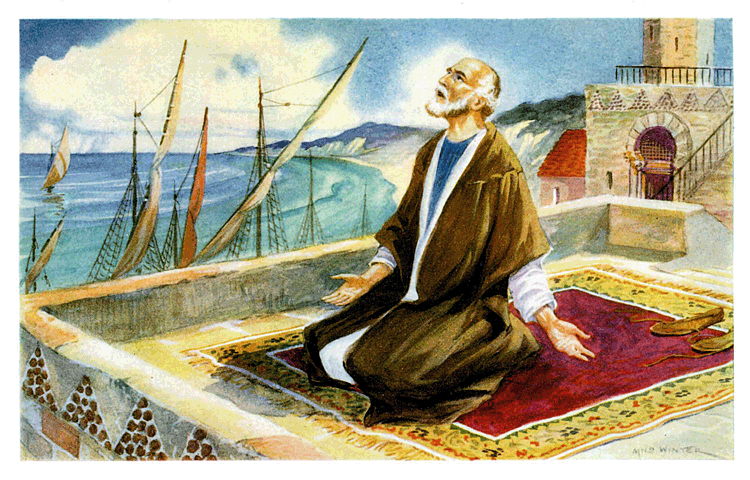
Under what circumstances does YHVH not answer prayers? Whose prayers does he not hear much less answer? The answers to these questions may shock some people who have been misled by the mainstream church to believe that YHVH Elohim is their divine sugar-daddy in the sky who is like a cosmic vending machine—every time you put in your coin and push the button, you’re automatically guaranteed to get something yummy in return. In reality, the Bible teaches us to view Elohim very differently. The Scriptures have a lot to say on this subject.
Before sharing what the Scriptures have to say about answered and unanswered prayer, consider this. YHVH Elohim is holy (Heb. kadosh) or set-apart and totally righteous. By his mercy and grace we exist. He doesn’t need us; we need him. He’s not obligated to do anything for us. To think that he is duty-bound to bless us by hearing, much less answering our prayers is presumptuous at the least, and arrogant and self-centered at the most, and it doesn’t line up with what the Scriptures say on the subject. If we have been guilty of this erroneous belief, it is time to repent and to line up our hearts and minds with what the Word of Elohim teaches us on this subject. If we operate within the perimeters of YHVH’s Word, we’re more likely to have our prayers answered. YHVH Elohim follows his own word, and so should we.
Remember these wise words from Solomon:
Walk prudently when you go to the house of Elohim; and draw near to hear rather than to give the sacrifice of fools, for they do not know that they do evil. Do not be rash with your mouth, and let not your heart utter anything hastily before Elohim. For Elohim is in heaven, and you on earth; therefore let your words be few.… a fool’s voice is known by his many words.…For He has no pleasure in fools. Pay what you have vowed…Do not let your mouth cause your flesh to sin, nor say before the messenger of Elohim that it was an error. Why should Elohim be angry at your excuse and destroy the work of your hands? For in the multitude of dreams and many words there is also vanity. But fear Elohim. (Eccl 5:1–4, 6)
There is a severe dearth of the fear of Eohim in the modern church, and this is contrary to what the Scriptures reveal should be our approach to the Almighty Creator and is thus offensive to him. It is time that the saints had a higher, more respectful view of Elohim and a lower view of themselves, and this has to do with our approach to prayer as well.
The “Phone Lines” to Elohim Are Not Always Open
Therefore let everyone who is godly offer prayer to you at a time when you may be found; surely in the rush of great waters, they shall not come near him. (Ps 32:6)
This infers that sometimes YHVH may be found when his people seek him, and sometimes he may not be found.
Give ear to my prayer, O Elohim, and hide not yourself from my plea for mercy. (Ps 55:1)
This teaches us that sometimes YHVH hides his face, even from his people who seek him in prayer.
It’s Not Guaranteed YHVH Will Hear All Prayers
O YHVH Elohim of hosts, hear my prayer; give ear, O Elohim of Jacob! Selah. (Ps 84:8)
If David had to cry out to Elohim to hear his prayers, then this indicates that he was humble enough to admit that YHVH wasn’t obligated to hear his prayers, or that Continue reading

When engaged in spiritual warfare prayer, consider this. Yeshua only addressed demons or Satan directly when the demon or Satan were actually manifesting. The same is true with Paul when dealing with the python spirit in the slave girl in Philippi, or with Peter when dealing with Simon the Magician. This is because at that moment they were on the spiritual battlefield, and direct confrontation with the enemy was unavoidable.
When not on the battlefield, we need to go through the courts of heaven when dealing with our spiritual enemies. To wit, I can think of no examples in the Bible of the saints speaking to Satan or his demons directly unless engaged in direct battle with them when evil spirits were actually manifesting.
Therefore, when engaged in spiritual warfare and not on the battlefield and in direct confrontation with the demonic element, we need to address our spiritual warfare issues and make our petitions known before the throne of the Almighty in the courts of heaven. It is also there that we will be given divine guidance to formulate our battle plans when the time comes to directly engage the enemy on the battlefield. We must communicate with Elohim in a way that the enemy will not overhear these strategic plans and thus be able to thwart them by mounting a defence against them ahead of time.
Yeshua instructed his disciples to be wise as serpents and harmless as doves (Matt 10:16). He also declared that, “the sons of this world are more shrewd in their generation than the sons of light” (Luke 16:8). Therefore, we need to engage the enemy prudently, shrewdly and intelligently following strict biblical protocols if we want to experience more victories.

Ecclesiastes 10:20 warns us, “Do not curse the king, even in your thought; do not curse the rich, even in your bedroom; for a bird [Heb. owf] of the air may carry your voice, and a bird [Heb. baal] in flight may tell the matter.” This verse is very revealing regarding what goes on in the unseen spiritual realm where Satan is the prince of the power of the air (Eph 2:2) and the ruler of this world (John 16:11).
The phrase in this verse is a parallelism—a form of Hebrew poetry where two phrases are juxtaposed and appear to be saying the same thing, but, in this case, a subtle spiritual truth is be being revealed in the second phrase. In the first phrase, the word for bird is a generic Hebrew word meaning “bird, winged creature, winged insect.” The second phrase reveals the subtle truth. It is telling us to be careful what you say or even think—even in private, for a god (or demon) might reveal it to it’s lord or king. In other words, a false god or demon spirit might convey what you’ve thought or said to its demon master, or even to Satan, who is the god of this age (2 Cor 4:4).
With regard to prayer we must remember this: “For we do not wrestle against flesh and blood, but against principalities, against powers, against the rulers of the darkness of this age, against spiritual hosts of wickedness in the heavenly places” (Eph 6:1). In light of this reality and with regard to prayer, it is vital that we remember this: When making intercession for situations or people or praying against the enemies of Elohim or engaging in spiritual warfare against Satan and his plans, ask YHVH to cover your prayers under the blood of Yeshua (Rev 12:11), to bind the (demonic) strong man (Matt 12:29; Mark 3:26–27 cp. Rev 20:2), to send his angels to protect you against the enemy’s plans to thwart your prayers (Ps 91:11–12; Heb 1:14), and to send confusion to our spiritual enemies (Ps 35:4, 26; 40:14; Jer 20:11).
It is essential that we employ this strategy against our spiritual adversary, so that he won’t be able to hear our prayers and thus be able to prepare a defensive plan or a punishing backlash against us to prevent our prayers from being effective. When he succeeds in this, the result is often unanswered prayers causing the saint to become discouraged, so that he prays less rather than more—a victory for the evil one.
Perhaps this is why some of our prayers go unanswered or seem ineffective; it is because we are inadvertently revealing our plans to the enemy thus allowing him to thwart them.