Some Reflections on the Biblical Dietary Laws

Leviticus 11:1–47, The biblical dietary laws are about holiness. Let’s briefly discuss the subject of clean and unclean meats. The focal point of biblical dietary laws are holiness and separation. There are other issues here that need to be explored as well. How serious are you about obedience to YHVH’s commands, or is your belly your god? (See Phil 3:19; Rom 16:18.) Do your taste buds or the Word of YHVH rule your life? Remember, Torah covers all aspects of life: physical, spiritual, emotional, relational, civil, agricultural, political, jurisprudence, religious and economic. ­Torah is a very holistic handbook on life. Are you one who takes the (humanistic) pick-and-choose approach to Torah-obedience? “I’ll obey only the biblical laws that suit me.” Such an approach is akin to what the serpent told Adam and Eve when he said, “You can have it your way … YHVH didn’t really mean what he said when it comes to obedience.”

The biblical kosher laws involve many areas such as health issues, holiness (not defiling the body, the temple of YHVH’s Set-Apart Spirit), and separation issues—how we’re to act, live, eat, worship, think, dress and talk differently than the heathens around us. The word kosher derives from the Hebrew word kasher (Strong’s H3787) meaning “to be straight, right, acceptable” (see Est 8:5; Eccl 11:6; 10:10). YHVH has called his people out of this world and sanctified (set-apart) them to be “straight, right and acceptable” to him. Therefore, YHVH hasn’t give us the liberty to act, speak, dress, eat and live the way the heathens do. He has called us to a higher moral and spiritual standard. We can’t expect to be called the children of the Most High, and still live like the children of the world. We must choose whom we are going to serve (see Josh 24:15): YHVH or mammon and this world (Matt 6:24).

Leviticus 11:4, 47, Unclean. The word unclean is the Hebrew word tameh meaning “defiled, impure, polluted ethically, ritually or religiously” and the word clean is the Hebrew word tahor meaning “pure physically, ceremonially, morally, ethically.” In verse 43, YHVH says that in eating unclean meats one becomes abominable (or detestable, filthy). In Ezekiel 22:26, YHVH rebukes his people because, “Her priests have violated my Torah-law, and have profaned my set-apart (Heb. kadosh) things: they have put no difference between the set-apart and profane, polluted or common, neither have they shown difference between the unclean and the clean, and have hid their eyes from my sabbaths, and I am profaned among them.” In Leviticus 11:45, the Torah states, “For I am YHVH that brought you up out of the land of Egypt, to be your Elohim. You shall therefore be set apart, for I am set apart/holy.” 

In 2 Corinthians 6:16–17, we read:

And what agreement does the temple of Elohim have with idols? For you are the temple of the living Elohim; as Elohim has said, “I will dwell in them, and walk in them; and I will be their Elohim, and they shall be my people. Wherefore come out from among them, and be you separate,” says the Master, “and touch not the unclean thing; and I will receive you.” (emphasis added)

The issue of clean or pure and unclean, polluted or abominable meats is not simply a dietary or health consideration, but a spiritual issue with YHVH. Both Moses (Lev 19:2) and the apostolic writers had a clear sense of the fact that without holiness no one will see YHVH (Heb 12:14), and that holiness or being kadosh or set-apart from the ways, lifestyles, ideologies of this world (i.e. from spiritual Egypt) is an absolute requirement of YHVH for his people. Is it possible to spiritualize away the concept of set-apartness and still be true to the Word of Elohim? Can one be spiritually sanctified (set-apart) through the atoning work of Yeshua at the cross, but then have a polluted lifestyle? Can one profess a righteous lifestyle and be set-apart without walking out that lifestyle? Can one follow the spirit of the law and violate the letter and still be acceptable to YHVH? What did James say about faith without works (Jas 2:20)? What did Yeshua teach at the Sermon on the Mount (Matt 5–7) about uniting the letter and the spirit of the law and practicing both? (Specifically read Matt 5:21–48 for the answer.)

Leviticus 11:10, 20, 23, 41, 42, Abomination. Heb. sheqets (Strong’s H8263) meaning “a detestable thing or idol.” It can also mean “to make abominable” or “contaminate.” This word is also used in connection with idolatrous practices, either referring to the idols themselves as being abhorrent and detestable in Elohim’s sight, or to something associated with the idolatrous ritual (The TWOT, pp. 954–955; e.g. Jer 16:18; Ezek 5:11; 7:20; 2 Chron 15:8). Not only are the idols an abomination, but those who worship them become detestable as well (Hos 9:10). In fact, the word abomination in “abomination of desolation” as mentioned in Daniel 9:27 and 12:11 is the same Hebrew word. It is generally viewed that this prophecy was fulfilled when Antiochus Ephiphanes (a prophetic foreshadow of the Antichrist) set up an idol of Zeus in the Jerusalem temple (ibid.). It should be clear that when YHVH uses sheqets (or its cognates) in relationship to certain practices (e.g. eating unclean meats or idol worship) that he is attempting to impress upon his people the extreme gravity of the sins they are committing against him. 

Leviticus 11:44, Be holy [Heb. kadosh], for I am holy [kadosh]. (See also verse 45; Lev 19:2; 20:26; 1 Pet 1:16.) How do we as redeemed believers initially become kadosh or set-apart? This occurs only through the blood of Yeshua, the Lamb of Elohim at the time of our salvation. 

And from Yeshua Messiah, who is the faithful witness, and the first begotten of the dead, and the prince of the kings of the earth. Unto him that loved us, and washed us from our sins in his own blood. (Rev 1:5)

“Come now, and let us reason together,” says YHVH. “Though your sins be as scarlet, they shall be as white as snow; though they be red like crimson, they shall be as wool.” (Isa 1:18)

How does one stay set-apart or sanctified and stay in fellowship with a kadosh Elohim? This is accomplished by staying under the blood of Yeshua the Lamb and by confessing and forsaking sin (i.e. violation of the Torah-law of Elohim—1 John 3:4) on a regular basis:

If we say that we have fellowship with him, and walk in darkness [sin or Torahlessness], we lie, and do not the truth [i.e. Torah/YHVH’s instructions in righteousness], but if we walk in the light, as he is in the light, we have fellowship one with another, and the blood of Messiah Yeshua his Son cleanse us from all sin. If we say that we have no sin, we deceive ourselves, and the truth is not in us. If we confess our sins, he is faithful and just to forgive us our sins, and to cleanse us from all unrighteousness. (1 John 1:6–9)


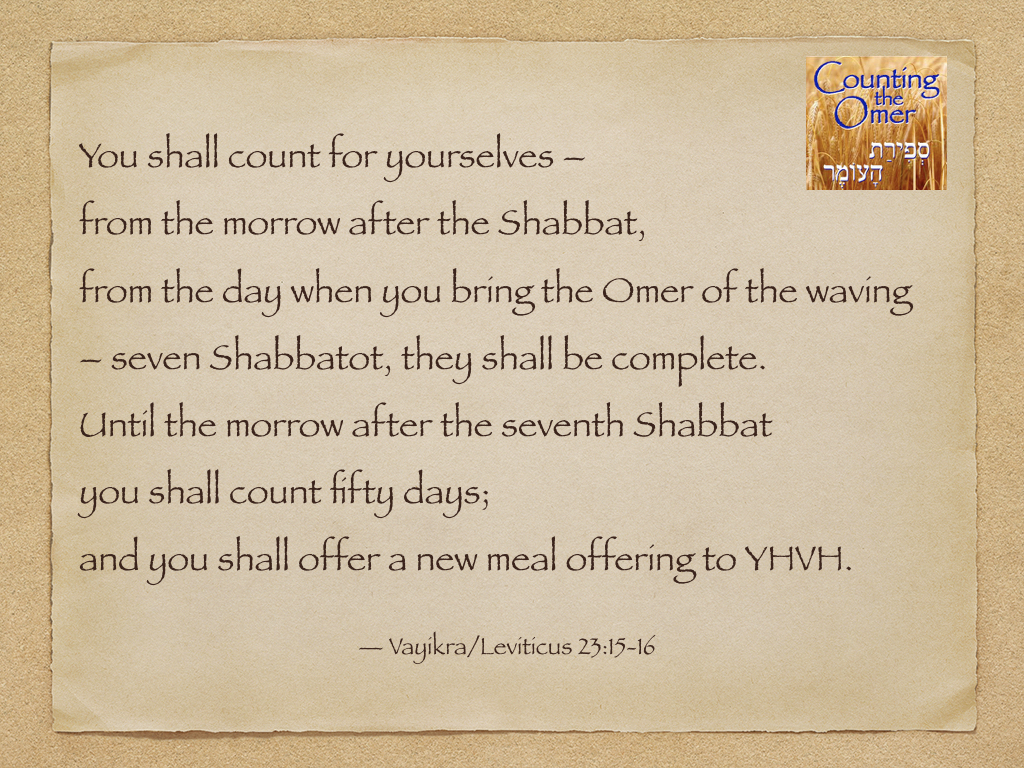
Counting the Omer—Week One

Today is the seventh day of the first week of seven weeks.

Today is the seventh day of the counting of 50 days from the day of the waving of the omer on the morrow after the Sabbath.

Today is Shabbat, the first Shabbat of seven Shabbatot.

Today completes the first week of seven weeks.


Some Good News! Pro-Life Student Activism on the Rise (Hopefully)

Kudos to these young people for taking a stand against the murder of babies euphemistically called abortion. May more bold and righteous young people continue to rise up against this evil!

Bet you didn’t hear about this in the mainstream media. At the same time, an anti-god progressive liberal burps or sneezes, and it makes national headlines all over America!

Who will rise up for me against the evildoers? or who will stand up for me against the workers of iniquity? (Ps 94:26)

From https://www.cnsnews.com/commentary/patrina-mosley/pro-life-students-partake-walkout-unborn

Pro-Life Students Partake in Walkout for Unborn

Patrina Mosley

By Patrina Mosley | April 12, 2018 | 12:05 PM EDT

Rocklin High School student Brandon Gillespie, who led the organization of #prolifewalkout, scheduled for April 11 at 10AM. (YouTube, CBS 13 Sacramento)

America’s most pro-life generation is at it again. Pro-life students across the country partook in a planned school walkout on Wednesday morning.

After a California high school history teacher was suspendedfor talking with students about whether pro-life students would receive the same support for their human rights concerns as those who engaged in the gun violence walkout, student Brandon Gillespie was inspired to organize a pro-life walkout for his school that has now spread across the country.

With the help of Students for Life of America, the nation’s largest pro-life organization with more than 1,200 groups in all 50 states, Gillespie and other pro-life students meeting on their campuses will receive “resources, legal help, and training for all who want to take a stand for life, to remember those lost to abortion, to call for support for mothers and their pre-born infants, and to demand that Planned Parenthood be defunded,” says Kristan Hawkins, president of Students for Life of America.

Also, the Thomas More Society will be there to offer “legal help, free of charge, to students as they prepare to exercise their constitutional rights to stand up for life and to students who encounter a pro-abortion double standard at their schools,” said Richard Thompson, president and chief counsel of the Thomas More Law Center.

Gillespie says, “I just want to spread awareness about the cruel things that are happening in Planned Parenthood clinics across the country, the cruel murder of these children who have done nothing wrong.”

Gillespie has inspired other students across the country to stand courageously for the dignity and sanctity of life.

Luke Gutierrez, 16, has organized a pro-life walkout for his school simply because he didn’t see anybody else doing it. He said he takes a stand against the one-sided agenda pushed to him and his fellow peers every day because he knows God created every person with a purpose, and that view should be represented as well.

In a promotional video for his pro-life walkout, he points out that 17 people tragically died in the Parkland high school shooting, but roughly 1,700 people die every day because of abortion.

According to the Centers for Disease Control and Prevention, more than 600,000 abortions were performed in the U.S. in 2014—with Planned Parenthood responsible for more than a third. In 2016, Planned Parenthood claimed to have aborted 881 babies per day—or one every 98 seconds. Since Roe v. Wade, we have lost more than 60 million people to abortion.

Gutierrez admits he is usually a shy guy and does not like to get out of his comfort zone, but he knows “[there are] issues in life you have to stand for and even though I’m a kid … if we don’t stand up for them, who will?”

This generation is showing no fear in the face of liberal bias in the classroom and on university campuses. There are some things that pro-life students are seeing as more important than getting their peers’ and teachers’ approval.

The moral conscience of our nation is rising. The voices of victims of the abortion industry are becoming louder. The wounded are becoming warriors, and abortion is becoming unthinkable.

As a pro-life generation, we hope to one day take our future grandchildren to an abortion clinic-turned-museum to remember a time when the unborn had no voice, and to declare, “No more.”

Patrina Mosley is Director of Life, Culture and Women’s Advocacy at Family Research Council.


Indiana Adopts Law That Counts Unborn Children as Persons

Please pray that what has happened in Indiana will spread across this nation! This is a major step in the right direction in the spiritual battle against abortion. May YHVH bless the governor and legislators of Indiana for this bold action.

From https://www.christianheadlines.com/blog/indiana-adopts-law-that-counts-unborn-children-as-persons.html

Veronica Neffinger | Editor, ChristianHeadlines.com | Tuesday, April 10, 2018
Indiana Adopts Law That Counts Unborn Children as Persons

INDIANA ADOPTS LAW THAT COUNTS UNBORN CHILDREN AS PERSONS


The state of Indiana has adopted a new law that essentially grants personhood to unborn children.

Relevant Magazine reports that Indiana Gov. Eric Holcomb has signed a bill into law that allows suspects to be charged with murder if they harm a pregnant woman who then loses her unborn child.

Pro-life supporters are championing this bill, as it acknowledges the personhood of unborn children. The law, however, does not apply to legally obtained abortions.

The law also brings to mind the Old Testament passage which says:

“Now suppose two men are fighting, and in the process they accidentally strike a pregnant woman so she gives birth prematurely. If no further injury results, the man who struck the woman must pay the amount of compensation the woman’s husband demands and the judges approve. But if there is further injury, the punishment must match the injury: a life for a life” (Exodus 21:22-23).

This law was brought to the attention of the state’s lawmakers by a woman whose 11-months-pregnant daughter was shot and killed. The woman felt it was unjust that the killer could not be tried for the death of the unborn child as well as the death of her daughter.

The law will go into effect in July 2018.


Home Churches—The NT Answer to Terrorism

Church bombings in Egypt, churching burnings in Africa and Asia, churches being shot up in America—what’s the solution? Home churches!

Think about it. Home churches are harder for terrorists to find and enter. They’re easier to protect. In a home church, everyone knows everyone, so terrorist can’t infiltrate as easily. They’re usually more spiritually vibrant, so less likely for the devil and his minions to take out. There are less people congregated in more places making it a more difficult target for the enemy to hit and to take out.

Also, it’s easier to invite family and friends to a home church or Bible study than to a building. That works well for evangelism!

Home churches are also tough on the unbiblical model of institutionalized religious structures, centralized denominations and hireling pastors, since it’s generally harder on the business model of the church system (i.e. controlling people for the purpose of collecting money), but it’s better for the people and their spiritual growth. This is a good thing. Plus home churches follows the NT model. Go read the book of Acts.

Home churches were the apostles answer to church persecution in their day. Again, go read the book of Acts!

From The Christian Post at https://www.christianpost.com/news/36-isis-suspects-sentenced-death-killing-christians-egypt-church-bombings-222803/

36 ISIS Suspects Sentenced to Death for Egypt Church Bombings 

Thirty-six militants accused of being part of Islamic State cells in Egypt have received preliminary death sentences for their alleged involvement in the bombing of three churches.

A military court has referred the cases of 36 defendants to the nation’s Grand Mufti with the recommendation that they be put to death. The defendants were convicted of being involved in four different acts of terror that occurred in 2016 and 2017, including the bombings of two churches on Palm Sunday last year, and an attack on a police checkpoint. They’re also accused of being part of the Islamic State cells in Cairo and Qena.

The cases were originally referred to the military court by Egypt’s Attorney General Nabil Sadek.

Two of the attacks occurred on April 9, 2017, when churches in Tanta and Alexandria were bombed during Palm Sunday attacks that were later claimed by the Islamic State terrorist group. The bombings took the lives of 47 people and injured over 120 others.

Additionally, some were convicted for their involvement in the bombing of the Botroseya Church in Cairo on Dec. 11, 2016, which took the lives of 29 people and injured 47. That attack was also claimed by the Islamic State.

The other attack occurred last January when eight policemen were killed and three were wounded during an attack on a police checkpoint in the New Valley.

The Egyptian news site Al-Ahram reports that the military court has referred the case to the Grand Mufti, Egypt’s highest official of religious law who weighs in with legal opinions and edicts. Earlier this year, the Grand Mufti approved the death sentence of a Muslim man who brutally murdered a Coptic priest in a Cairo street.

The convictions of the 36 suspects are subject to appeal. In addition, prosecutors charged three of the defendants with providing other militants with combat training at training camps and with training other militants to manufacture bombs.

According to Daily News Egypt, the case involves a total of 48 defendants who have all been accused of joining an illegal terror group and were not only involved in the four attacks but were also planning to launch other violent attacks inside Cairo that would have targeted Christians.

Reuters reports that 11 of the 36 are being tried in absentia. An official verdict is expected on May 15.

As Coptic Christians comprise about 10 percent of the Egyptian population, the community has faced numerous attacks from radicals in the past year-plus. In addition to the bombings, a number of Copts have been brutally killed in separate attacks and Christians’ homes have been burned.

Egypt ranks as the 17th-worst nation in the world when it comes to Christian persecution, according to Open Doors USA’s 2018 World Watch List.

The persecution comes as President Abdel-Fattah el-Sisi has extended an olive branch to the Coptic community and has tried to foster peace and protection for the persecuted Christians.

In 2015, Sisi gave a speech before Muslim leaders at Egypt’s 1,000-year-old Al-Azhar University where he called for the Muslim leaders to lead a “religious revolution” that embraces peace rather than violence.

Sisi has also attended masses during Christian holidays to show his solidarity with the Coptic community. After he came to power in 2014, Sisi personally ordered the rebuilding of dozens of churches that were destroyed by Muslim Brotherhood extremists.

“When a law passed by parliament to protect churches was trapped in a maze of bureaucracy and indifference, [Sisi] intervened, ordering it all to be sped up,” American religious freedom advocate and informal advisor to the Trump administration Johnnie Moore wrote in an op-ed this week. “Under President el-Sisi, Egypt’s religious establishment has also signaled moderation.”


Church Activities Per the Testimony of Yeshua (NT)


Acts 13:14–15, A synagogue service. In that day as in our day, a typical Jewish Sabbath day synagogue service involved reading the from the Torah and the rest of the Tanakh and then hearing a teaching on what was read or on some other biblical subject. Add these Sabbath day activities to those mentioned in Acts 2:42, 47; 1 Tim 4:13; Eph 5:19–20; Col 3:16; Jas 5:13–14 and 1 Cor 14:26 and we have a list of activities the early believers did when they came together. These include

  • Teaching the word of Elohim (including the Torah), teaching doctrine, presenting the gospel (Acts 2:40–42; 1 Cor 14:26; 1 Tim 4:13)
  • Baptizing new converts (Acts 2:41)
  • Fellowshipping (Acts 2:42)
  • Sharing meals together (Acts 2:42
  • Praying for the sick (Jas 5:14)
  • Singing psalms (Gr. psallo meaning “to play on a stringed instrument a praise song to Elohim,  Jas 5:13) or to give a psalm (Gr. psalmos meaning “a striking, twanging, of a striking the chords of a musical instrument, of a pious song, a psalm, 1 Cor 14:26), for singing in general (1 Cor 14:15)
  • Confessing one’s sins one to another (Jas 5:16)
  • Praying for one another (Jas 5:16) or prayer in general (1 C or 14:14–15)
  • Turning those who are wandering from the truth back to Elohim (Jas 5:19)
  • Reading the Scriptures (1 Tim 4:13)
  • Exhorting (Gr. paraklesis meaning “calling near, summons, importation, supplication, entreaty, admonition, encouragement,consolation, comfort, solace,” 1 Tim 4:13)
  • Exercising the gifts of the Spirit (1 Cor 12) including speaking in tongues and prophesying (1 Cor 14:12, 26, 29, 39)
  • Giving spiritual revelations (1 Cor 14:26)

How many modern day churches do all of these things on a regular basis? If not, maybe it’s time to find a new church…


A (Hidden) Message in the Middle of the Torah

Leviticus 10:16, Diligently sought or inquired insistently (ASET). According to one Jewish tradition, these two words are the exact halfway mark of the words of the Torah. “This is to teach us that the entire Torah revolves around constant inquiry. One must never stop studying and seeking deeper and broader understanding of the Torah” (The ArtScroll Vayikra/Leviticus Commentary, p. 159).

How many times have you read a passage in the Word of Elohim many times only to receive a fresh revelation or to find a new nugget of understanding? This is because the Word of Elohim is spiritually alive! (Heb 4:12; John 14:25–26; 16:13; also Ps 119:30; Isa 55:11.)

It must be noted that other Jewish traditions place the center of the Torah in other passages as well. (These options are discussed in The Babylonian Talmud, Kiddushin 30a.) 

Study to shew thyself approved unto Elohim, a workman that needeth not to be ashamed, rightly dividing the word of truth. (2 Tim 2:15)