The biblical pilgrimage or aliyot (singular: aliyah) festivals are Passover (Pesach) and Unleavened Bread (Chag haMatzot) and the Feast of Weeks or Pentecost (Shavuot) in the spring and the Feast Tabernacles (Chag haSukkot) in the fall. At these feasts, the Torah, the Word of Elohim, commands all of YHVH’s his people Israel to come up (or make aliyah) to the place where YHVH has chosen to place his name. There they are to worship and serve him as they fellowship with joy with their Israelite brothers from far and near.
What are the reasons and benefits for YHVH’s people to faithfully and obediently celebrate his holy or set-apart feasts as he has commanded in is Set-Apart Word?
The biblical feasts are a prophetic shadow-picture of things to come (Col 2:16–17; Heb 10:1). When they were given to ancient Israel they pointed forward to future events that would occur to the nation of Israel including redeemed believers. The spring feast days, for example, point to Yeshua the Messiah’s first coming, while the fall feast days point to his second coming leading into the Messianic Age (Millennium) and into eternity beyond.
All the biblical feasts point to Yeshua. Yeshua is the Hebrew name for Jesus and means “salvation.” All the biblical festivals point to the various stages or steps of the path of salvation that believers find themselves on.
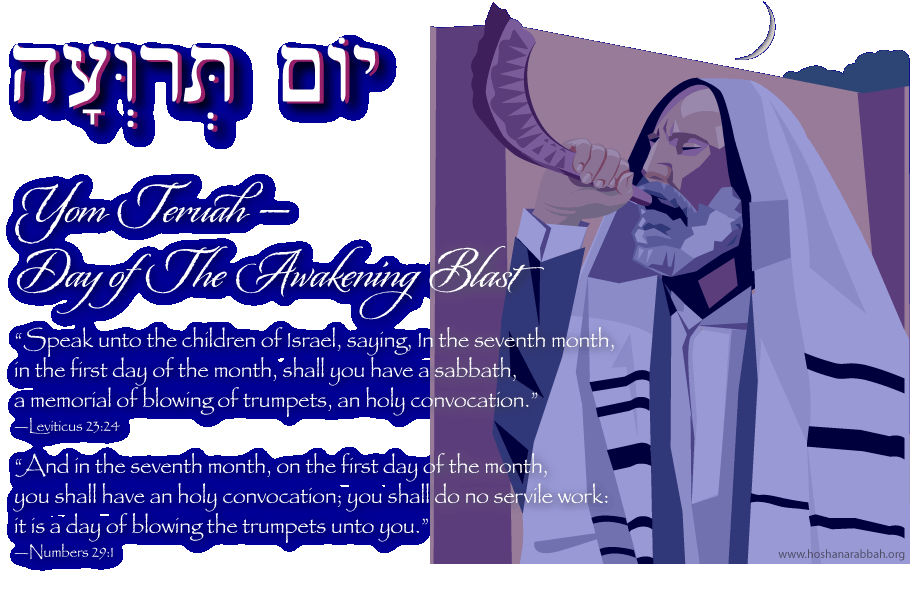
The new moon was sighted by multiple witnesses this past evening marking the first day of the seventh month on the biblical calendar. This means that Yom Teruah, the Day of Trumpets/Shofars, will be on Monday, September 30. A joyous Yom Teruah to all!
My family and I (at least the ones who can make it) will be celebrating Yom Teruah at home as a high holy day Shabbat. This means that I will be shutting down my business, no work, and spending the day with YHVH and our family focusing on the meaning of the day.
Ten days from now, on the tenth day of the seventh biblical month, will be Yom Kippur on Wednesday, October 9. Five days after that will be Sukkot, the Feast of Tabernacles, starting on Monday, October 14 and lasting until Sunday, October 20. The first day of Sukkot is a high holy day Shabbat. Shemini Atzeret, the Eighth Day, another high holy day Shabbat, will be Tuesday, October 21.
As I have done my entire life (since 1960), except for several years in the 1990s when I was part of the Sunday church world and failed to honor the Sabbath and biblical feasts, I, along with my wife, will be taking the time off from our daily work to honor these divinely mandated, set-apart times and to be with YHVH Elohim and his people.
May YHVH bless you as you honor and obey him by celebrating these appointed times!
Most of this week’s blog discussion points will be on these passages. If you have general comments or questions on the weekly Scripture readings not addressed in a blog post, here’s a place for you to post those. Just use the “leave a reply” link or the “share your thoughts” box below.
The full “Read Through The Scriptures In A Year” schedule, broken down by each day, can be found on the right sidebar under “Helpful Links.” There are 4 sections of scripture to read each day: one each from the Torah, the Prophets, the Writings, and from the Testimony of Yeshua. Each week, the Torah and haftarah readings will follow the traditional one-year reading cycle.
** A different Haftarah is read when it is a special sabbath in Jewish tradition. This week it is Shabbat Shuva (Sabbath of Return) on the traditional calendar. Otherwise, Isaiah 55:6 – 56:8 would be read.
Weekly Blog Scripture Readings for 9/29/19 through 10/5/19.
Please enjoy this little video from our most recent overseas trip. It contains some beautiful video and stills of YHVH’s plant kingdom and other natural wonders of creation.
Life is a series of tests. We either pass or fail them. YHVH is the school teacher who determines whether we will pass or fail, not us. His Word is our text book that tells us how to pass. If we learn the lessons and put to practice the things we have learned, we will pass. If not, we will fail.
The problem is that we’re not just in a regular school classroom where if we fail, it’s really not a big deal in the bigger scope of life. Our classroom is this life. Whether we pass or fail will determine not only whether we will obtain eternal life or eternal damnation, but if we pass, the grade we get will determine our level of rewards in YHVH’s eternal kingdom. There are a couple of things going on here.
When YHVH calls us with his holy calling and we respond, we have a choice. The choice we make will determine whether we will be the least or the greatest in his kingdom (Matt 5:19). If we choose to obey him only a little, we will be least in his kingdom. If we choose to obey him all the way, we will be the greatest in his kingdom. Our level of obedience to his commandments determines our level of rewards in his kingdom.
If we give him our all, like Ruth did when she chose to forsake the world and follow Naomi, we can become the bride of Yeshua. Ruth is a prophetic picture of Yeshua’s bride. The heart-attitude of the bride is: your people will be my people, your Elohim will be mine, and where you go, I will go.
Yeshua refers to his bride in the book of Revelation. She is unreservedly faithful to him. Yeshua’s bride is comprised of those who are follow the Lamb of Elohim wherever he goes; they don’t just follow him only when it’s convenient!
And I looked, and, lo, a Lamb stood on the mount Sion, and with him an hundred forty and four thousand, having his Father’s name written in their foreheads. And I heard a voice from heaven, as the voice of many waters, and as the voice of a great thunder: and I heard the voice of harpers harping with their harps: and they sung as it were a new song before the throne, and before the four beasts, and the elders: and no man could learn that song but the hundred and forty and four thousand, which were redeemed from the earth. These are they which were not defiled with women; for they are virgins. These are they which follow the Lamb whithersoever he goeth. These were redeemed from among men, being the firstfruits unto God and to the Lamb. And in their mouth was found no guile: for they are without fault before the throne of God. (Rev 14:1–5)
Yeshua demands total and unreserved commitment from his disciples. He said that his followers would need to love him more than anyone else including one’s closest family members. He said that he who loves mother and father, son or daughter more than him is not worthy of him (Matt 10:37). He said that whoever wants to save his life will lose it, but whoever seeks to lose his life for Yeshua’s sake will find it (v. 39).
Revelation 3:9, Worship/bow down before your feet. This scripture has puzzled many. Who are these saints before which those who are of the synagogue of Satan will at some time in the future bow down in worship? Who are those who are of the synagogue of Satan? First, the saints are wearing crowns (verse 11) and they have the name of Elohim written upon them (verse 12). We know that a group of saints will be ruling with Yeshua in his millennial kingdom (Rev 1:6; 5:10). These same will be part of the first resurrection (Rev 20:6), which occurs at Yeshua’s second coming. Not all saints will be kings and priests. There are levels of rewards (and responsibilities) in YHVH’s kingdom depending on how obedient one has been to his Torah-commandments. This Yeshua teaches in Matthew 5:19. Some saints will be the least in his eternal kingdom, while some will be the greatest depending on their level of Torah-obedience. Similarly, Yeshua identifies two groups in his Parable of the Ten Virgins (Matt 25:1–13). The wise virgins will go into the wedding supper of Yeshua, and presumably will become his bride. In Revelation chapter three, Yeshua further identifies two groups of believers: those who are spiritually lukewarm and those who are spiritually hot (Rev 3:14–22). It is not a stretch to connect those who are spiritually on fire in Laodicea with those in Philadelphia who have been faithful to his commands, who will be given a crown and who will be worshipped.
Can we further identify these faithful saints who will be worshipped (or before whom the knees of lower order saints will bend) in Yeshua’s kingdom? They have crowns and are thus ruling as kings and have the name of Elohim written on them. Similarly, the 144 thousand have the seal of YHVH’s name on them (Rev 7:3–4 and 14:1), and they keep his Torah commandments and have the testimony or faith of Yeshua (Rev 14:12). These are the likely candidates for being those Yeshua describes in Matthew 5:19 who will be the greatest in the kingdom of Elohim, and who others will worship (Rev 3:9).
Why would people be worshipping (or bending the knee before) these glorified, resurrected and kingly saints? There are several possible explanations here. First, the bride of Yeshua will be ruling and reigning with Yeshua as a queen (in ancient Jewish thought) or like a king (under Yeshua, who is the King of kings, as presented in the Book of Revelation). Second, Paul teaches us that those saints who will be resurrected will be literally adopted (Rom 8:15, 23; 9:4; Gal 4:5; Eph 1:5) into the family of Elohim as sons of YHVH Elohim.
In Galatians, Paul speaks of redeemed believers being both Abraham’s seed and being adopted as sons of Elohim (Gal 3:29; 4:5). Elsewhere where the term adoption is used in the Testimony of Yeshua, it is in reference to our relationship with our Heavenly Father, not with our earthly father, Abraham. The redeemed are therefore, sons or the seed of Abraham, yet adopted into the family of Elohim as spiritual sons (Rom 8:15, 23; Eph 1:5). In other words, the saints are literal sons or seed (physically) of Abraham, yet adopted sons (spiritually) of YHVH. This adoption will be finalized or completed at the resurrection when the saints receive their spiritual bodies (Rom 8:23), for then they will be like him for they shall see him as he is (1 John 3:2).
Elohim is a plural word in Hebrew and can mean many things, and has many usages in the Scriptures. It is used to refer to the Creator, YHVH Elohim, as well as to angels, kings, judges and humans in authoritative capacities. When the saints are resurrected, they will be as Elohim and will be part of the family of Elohim, though they will not be Elohim, who has existed forever and is the Creator of all things. It appears that these saints will be worshipped, not as YHVH Elohim, but as his created sons who have been elevated through the process of redemption, sanctification, glorification and adoption into members of the family of Elohim.
Revelation 1:10, The Lord’s Day. This verse is one of the cliche biblical passages that mainstream church scholars use to “prove” Sunday’s replacement of the Sabbath. The problem with this position is that there’s no clear scriptural proof that the apostles ever changed the Sabbath to Sunday. What’s more, to view this passage as referring to Sunday is to take a phrase the early church fathers used as a euphemism for Sunday when pushing for Sunday in place of Sabbath observance and to retroactively apply this meaning to John’s use of the phrase. Frankly, it is biased and dishonest scholarship to take the phrase “the Lord’s day” with its second century colloquial meaning and then to back-apply this meaning to John’s use of the phrase when there’s no reason to believe this was John’s intended meaning.
Alternatively, the phrase, “the Lord’s day, can be a reference to the biblical term “the day of the Lord’s wrath” when YHVH, in the end times, will judge the nations for their wickedness. This is a point that several biblical scholars have made (see From Sabbath to Sunday, by Samuele Bacchiochi, p. 111; E. W. Bullinger’s Companion Bible footnote on Rev 1:10; The Jewish New Testament Commentary on this verse, p. 791, by David Sterns).
There is actually more scriptural proof that the phrase “the day of the Lord” is a reference to the seventh day Sabbath than to the first the week. In Isaiah 58:13, the prophet YHVH refers to the Sabbath as “my holy day…the holy day of the Lord.” So conceivably, it could have been on the Sabbath day itself that John received his vision on the island of Patmos about that great and terrible day of YHVH’s wrath that is to come on the earth just prior to the Messiah’s second coming.