Our new annual Scripture Reading Schedule for 2019-2020 with daily readings is available to download and print. If you are still working through 2018-2019’s Scripture Reading Schedule, the link will still be available on the right sidebar under “Helpful Links”. If you are using a mobile device or tablet, the link may be below, meaning you’ll need to scroll down instead.
Most of this week’s blog discussion points will be on these passages. If you have general comments or questions on the weekly Scripture readings not addressed in a blog post, here’s a place for you to post those. Just use the “leave a reply” link or the “share your thoughts” box below.
The full “Read Through The Scriptures In A Year” schedule, broken down by each day, can be found on the right sidebar under “Helpful Links.” There are 4 sections of scripture to read each day: one each from the Torah, the Prophets, the Writings, and from the Testimony of Yeshua. Each week, the Torah and haftarah readings will follow the traditional one-year reading cycle.
* Verse numbers in parenthesis refer to the verse number in Christian English Bibles when they differ from Hebrew Bibles or the Tanakh.
Weekly Blog Scripture Readings for 12/1/19 through 12/7/19.
Whenever I post this article, it engenders a lot of heated, passionate debate. Often there is more heat than light in the responses. Hopefully, the following article will add light to the discussion as to whetherYeshua was crucified on a cross or not.
Whether you agree with me or not really doesn’t matter in the final analysis, for this is not a salvational issue. What is a salvational issue, though, is whether you have believing faith that Yeshua died for YOUR sins, and have YOU repented of those sins and accepted Yeshua as YOUR Master and Savior and are willing to stop sinning and live YOUR life in accordance with his Word? Make no mistake, this the most important thing in this discussion!
Matthew 27:40,The cross.For a discussion of the meaning of the Greek word stauros and the pagan connotations of the cross, see The Companion Bible (appendix 162).
A t-Shaped Cross Vs. an I-Shaped Cross Discussed
Stauros, the Koine Greek word for cross, like most words in all languages, has several meanings. To arrive at the true meaning of a word, we can’t just look at the first meaning in a list of dictionary definitions or choose the meaning that best suits our personal biases or theologies.
Too determine which dictionary definition of a word best applies to a particular word in a literary situation, we must consider all the meanings of a word and then look at the context of the literature in which the word is found, and then choose the meaning that best fits.
Even then, well meaning people will have differences of opinions on this (e.g. The Companion Bible, by E.W. Bullinger, appendix 162). This is the dilemma that scholars who translate literary documents from one language to another face. This is the case with the Koine Greek word, cross, which is found in the NT some 32 times.
Stauros literally refers to “an upright, pointed stake used for fencing or in the construction of a stockade.” It can also refer to a torture instrument, or a cross on which the Roman’s executed criminals. A stauros came in several basic forms: a vertical upright, pointed stake, or an upright stake with a crossbeam resembling our capital letter “T” or our small letter “t”, or it consisted of two intersecting beams of equal length like our letter “X”. Due to the sign that was attached to the top of Yeshua’s torture stake, it seems that his cross was shaped like a “t”; that is, the upright stake projected above the cross beam thus giving the Romans a place to attach the sign (The TDNT, vol 7, p. 572; International Standard Bible Encyclopedia, vol 1, pp. 826-827).
The reasons that I lean toward the idea that Yeshua was crucified on a t-shaped cross are several. As noted above, such a cross gave a place for the Romans to attach their sign (Mattt 27:37, Mark 15:26, Luke 23:38, John 19:19).
Additionally, more than one nail was used in Yeshua’s hands to attach him to the cross (John 20:25). The use of two nails would have been more necessary had the cross been t-shaped as opposed to an upright stake.
Psalm 46:10, Be still and know. The word still means “to sink down, relax, withdraw, be quiet, let go.” This concept of how to hear the voice of Elohim reminds us of Elijah’s cave experience (1 Kgs 19:12). The voice of Elohim was still and small (1 Kgs 19:11–12). It was not in the rushing wind or the earthquake. The prophet heard Elohim only when things got quiet, so that he could he hear the voice of Elohim.
There is a great lesson in this when we’re trying to hear from YHVH. Namely this. Turn off the phone, television and computer when you want to hear from Elohim. In other words, get a way and alone from it all. This is because the cares of this life are like weeds that choke out the Word of Elohim as Yeshua taught in the Parable of the Sower (Matt 13:22). Get alone (away from other people) when you want to connect with Elohim (Luke 18:13–14). Vacate to some quiet and secluded place outdoors as Yeshua did numerous times (Matt 4:1; 14:23; 26:36; Mark 1:35; 6:46; Luke 5:16; 6:12; John 6:15), where you’ll shielded from outside distractions.
How many times have we heard of people receiving divine revelation while in the shower, early in the morning hours or at some other time when they’re relaxed, alone and quiet? Perhaps this has happened to you. This is because our Father in heaven says, “Be still and know that I am Elohim.”
Psalm 45:6–11, A messianic prophecy. This passage (verse 7) is difficult for non-Messianic rabbinical scholars to deal with since it seems to indicate so clearly the deity of the Messiah. For example, the Orthodox Jewish The ArtScroll Stone Edition Tanach renders this passage as follows: “…therefore has Elohim, your Elohim, anointed you …” (emphasis added)—a translationwhich, in effect, changes the whole meaning of the passage to deflect off of the Messiah any connotations of deity. Yet the word has does not appear in the original Hebrew.
In fact, in The ArtScroll Schottenstein Edition Tehilim (The Book of Psalms With an Interlinear Translation) under the Hebrew word Elohim (Strong’s H430), which in English is translated simply as God, and means nothing more nor nothing less, appears the word has alongside of God. Quite clearly, as noted above, the word has was added, though it does not appear in the original language.
What is the upshot of this discussion? Very simply stated, Elohim is addressing Elohim-Messiah as Elohim. This passage witnesses to the fact that Elohim in Heaven is addressing Messiah-Elohim as deserving of the worshipful title of Elohim all of which speaks of the deity, incarnation and virgin birth of the Messiah.
Furthermore, in verse 11 we see the imperative command to worship the Messiah as Lord (Adon), again showing the incarnation and deity, and by implication the virgin birth, of the Messiah.
Psalm 45:14, The virgins and her companions. This may be a prophetic picture of the bride of Yeshua (the wise virgins in Yeshua’s Matt 25 parable) accompanied by her non-bride companions (the foolish virgins in the same parable).
Matthew 26:28, New testament.(Also see notes at Heb 8:8 and notes at Ps 50:5.)
Did you ever wonder where the terms New Testament or New Covenant came from? Yes, you will find these phrases used in the Testimony of Yeshua portion of your English Bible in exactly nine places (Matt 26:28; Mark 14:24; Luke 22:20; 1 Cor 11:25; 2 Cor 3:6; Heb 8:8, 13; 9:15; 12:24), but does the English translation do justice to the Hebrew and Greek words behind them and to the biblical concept of the “New Covenant” as it is commonly called?
Let’s begin to answer this question by first asking a question. When you think of the word new, what comes to your mind? A brand new car? A new house? A new pair of shoes?
You see, in English there is one common word for new, while Greek and Hebrew have more than one word for new. While English speakers are limited to one word, they nuance the meaning of new by adding qualifiers to the word new (e.g. brand new as opposed to used but it’s new to me) to differentiate between brand new versus new to me, or refurbished or repaired new.
In the Testimony of Yeshua, there are two Greek words for new: neos and kainos, and each one has a different connotation. Neos more often means “brand new or numerically new,” while kainos means “renewed, refreshed or repaired or qualitatively new.” When you see the term New Covenant or New Testament used, in eight of nine time the authors use kainos. Only in Hebrews 12:24 is neos used in reference to the new covenant.
The Testimony of Yeshua’s preference over using the Greek word for renewed over the word (brand) new is exactly consistent with the author of the Epistle to the Hebrew’s usage of the word in Hebrews 8:8,
Obedient and truth-seeking disciples of Yeshua will want to love him by keeping his commandments (John 14:12), and by teaching and doing everything he commanded (Matt 28:20). They will be following Paul’s example to imitate Yeshua (1 Cor 11:1) as well heeding John’s admonition “to walk just as [Yeshua] walked” (1 John 2:6). The Passover communion service is an example of doing what Yeshua and his disciples did. How and when did he do it, so that we can follow his example? Let’s now explore this subject from a whole-Bible, Hebraic perspective.
With regard to obeying YHVH’s commands, symbols and memorials figure prominently in YHVH Elohim’s spiritual economy. Why is this? They are teaching aids. Physical humans need physical things to help them to comprehend spiritual truths and ideals. Using symbols, commemorations and memorials is a method of teaching and relates to pedagogy, which is “the method and practice of teaching, especially as an academic subject or theoretical concept.” A effective teacher endeavors to build bridges of understanding between what the student knows and what the teacher wants to teach the student— between the known and the unknown, between what the student understands now and what the teacher wants his students to learn. A successful teacher learns the skill of building bridges of understanding with his students to bring them to a higher level of understanding. The same is true of YHVH Elohim as we works with humans to teach them about spiritual things.
On a spiritual level, YHVH Elohim, our Heavenly Teacher, employes similar pedagogic or teaching techniques as he endeavors to bring men to a higher level of understanding heaven’s spiritual truths and realities. The use of symbols and memorials as teaching tools is essential to this process of teaching and learning.
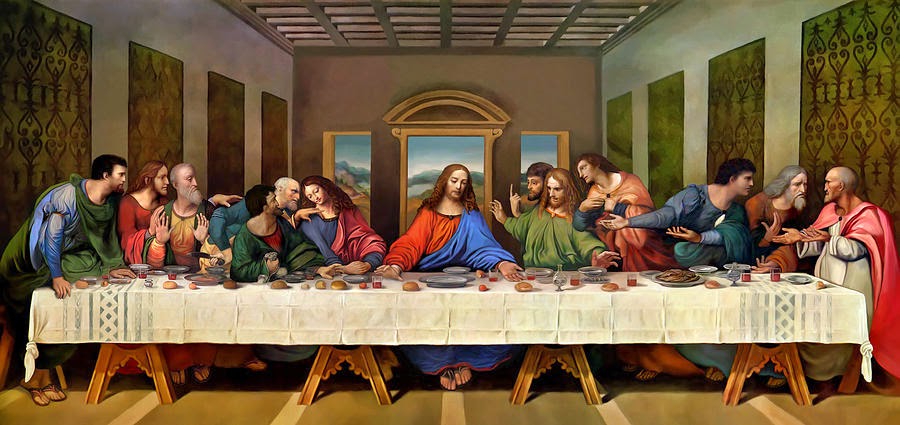
When did the disciples keep the Passover or the last super?Since Yeshua had to be hanging on the cross during the time that the Jews were offering the Passover lamb in the Temple, which was the same time that ancient Israel was killing their Passover lamb, it seems impossible that Yeshua could keep Passover with his disciples at this exact time. Yet Scripture mandates that Passover be kept on the fourteenth day of the first month. How do we resolve this difficulty?
Let’s look at some scriptures relating to this subject:
Matthew 26:17 reads, “Now the first of the unleavened bread the disciples came to Yeshua, saying unto him, Where do you want us to prepare for you to eat the Passover?” (italicized supplied words not in the original Greek have been removed). Mark 14:12 reads the same.
Luke’s account says, “Then came the day of Unleavened Bread, when the Passover must be killed” (22:7).
The Scripture shows us that in the Gospel narrative the terms “Unleavened Bread” and “Passover” are synonymous and interchangeable (Luke 22:1). Furthermore, we see that the “Passover [lamb] was killed on the Day of Unleavened Bread” (Luke 22:7). In a strict letter-of-law Torah sense, this is impossible since Passover and Unleavened Bread were two separate appointed times falling on two separate days, though the days were adjoining each other. In the Gospel accounts, however, the writers use the colloquial term Passover to designate both appointed times—a common practice in the first century.
The Gospels further tell us that Yeshua commanded his disciples to go and prepare a place to keep Passover (Luke 22:8). The disciples asked Yeshua where to go to prepare for it (Luke 22:9). Yeshua reiterates that he will be eating the Passover meal with them (Luke 22:11). The disciples make the room ready for the Passover meal (Luke 22:13). And finally, Yeshua calls this meal the Passover. He tells his disciples in Luke 22:15, “With desire I have desired to eat this Passover with you before I suffer.” (Mark and Matthew’s accounts of these events corroborate this.) The word Passover (pascha, Strong’s G3957) in the Greek can refer to the Passover day, Passover meal or the Passover lamb. The context in which the word is used has to determine which one of its several meanings is applicable here. It seems that the context here would point to a meal.
John 13:2–30 offers further proof that the Passover meal that Yeshua was doing was not at the end of the fourteenth and the beginning of the fifteenth, which would have made it the evening of the Sabbath (Heb. erev Shabbat)—in this case, the high Sabbath or the first day of the Feast of Unleavened Bread. When Judas left the supper (verse 27), the disciples figured that he was departing to purchase more supplies for the Passover meal, which was yet to come (verse 29). Furthermore, for them to think this means that they knew that the shops were open from which to buy supplies (and therefore it was not the Sabbath or Shabbat). This would not have been the case had the last supper been at the end of the Passover as it was approaching the beginning of the fifteenth, which was still 24 hours off.
Since Yeshua could not partake of the Passover meal on the afternoon of the fourteenth, and since the Gospels tells us that it was evening when he celebrated Passover with his disciples, and since we know it occurred on the fourteenth of the month of the abib, when was the Lord’s supper or last supper? It had to have been at the end of the thirteenth and at the beginning of the fourteenth after sundown. They simply kept it earlier on the same day (at the beginning of the fourteenth rather than at the end). At the end of that same day, he was hanging on the cross as the Passover Lamb. After the Lord’s supper Yeshua and his disciples went to the Garden of Gethsemane where he was arrested by the Jewish leaders later that night. During the evening and into the morning he was put on trial before the Jewish leaders and afterwards he stood before Pilate, after which he was nailed to the cross sometime between the third and sixth hour (according to the Gospel accounts). At 3 p.m. (Luke 23:44-46), he proclaimed the famous words: “Eloi, Eloi …” and shortly after that exclaimed, “Father receive my spirit …” whereupon he died.
Did Yeshua celebrate an actual Passover service or was it simply a memorial dinner, or a fellowship meal often referred to as the Lord’s supper? There are valid arguments on each side of this issue. Perhaps it doesn’t really matter. For us now, the big question is how could Yeshua keep the Passover (as he said he did) with his disciples on the fourteenth of Abib as Torah commands and still be hanging on the cross on the same day as the spiritual fulfillment of the Passover Lamb?
The Gospel accounts are clear about the fact that Yeshua was keeping a “Passover” meal, for he says so, yet we have seen that it had to have been an early meal on the same day. It was not the main meal that was to be held later at the end of the fourteenth into the fifteenth of Abib as the Torah instructs in Exodus chapter 12.
Alternative “Passovers”
What was the precedence for such a meal? Does Torah make allowances for another Passover celebration at another time? The answer is yes.