Sukkot Series (4)—The Song of Solomon on Passion for Yeshua Our Bridegroom

This is the final video of Nathan’s 2023 Sukkot Series, and we end on a high note—in fact, there is none higher! It is all about our passionate love for Yeshua the Messiah—a love that will carry each of us to the highest possible place in his coming kingdom of heaven on earth, which is involves our becoming the glorified bride of Yeshua and ruling and reigning with him for eternity in that kingdom.

The Song of Solomon, the greatest love song ever composed and the subject of this teaching, gives us a glimpse into the kind of love the potential bride of Yeshua will need to have for her soon-coming heavenly Bridegroom.

Listen to and then let this teaching sink into your heart and inspire you to new heights in your passion for Yeshua your Savior, Lord and King.

Nathan’s Commentary Notes on the Song of Solomon Chapter One

Song 1:2, Kisses of his mouth. Allegorically, kisses from our beloved Messiah can be a symbolic metaphor for the tokens of Yeshua’s love for his bride (that, those saints who have qualified to be his bride). The kisses of his mouth may well represent his grace and pardon for our sins, his sending us the Comforter of his Set-Apart Spirit to guide us to our Father in heaven, along with the joy and peace that comes from knowing him, as well as the fruit and gifts of his Spirit, and the hope for a glorious future that he promises those who love and obey him.

Your love is better than wine.Though wine joys the heart and calms the nerves, it is but a temporary and superficial fix to life’s problems. Like a band-aid on a wound, it fails reach the root cause of man’s empty and lonely heart. The love of Yeshua, on the other hand, is a river of life that is a never-ending source of joy, which strengthens and heals us at the deepest levels. Instead of being drunk with wine, the Bible encourages us to become “drunk” with passion for Yeshua the Messiah, who offers the human heart love, joy, peace and hope—something that alcohol can never do. Ephesians 5:18 tells us, “Be not drunk with wine…but be filled with the Spirit,” which is Yeshua’s love gift or mohar to his betrothed bride as a down payment or guarantee of his devotion. The Set-Apart Spirit—its fruit and gifts—is Yeshua’s engagement ring, down payment, pledge or earnest money to his saints (2 Cor 1:22; 5:5) guaranteeing that his promise of their future inheritance (i.e., eternal life and marriage to him) is good.

Your good ointments.Like a soothing and healing balm or ointment on chapped, dry and cracking skin, so is a relationship with Yeshua the Messiah. Elsewhere Jeremiah asks the question, “Is there no balm in Gilead, is there no physician there? Why then is there no recovery for the health of the daughter of my people?” (Jer 8:22). The answer is yes, there is a Person who is like a healing ointment to the soul. His name is Yeshua the Messiah, and he offers healing for those who will take hold of him, love him and follow him. Not only is a relationship with YHVH-Yeshua a tree of life with fruit that is lovely to the taste (Ps 34:8), but it is fragrant to the nostrils as well, unlike the fruit of the tree of knowledge of good and evil which looks good to the eye, is appealing to the taste buds, but upon ingestion becomes bitter like wormwood. 

Song 1:3,Your name is better than ointment poured forth. (Heb. sheman meaning oil.)The name (i.e., the personality, character and reputation) of Yeshua is better than any ointment. Ointment or olive oil soothes and heals wounded, chaffed, burned, and aching skin. When we are wounded emotionally and spiritually, there is always a place of healing and comfort at the foot of Yeshua’s cross where his arms were open wide in loving acceptance of sinners like you and me. There is forgiveness, power, victory and healing in the name of Yeshua. Through faith in him, one can overcome all fear and anything that the world, the flesh and the devil would throw at us.

The virgins love you.The disciples of Yeshua are like spiritual virgins, who refuse to fornicate with the world, and who remain undefiled by the world, while only having eyes for Yeshua their Bridegroom. They  are not drawn away by the passions of this world. They follow Yeshua the lamb, their Bridegroom, wherever he leads them (Rev 14:4). Why? Because they have not grown cold in their love for Yeshua. They have never lost their first love like others in the church (Rev 2:4).

Song 1:4, Draw me away. Are our hearts drawn away from Yeshua by the world, the flesh or the devil, or are we totally dedicated to him? Do we long to be with and to know Yeshua and his love? Yeshua is looking for a bride who refuses to taker her eyes off of him, and who is not drawn away from him by other lovers through fornication with the world.

We will run. (Daughters of Jerusalem speaking). Are those around us drawn to Yeshua because they see our unreserved and undefiled love for him? Are we a light to our children, to our unbelieving family members, to our neighbors and work associates? Yeshua speaks of two classes of virgins: those who are wise and are prepared for Yeshua, the Bridegroom, and those who are not (Matt 25:1–13); those who are on the inside with Yeshua at his wedding feast because they prepared themselves for him, and those who are on the outside looking in because they did not prepare themselves for him. The daughters love the Shulamite’s beloved too, but not as much as the Shulamite. That is why the Beloved did not bring them into his inner chambers. The daughters of Jerusalem are like immature, carnal and lukewarm Christian believers who are not yet established in their faith and committed to wholly serving and walking with Yeshua. He may be their Savior, but he is not their Lord or Master.

Chambers [Heb. cheder]. Literally an apartment or inner enclosure.

Song 1:5, Dark and lovely. Why is the Shulamite dark? There are two potential reasons for this. Perhaps the bride is dark from the defilement of sin. More likely it is because she has been busy working out in the field in hot sun. She is productive, not lazy. Similarly, Yeshua’s bride are called to occupy in his spiritual; field until he comes for her (Luke 19:13). Yeshua’s bride will be working in the field (the field of this world reaching lost for Yeshua, Matt 13:38; 28:19–20). She is not self-indulgently primping and preening herself and confining her activities self-righteously to the safe confines of the church system. No. Yeshua is coming for a bride who will be sun tanned, with calloused hands and strong muscles from hard work. She is preparing to rule in his kingdom. She is currently engaged in on the job training. His bride will be ruling with him in his kingdom as a kingdom of priests. They will not just be like decorative figurines adorning clouds playing harps.

Lovely. Whatever the reason for her darkness, he considers her to be lovely. Yeshua loved us while we were yet sinner (Rom 5:8).

Kedar. (Heb. means ““to mourn, to be dark.” ) A son of Ishmael and an area in the northern Arabian desert inhabited by this tribe (Gen 25:13; Isa 21:16).

Tents of Kedar. This suggests that the Shulamite was at times a nomad or is living in a tent while tending the sheep. Other times, the Song records her living in a house in the city (Song 2:9; 3:1, 4; 5:2–7). Yeshua’s saints can be found living and ministering in a variety of place wherever he leads them and they are needed whether in the wilderness or in the city.

Song 1:6, My own vineyard I have not kept.The Shulamite is so occupied with her work that she has neglected her own well-being. She is not a self-absorbed or narcissistic bride. There is a lesson in this for the bride of Yeshua.

Song 1:8, Follow in the footsteps of his flock.Those who love Yeshua will be apart of his flock. There are privileges and benefits to being in a productive, life-giving, protected flock under the watchful care of Yeshua’s pastors or under-shepherds. The bride of Yeshua will be part of a spiritual flock, and will cherish the many benefits that come as result of fellowship with other believers.

Song 1:8, Besides the shepherds’ tents. Shepherds is plural speaking of the King Solomon’s under-shepherds. The wise believer sits under the direction of godly, spiritual leaders.

Song 1:12, Spikenard. This is a costly oil made from an aromatic plant shipped from India in alabaster jars and stored and used for only special occasions, such as anointing household guests at arrival. Such an occasion occurred twice in Yeshua’s life; one when Mary anointed Yeshua’s feet at the party to celebrate Lazarus’ resurrection. (Mark 14:3; John 12:3).

Song 1:13, Myrrh.This is an Arabian gum from the bark of a tree used in sacred oil and perfume. Myrrh is from maror meaning “to be bitter, to be strong or strengthen.” This word is used again in Song 8:6 where we read, “For love is stronger than death…” to denote not the bitterness, but the strength of love. It was used in the purifying rites of women (Esth 2:12), as a gift for the young Yeshua (Matt 2:11), for embalming (John 19:39) and was offered to Yeshua in the form of a bitter drink mixed with sour wine or vinegar (Mark 15:23; Matt 27:34).

Song 1:14, Camphire or henna. A plant used to produce a valuable orange-red dye. It was seven to ten feet high and produced fragrant white flowers. Heb. kopher from kaphar meaning “to cover, to make atonement, to make reconciliation, to pacify, purge away, cover over with pitch.” This speaks of Yeshua spilling his blood for atonement for our sins. It is interesting that henna is orange-red in color, which is an allusion to the blood of Yeshua that washes away sin. Women to this day use dyes containing henna to color their hair.

En Gedi.An oasis in the barren western shores of the Dead Sea up in the mountains. It contained hideouts and hot springs that come out of large cliffs. The abundant water from the hot springs provide a semi-tropical-like garden environment. Lit. ayn (eye, spring, well) of the kid, or young male goat. Knowing Yeshua is like coming to an oasis next to the Dead Sea wilderness of life.

Song 1:16, Our bed is green.The Hebrew word for green means “luxuriant or fresh.”Knowing Yeshua and being in a spiritual relationship with him is like feeding in green pastures beside the still waters (Ps 23:2). It is like being a tree planted by the rivers of life whose leaf does not wither in the hot sun and which bears fruit in its season (Ps 1:3). These horticultural metaphors are an apt description of the spiritually verdant and fruitful life of the true saint-bride of Yeshua.

Song 1:17, Beams of our houses.Is the bride anticipating the “mansion” that her bride is building for them once they are completely married? Similarly, Yeshua promised a “mansion” for the saints who qualify to be his bride in his future kingdom (John 14:2). Do our hearts long to be living with Yeshua in the house that he has promised his bride in his future kingdom?


The Feast of Shavuot/Pentecost Is Coming—Are YOU Ready to Meet YOUR Bridegroom?

Celebrating a (Re)New(ed) Covenant Involving YHVH Writing Torah on Our Hearts

Long ago Jeremiah prophesied that YHVH would make a new (or renewed) covenant with his people Israel, which would involve both houses of Israel (Judah and Ephraim, or, prophetically speaking, the Jews and the Christians), and that he would write his Torah-law on their hearts.

Behold, the days come, saith YHVH, that I will make a new covenant with the house of Israel, and with the house of Judah: Not according to the covenant that I made with their fathers in the day that I took them by the hand to bring them out of the land of Egypt; which my covenant they brake, although I was an husband unto them, saith YHVH: But this shall be the covenant that I will make with the house of Israel; After those days, saith YHVH, I will put my law in their inward parts, and write it in their hearts; and will be their Elohim, and they shall be my people. And they shall teach no more every man his neighbour, and every man his brother, saying, Know YHVH: for they shall all know me, from the least of them unto the greatest of them, saith YHVH: for I will forgive their iniquity, and I will remember their sin no more. (Jer 31:31–34)

Contextually, in the verses surrounding this prophecy, we discover some other important details.

Verse 27, The houses of Judah and Israel were to be mingled throughout the beast (or heathen) nations of the world as punishment for breaking their covenant with YHVH that they made with him on Shavuot (the Feast of Pentecost) at Mount Sinai (Exod 19–20, 24).

Verse 28, At some point in the future, YHVH’s punishment of Israel for breaking their covenant and their resulting exile among the gentile nations will come to the end. He will rebuild and restore the nation of Israel.

Verses 29–30, Whereas in times past, Israel was punished as a collective nation for their sins when they disobeyed YHVH, and conversely were blessed when they obeyed him, in our day each person will be cursed or blessed for his own sins. Salvation is more of an individual matter now.

Verses 31–33, YHVH promises to make a new or renewed covenant with the two houses of Israel at some time in the future (from Jeremiah’s perspective). It will be different from the covenant he made with Israel at Mount Sinai in two major ways:

Though it will be a covenant with Israel collectively (both houses of Israel), it also will be made with individuals.

At that time, he will deal with the heart of each individual Israelite when he writes his Torah-law on their hearts.

Verse 34, This renewed covenant will involve mercy and forgiveness (or grace). It will involve a personal relationship between each person and YHVH (i.e., “they shall all know me…”).

Verses 35 and 37, As the sun, moon, stars, the sea, and expanse of the heavens and the earth exist, so YHVH will renew his Torah covenant with Israel. The words of Yeshua in Matthew 5:18 are reminiscent of the this prophecy. Not one jot or tittle (in Heb. yud or tag, which are the smallest elements of the Hebrew alphabet) of YHVH’s Torah will pass as long heaven and earth still exist.

Verse 36, The very survival of the nation and people of Israel (and hence the fulfillment of the covenants YHVH made with Abraham), is dependent on YHVH regathering and restoring  both houses of Israel. If YHVH doesn’t bring this to pass, then YHVH is a liar and his Word is a lie and there is no hope for the world! This cannot be! Our future hope and YHVH’s reputation and character depend on it.

Jeremiah’s prophecy begin to be fulfilled during the time of the writing of the Testimony of Yeshua (New Testament). The author of Hebrews talks about this in Hebrews 8.

But now, Yeshua the Messiah has attained a more excellent public service, since He is the Mediator of a more excellent covenant, one that was legislated with better promises than the former. (Heb 8:6)

The “better promises” is everything that Yeshua taught about salvation and eternal life as a person puts their trust in him. These better promises he taught during his life and ministry, and formalized this at his last supper through the communion elements. It is all these glorious promises to which the whole Levitical and sacrificial system pointed, which, as the author of Hebrews makes clear, was fulfilled in Yeshua.

If the first covenant had been faultless, there would have been no need to look for a second one. Finding fault with THEM He said, “Look, the days are coming, says Yehovah, when I’ll enact a New Covenant with the descendants of Israel, and with the descendants of Judah. It wont be like the covenant that I made with their ancestors during the time when I took them by the hand and brought them out of the land of Egypt, because they didn’t remain loyal to My covenant, and I rejected them, declared Yehovah. But this is the covenant that I’ll enter into with the descendants of Israel after that time, says Yehovah; I’ll put My Torah in their minds—inscribing it on their innermost thoughts. I’ll be their Aloha, and they’ll be My people. No one will teach doctrine to their fellow citizens [evangelize], or a friend, or ask: “Do you know Yehovah” [witness to anyone], because they’ll all know Me, from the youngest of them to the oldest. I’ll be merciful regarding their wrongful behavior; and I’ll no longer remember their sins.” When He [Yeshua] mentioned, a New Covenant, He was saying that the first one was old and about to be repealed; and what was then old and failing, was about to disappear. (Heb 8:7–13, GV)

Other Scriptures Relating to the Renewed Covenant and the Heart of Man

The Tanakh is full of scriptures that speak of the renewed covenant where YHVH will write his Torah on the hearts of men. For example, in Jeremiah 32:40, YHVH reiterates his promise to make an everlasting promise with Israel. This new covenant will also involve him putting his fear in their hearts. As a result, they will no longer depart from him.

And I will make an everlasting covenant with them, that I will not turn away from them, to do them good; but I will put my fear in their hearts, that they shall not depart from me.

The following is a list of other scriptures that talk about the Torah being written on men’s hearts.

Deut 30:6, And YHVH thy Elohim will circumcise thine heart, and the heart of thy seed, to love YHVH thy Elohim with all thine heart, and with all thy soul, that thou mayest live.

Ps 37:31, The law of his Elohim is in his heart; none of his steps shall slide.

Ps 40:8, I delight to do thy will, O my Elohim: yea, thy law is within my heart.

Isa 51:7, Hearken unto me, ye that know righteousness, the people in whose heart is my law; fear ye not the reproach of men, neither be ye afraid of their revilings.

Ezek 11:19, And I will give them one heart, and I will put a new spirit within you; and I will take the stony heart out of their flesh, and will give them an heart of flesh:

Ezek 36:25, Then will I sprinkle clean water upon you, and ye shall be clean: from all your filthiness, and from all your idols, will I cleanse you.

Eze 36:26, A new heart also will I give you, and a new spirit will I put within you: and I will take away the stony heart out of your flesh, and I will give you an heart of flesh.

Ezek 36:27, And I will put my spirit within you, and cause you to walk in my statutes, and ye shall keep my judgments, and do them.

Continue reading
 

Reasons to Believe in Yeshua

Why Believe in Yeshua the Messiah?

Have you ever heard someone say, “I’ll believe it when I see it”? Is seeing really believing?  Many people saw Yeshua when he was on this earth, but most didn’t believe him.

It has been 2000 years since Yeshua walked this earth, and since we’ve never seen him, nor even talked to those who saw him, what is the basis of our faith? Is faith in Yeshua blind? Or are there logical reasons to believe in him?

For those of us who have had a faith in Yeshua for a while, for us there are a myriad reasons that have come together to form the basis of our faith. However, for those who are new in their faith walk and don’t have a lifetime of “spiritual experiences” that corroborate that faith, initially finding a basis for that faith can be difficult.

Some people come to Yeshua because that’s their last hope. They’ve hit rock bottom in their lives and there’s no where else to go. They hear and believe the gospel message of hope and end up experiencing the power of the Yeshua and his Holy Spirit in their lives.

Others take a more reasoned approach to establishing a faith in Yeshua. Perhaps their lives haven’t hit rock bottom, but they know they’re missing something — there’s still a void in their life. They sense that there must be more to life — a higher purpose — than simply existing and then dying. 

Others come to faith in Yeshua because they look around and see intelligent design behind everything in existence, which speaks of a Creator, which leads them to want to know more about him. 

Some people come to Yeshua as a way of dealing with their on mortality.  In their quest to answer the question of whether there’s life after death, they come to faith in Yeshua. 

Perhaps some come to faith in Yeshua due to the pang of a guilty conscience because of their sin and the need for redemption. 

Some people have studied the world’s religions and find that only the gospel message as presented in the Bible addresses the deeper issues of life. 

These are all valid and logical reasons for coming to faith in Yeshua.

Whatever the reason for believing what the Bible says about Yeshua, there are good reasons to believe in him  based on both the claims of the Bible and logic.

Yeshua — A Historical Figure

Whatever we think about Yeshua pro or con, he was a historical figure. More has been written about him than anyone else, and he has impacted the world more than anyone. There must be something to all this, and thus we have to deal with this reality. Twenty-seven different first-century New Testament documents attest to the reality of his existence and to his impact on humanity. Additionally, numerous Christian, Jewish and Roman historians from the first and second centuries attest to his existence and his positive impact on the lives of thousands, if not millions of people.

An Important Question

Continue reading
 

The Resurrection of Messiah Yeshua Prophesied in the Hebrew Scriptures

In recent years, as many Christians have been rediscovering the Hebrew roots of their faith, some Bible teachers are casting a shadow of doubt and skepticism on some of the most fundamental aspects of the Christian faith. 

Such cornerstone Christian doctrines as the deity of Yeshua, his incarnation, his virgin birth, his blood atonement and his bodily resurrection are now being called into question by some skeptics. They claim that these concepts were not components of the original apostolic faith, but were added later, and that the Apostolic Scriptures were redacted by the early church fathers to reflect a diluted Hebraic-based faith melded with some popular pagan concepts of the day.

Indeed, a cursory study of the writings of the Anti-nicene church fathers reveals that there occurred much syncretizing between Christianity and Greek or Hellenistic (pagan) thought and a rejection of much of what was considered to be Jewish, such as the Torah (law of Moses). But what aspects of the apostolic faith did they indeed keep without replacing it with a paganized counterfeit? What aspects of Christian orthodoxy are original to the apostles? How can we know whether what we have learned in the Christian church is the truth or not? These are serious questions that need answers. If one comes to the wrong conclusion on these issues, the eternal consequences could be devastating!

Sadly, some Believers have bought into the line of reasoning without studying the issues carefully that the deity of Yeshua, his virgin birth and incarnation, the blood atonement and his bodily resurrection are pagan concepts. Some make these bold assertions based on the belief that these concepts are foreign to the Hebrew Scriptures (Old Testament). Is this true? This author has proven in other works posted on our ministry web site (www.hoshanarabbah.org) that the deity and incarnation of Yeshua, the virgin birth, and the blood atonement are Hebrew, not pagan concepts, and are rooted firmly in and prophesied about in the Hebrew Scriptures. 

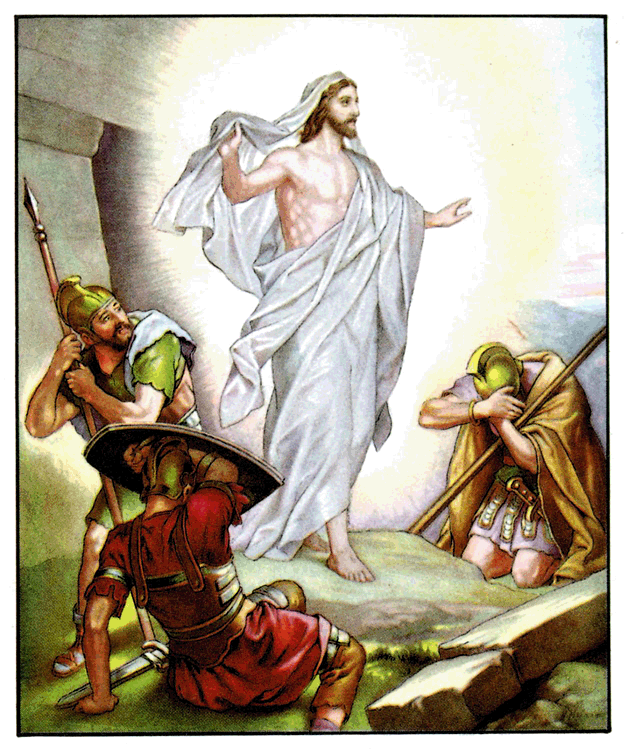
In this teaching article, we will discuss the issue of the bodily resurrection of Yeshua. It must be acknowledged that if Yeshua did not resurrect from the grave after his crucifixion then he failed to defeat sin, death and the grave, and it therefore follows that he is not the Savior and Redeemer of man, man has no hope of a bodily resurrection or afterlife himself, and as Paul said, let us eat and drink, for tomorrow we die (1 Cor. 15:32).

There were those who questioned the fundamentals of the faith in Paul’s day, for he spoke of those who had left the faith and had become spiritually shipwrecked (1 Tim. 1:19). Furthermore, he was not so self-assured to think that even he could defect from the very faith he preached and become himself a spiritual castaway or reprobate (1 Cor. 9:27). This should be a word of warning to us all to diligently search out the Scriptures, and to prove whether what we have been taught to believe squares with the Hebrew Scriptures or not. That is the basis for determining the truth of what is written in the Apostolic Scriptures—nothing more and nothing less.

Scriptures and Analysis

In this brief study, we will present to you a series of texts from the Hebrew Scriptures (or Old Testament) with commentary that foretell of a Messianic Redeemer dying and then bodily resurrecting.

Psalms 16:10, For thou wilt not leave my soul [nephesh] in hell [sheol]; neither wilt thou suffer thine Holy [chaseed or faithful, kind, pious, devout, saint, godly] One to see ­corruption [shakhath or decay of the grave, according to The Theological Wordbook of the Old Testament].

COMMENT: To whom is this verse referring? Who is YHVH’s Holy One? This is obviously not a reference normal humans whose bodies and souls go into the grave at the time of death (so says this verse) to await the resurrection, and where they decay into dust. Who in Scripture, but Messiah Yeshua resurrected after three days before his body could corrupt (start to decay)? According to Jewish thought, bodily decay starts after three days.

Psalms 49:15, But Elohim will redeem my soul from the power of the grave: for he shall receive me. Selah. 

COMMENT: This is a generic reference to the resurrection of the righteous. Using a kal v’khomer or light and heavy (a fortiori) rule of logic (or Rabbi Hillel’s first law of Biblical hermeneutics/interpretation) we can reason that if the righteous dead are resurrected how much more so YHVH’s righteous Messiah?

Psalms 22:26, The meek shall eat and be satisfied: they shall praise YHVH that seek him: your heart shall live for ever.

Continue reading
 

The Feast of Unleavened Bread—Insights from Nathan

The Feast of Unleavened Bread Is a Commemorative Ritual

Passover going into the first day of the Feast of Unleavened Bread is the birthday of the nation of Israel. In ancient times, universal Israel came together in Jerusalem to celebrate this event. Today, redeemed Israelites or the Israel of Elohim (Gal 6:16) come together to celebrate these divine appointment sacred convocations (1 Cor 5:6–8) cp. 11:17–29).

Abstaining from leavened bread for seven days is symbolic of Elohim’s people separating themselves from sin and entering into a holy or set-apart relationship with him. Without holiness, no one ever see Elohim (Heb 12:14). Set-apart from what? The world, the flesh and the devil (Rev 18:4; 2 Cor 6:14–18; John 17:11, 14; Jas 4:4)

Removing leavening from our  homes is a symbolic activity just like taking communion, being baptized for the remission of sins, or building a sukkah during the Feast of Tabernacles. As humans, we need symbolic commemorative occasions for several reasons. They give us a sense of history by helping us to understand the past, so that we can move forward into the future knowing who we are and where we’ve come from. They give us guidance so that we’ll learn from the lessons of history, both the good and bad ones. Our American culture is full of symbolic rituals and commemorative acts and markers (Christmas, Easter, birthdays, anniversaries, Independence Day, Memorial Day, Veterans Day, Thanksgiving Day, statues, historical markers, monuments, museums, heritage sites, etc.). Likewise, Biblical commemorative rituals help us in several ways.

  • They help us to both recall and commemorate past and future events. 
  • They help us to understand who we are by recalling where we’ve come from which in turn helps us to understand where we’re going.
  • They can be something physical that helps us to wrap our minds around difficult-to-understand spiritual principle.
  • They are something physical that help to point us toward a spiritual reality. They help to raise our hopes and our eyes above our mundane existence and strengthen our faith as we move toward the higher goal or reality to which the ritual or commemorative event points.
  • They help us to teach and to pass on to each new generation not only about our past history, but our future hope.

Leavening Is a Picture of Sin

The observance of the Feast of Unleavened Bread is a symbol of our commitment to turn towards righteousness and turn away from sin. How serious we are about removing physical leaven from our homes in compliance with YHVH’s commands is an indicator of how serious we are about removing sin from our lives. 

While leavening makes bread rise and is therefore a symbol for pride, leavening is also a symbol of decay. The rising of the dough is only possible by the natural process of fermentation or decay through fungal activity. In ancient times, a pinch of fermented or sour dough was placed into a batch of unleavened dough to make it sour and cause it to rise. Yeast is a living micro organism that is classified as a fungi. Fungi feed on both living and dead and decaying organic matter. Yeast turns food sour through the process of fermentation and this begins the process by which something dies. Yeast is an apt metaphor for the corrupting influences of sin, which invades our lives and turns our souls from sweet to sour leading to spiritual death. Were it not for the curse of death because of Adam and Eve’s sin, it’s quite possible that fungi would not exist.

When YHVH commands us to remove the leavening from our homes during the Feast of Unleavened Bread, he’s teaching us an important lesson: We must remove the contagion of sin from our lives if we’re to be sweet, pure, sinless and holy (or set-apart unto YHVH). Sin, like yeast fungi, causes decay and death, and to remove yeast from our homes is like removing sin from our lives, which brings about a reverse of the curse of death resulting in eternal life.

In ancient times, unleavened bread was made to rise by the injection of sour dough or leavened dough into the pure and undefiled unleavened lump of dough. Unleavened dough has nothing old from the past that is added to it. It’s a totally new lump. That’s what were to be in Messiah —  a new creation, or a new lump.

Purge out therefore the old leaven, that ye may be a new lump, as ye are unleavened. For even Christ our passover is sacrificed for us. Therefore let us keep the feast, not with old leaven, neither with the leaven of malice and wickedness; but with the unleavened bread of sincerity and truth. (1 Cor 5:7–8)

Through Messiah, our past sins—our past sour history is broken off (the sour dough yeast from the past, Rom 3:25) and has been forgiven and we get to start out totally new! What’s more, every time we sin, if we confess our sin and repent of it, he forgives and cleanses us and make us new yet again (1 John 1:9).

Unleavened bread is a picture of the life of Yeshua unspoiled by the taint of sin and death. Even his body, after his death, resurrected to life before decay could set in. He truly was the Lamb of Elohim who was without blemish in every possible way. When we eat unleavened bread, it’s symbolic of putting on or into ourselves the righteousness of Yeshua.

Paul mentions the unleavened bread of sincerity and truth (1 Cor 5:7–8). Sincerity and truth is in contradistinction to the concept of the leaven of the Pharisees, which is hypocrisy (Luke 12:1). Hypocrisy is a form of self-inflated ego or pride where one thinks that he is better than he really is or better than someone else based on outward show, but in reality, it’s a sham. The Greek word for hypocrisy (hupokrisis) literally means “to play act like an actor, to pretend, to simulate, to feign.” This kind of sinful behavior doesn’t belong in one who is a new, unleavened lump in Yeshua.

This feast helps us to focus on putting sin out of our lives and replacing it with righteousness or the righteous works of obedience to Elohim the opposite of which is sin. This can only be done through a relationship with Yeshua the Messiah and with the help of the resurrection power of Yeshua living in us through his Holy Spirit. This is why the next feast to occur after Unleavened Bread is the Feast of Pentecost, which celebrates the receipt of the Holy Spirit who came to empower us to keep the laws of Elohim (the opposite of sin) by writing them on our hearts—that is, giving us the internal desire and fortitude to obey them.

Unleavened Bread Is the Bread of Affliction

Scripture calls unleavened bread “the bread of affliction [poverty, misery, to be humbled, to put down, to stoop, to be depressed, to come low].” 

Thou shalt eat no leavened bread with it; seven days shalt thou eat unleavened bread therewith, even the bread of affliction; for thou camest forth out of the land of Egypt in haste: that thou mayest remember the day when thou camest forth out of the land of Egypt all the days of thy life. (Deut 16:3)

Unleavened bread pictures the Israelites coming out of Egypt where they were afflicted in bondage under the cruel slavemaster’s whip. But even as each of us has been set free from spiritual enslavement to Satan and this world, we still have to endure the wilderness of this life en route to the Promised Land of our spiritual inheritance in the kingdom of Elohim. As Yeshua suffered for us that we might have life through him, we must follow in his footsteps as we endure suffering and persecution to be victorious over the world, the flesh and the devil even as he was.

The Resurrection Life of Yeshua

Yeshua resurrected during the Feast of Unleavened Bread. The importance of this event can’t be overemphasized. Now through the power of his resurrected life, believers have the ability to overcome the power of death as represented by yeast and leaven, which is a picture of sin, and to live in an unleavened or sin-free state.

Unleavened Bread Versus Manna

During the Feast of Unleavened Bread, YHVH commands us to eat matzah, which is a picture of the sin-free Yeshua. The Scriptures call it the bread of affliction, since it memorializes the end of the Israelites’ enslavement in Egypt. The unleavened bread also marked the beginning of Israel’s freedom, for it was on the first day of this festival that they came out of Egypt. It was the unleavened bread that they made while exiting Egypt that empowered them physically for their trek out of the land of their affliction. After that, YHVH fed them manna, which was  the bread of life that empowered them to press onward to the Promised Land. The unleavened bread symbolizes taking into ourselves the sinless life of Yeshua who empowers us to leave the Egypt of the old self behind with its life of bondage to sin, the devil and the rudiments of this world.

The unleavened bread of the Feast of Unleavened Bread, the bread of communion and that bread that was offered at the daily sacrifices is different than the manna YHVH fed the Israelites each day. The manna is the bread of life to which Yeshua speaks about in John 6:33, 50, 51. Though different, the unleavened bread and manna each point to something different about Yeshua. The unleavened bread commemorates leaving the sin of Egypt behind and identifying with the broken and sinless body of Yeshua on the cross. The manna, on the other hand, fed and nourished Israel on a daily basis during their journey through the wilderness en route to the Promised Land. The manna is a prophetic metaphor speaking of how the Word of Elohim (both through the Written Word and the leading of the Holy Spirit) sustains the redeemed believer through the wilderness of life. The manna is about living in and through the power of YHVH’s Word, while the unleavened bread of the Passover communion, the Feast of Unleavened Bread and the daily sacrifices is about dying to old lifestyles and deliverance from and forsaking the leavening of sin through Yeshua’s death on the cross. The manna is all about receiving Elohim’s spiritual provision, whereas the unleavened bread is all about dying to self, and leaving sin and the world behind.

Conclusion

Paul instructed believers to celebrate the Feast of Unleavened Bread (1 Cor 5:8). So why doesn’t the whole Christian church worldwide do so?